How to Use Claude Fable 5 to Automate AI Creative Workflows

In this article▾
- Why Claude Fable 5 changes creative automation
- What you need before you start
- Step 1: Design the pipeline you want to hand over
- Step 2: Connect Claude Code to the canvas
- Step 3: Create the workflow with a plain-language prompt
- Step 4: Edit by instruction, not by rebuilding
- Step 5: Execute programmatically with webhooks
- Step 6: Hand over the responsibility
- FAQ
- Conclusion
Claude Fable 5, released by Anthropic in June 2026, is the first model built to hold standing responsibilities rather than one-off tasks, and that makes it a practical engine for automating AI creative workflows. This guide walks through the full loop on Wireflow: an agent that creates a pipeline, edits it on instruction, and executes it on a schedule without a human in the middle.
Why Claude Fable 5 changes creative automation
Anthropic shipped Fable 5 in two configurations: the generally available Fable 5 on paid plans, and Mythos 5 for Glasswing partners. Benchmarks aside, the meaningful change is reliability over long-running loops. Earlier models could complete a task you handed them; Fable 5 can own an outcome, like keeping a content calendar full or a product catalog stocked with fresh visuals. The media side of that job is what a saved content automation workflow on Wireflow handles: a brief goes in and the images, voiceover and clip come out.
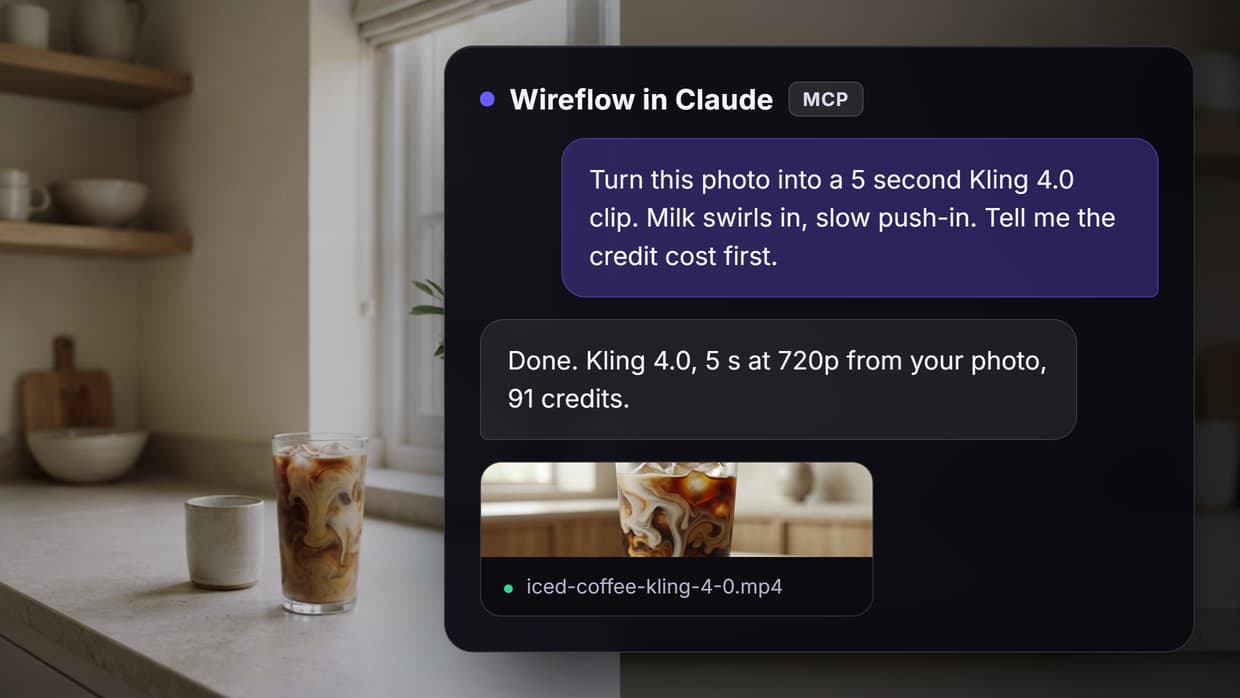
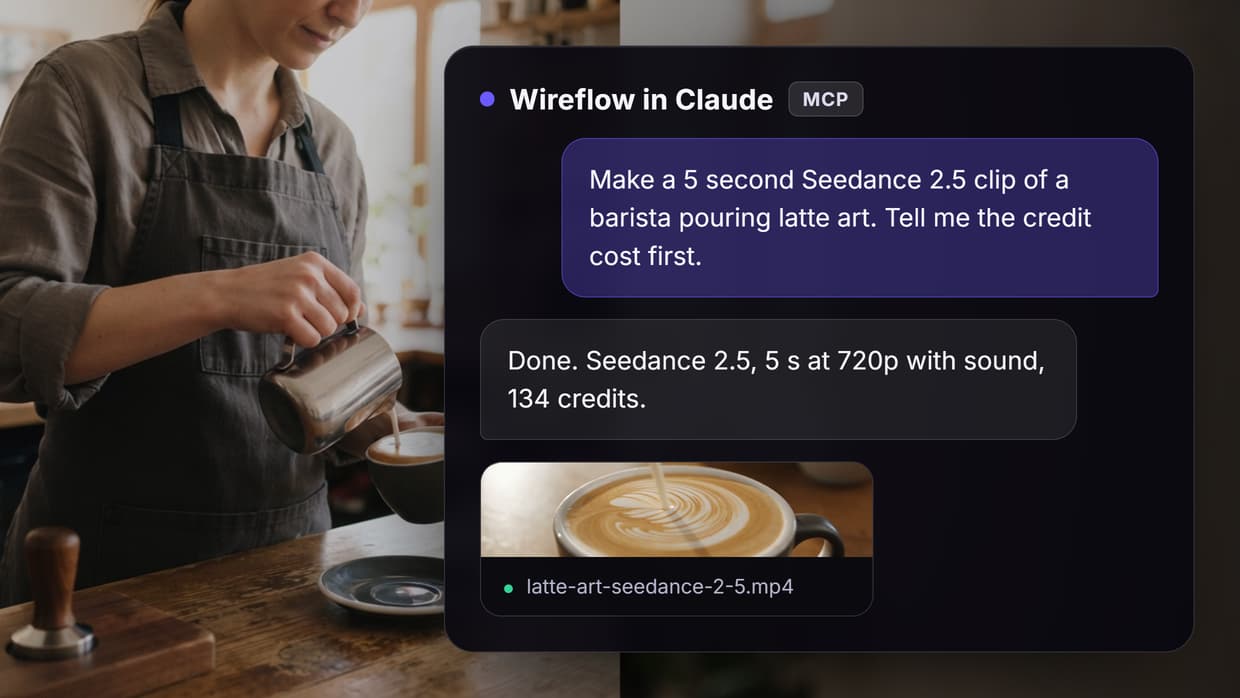
For one concrete case, our guide to making Seedance 2.5 clips from Claude shows a single chat request turned into a video with its credit cost reported.
A common build is an automated social posting workflow that writes a caption, renders an image, and posts to your channels through a Social Publish node.
That only matters if your AI creative workflows are addressable by an agent in the first place. A pipeline that lives in someone's head, or in a UI-only tool, cannot be created, edited, or executed by a model. The prerequisite for everything below is a workflow platform with a real API surface.
Build this in Wireflow
Make the same kind of asset on a canvas you control, with a free account and no credit card.
What you need before you start
Three things, all available on free or entry tiers:
- Claude Code running Fable 5. Fable 5 is available on Anthropic's paid plans as of June 2026.
- A Wireflow account and API key. The API is available on every tier, including free, so you can test the whole loop without paying anything.
- A defined outcome. Not "make images" but something an agent can be accountable for, like "every new product gets three lifestyle shots, upscaled, with a caption."

Step 1: Design the pipeline you want to hand over
Before involving the agent, decide what the workflow actually does. The simplest productive shape is brief in, assets out: a text brief enters, an image model generates candidates, an upscaler finishes the best one, and a language model writes the caption. Sketching this on a no-code AI canvas first helps you spot missing steps before any automation exists.
Keep the first version small. One input, three or four nodes, one output. Every node you add later is a one-sentence instruction to the agent, so there is no penalty for starting minimal.
Step 2: Connect Claude Code to the canvas
Generate an API key from your Wireflow dashboard and add the Claude Code integration so the agent can talk to the platform directly. Once connected, Fable 5 can list your workflows, inspect their node graphs as JSON, create new ones, and trigger runs from the terminal or from an automated session.
This is the step that separates agent-ready platforms from UI-only tools. If a canvas product has no API, there is nothing to connect, and the loop below is not possible no matter how capable the model is.
Step 3: Create the workflow with a plain-language prompt
Describe the pipeline to Claude Code the way you would brief a colleague: "Build a workflow that takes a product brief, generates a lifestyle image with GPT Image 2.5 Flare, upscales it 4x, then writes a two-sentence marketing caption." Fable 5 assembles the node graph, wires the connections, and the workflow appears on your canvas, ready to inspect.
Under the hood this works because nodes pass raw JSON between each other, which is the same mechanism that makes AI model chaining possible: the output of the image node becomes the input of the upscaler, and the upscaler's result feeds the caption node. The agent reasons about the graph the same way you read it.
Run it once manually here. You want to confirm the pipeline produces what you expect before an agent runs it unattended.

Step 4: Edit by instruction, not by rebuilding
The first version will need changes, and this is where the agent loop starts paying for itself. Tell Claude Code what to adjust: "Swap the image model for GPT Image," "add a background removal node before the upscaler," "generate three candidates instead of one." Fable 5 modifies the existing workflow through the API rather than creating a new one, so your run history, costs, and endpoint stay stable.
Editing by instruction also means non-technical teammates can request changes in plain language. The workflow definition stays visible on the canvas the whole time, so every modification the agent makes is inspectable, which matters when you are deciding how much autonomy to grant.
Step 5: Execute programmatically with webhooks
With the workflow stable, execution moves to the AI workflow API: the agent triggers the endpoint with run-specific inputs, and a webhook delivers the finished assets back when the run completes. Webhooks are what let the agent fire a pipeline and move on instead of polling for results, which is the difference between an agent that scales to fifty runs a day and one that babysits each job.
Each run reports its credit cost per node, so the agent always knows what a pipeline execution costs before and after it happens. For an unattended loop, that visibility is a guardrail: you can instruct the agent to stop and escalate if costs drift outside an expected range.
Step 6: Hand over the responsibility
Everything so far is still task-shaped: you ask, the agent does. The final step is the shift Fable 5 was built for. Put the agent on a loop with a standing instruction: "Watch the new-products feed; for every new SKU, run the workflow and file the assets; escalate failures and anything off-brand." Combined with AI pipeline automation, the agent now owns the outcome, not the task.
Start with a loop where failure is cheap, like internal drafts or social variants. Review the output feed for two weeks, tighten the escalation rules, then widen the agent's scope. Autonomy is something you ratchet up, not something you switch on.

FAQ
What is Claude Fable 5?
Claude Fable 5 is Anthropic's flagship model released in June 2026, alongside a restricted configuration called Mythos 5. It leads nearly all reported benchmarks and is designed to hold long-running responsibilities, which makes it well suited to operating automated pipelines.
Can Claude Fable 5 generate images or video by itself?
No. Fable 5 is a language model. It directs creative pipelines by calling image and video models through APIs, deciding inputs, sequencing steps, and reviewing outputs rather than rendering media itself.
Do I need Mythos 5 for creative workflow automation?
No. Mythos 5 is limited to Anthropic's Glasswing partners as of June 2026. The generally available Fable 5 handles workflow creation, editing, and execution; nothing in this guide requires the restricted configuration.
Which models can the automated workflow use?
Whatever the platform exposes as nodes. On Wireflow that includes image models like Flux and GPT Image, video models like Kling and Veo 3, upscalers, background removal, and LLM nodes for captions and copy.
How does the agent know when a run finishes?
Through webhooks. The agent triggers a workflow endpoint, continues with other work, and receives a callback with the finished assets when the run completes. Without webhooks, agents waste cycles polling for results.
How do I keep an autonomous agent from overspending?
Use per-node cost visibility. Every Wireflow node shows its credit cost before it runs, so you can give the agent explicit budget rules and an instruction to escalate instead of running jobs outside the expected range.
Is this different from Zapier-style automation?
Yes. Trigger-action tools fire fixed recipes. A Fable 5 agent makes judgment calls inside the loop: choosing inputs, evaluating whether outputs meet the brief, retrying with adjusted prompts, and escalating edge cases to a human.
Conclusion
The workflow loop in this guide, create by prompt, edit by instruction, execute by API, is the practical version of the shift Anthropic described at the Fable 5 launch: AI moving from tasks to responsibilities. Creative production is one of the first places it lands because pipelines are repetitive, outcomes are checkable, and every step is already model-shaped work.
Start small: one pipeline, one agent, cheap failure. Wireflow's free tier includes the API and the Claude Code integration, so the whole loop in this article costs nothing to test. Design the workflow once, hand the endpoint to Fable 5, and let it hold the responsibility.

Co-Founder & Operations at Wireflow
Runs client operations and content strategy at Wireflow. Works directly with creative teams and agencies to build production AI workflows.
- Content Strategy
- Client Operations
Make AI videos and ads.
Start free, no card needed.