 Andrew Adams · Co-Founder & Operations at Wireflow ·
 Scenario.gg API Alternative
Searching for a Scenario.gg API alternative usually means you want AI generation your code can call without a game-asset lock-in or a training step first.
Wireflow publishes any node workflow as one REST endpoint and one MCP tool across the full media stack.
Free to build · no credit card · See how it works ↓
How to Use Scenario.gg API Alternative
Steps to get you started in Wireflow.
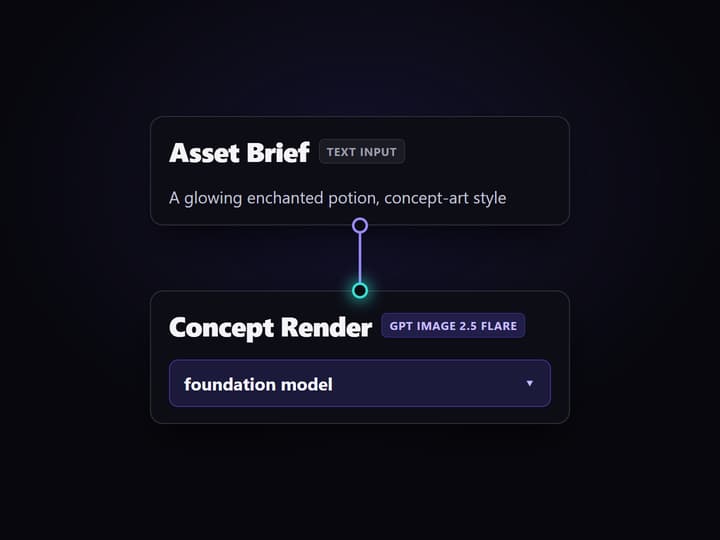
Wire a brief into a foundation model
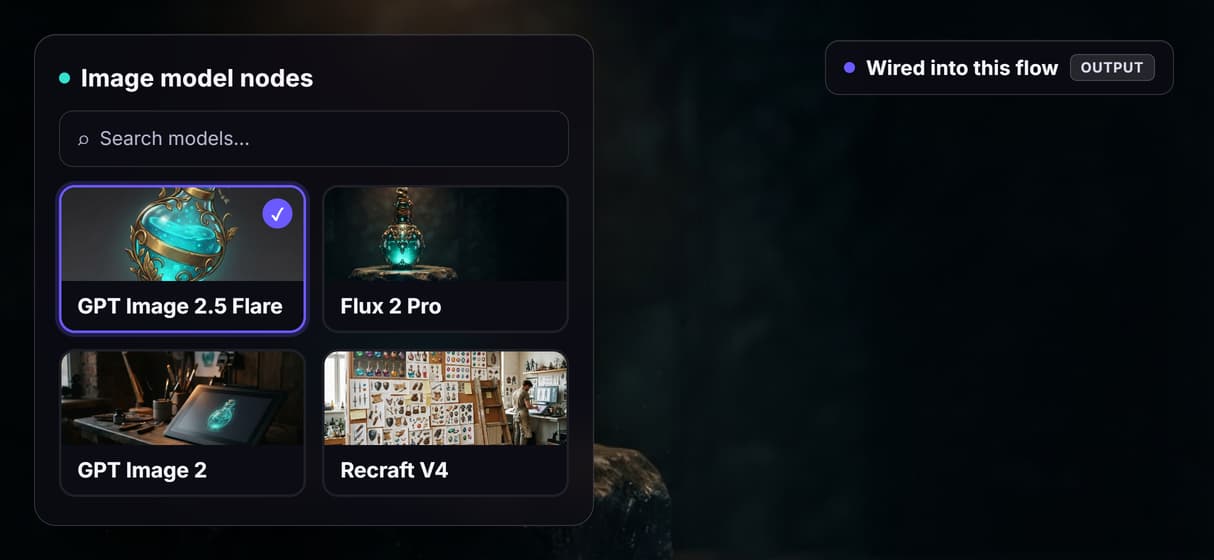
Drop a Text Input for the asset brief and wire it into a GPT Image 2.5 Flare node. No reference set, no trained style model, no onboarding step: the model is callable the moment the node lands.
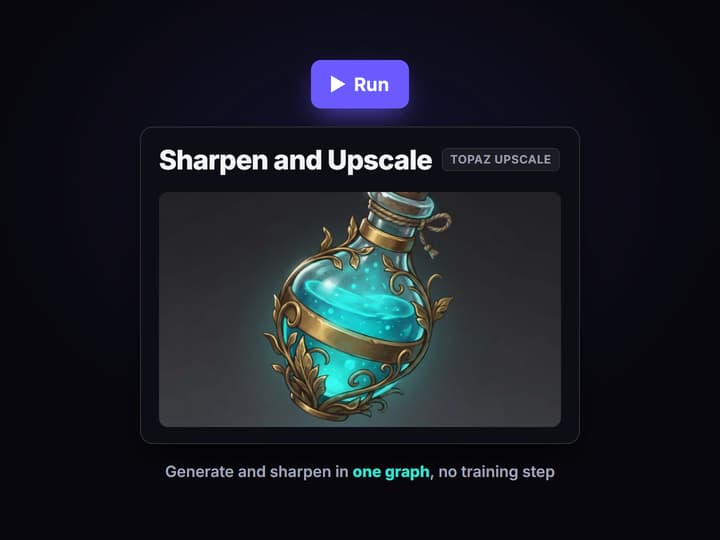
Chain a post step and run it
Wire the render into a Topaz Upscale node so one graph handles generate and sharpen. Press Run on the canvas and iterate on wording here, where a weak brief costs one run instead of a deploy.
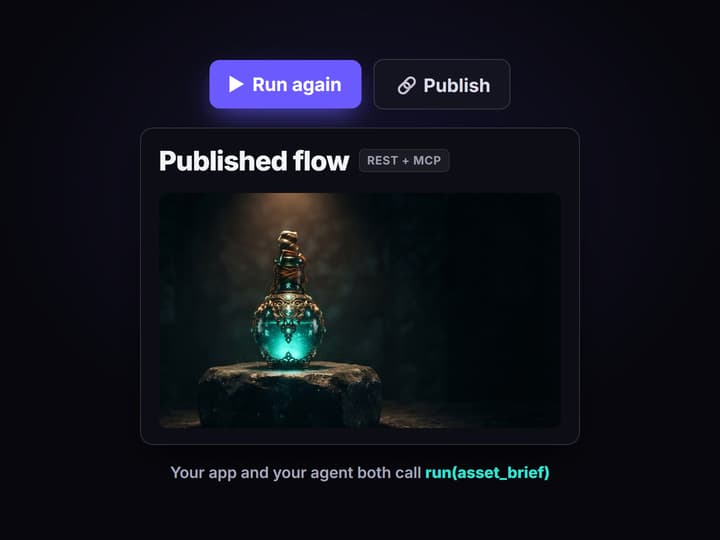
Publish it as a REST and MCP endpoint
Publish the flow and it becomes a REST endpoint and an MCP tool with typed inputs. Your app posts the brief and gets an asset URL back; an agent lists the tool and runs the same graph.
An honest answer to the Scenario.gg API search
Scenario runs a real API, supports MCP, and gives game studios a node workflow builder for trained, on-brand asset generation. If that is your job, Scenario is a credible tool, and Wireflow will not pretend otherwise: the two platforms are not affiliated, and Wireflow does not host or resell Scenario's models.
Most developers typing this search want something narrower: AI generation their code can call, without a game-art focus and without training a style model first. That is what the workflow above is. An Asset Brief wired into GPT Image 2.5 Flare makes a working AI concept art generator, a Topaz Upscale node sharpens it, and publishing the graph turns it into the endpoint your product calls. You iterate on the canvas; your codebase keeps one URL.
What the workflow API gives a developer
70+ hosted models
Nano Banana Lite, Flux 2 Pro, Seedream V4.5, GPT Image 2, and Recraft V4 all run as canvas nodes, no training required.
Beyond static art
Image, video, and audio nodes live on one canvas, so a pipeline is not limited to game sprites or a single media type.
Chained steps
Wire Topaz Upscale or a background remover after the model; the whole chain answers one API call.
REST and MCP built in
Every published workflow is an endpoint and an MCP tool with typed inputs and asset URLs returned.
Batch over a feed
Loop one published workflow across a CSV or product feed so every row renders through the identical graph.
Auditable pipelines
Nodes and wires are visible and versioned server-side, so the graph behind a call is inspectable, not opaque.
Call it from code, or hand it to an agent
The reason a developer types 'api alternative' is that a UI does not ship to production. So here is the concrete shape the whole SERP leaves out. Once you publish this flow, your app posts the brief to the workflow's REST endpoint (POST /api/v1/workflows/{id}/run) with a bearer token and gets an asset URL back. No queue plumbing, no orchestration code, one call against the graph you tested on the canvas.
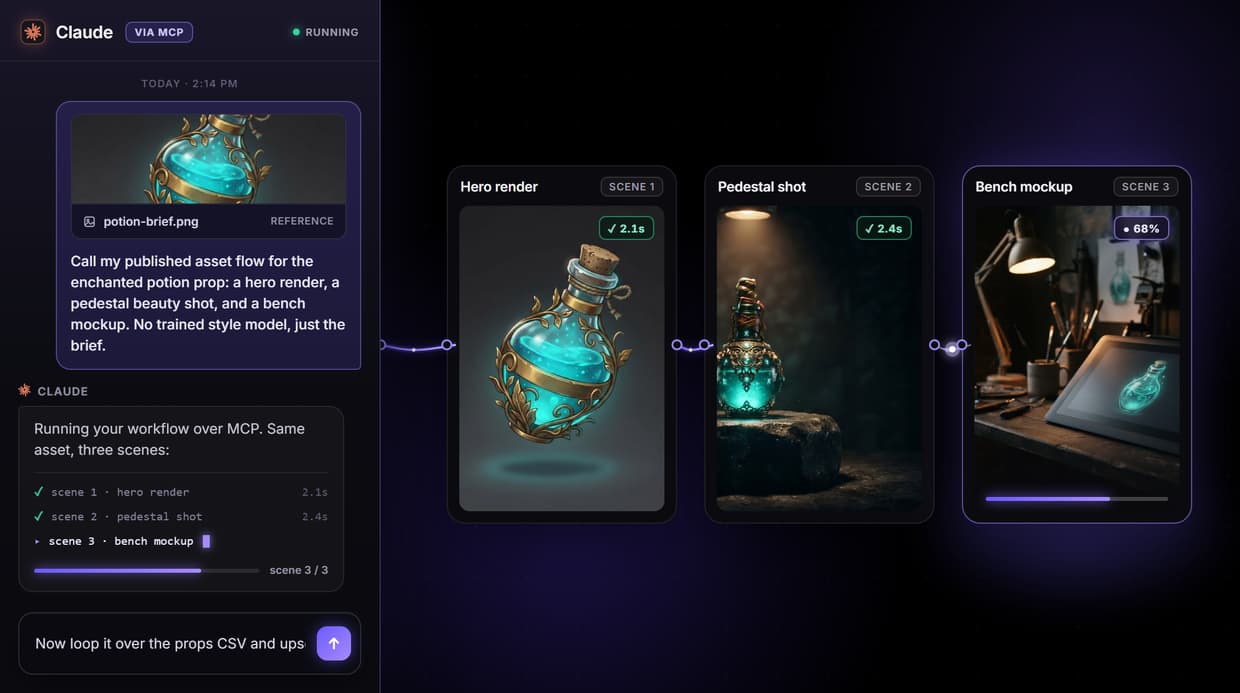
The same workflow is also an MCP tool. An agent in Claude, Cursor, or any MCP client lists your published workflows, reads the typed inputs, and runs one with run(asset_brief), receiving the same asset URL a curl would. This is the honest content gap: not that Wireflow has an API and others do not, but that a workflow here is a REST endpoint and an agent tool in one publish, and you can watch the creative workflow automation run node by node.
When Scenario is the better fit
Scenario is purpose-built for game studios that need consistent, on-brand sprite and character art from a custom-trained style model, a Unity plugin to pull assets straight into an engine, or enterprise security certifications for a compliance-bound pipeline. Wireflow does none of those: it does not train on your art library, it ships no game-engine integration, and it is the generation layer rather than a game production suite. If a trained game-asset pipeline is the job, Scenario is the honest recommendation.
Wireflow earns its place when the work is broader than game art: when you want to call foundation models immediately with no training step, span images plus video plus voice in one graph, keep a single endpoint while models rotate underneath it, and hand the whole workflow to an agent as an MCP tool. It also runs only on hosted compute, with no offline mode and no custom Python nodes, and every generation spends credits, so an unattended agent loop needs a cap. If that shape matches your problem, the three-node flow above is the smallest honest start.
More Than Just Scenario.gg API Alternative
No game-studio lock-in
Scenario is built game-art-first. Wireflow makes every media type a node: stills, product shots, video, and voice in one multi-model AI workflow.
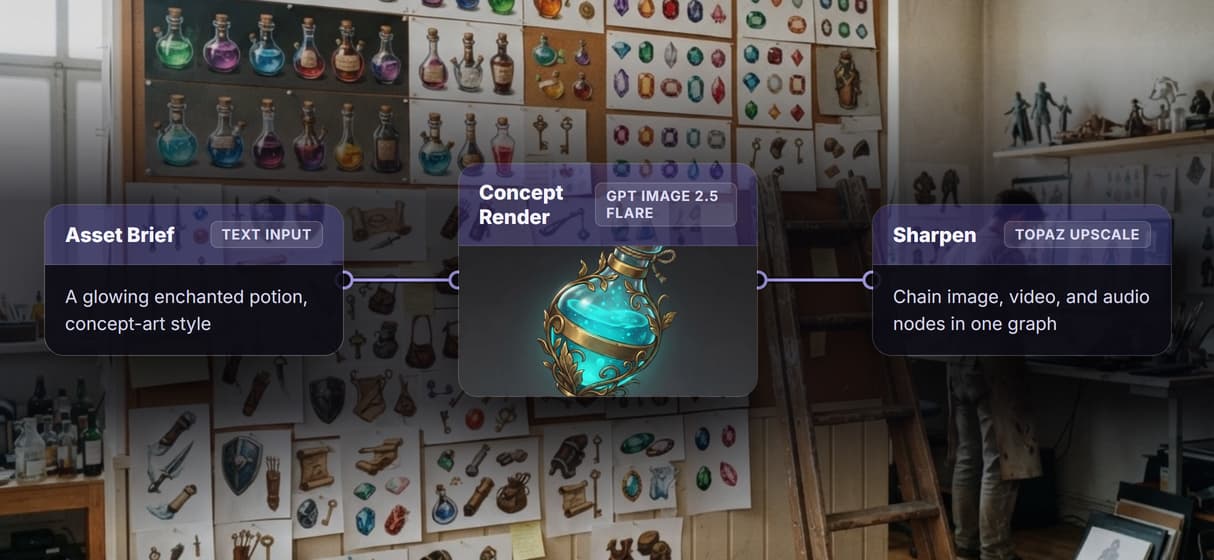
Skip the training step
No style model to train first: a Text Input wired into a foundation model is a working AI image generator on the first run, callable once published.
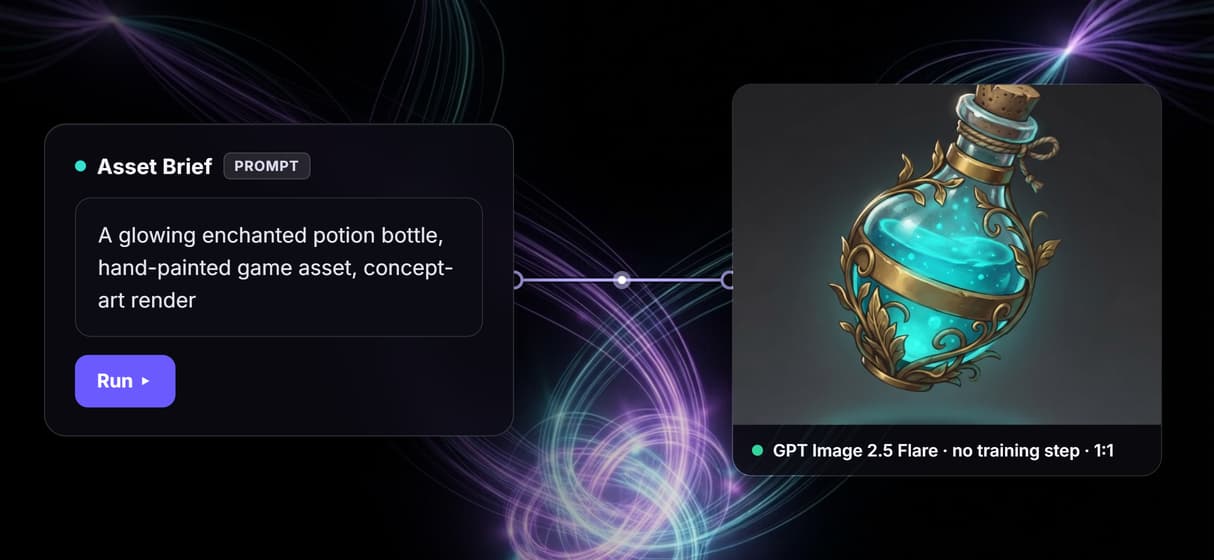
REST endpoint plus MCP tool
Publish the graph, then curl it or let Claude call the listed MCP tool with typed inputs. Both hit the same pipeline.
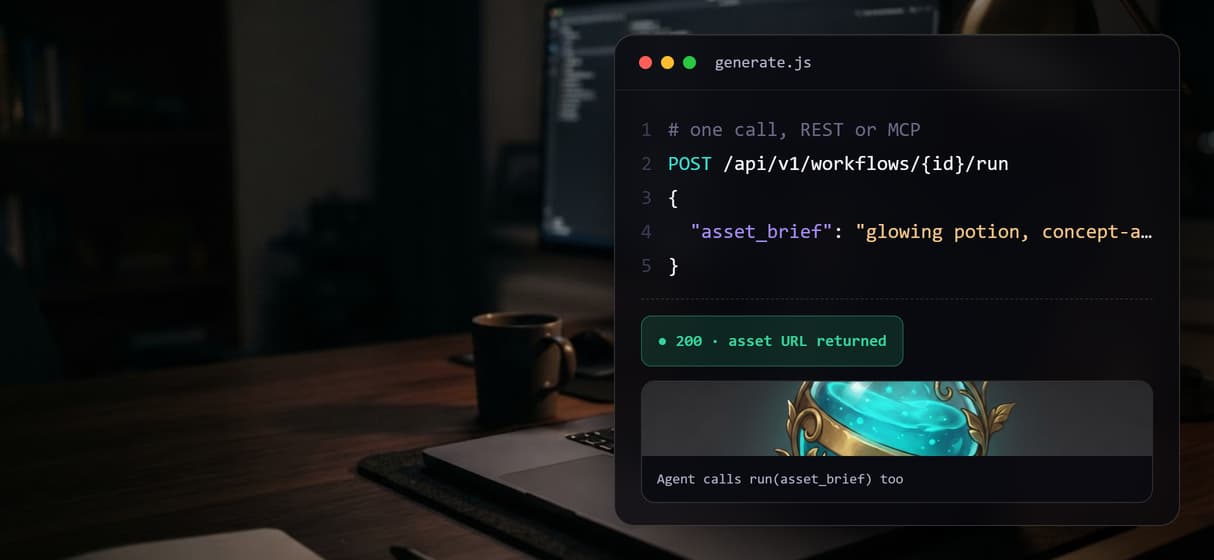
Readable graph, not a black box
Every node and wire stays visible, so each API call is auditable and shows exactly what the request runs.
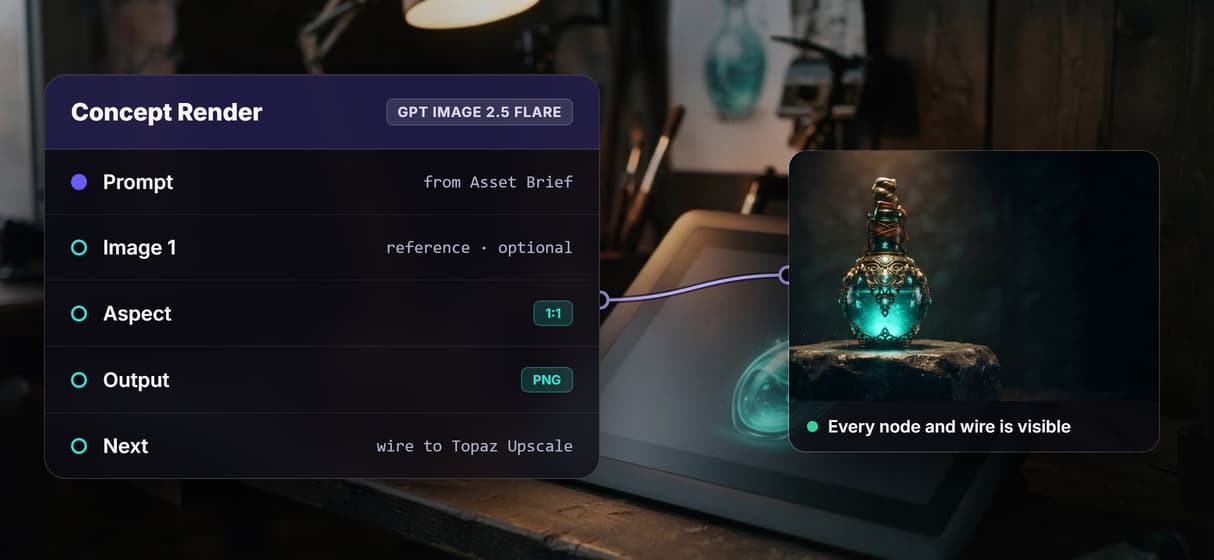
Swap the model, keep the call
The model is a node, not a vendor contract. Swap in Flux 2 Pro or GPT Image 2 on the AI canvas with a REST API; the URL your code calls never changes.
Scenario.gg api alternative Workflows
No Code Required
API & Batch Processing
FAQs
Generating game art programmatically with Scenario's own trained models and workflow tools. Scenario is a real API-first platform aimed at game studios. Wireflow is a separate platform and does not host or resell Scenario's models.
Discover related AI tools
- AI Pipeline Automation
- AI Workflow Templates
- AI Video Pipeline: Build One on a Node Canvas
- Batch AI Generation: Many Assets, One Run
- AI Model Chaining
- AI Asset Pipeline
- AI Workflow Builder
- AI Content Generation API
- AI Workflow API
- AI Orchestration API
- Headless AI Workflow Platform
- Krea AI API Alternative: Image and Video From One REST Endpoint
More From Wireflow
Written by
Andrew Adams · Co-Founder & Operations at Wireflow
Runs client operations and content strategy at Wireflow. Works directly with creative teams and agencies to build production AI workflows.
See the REST and MCP shape before you build
The three-node flow behind this page is live: an Asset Brief wired into GPT Image 2.5 Flare, then Topaz Upscale. The API docs show the exact call your code and your agent make against a published workflow. Building is free; generations are pay per run.