
The best Mosaic AI alternatives in 2026 split into two groups: platforms that replace Databricks Mosaic AI for building and serving your own models, and tools that simply deliver AI output through an API without any infrastructure to run. Wireflow leads the second group by turning a visual canvas of chained image, video, and text models into a single REST endpoint your code and agents can call. This guide ranks eight options across both groups, with clear notes on who each one actually fits, so you can pick based on the job in front of you rather than the marketing.
Which Mosaic AI Are You Replacing?
"Mosaic AI" almost always refers to Databricks Mosaic AI, the enterprise stack for training, fine-tuning, serving, and governing machine learning and generative models inside the Databricks platform. It is built for data teams that own their models and need governance, evaluation, and model serving in one place. If that is the exact job you have, most of the alternatives below are infrastructure platforms in the same category. If you landed here because you just want reliable AI generation behind an API, the honest answer is that you may not need a full model platform at all, which is where a multi-model AI workflow tool becomes the simpler path.
Quick Summary
- Wireflow: Best overall for AI media generation as an API
- Amazon Bedrock: Best for AWS-native enterprise teams
- Baseten: Best for deploying and serving custom models
- Fireworks AI: Best for fast, low-cost inference
- Together AI: Best for open-model inference and fine-tuning
- Replicate: Best for running models with a simple API
- Modal: Best for serverless GPU infrastructure
- Hugging Face: Best open-source model hub
Comparison Table
| Tool | Best for | What you run | Pricing model | API access |
|---|---|---|---|---|
| Wireflow | Media generation pipelines | Hosted model chains | Usage-based per generation | REST + MCP |
| Amazon Bedrock | Enterprise on AWS | Foundation models | Usage-based | REST + SDK |
| Baseten | Custom model serving | Your own models | Usage-based | REST |
| Fireworks AI | Fast inference | Open + custom models | Usage-based | REST |
| Together AI | Open models + tuning | Open models | Usage-based | REST |
| Replicate | Prototyping | Community models | Per-second compute | REST |
| Modal | Serverless GPU jobs | Your own code | Per-second compute | Python SDK |
| Hugging Face | Open-source models | Hosted endpoints | Usage-based | REST |
1. Wireflow
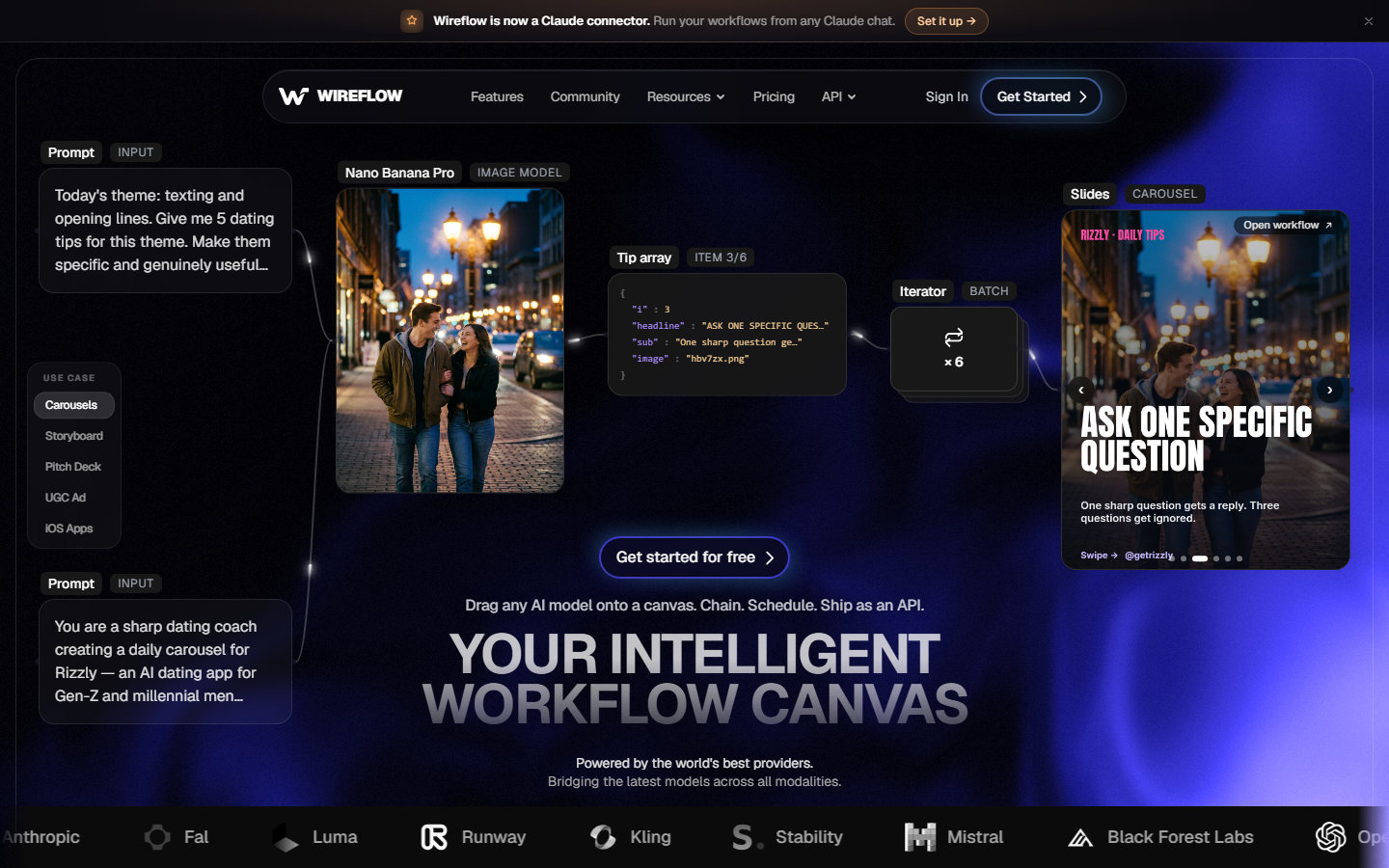
Wireflow covers one slice of what Mosaic AI does, and it covers it well: AI media generation. Image, video, and audio models run as nodes on a visual canvas, and any pipeline you build becomes a hosted AI canvas with a REST API that your application or agent calls through a single URL. There is no GPU cluster to provision and no serving layer to maintain.
The difference from a model platform is scope. Mosaic AI is where you train and govern your own models; Wireflow is where you compose existing best-in-class models into a working output. You can chain AI models over an API so one node's output feeds the next, then expose the whole chain to code with usage-based pricing that charges per generation instead of per idle GPU hour. For a hands-on look at this positioning, see the Mosaic AI alternative feature page.
It fits teams that want generation without infrastructure, including agent builders who need a callable tool. Because every workflow is also an MCP tool, an LLM agent can trigger a full media pipeline the way it calls any other function. It does not replace training and serving your own foundation models.
2. Amazon Bedrock
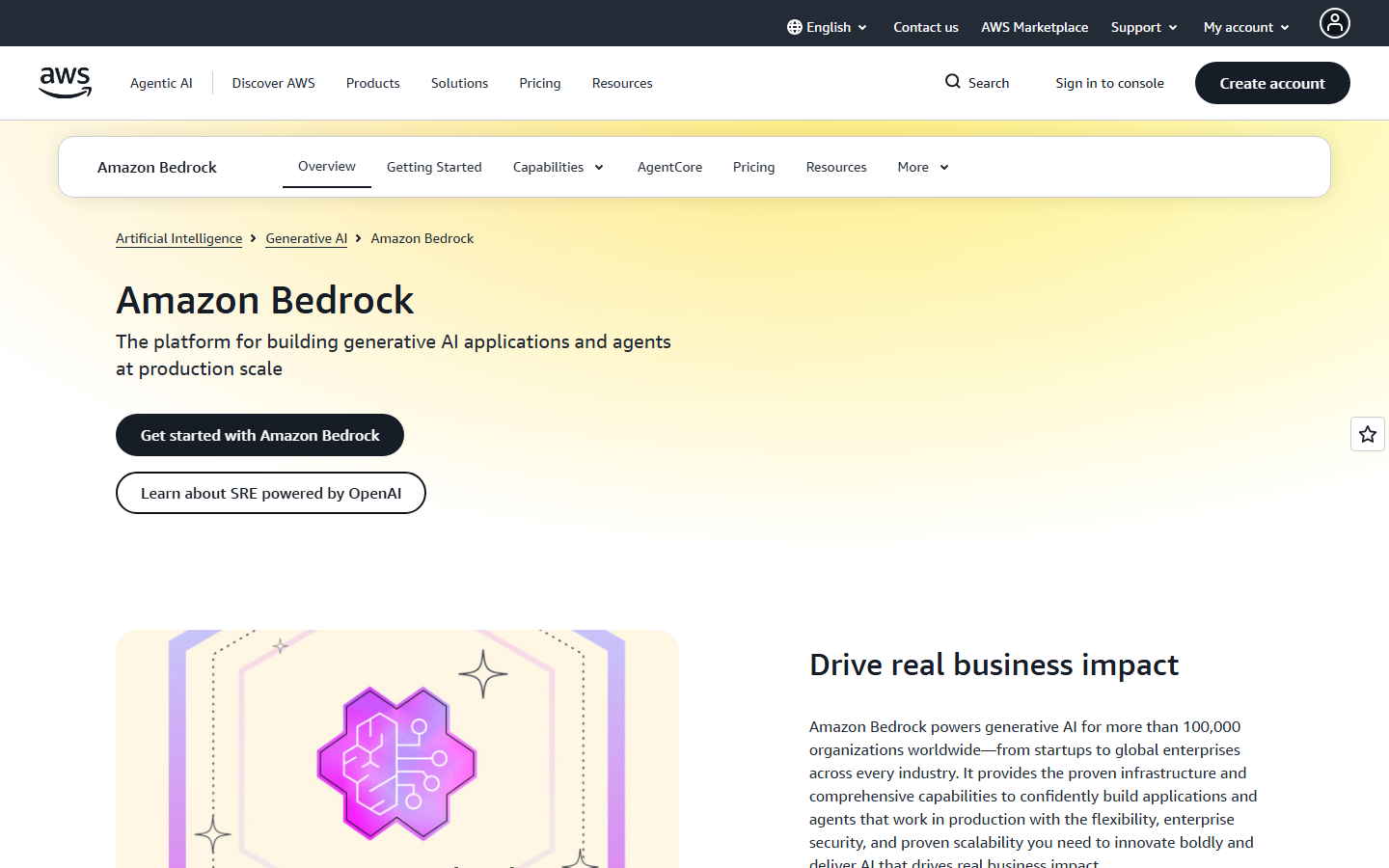
Amazon Bedrock is the closest enterprise match for teams already committed to AWS. It offers managed access to a catalog of foundation models from several providers, plus fine-tuning, guardrails, and agent features, all inside the AWS security and billing perimeter.
Bedrock makes sense when governance, data residency, and existing AWS commitments matter more than raw flexibility. Pricing is usage-based, and it integrates cleanly with the rest of the AWS stack. For teams that want a lighter path to production, a headless AI workflow platform removes the cloud-account overhead while still exposing an endpoint. Bedrock is the stronger pick when compliance and AWS-native tooling are hard requirements.
3. Baseten
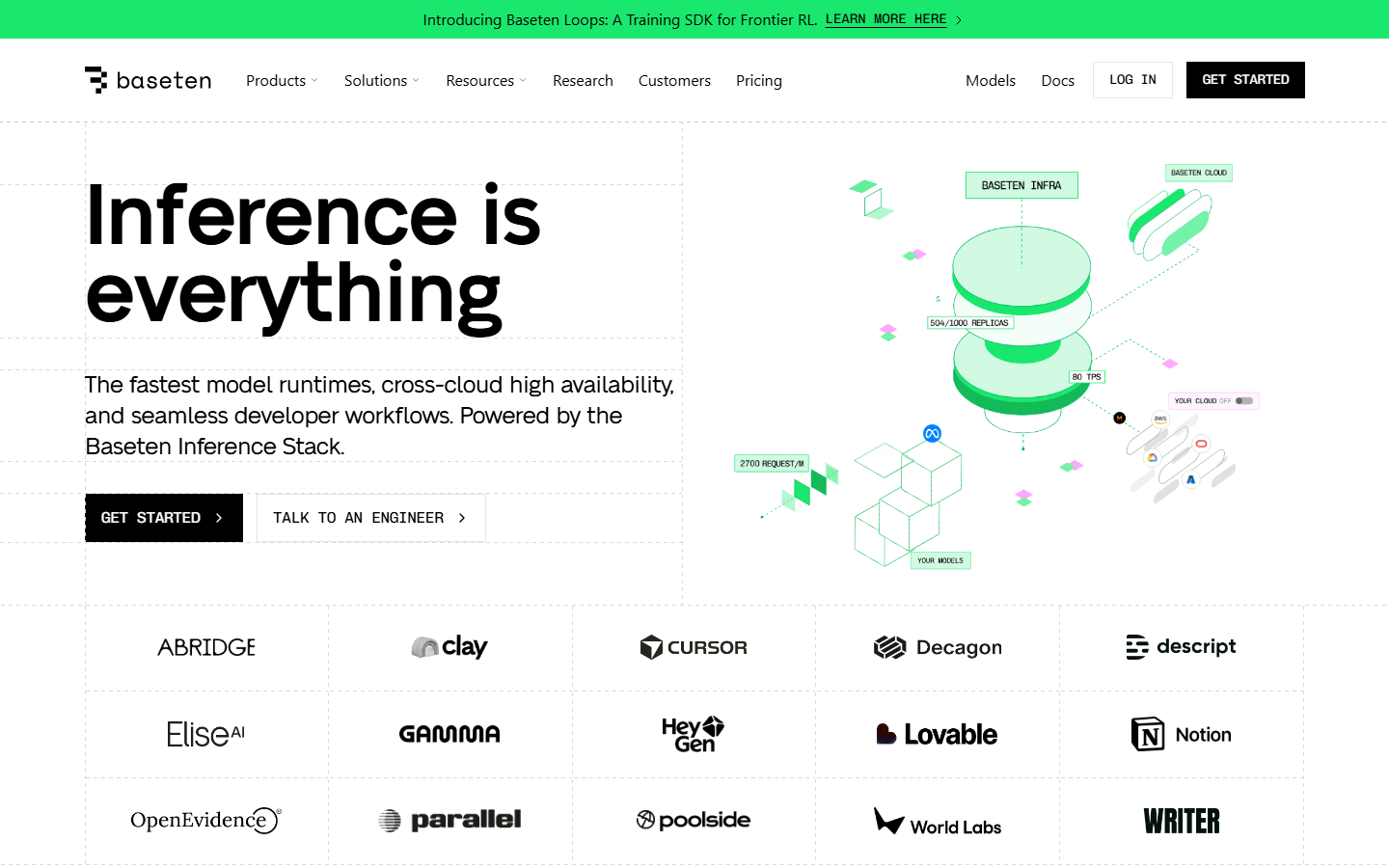
Baseten focuses on deploying and serving models you already have. You bring a model, and Baseten handles autoscaling inference, so it overlaps directly with the model-serving half of Mosaic AI.
It suits engineering teams that have trained or selected a specific model and need dependable production serving with low-latency endpoints. Pricing is usage-based on the compute your model consumes. Teams that would rather skip the model-ownership step and call ready-made pipelines often prefer an AI generation API built for SaaS apps, where the serving is already handled. Baseten is the right tool when you own the model and only need somewhere reliable to run it.
4. Fireworks AI
Fireworks AI is built for speed and cost on open and custom models. It runs a large catalog of open models with fast inference and offers fine-tuning, making it a practical alternative for the inference workloads Mosaic AI teams often run.
It is a good fit for developers who care about latency and per-token cost and are comfortable working directly with model APIs. Pricing is usage-based per token. If your workload is media generation rather than text, a purpose-built AI model chaining canvas covers image and video steps that a text-first inference API does not. Fireworks is strong when your priority is cheap, quick access to open language models.
5. Together AI
Together AI provides inference and fine-tuning across a wide range of open models, with an emphasis on open-source flexibility and training support. It appeals to teams that want to run and adapt open models without the full weight of an enterprise platform.
Pricing is usage-based, and the open-model breadth is the main draw for research-minded and cost-sensitive teams. For projects that combine several models into one output rather than calling them individually, comparing options on a list of AI workflow platforms with API access helps clarify where an orchestration layer adds value. Together AI is a solid pick when open models and fine-tuning are central to your plan.
6. Replicate
Replicate makes it simple to run thousands of community and commercial models through one consistent API. It is popular for prototyping because you can call a model in a few lines without managing any hardware.
Pricing is per-second of compute, so light usage stays cheap while heavy usage scales with time on the GPU. Replicate is model-by-model rather than pipeline-first, so building a multi-step flow means wiring calls together in your own code, whereas a no-code AI canvas handles the wiring visually. Replicate is the natural choice for quick experiments and single-model calls across a broad catalog.
7. Modal
Modal is serverless infrastructure for running your own Python code on GPUs without managing servers. It sits lower in the stack than Mosaic AI, giving you raw compute where Mosaic gives you a managed model platform.
It fits engineers who want full control over their code and dependencies and are happy to build the model logic themselves. Pricing is per-second of compute used. Modal is powerful but hands-on; if you want the endpoint without writing and maintaining the serving code, an AI generation API with spend limits gives you a managed layer and predictable budgeting. Modal is the right call when you want flexible, code-first GPU compute.
8. Hugging Face
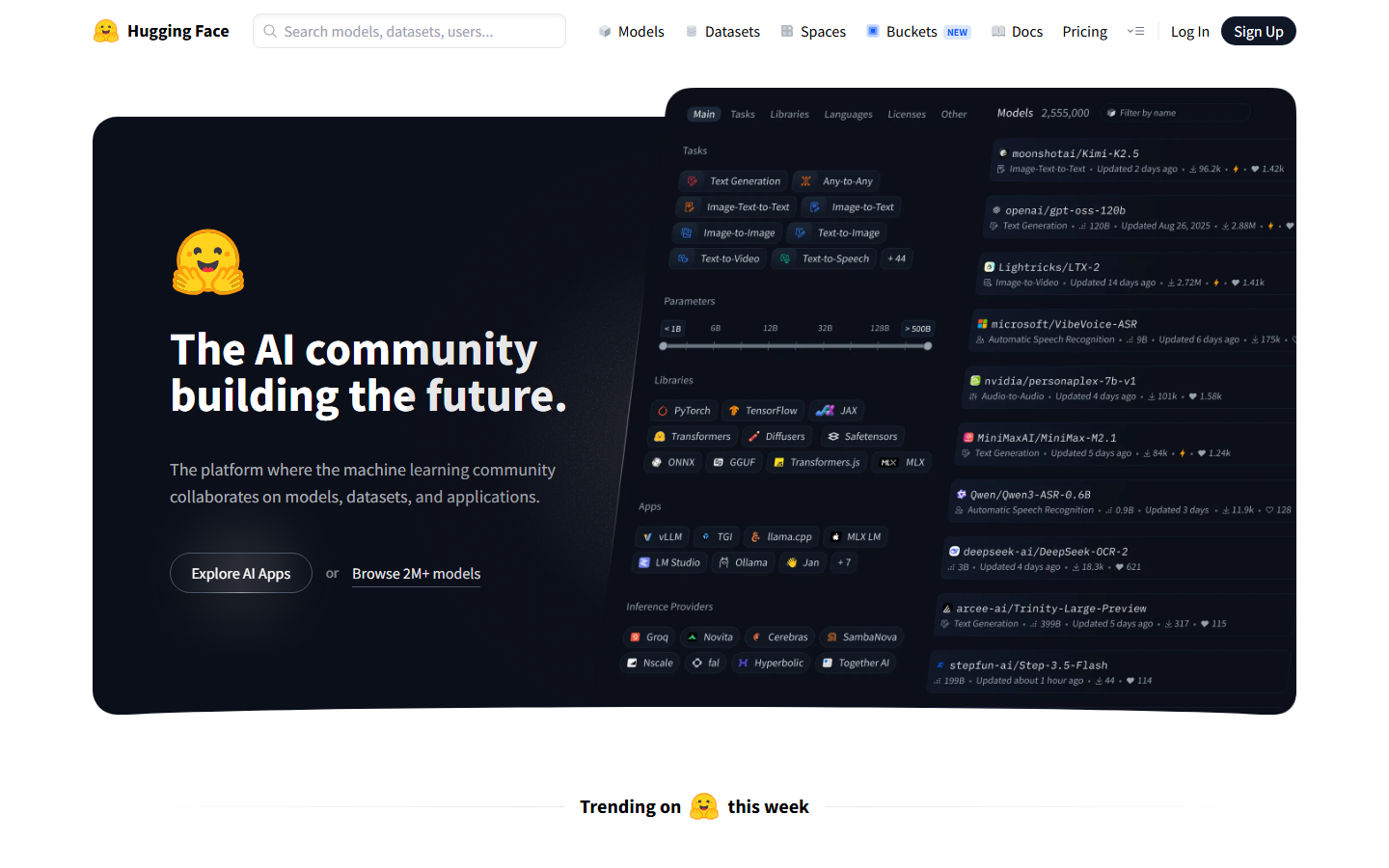
Hugging Face is the center of the open-source model ecosystem, with hosted inference endpoints, datasets, and tooling. For teams that live in open models, it overlaps with the model-hosting and experimentation parts of Mosaic AI.
Its inference endpoints are usage-based, and the breadth of available models is unmatched for open-source work. The tradeoff is assembly: you choose, host, and connect models yourself, while a platform that lets you chain AI models with Claude Code integration hands you a pre-wired path from prompt to output. Hugging Face is the best home base for open-source model discovery and lightweight hosting.
How to Choose
Start from the job, not the brand. To train, govern, and serve your own models, look at Amazon Bedrock, Baseten, or Modal. For fast text inference on open models, Fireworks AI, Together AI, and Hugging Face are the closest fits. If your real goal is AI media output through a clean endpoint with no infrastructure, a generation-first canvas with transparent, usage-based API pricing reaches production faster than any model platform.
Before you commit, build the flow you have in mind and see it run end to end, so you can judge the approach on real output rather than a demo.
Try it yourself: Build this workflow in Wireflow. The nodes are pre-configured with the setup discussed above, and the output is a REST endpoint your code or agent can call.
FAQ
What is Mosaic AI used for? Databricks Mosaic AI is used to build, fine-tune, serve, evaluate, and govern machine learning and generative models inside the Databricks platform. It is aimed at data teams that own their models and need production serving and governance in one place.
What is the best Mosaic AI alternative? It depends on the job. For AWS-native enterprises, Amazon Bedrock is the closest match. For custom model serving, Baseten fits well. If your real goal is AI media generation through an API rather than owning models, a generation-first canvas is often the simpler choice.
Are there Mosaic AI alternatives that do not require managing infrastructure? Yes. Managed generation platforms expose a hosted endpoint, so there is no GPU cluster or serving layer to run. You send a request and receive output, which suits teams that want results without operating infrastructure.
Which Mosaic AI alternative is cheapest? Cost depends on your workload. Per-second compute platforms like Replicate and Modal stay cheap for light or bursty usage, while usage-based per-token services suit steady inference. Compare against your expected volume rather than the sticker price.
Can these alternatives be called by AI agents? Several can. Platforms that expose a REST API can be wrapped as agent tools, and those that also publish an MCP interface let an agent trigger a full pipeline directly, which is useful for autonomous workflows.
Do I need Databricks to use Mosaic AI? Databricks Mosaic AI runs within the Databricks platform, so it best suits teams already using it. The alternatives above are standalone and do not require it.
Which alternative is best for image and video generation? Model platforms focus mostly on text and custom models, so for image, video, and audio pipelines a media-first canvas that chains generation models is a closer fit than a general model-serving platform.
Would you rather we just built it?
We get on a call, learn your style, build the workflow, and ship the deliverables on a schedule. You keep the workflow either way.


