 Andrew Adams · Co-Founder & Operations at Wireflow ·
 Mosaic AI Alternative
Searching for a Mosaic AI alternative usually means you want AI output without standing up your own infrastructure.
Wireflow does that for one slice of the problem: media generation, built once on a canvas and published as a REST endpoint your code and your agents can call.
Free to build · no credit card · See how it works ↓
How to Use Mosaic AI Alternative
Steps to get you started in Wireflow.
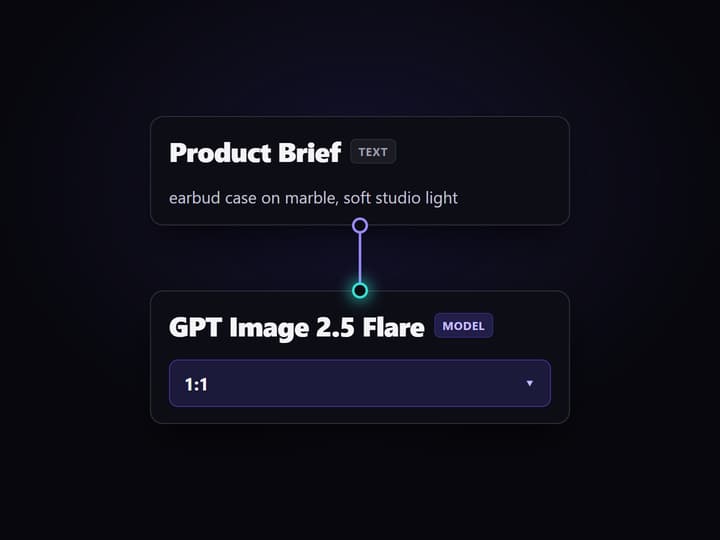
Wire a brief into the model
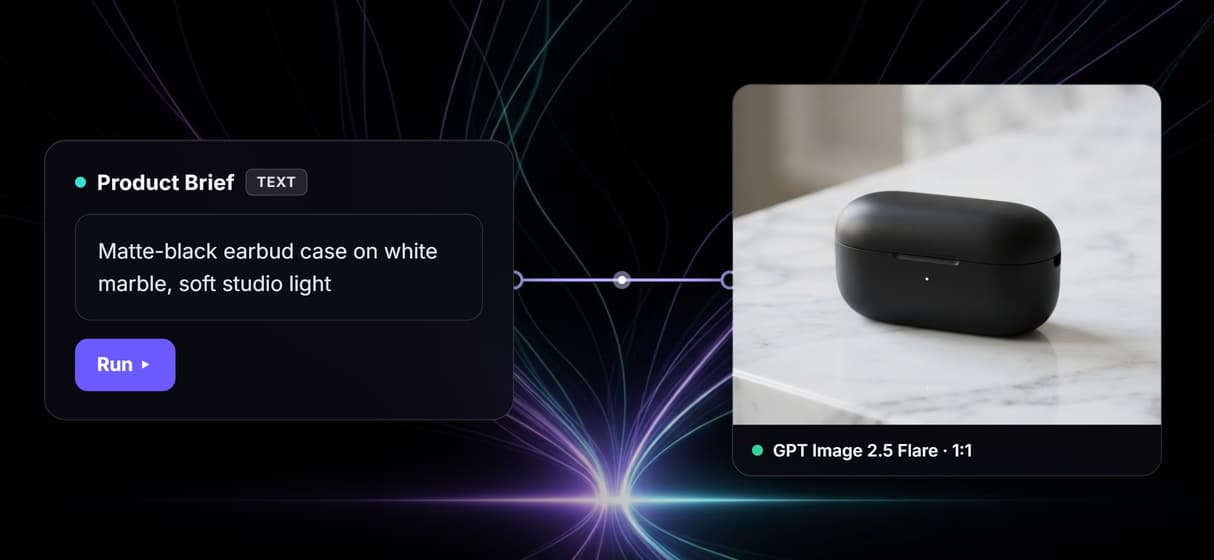
The flow is two nodes. A Product Brief text node holds the scene description, and its output wires into the prompt port of a GPT Image 2.5 Flare node set to a square 1:1 aspect.
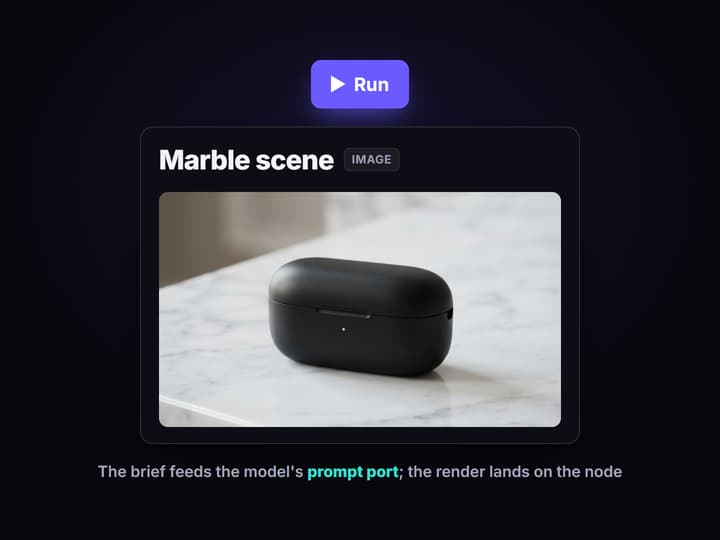
Run it on the canvas first
Type the brief and press Run; the finished image lands on the model node. Iterate on wording here, where a weak prompt costs one generation instead of a code deploy.
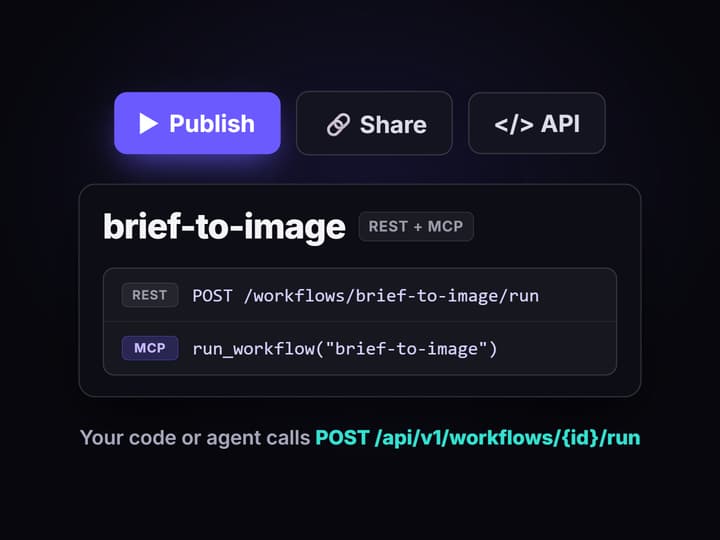
Publish it and call it from code
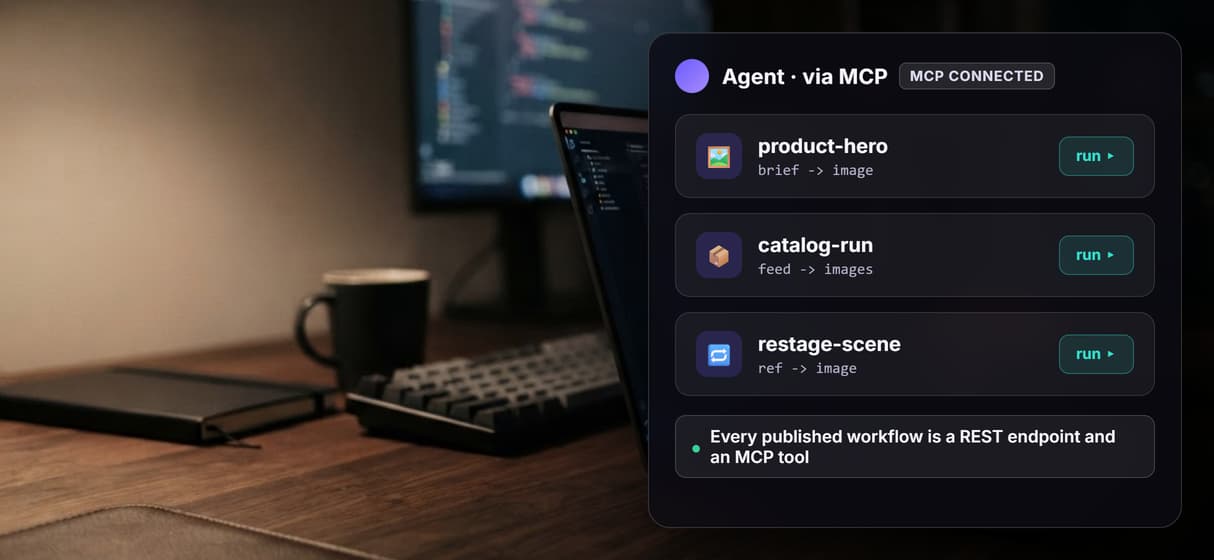
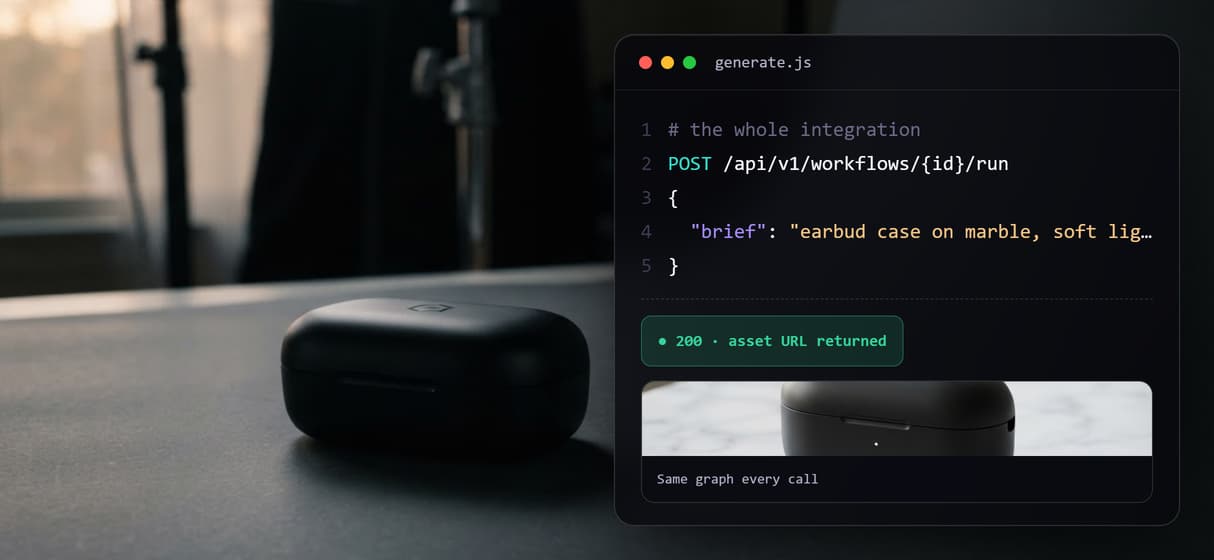
Publish the flow and it becomes a REST endpoint and an MCP tool with a typed brief input. Your app or agent posts the brief and gets the asset URL back, no model to host.
An honest answer to the Mosaic AI alternative search
Databricks Mosaic AI is a platform for building, serving, and governing your own models and agent systems on the Lakehouse. If that is the job, that platform is the right tool, and Wireflow will not pretend otherwise: it does not train or serve models, has no governance layer, and is not affiliated with Databricks or Mosaic AI.
What a lot of teams typing this search actually want is AI output they can call without owning the infrastructure that produces it. For media specifically, that is what the workflow above is. A Product Brief wired into GPT Image 2.5 Flare makes a working product image generation flow, and publishing it turns the graph into the endpoint your product calls. You iterate on the canvas; your codebase keeps one URL.
What the media workflow layer does
70+ hosted models
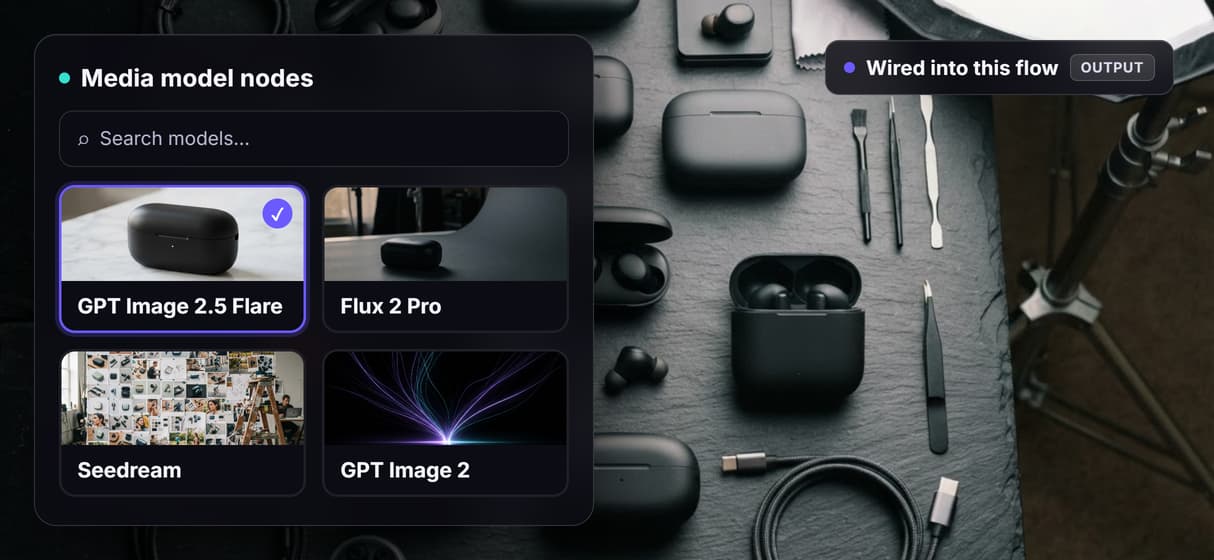
Nano Banana Lite, Flux 2 Pro, Seedream, GPT Image 2, Recraft V4, plus video and audio models, all run as canvas nodes.
REST and MCP built in
Every published workflow is an endpoint and an MCP tool with typed inputs and asset URLs back, ready for an agent to call.
No GPU infrastructure
Hosted compute runs every generation. No CUDA, no cluster to size, no serving stack, no install.
Chain and post-process
Wire an upscaler or background remover after the model and the whole chain answers one API call.
Batch over a feed
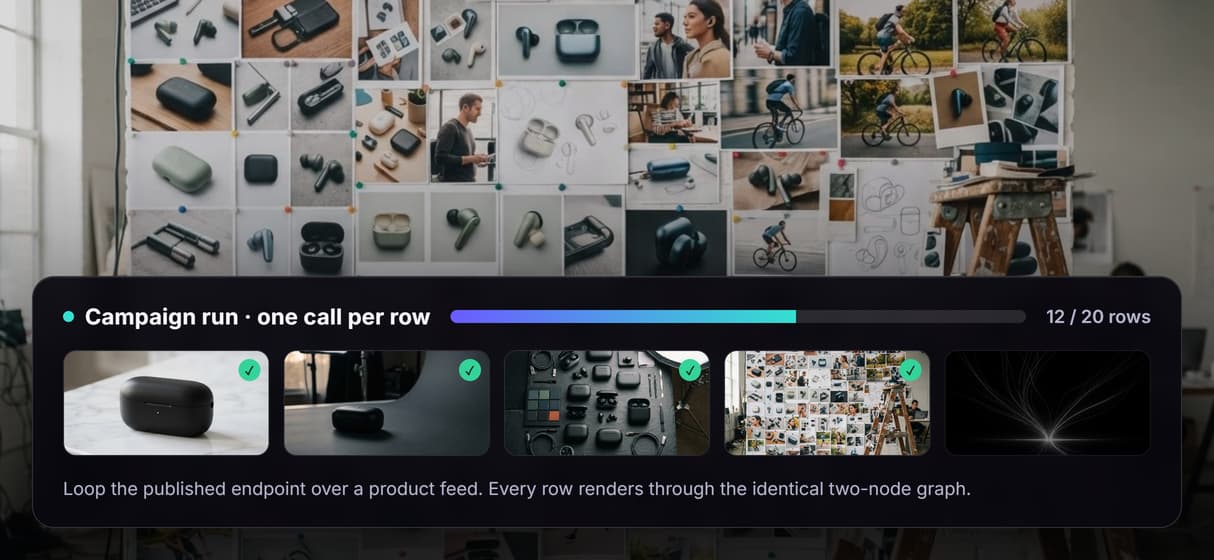
Loop one workflow across a CSV or product feed and render every row through the same graph.
Canvas-first testing
Dial in the brief and settings visually, then publish; the endpoint serves exactly the graph you tested.
Why the media layer is worth splitting out
Media models age in months. The model that wins on photorealism today loses to a release that ships next quarter, and an integration welded to one vendor inherits that decay. On a canvas the model is one node in a graph: unplug GPT Image 2.5 Flare, drop in Flux 2 Pro or add video generation, run the same brief, and keep whichever wins.
Reproducibility is what makes the swap safe. Workflows are versioned server-side, so the five hundredth render walks the same graph as the first, and a model change is a deliberate new version instead of silent drift. The honest tradeoff: every generation spends credits, so a batch over a large feed is a budgeting decision, and building the graph itself costs nothing.
When Mosaic AI is the better pick
If you need to train or fine-tune your own models, serve custom LLMs, run RAG over proprietary data, or keep everything inside your own cloud with governance and audit trails, Wireflow is not that. Databricks Mosaic AI or a comparable ML platform is the right tool, and no media canvas changes that. Wireflow also does not run offline, support custom Python nodes, or host a reasoning agent of its own.
Wireflow earns its place when the job is media generation and you would rather not build the plumbing: test prompts visually before they hit production, chain generation into upscaling or background removal, keep one endpoint while models rotate underneath it, or hand the whole workflow to an agent as an MCP tool. If that is the shape of your problem, the two-node flow above is the smallest honest start.
More Than Just Mosaic AI Alternative
A brief in, an on-brand asset out
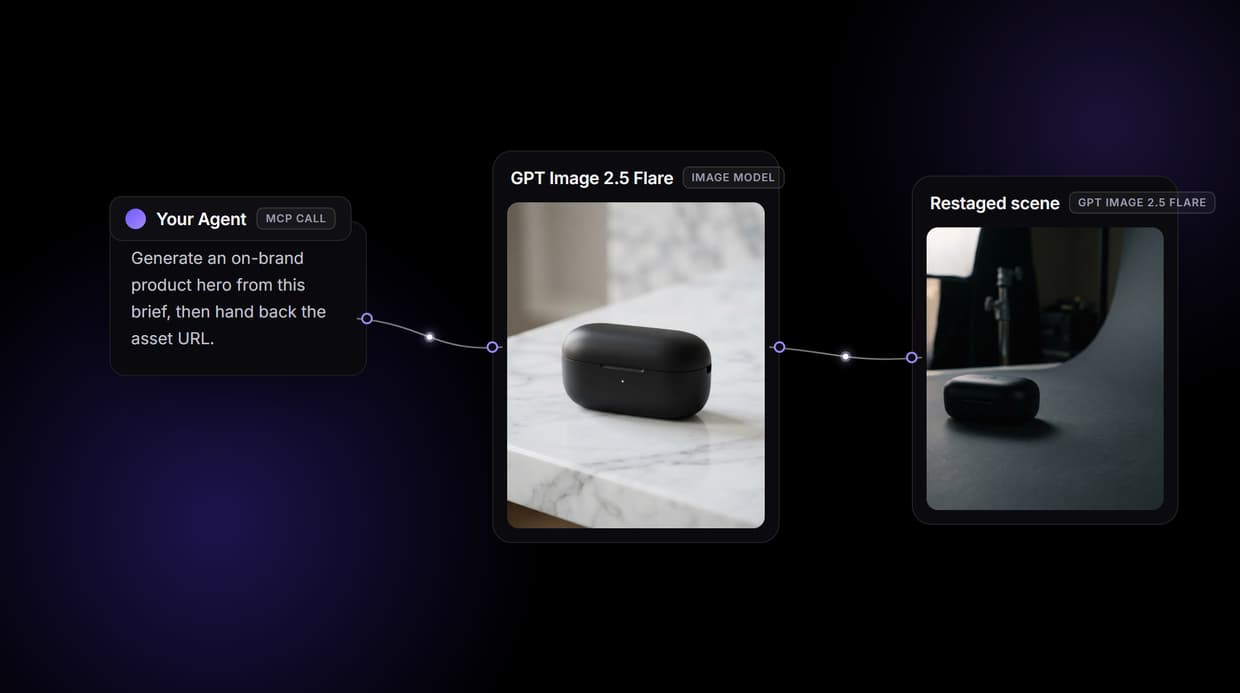
Two nodes: a Product Brief wired into a GPT Image 2.5 Flare node. Run it and a clean product image lands on the node, a working AI image generator with no GPU to rent.
Publish once, hand it to an agent
Publish the flow and it becomes a REST endpoint and an MCP tool. An agent fills the brief and gets an asset URL back, the way a headless AI workflow platform should work.
70+ models, one endpoint
Swap GPT Image 2.5 Flare for Flux 2 Pro, Seedream, or a video model on the canvas and the URL your code calls never changes, the point of a multi model AI workflow.
One call, a whole campaign
Loop the published endpoint over a product feed and every row renders through the identical graph, the shape of batch image generation via API when runs stay reproducible.
No cluster, no MLOps stack
No GPU cluster to size, no serving stack to babysit. Your app posts a brief to one URL and gets an image back, a hosted alternative with API access to running it yourself.
Build Any AI Workflow
AI Models Integrated
Full Commercial License
FAQs
It is an enterprise platform for training, fine-tuning, serving, and governing your own models and agent systems on the Databricks Lakehouse. If you need that, use it directly; Wireflow is a separate platform and does not host or replace it.
Discover related AI tools
- AI Image Upscaler: Upscale to 4K in a Visual Workflow
- AI Background Remover
- AI Image Generator: Flow-Based Canvas, 31 Models
- ComfyUI Alternative
- AI Face Swap Online: Photos and Video in Your Browser
- Virtual Try On
- AI Thumbnail Generator
- AI Photo Generator
- AI Image Editor
- AI Art Generator
- Midjourney Alternative
- AI Headshot Generator
More From Wireflow
Written by
Andrew Adams · Co-Founder & Operations at Wireflow
Runs client operations and content strategy at Wireflow. Works directly with creative teams and agencies to build production AI workflows.
Open the two-node flow behind this page
It is live on the canvas: a Product Brief wired into GPT Image 2.5 Flare. Run a brief, watch the render land on the node, then publish your own copy as the endpoint your code and agents call. Building is free; generations are pay per run.