 Andrew Adams · Co-Founder & Operations at Wireflow ·
 AI Content Agent
Give your AI agent a reproducible content factory: build an image and video workflow once, then let the agent call it as an MCP tool or REST endpoint to generate on-brand assets on demand.
Free to build · no credit card
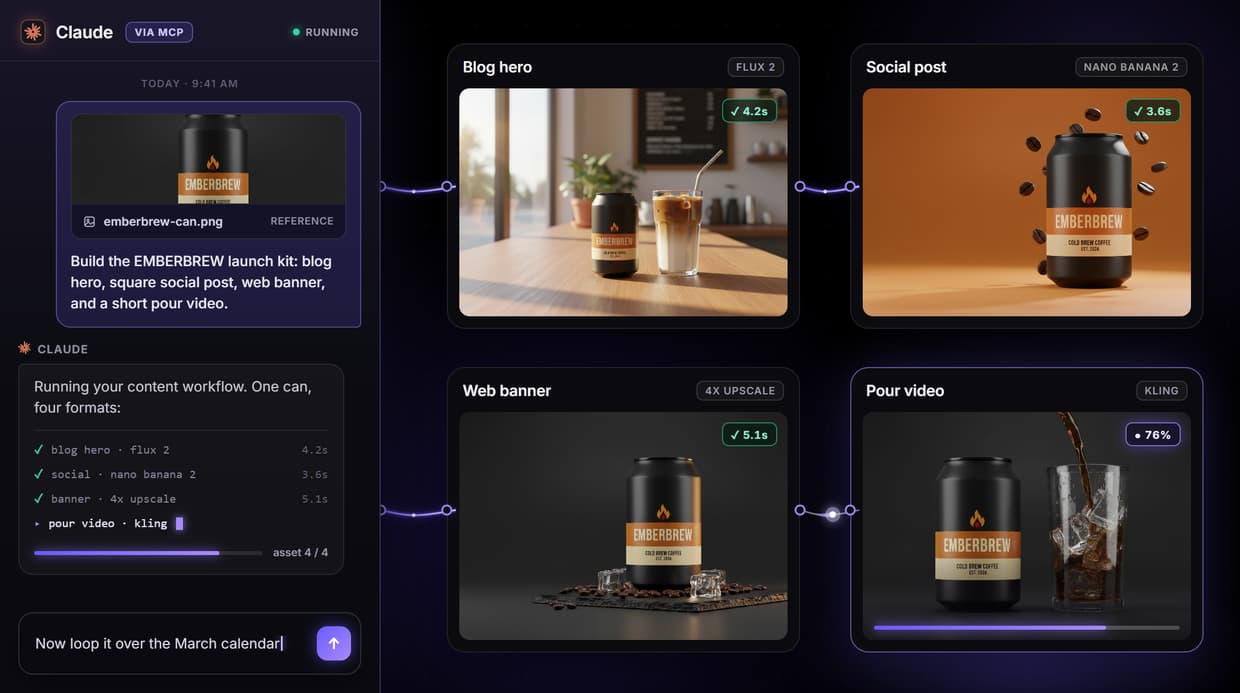
An agent that makes content, not just text
Most AI agents are strong at text and weak at everything else. The moment the task is a product shot, a thumbnail, or a short video, a text-only agent stalls. An AI content agent fixes that by giving the agent a real pair of hands: a hosted pipeline that turns a prompt into a finished asset.
Wireflow is that pair of hands. You build the content pipeline once on a node canvas, then publish it so an agent can call it as a tool. The agent decides what to make and Wireflow makes it, on the same models every time, with no GPU to provision and no server to babysit.
Wireflow is the hands, not the brain. Your agent, Claude, GPT, or your own, still does the thinking and writes the copy. Wireflow takes it from there and returns the finished image or video.
What the content pipeline can do
Image generation
Generate with SDXL, Flux, Flux 2, Nano Banana, or Recraft from a single prompt node.
Video generation
Turn an image or script into motion with Kling, Veo, or Seedance in the same graph.
Upscale and clean up
Chain a 4x upscaler or a background remover onto any output before it ships.
Multi-step chaining
Feed one model into the next: a base image becomes a refined frame becomes a clip.
MCP and REST
Every published graph is both an MCP tool and a REST endpoint, no extra wiring.
Versioned runs
Server-side versions mean the same call runs the same pipeline every time.
How an agent drives the canvas
The agent never touches a GPU or a model file. It calls the workflow the way it calls any other tool.
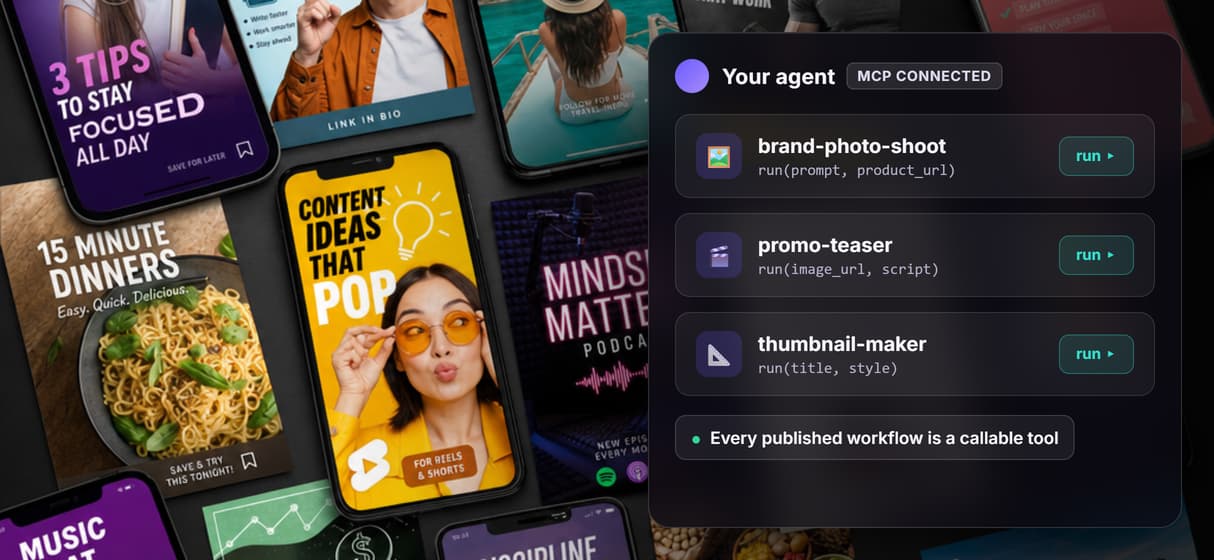
- Discovery. Over the hosted MCP server, the agent lists your published workflows and reads each one's typed inputs, so it knows a graph expects a prompt, a seed, and an optional reference image.
- Invocation. The agent calls the workflow with its own values. Wireflow runs the graph on hosted compute and returns asset URLs the agent can post, save, or pass to the next step.
- Reproducibility. The graph is a versioned object, so the same call yields the same pipeline every run. That is what makes an agent's output trustworthy instead of a lucky one-off.
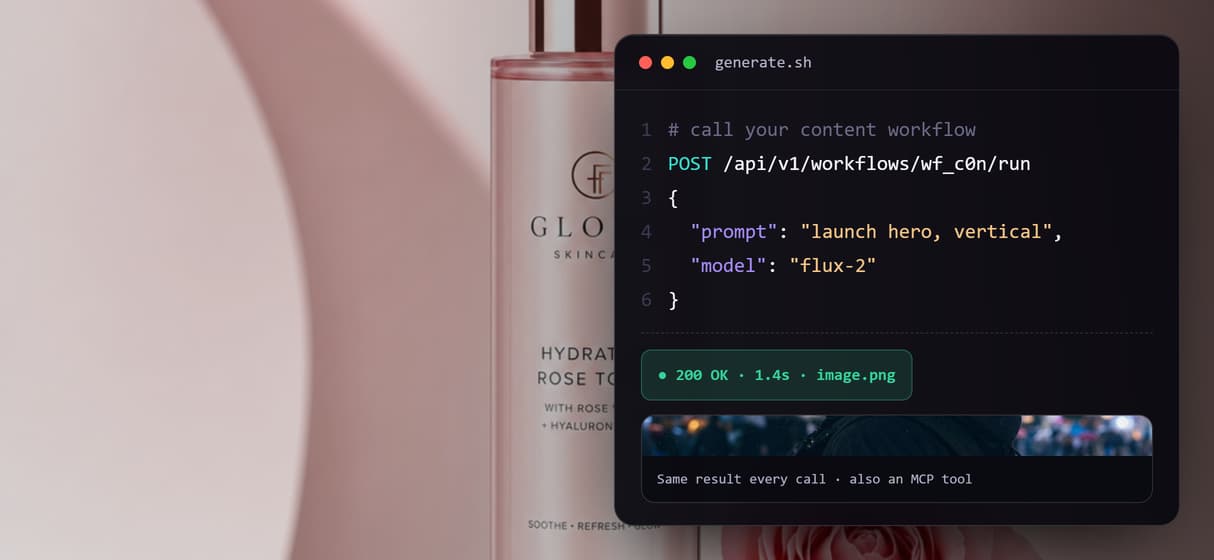
Prefer to orchestrate from code? The same workflow answers a plain REST call, so a cron job or an app backend drives it exactly like an agent would. The pattern is the same one in Claude Code integration.
What it is, and what it is not
Wireflow is the generation layer, not the brain. It runs the image and video pipeline; you bring the agent that decides what to make, whether that is Claude, GPT, or your own orchestration. Text nodes can shape a prompt inside the graph, but the reasoning and the content strategy live in your agent.
So the honest split is simple. If your job is pure copywriting, you do not need this. But when your agent has to produce images and video on brand and at scale, it needs a pipeline it can actually call. Publish a workflow once and it becomes a REST endpoint and an MCP tool your agent runs by name, same versioned pipeline every time. That callable, reproducible layer is the piece that has been missing.
More Than Just AI Content Agent
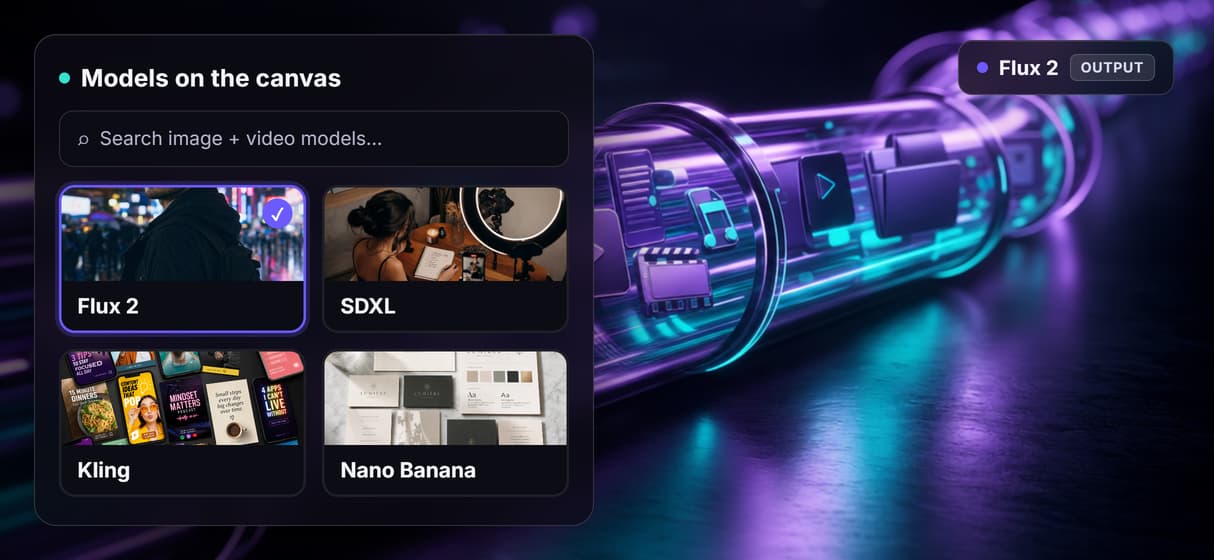
One canvas, every model
Chain image and video models in a single graph without a GPU. Generate on SDXL or Flux, refine, then push into Kling or Veo, all inside one multi-model AI workflow.
Callable as an MCP tool
Publish a workflow and it appears on the hosted MCP server, so your agent lists and runs it like any other tool. See how the MCP layer turns a graph into an action.
REST endpoint for every graph
Prefer code over an agent framework? Each workflow is also a plain REST call, so any backend can drive it. Details in the AI canvas with REST API.
Reproducible by default
Workflows are versioned server-side, so the same call runs the same pipeline every time. Walk the pattern in how to build AI workflows with an API.

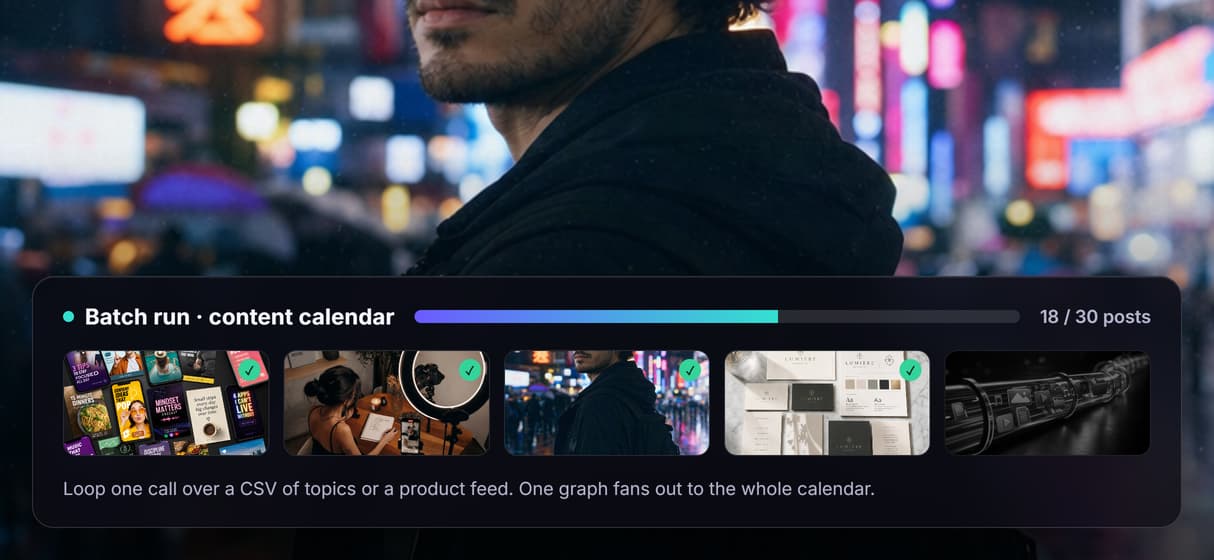
Scale to a content calendar
Loop one call over a CSV of topics or products to produce a whole batch, the same way batch AI generation fans a single graph across many inputs.
AI Models Available
Automate Any Workflow
Included in Every Plan
FAQs
It is an autonomous agent that produces content by calling tools. On Wireflow the tool is a hosted image or video workflow the agent runs to get finished assets back, instead of trying to generate everything in one prompt.
More From Wireflow
Written by
Andrew Adams · Co-Founder & Operations at Wireflow
Runs client operations and content strategy at Wireflow. Works directly with creative teams and agencies to build production AI workflows.
Turn a canvas into your content agent
Build one content workflow, publish it as an MCP tool and REST endpoint, and let your agent generate on-brand images and video on demand. No GPU, no server, reproducible every run.