Best Video API for Coding Agents Tools in 2026

In this article▾
Coding agents that generate, edit, and assemble video autonomously need APIs built for unattended execution: async job polling, webhook callbacks, idempotent retries, and structured error responses. Wireflow takes a pipeline-first approach, letting agents chain image generation, video synthesis, and post-production into a single REST call with built-in webhook delivery. Below are eight platforms worth evaluating if you are building agent-driven video workflows in 2026. The same REST call can render a whole scene through an AI movie maker you can call as an endpoint.
Quick Summary
- Wireflow - Best overall for multi-model agent pipelines
- Shotstack - Best for template-based rendering at scale
- Creatomate - Best for brand-consistent social video
- JSON2Video - Best for JSON-defined video assembly
- Mux - Best for streaming and playback infrastructure
- api.video - Best for upload, encode, and deliver
- Plainly - Best for After Effects template automation
- Cloudinary - Best for media transformation pipelines
For a hands-on look at how Wireflow handles video generation for coding agents, check out the video API for coding agents feature page.
To call Grok Imagine from code, publish a flow as a REST endpoint and POST a prompt to it.
For the still-frame case, a dedicated endpoint lets an agent animate a source image from code and poll the job to completion.
1. Wireflow
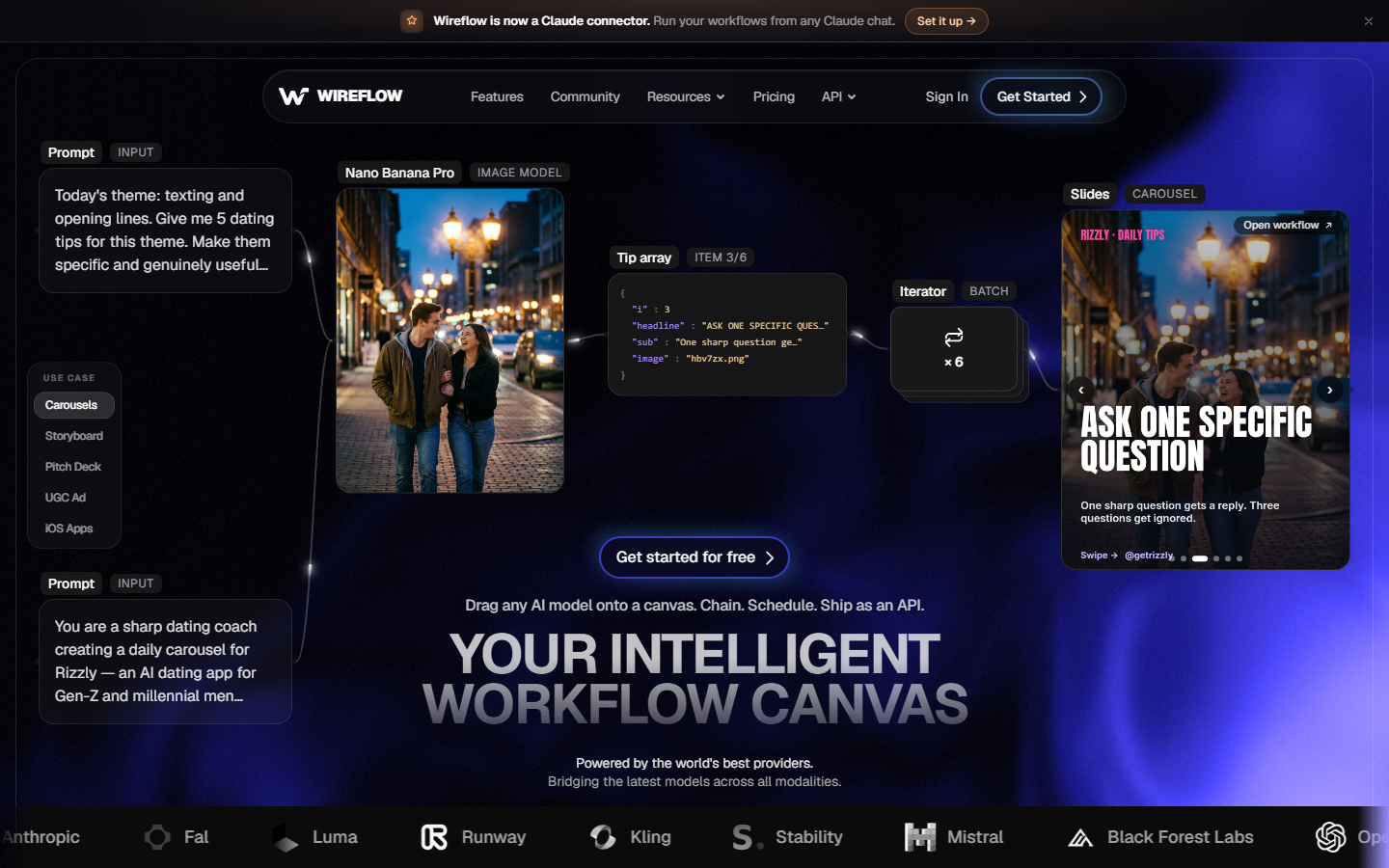
Wireflow is a visual node editor with a full REST API that lets coding agents chain multiple AI models into a single workflow. An agent sends one POST request with input parameters, and the platform routes the job through generation, editing, and composition nodes sequentially. Webhooks fire on completion, so the agent does not need to poll. The visual node editor makes it straightforward to prototype a pipeline by hand, then hand the workflow ID to an agent for programmatic execution.
Pricing follows a usage-based model with per-second billing on GPU nodes. There are no seat licenses, which matters for agent deployments where dozens of autonomous processes may call the API concurrently. Rate limits scale with plan tier, and the API returns structured JSON errors with retry-after headers.
Build this in Wireflow
Make the same kind of asset on a canvas you control, with a free account and no credit card.
2. Shotstack
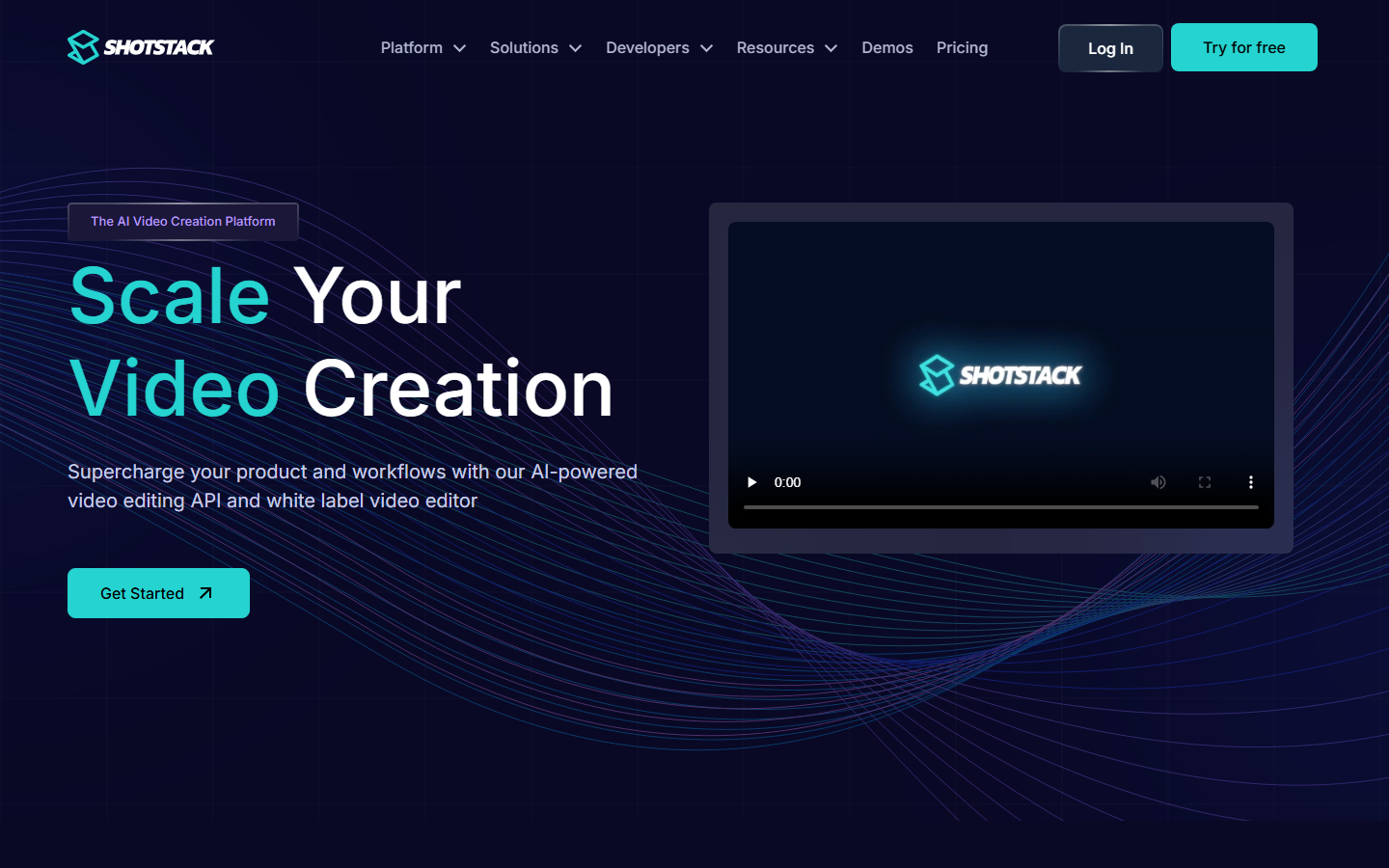
Shotstack provides a JSON-to-video rendering API that accepts a timeline object describing clips, transitions, text overlays, and audio tracks. Agents construct the timeline programmatically and POST it; Shotstack renders the video in the cloud and returns a download URL. The batch generation API pattern translates well here, since Shotstack supports queuing hundreds of renders and polling their status.
Render times depend on output duration and resolution. For short-form social clips under 60 seconds, expect sub-minute turnaround on the production tier. Shotstack also offers a media hosting CDN, so agents can skip the upload-to-S3 step entirely.
3. Creatomate
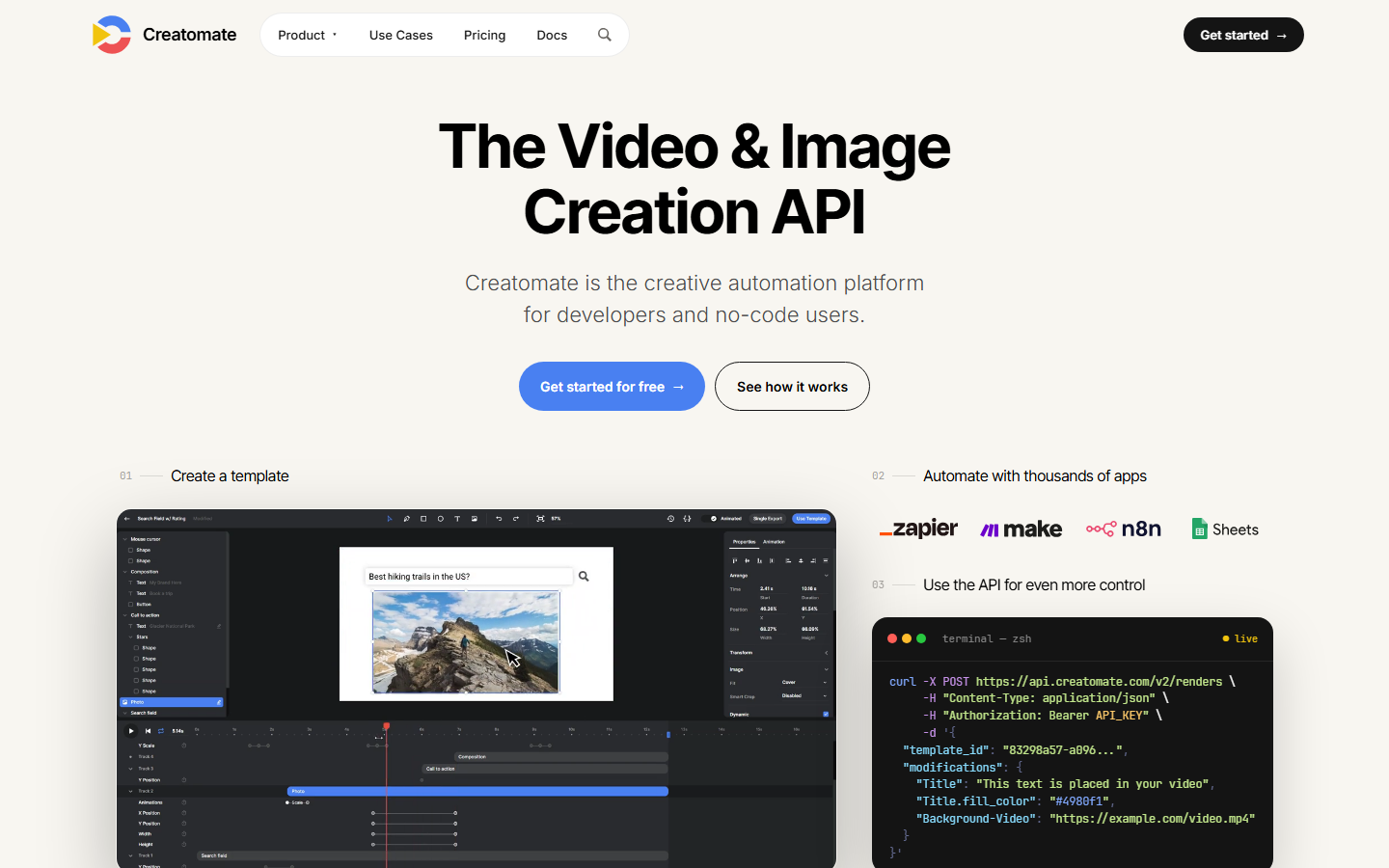
Creatomate focuses on template-driven video and image rendering. You design templates in their editor, then agents hit the REST API with dynamic data (text, images, colors) to produce branded variations. This works well for agents handling ad creative at scale, where the visual layout stays fixed but copy and assets rotate per campaign.
The API supports both synchronous (wait for render) and asynchronous (webhook callback) modes. Templates can include conditional logic, so an agent can pass a single payload and get different output depending on data values. Pricing is per render, with volume discounts above 1,000 renders per month.
4. JSON2Video
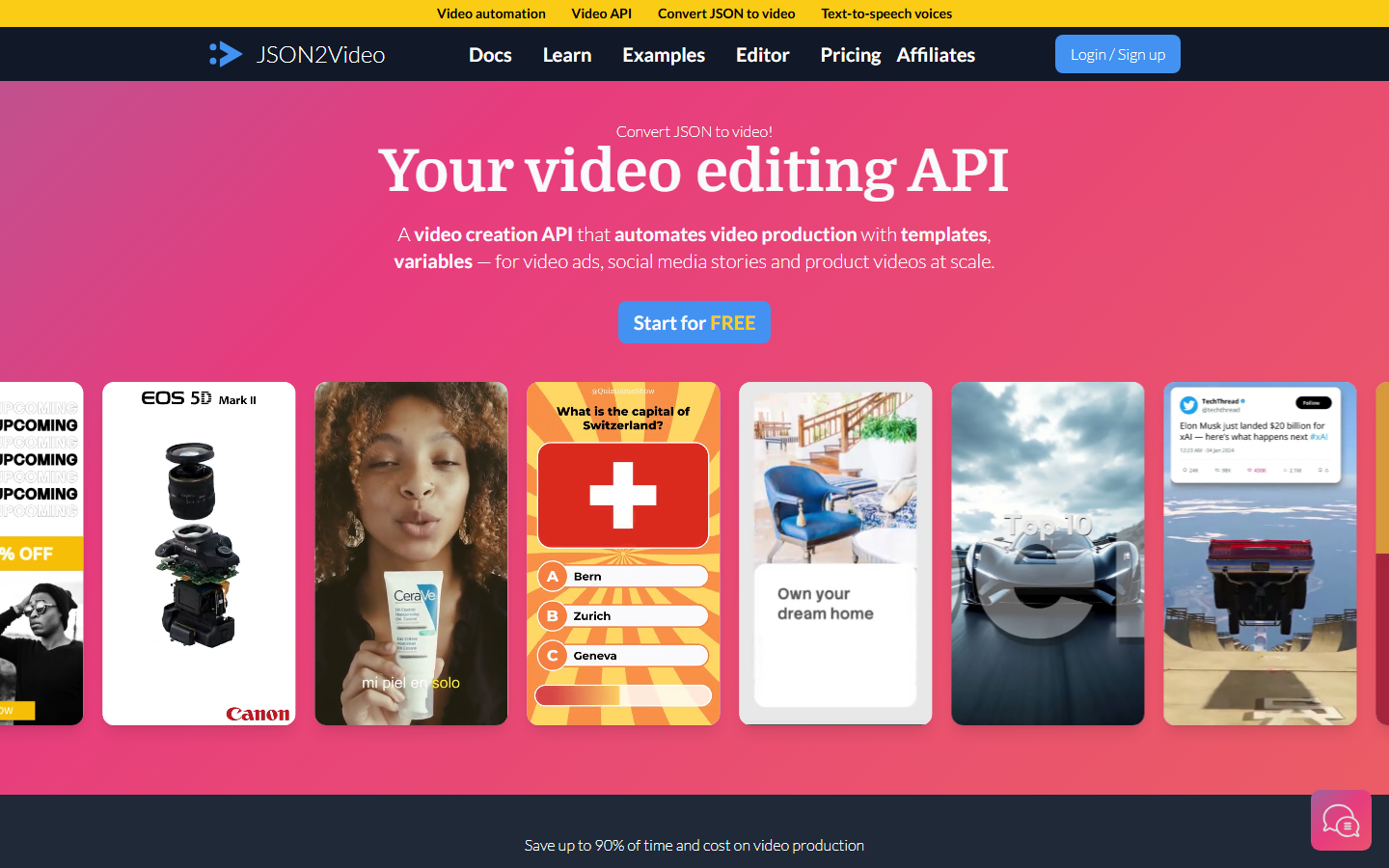
JSON2Video takes a declarative approach: agents define video scenes, elements, and timing in a JSON document, and the API renders the final MP4. The schema is well-documented, which reduces hallucination risk when an LLM agent generates the payload. For teams building video assembly pipelines, JSON2Video provides a lightweight entry point without requiring template design.
It supports text-to-speech, stock footage insertion, and screen recording compositing. The API is stateless, meaning each request is self-contained. Agents do not need to manage sessions or upload assets ahead of time; they can inline base64-encoded media or reference public URLs directly.
5. Mux
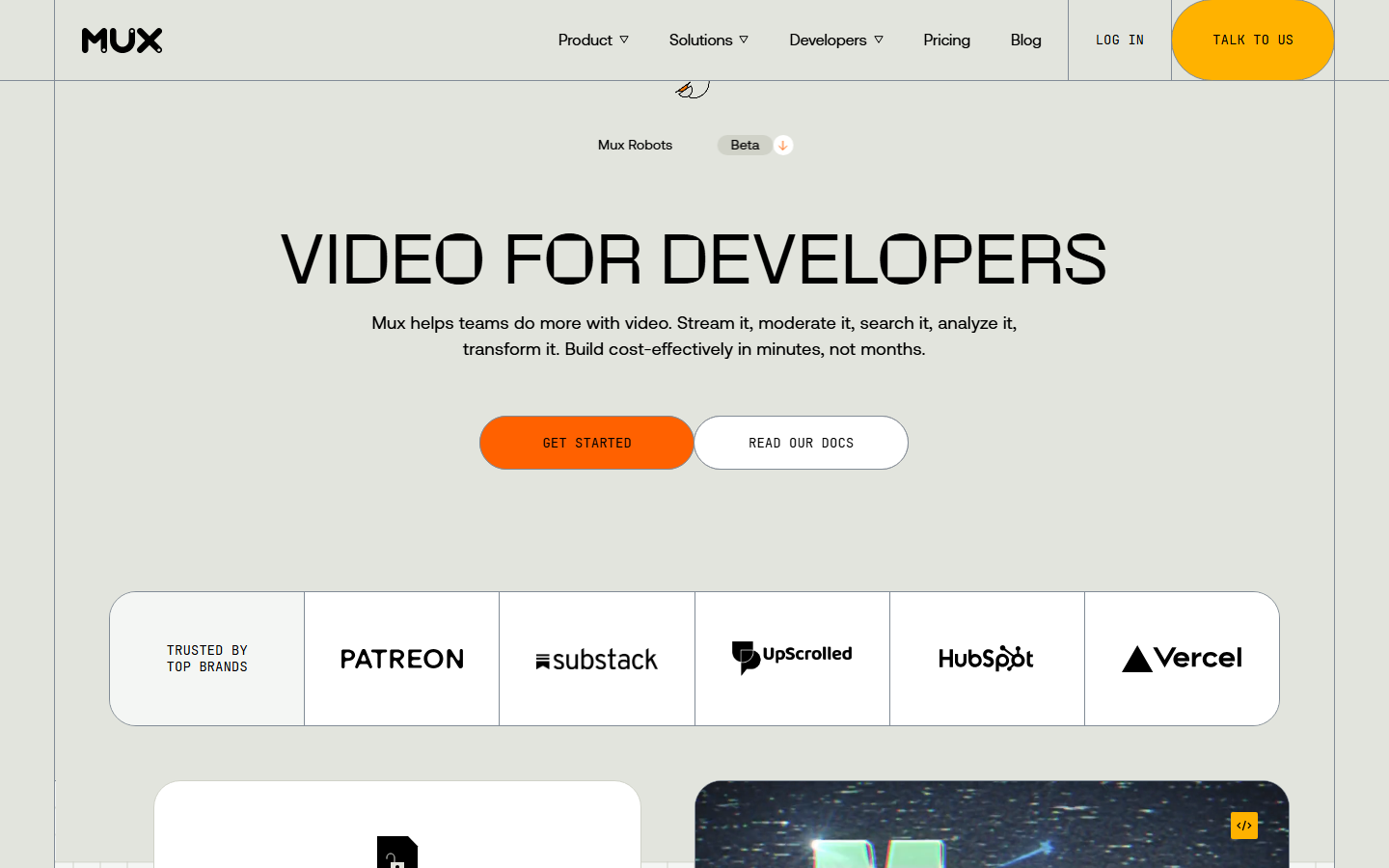
Mux is primarily a video infrastructure platform covering upload, encoding, streaming, and analytics. For coding agents, the value is in the ingest and delivery API: an agent uploads raw video (or provides a URL), Mux transcodes it into adaptive bitrate streams, and returns a playback ID usable in any player. The video generation API landscape often ends at file output; Mux picks up where those APIs leave off by handling distribution.
Mux also provides real-time video quality metrics, which agents can use to trigger re-encodes or flag quality issues. The webhook system covers asset readiness, live stream state changes, and encoding completion. Pricing is per minute of video stored and delivered.
6. api.video
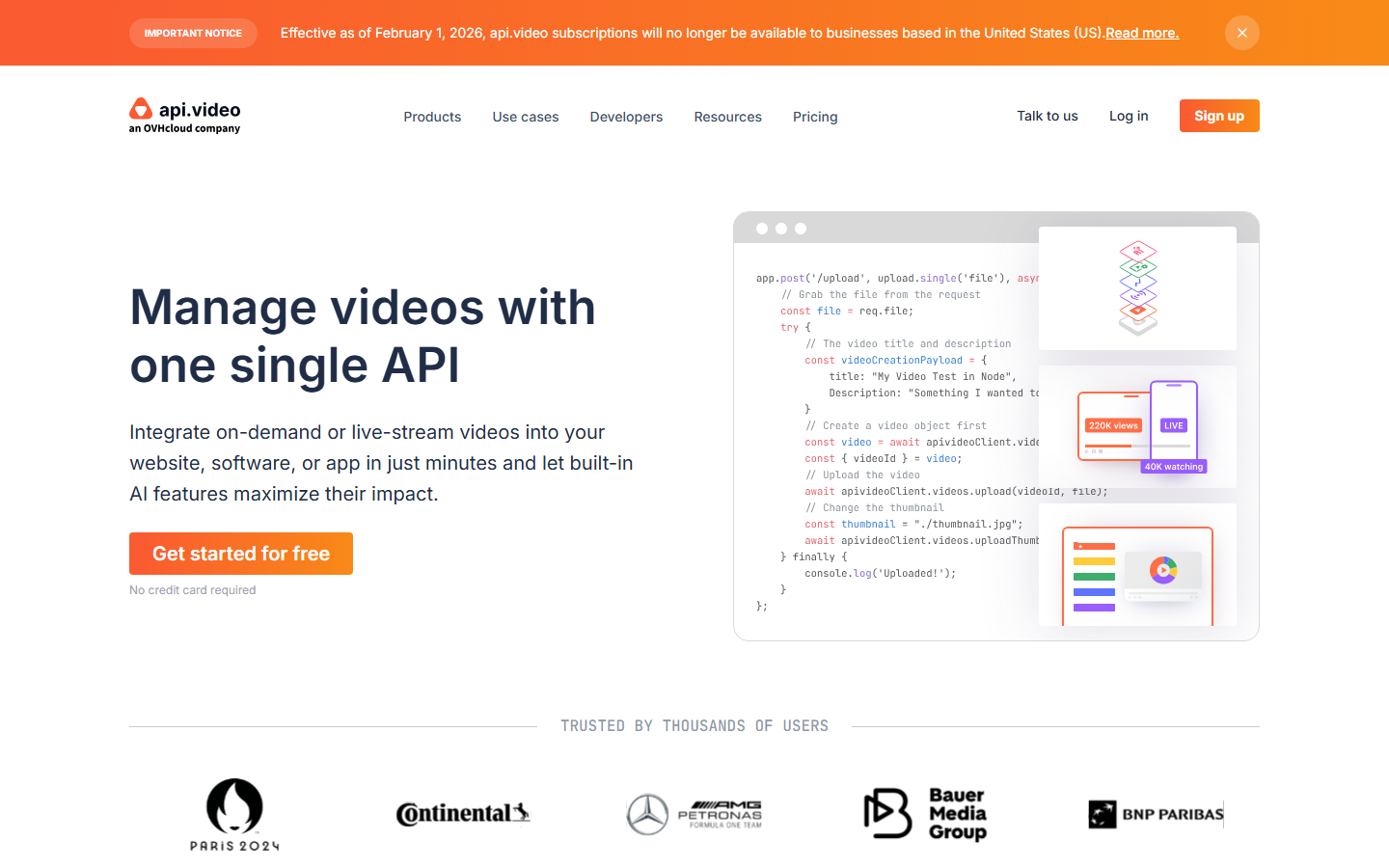
api.video offers upload, transcode, and delivery APIs with a developer-friendly SDK available in Python, Node, Go, and PHP. For agents that need to create marketing videos, api.video handles the infrastructure layer: the agent generates frames or clips using an AI model, uploads them, and api.video serves adaptive streams.
The platform includes a live streaming API, video analytics, and player customization. Webhooks cover encoding completion and live stream events. The free tier includes 50 videos per month with watermarking, which is enough for agent development and testing before production deployment.
7. Plainly
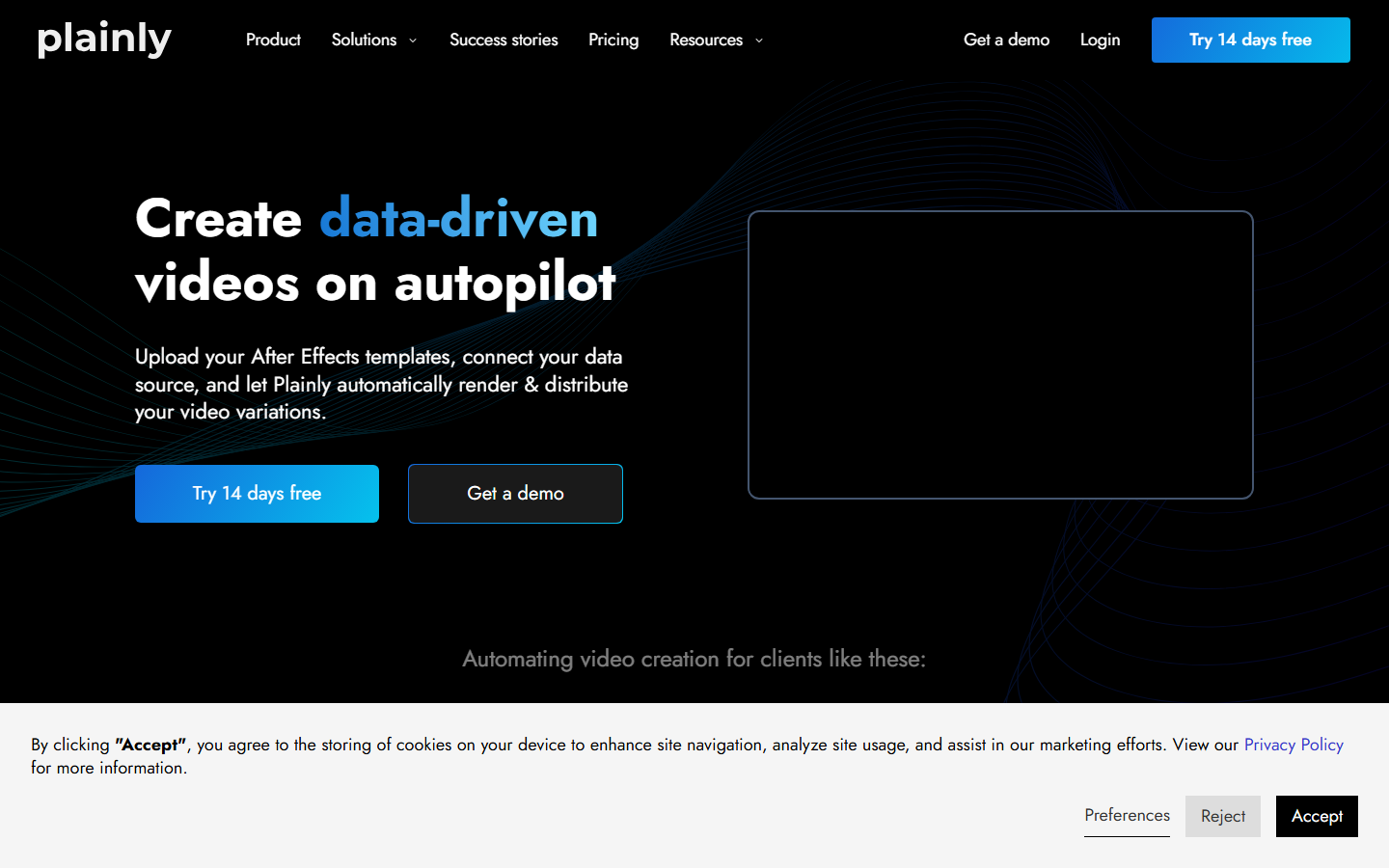
Plainly bridges Adobe After Effects and API-driven automation. Designers create AE templates with dynamic layers, upload them to Plainly, and agents call the API with data to produce rendered videos. This is useful when the visual quality bar is high and the motion design requires keyframe-level control that programmatic video generation platforms cannot match.
Render times are longer than simpler template engines (AE rendering is compute-intensive), but the output quality is broadcast-grade. The API supports batch jobs and webhook callbacks. Agents can poll job status or wait for the webhook, depending on latency requirements.
8. Cloudinary
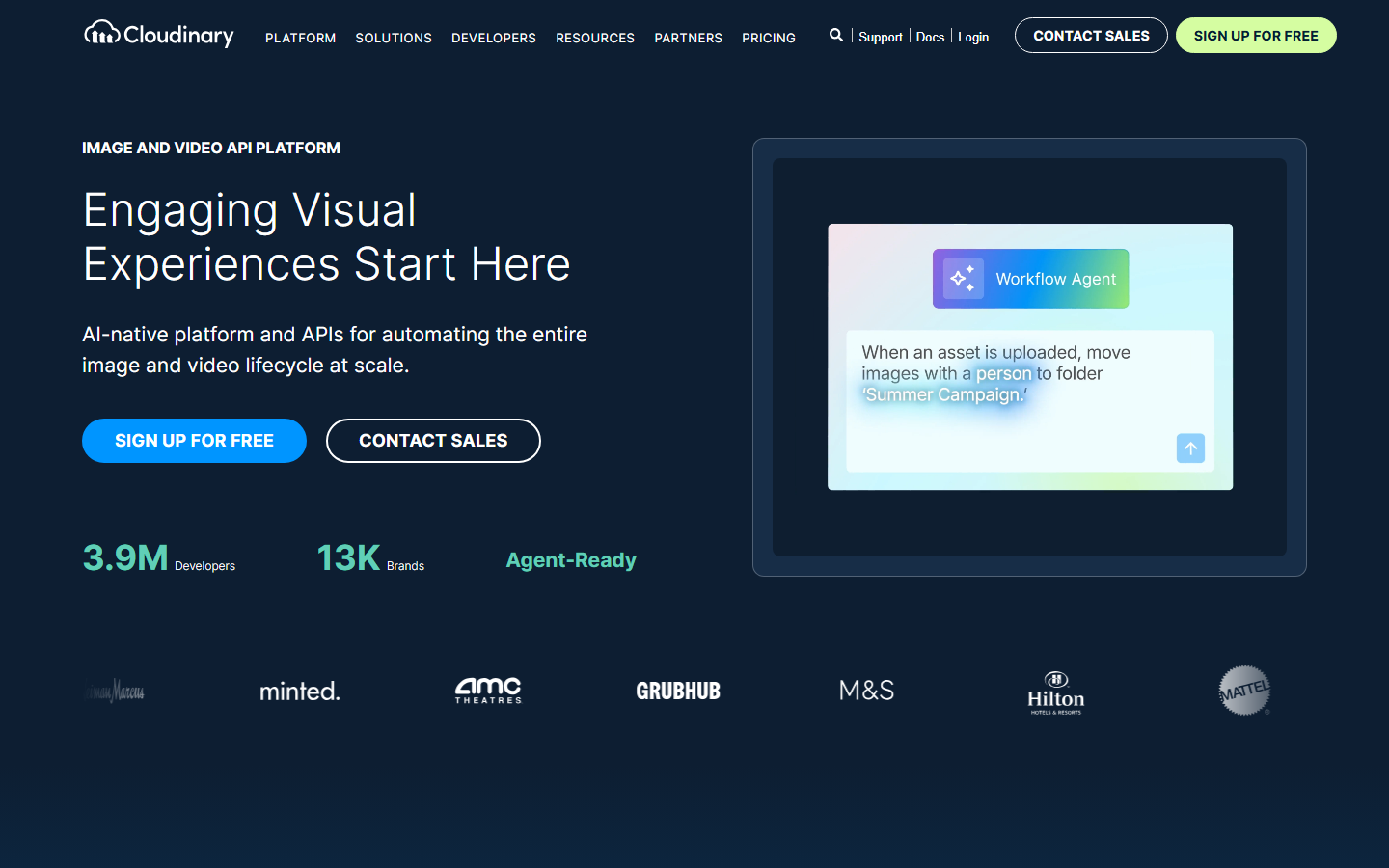
Cloudinary is a media management platform with video transformation capabilities. Agents can upload video, apply transformations (trim, overlay text, add watermarks, concatenate clips) via URL parameters or the API, and serve the result through the CDN. For agents working on AI content generation, Cloudinary acts as the post-processing layer: generate raw media with an AI model, then transform and deliver through Cloudinary's edge network.
The transformation API is URL-based, which means agents can construct delivery URLs without making separate API calls. This reduces latency for read-heavy workflows. Cloudinary also supports eager transformations, where processing happens at upload time rather than on first access.
Comparison Table
| Platform | Best For | Async/Webhook | Agent SDK | Pricing Model |
|---|---|---|---|---|
| Wireflow | Multi-model pipelines | Yes | REST + MCP | Usage-based |
| Shotstack | Template rendering | Yes | Node, Python, Ruby, PHP | Per render |
| Creatomate | Brand-consistent video | Yes | REST | Per render |
| JSON2Video | Declarative video assembly | Yes | REST | Per render |
| Mux | Streaming infrastructure | Yes | Node, Python, Go, Ruby | Per minute |
| api.video | Upload and delivery | Yes | Node, Python, Go, PHP | Per minute |
| Plainly | After Effects automation | Yes | REST | Per render |
| Cloudinary | Media transformations | Yes (eager) | Node, Python, Go, Java, PHP | Per credit |
What Coding Agents Actually Need From a Video API
Building a reliable agent-driven video pipeline requires more than a render endpoint. The API needs to support idempotent requests so that retries after network failures do not produce duplicate outputs. It needs structured error codes (not HTML error pages) so the agent's error-handling logic can branch correctly. And it needs webhook delivery for completion events, because polling adds latency and wastes compute.
Rate limiting behavior matters too. An agent running in a loop can easily exceed rate limits if the API does not return clear 429 responses with retry-after headers. The best APIs in this list handle concurrency gracefully and surface quota information in response headers so agents can self-throttle before hitting limits.
Try it yourself: Build a video pipeline workflow in Wireflow. The nodes are pre-configured with the exact multi-model setup discussed above.
FAQ
What is a video API for coding agents?
A video API for coding agents is a REST or webhook-based service that lets autonomous software (LLM agents, scripts, bots) generate, edit, or transcode video without human interaction. The API accepts structured input, processes the job asynchronously, and returns the result via callback or polling.
Which video API is best for autonomous agent workflows?
Wireflow is the strongest option for multi-step agent workflows because it chains multiple AI models (image generation, video synthesis, composition) into a single API call with webhook delivery. For simpler single-step renders, Shotstack and Creatomate are solid alternatives.
Do I need a separate streaming API after generating video?
If your agent needs to serve video to end users with adaptive bitrate, yes. Mux and api.video handle transcoding and CDN delivery. If you only need to store and download the rendered file, the generation API's output URL is sufficient.
How do I handle video API failures in an agent loop?
Use idempotency keys on each request so retries are safe. Check for 429 rate-limit responses and respect retry-after headers. Implement exponential backoff with jitter. Log the full error response body, not just the status code, so you can debug malformed payloads.
What is the typical cost per video render via API?
Costs vary by platform and output duration. Template-based renders (Shotstack, Creatomate, JSON2Video) typically range from $0.02 to $0.10 per render for sub-60-second clips. AI-powered generation (Wireflow) bills credits per model run, so a clip's cost depends on the model and its length (see current prices).
Can I chain multiple AI models in a single video API call?
Yes, with pipeline-oriented platforms like Wireflow. You define a workflow with multiple nodes (e.g., generate image, animate with Gemini Omni Flash 1.1, compose with audio), and the platform executes them sequentially. Other APIs require separate calls for each step, which means the agent must manage orchestration itself.
How do webhooks work with video rendering APIs?
You register a callback URL when submitting a render job. When the job completes (or fails), the API sends a POST request to your URL with the job status and output URLs. This eliminates the need for polling and reduces agent idle time.
What rate limits should I expect from video APIs?
Most platforms allow 10 to 100 concurrent requests on standard plans. Enterprise tiers scale higher. Always check the API documentation for your plan's limits, and implement client-side throttling based on the X-RateLimit-Remaining header to prevent 429 errors during batch operations.

Co-Founder & Operations at Wireflow
Runs client operations and content strategy at Wireflow. Works directly with creative teams and agencies to build production AI workflows.
- Content Strategy
- Client Operations
Make AI videos and ads.
Start free, no card needed.