OpenArt vs Higgsfield: Plans, Models and Who Each One Suits

In this article▾
OpenArt vs Higgsfield: OpenArt is built around characters, stories and its Director tool, while Higgsfield is built around video apps, presets and an agent. We read both vendors' own pricing and product pages on 24 October 2026, then ran one shared job, an original character placed in a second scene, on Wireflow, the node-based AI canvas we build, to show its time and cost next to theirs.
Both are multi-model platforms that offer many of the same models. OpenArt calls itself an all-in-one platform that brings "characters, stories, brands, and worlds to life", and Higgsfield leads with apps such as Content Factory, Genjutsu and Cinema Studio on top of models like Kling 4.0 and Seedance 2.5. Prices below are the vendors' own, so check them again before you buy; our Higgsfield AI pricing guide tracks Higgsfield's credit rates in more detail.
Quick summary
- Wireflow: a node canvas that chains image and video models step by step. Best for repeatable multi-step jobs
- OpenArt: character library, Director and 100+ models. Best for character-led stories
- Higgsfield: video apps, presets, its own models and an agent. Best for short cinematic and social video
OpenArt: characters, stories and Director
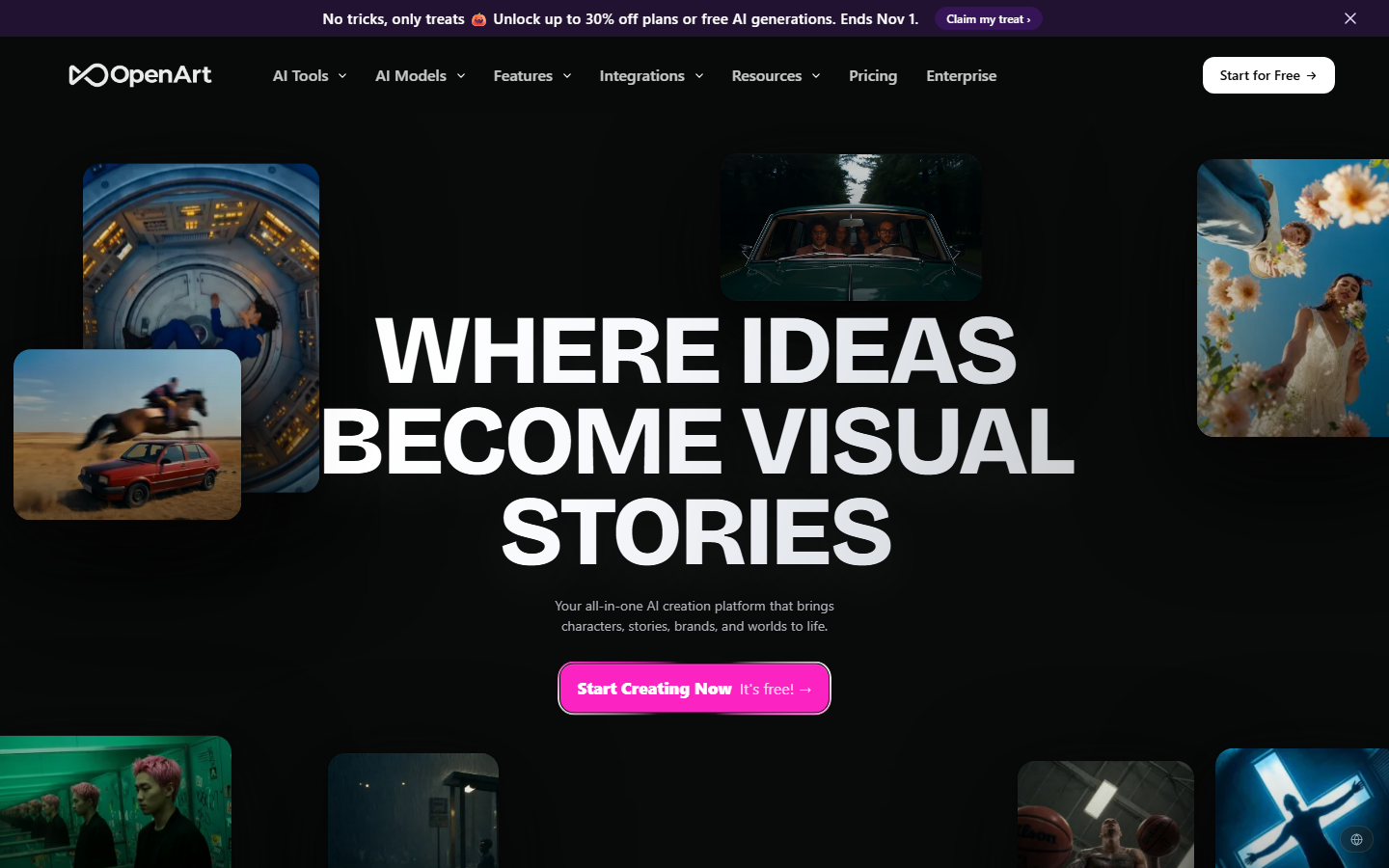
OpenArt is organized around the things you reuse: characters, worlds and storyboards. You build a character once, save it to your library, and drop it into new images and videos, a common need when creating AI characters for games and stories.
- Characters: built from reference images or a text brief and reused across images and video. Starter covers up to about 13 consistent characters, Pro about 80.
- Director: lay out a storyboard and shape each shot by chat, with templates for short films, music videos, UGC ads and product ads.
- Worlds: a persistent, navigable 3D environment from one prompt, where you can place characters and take shots.
- Motion and edits: Smart Shot, motion transfer from a 3 to 30 second reference clip, relighting, upscaling and background swaps.
- Models: video up to 15 seconds and up to 4K with Veo 3.1, Seedance 2.0, Kling 3.0 Omni and Sora 2 named on the homepage; images with GPT Image 2, Nano Banana Pro and Seedream 5.0.
- Agents: OpenArt MCP and CLI, plus an Adobe After Effects plugin.
OpenArt suits people who reuse the same characters across many pieces: comics, short series, brand mascots and multi-scene ads.
Build this in Wireflow
Make the same kind of asset on a canvas you control, with a free account and no credit card.
Higgsfield: video apps, presets and an agent
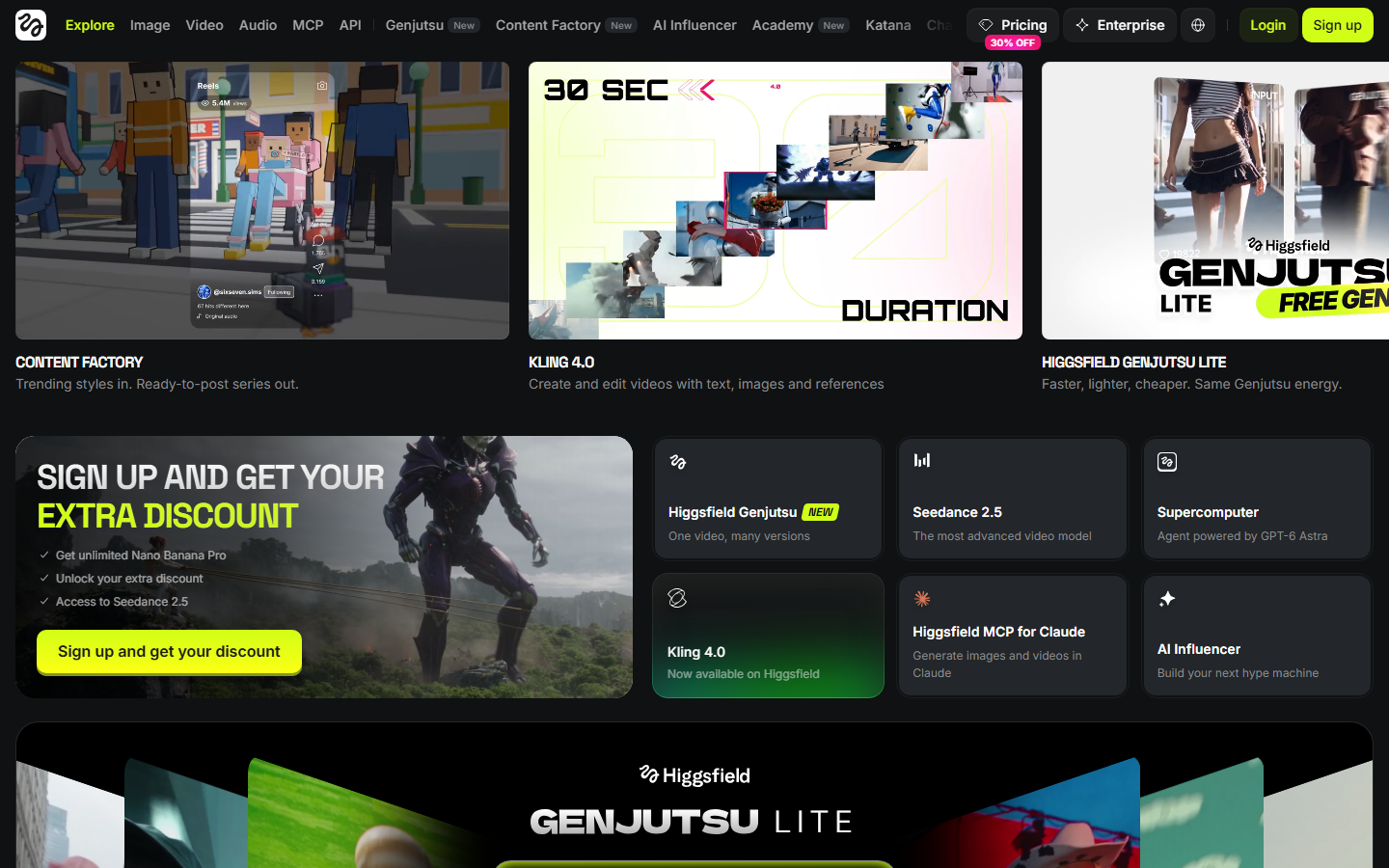
Higgsfield is organized around apps that each package one kind of output. Genjutsu, for example, recasts a motion clip with your own characters, locations and products; we cover Genjutsu alternatives separately.
- Apps: Content Factory (trending styles into ready-to-post series), Genjutsu and Genjutsu Lite, AI Influencer, Ads Studio, Marketing Studio, Effects and Cinema Studio.
- Own models: Soul 2.0 images at 0.12 credits each, DoP video, Speak 2.0 lip sync and Popcorn, next to Kling 4.0, Seedance 2.5, Veo 3.1, Wan 3.0 and Nano Banana Pro.
- Characters: the pricing table allows up to 1 character generation on Free, 108 on Starter, 480 on Plus and 1,200 on Ultra.
- Supercomputer: an agent mode, described on the homepage as "Agent powered by GPT-6 Astra".
- Agents and code: Higgsfield MCP for Claude, a ChatGPT plugin, a CLI and an API.
One limit is easy to miss: Higgsfield's unlimited and free generations work only on higgsfield.ai, not through MCP or CLI, Canvas or Supercomputer. If you planned to drive it from an agent, compare these Higgsfield MCP alternatives.
Pricing compared
All three sell monthly credit plans. Individual plans as listed on each pricing page on 24 October 2026, before tax:
| Plan | Monthly billing | Billed annually (per month) | Credits per month |
|---|---|---|---|
| OpenArt Starter | $14 | $13 | 4,000 |
| OpenArt Plus | $34 | $27 | 12,000 |
| OpenArt Pro | $56 | $44 | 24,000 |
| OpenArt Wonder | $240 | $175 | 106,000 |
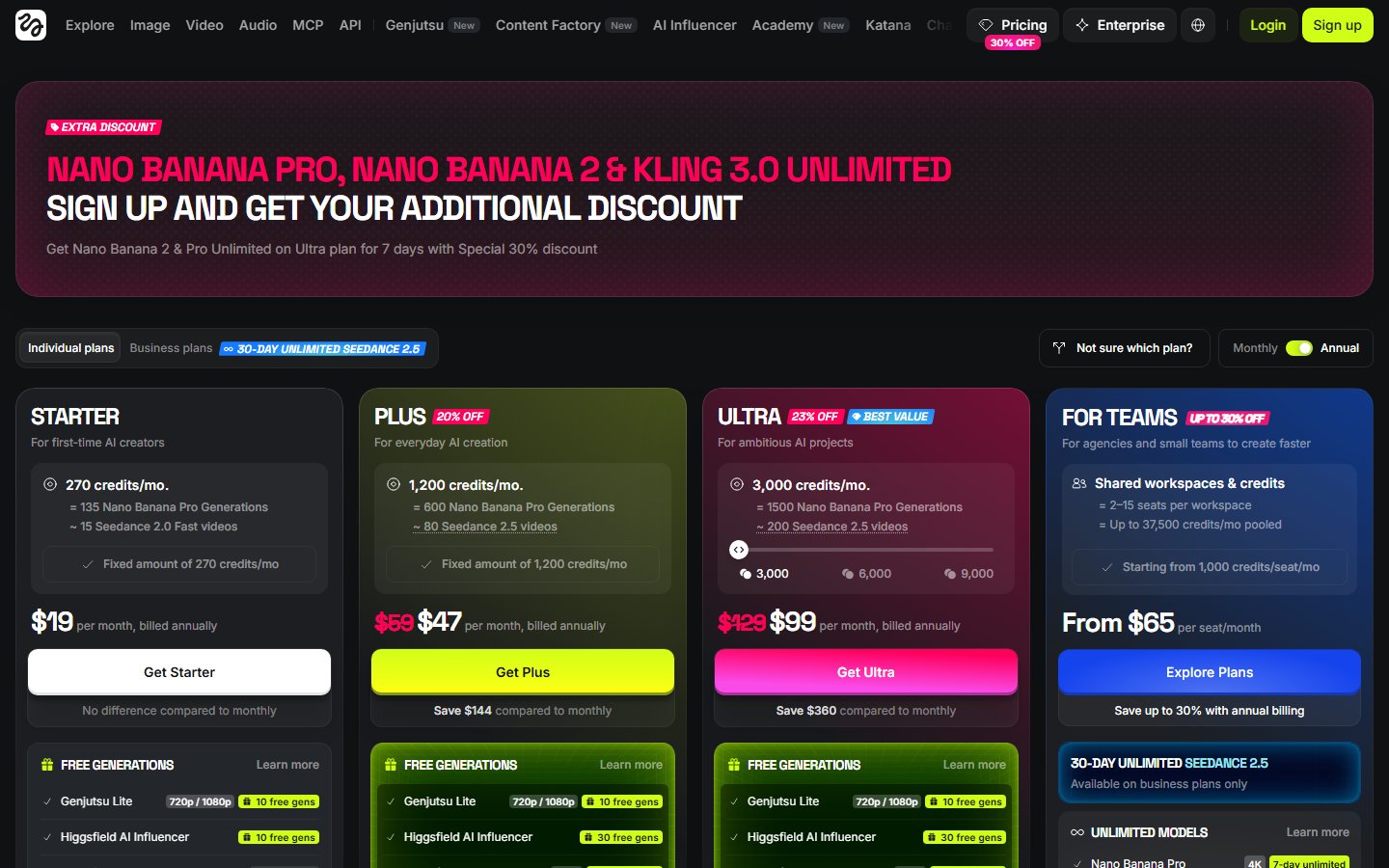
| Higgsfield Starter | $19 | $19 | 270 |
| Higgsfield Plus | $59 | $47 | 1,200 |
| Higgsfield Ultra | $129 | $99 | 3,000 (6,000 and 9,000 options) |
| Wireflow Starter | $36 | Monthly only | 2,660 |
| Wireflow Professional | $59 | Monthly only | 4,370 |
| Wireflow Team | $299 | Monthly only | 22,140 (shared pool) |
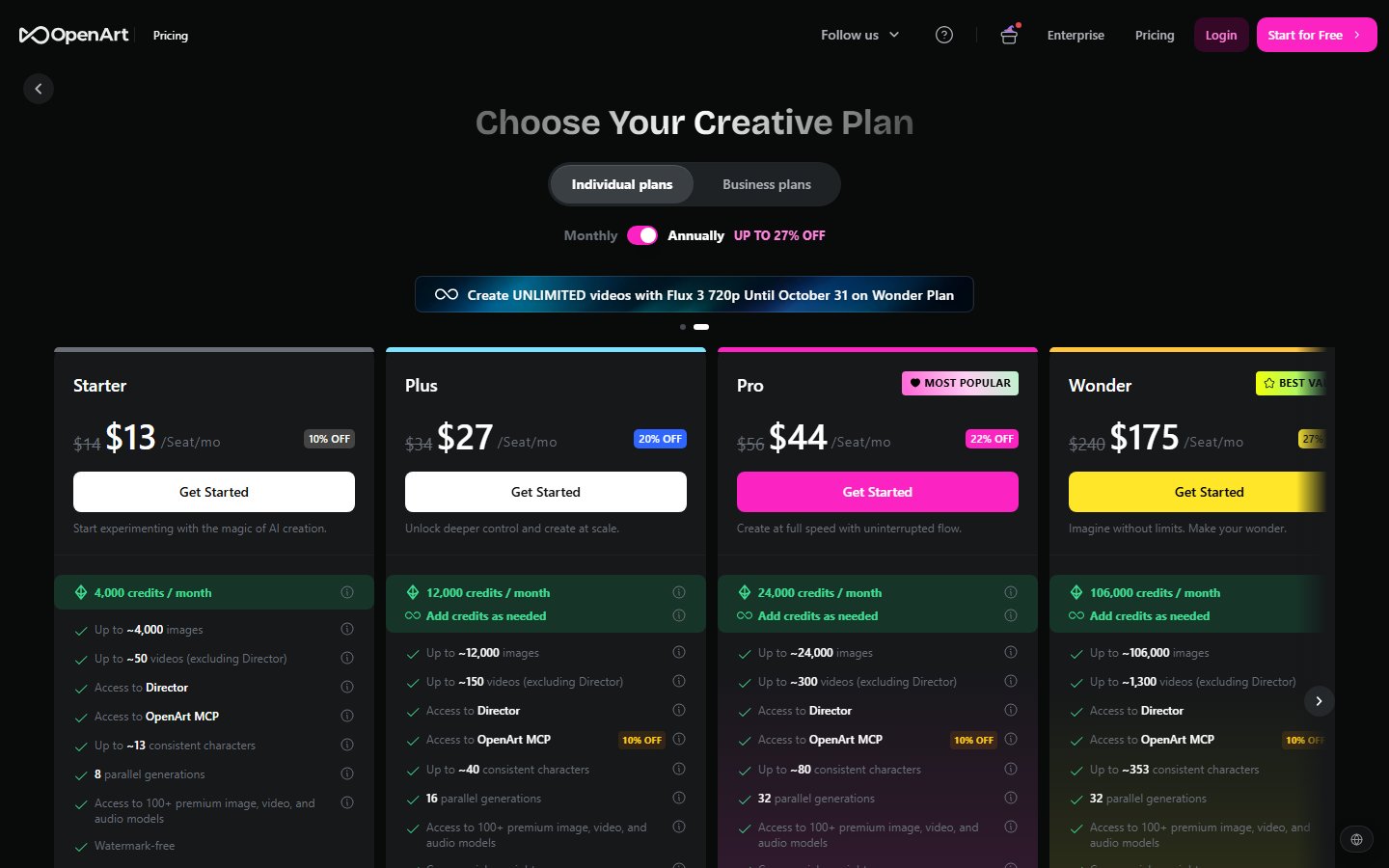
Credit counts are not comparable across vendors, because each one prices models differently. Higgsfield publishes a rate card: Nano Banana Pro costs 2 credits an image, Kling 3.0 at 1080p about 8 credits per 5 seconds, Veo 3.1 at 1080p about 40 credits per 4 seconds, and Seedance 2.0 at 1080p about 60 credits per 5 seconds. Our Seedance pricing comparison shows how those video rates stack up elsewhere.
OpenArt publishes plan totals instead of a rate card: Starter says "up to ~4,000 images" and "up to ~50 videos (excluding Director)", so the cost of a given model shows in the app. Pro and Wonder currently get 50% off Kling 4.0 generations until 20 November; our Kling 4.0 pricing breakdown covers that model's rates.
The plan details matter as much as the price:
- Commercial use: OpenArt lists commercial use rights from Plus upward, not on Starter. Higgsfield includes it from Starter upward, not on Free.
- Model access on the entry plan: OpenArt Starter includes Director, MCP and its full model list. Higgsfield Starter lists Seedance 2.0 Fast and 2.0 Mini and "selected models only"; Plus unlocks all models.
- Free options: OpenArt's FAQ describes a trial with daily credits and no credit card. Higgsfield's Free column says "limited use" with no monthly credits. Our own pricing page lists a free plan with up to 60 starter credits.
OpenArt vs Higgsfield side by side
| OpenArt | Higgsfield | |
|---|---|---|
| Built around | Characters, stories, worlds | Video apps and presets |
| Free option | Trial with daily credits | Limited free use |
| Commercial use | Plus and above | Starter and above |
| Character tools | Character library from images or text | 108 to 1,200 character generations by plan |
| Long-form tool | Director (storyboard by chat) | Cinema Studio, Content Factory |
| Models | 100+ image, video and audio models | Partner models plus its own Soul 2.0, DoP and Speak 2.0 |
| Agent access | OpenArt MCP and CLI | MCP for Claude, CLI, API, Supercomputer |
| Parallel jobs on entry plan | 8 | 2 videos, 4 images |
A third option: the same job on a canvas
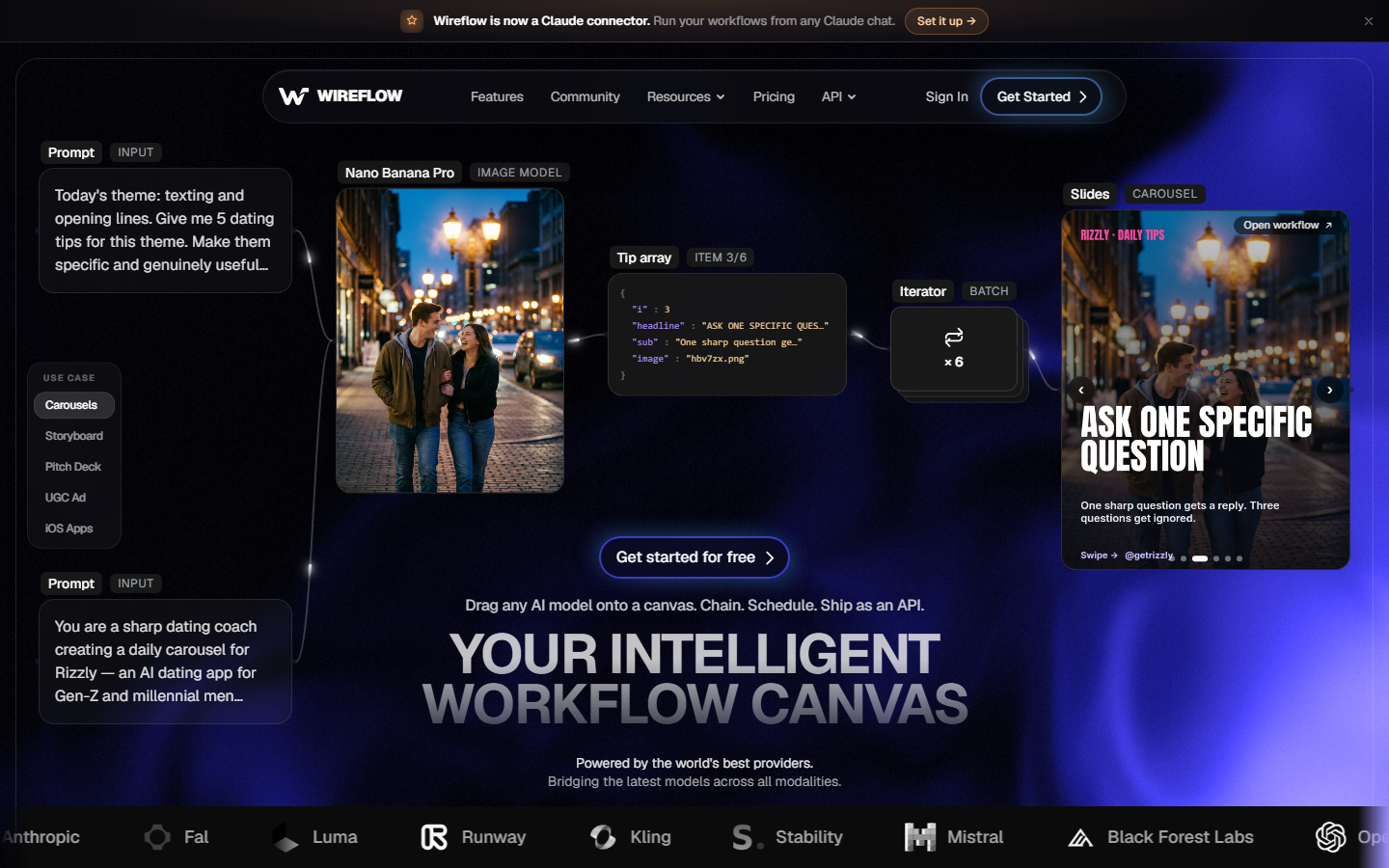
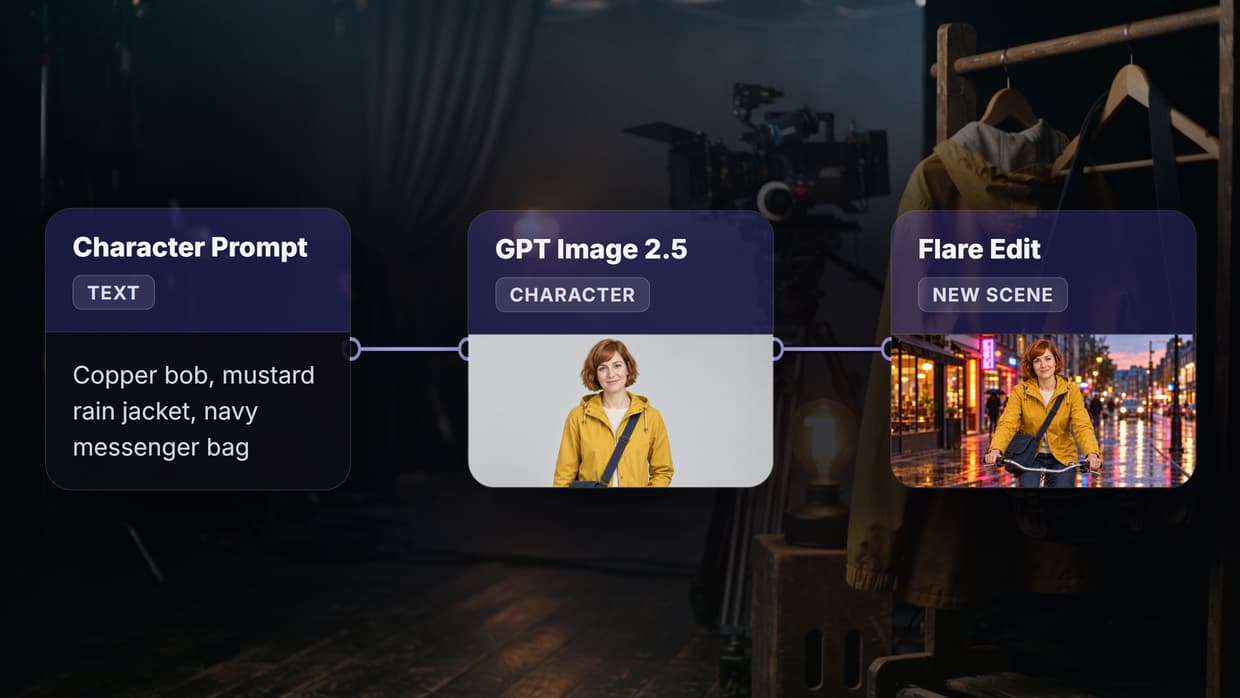
Both vendors pitch consistent characters, so we used that as the shared job: make an original character, then place the same character in a new scene. On 24 October 2026 we built it as four nodes, a character prompt into GPT Image 2.5 Flare, and a scene prompt into GPT Image 2.5 Flare Edit with the character image wired in as its reference.
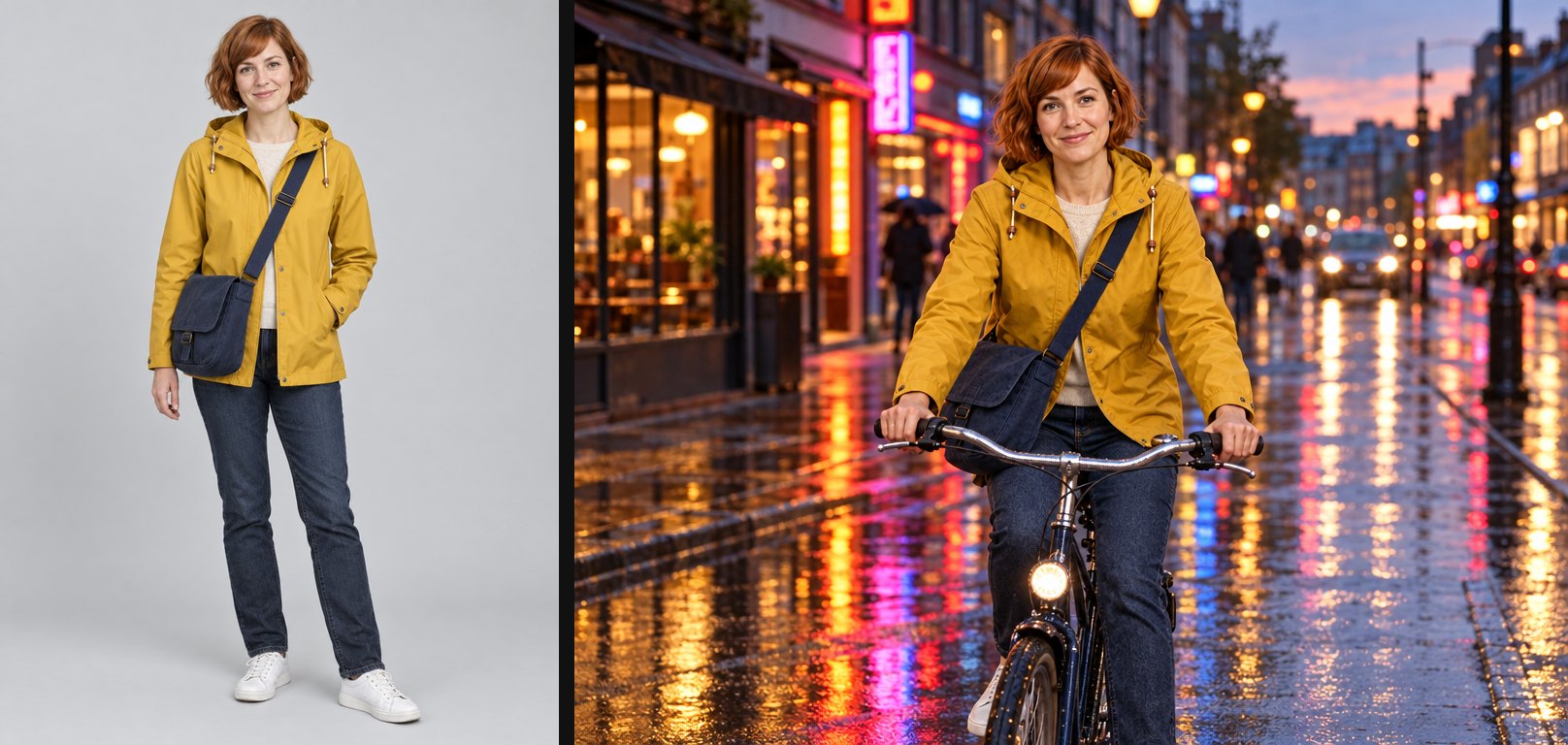
These figures come from the run record:
| Step | Model and setting | Time | Credits |
|---|---|---|---|
| Character | GPT Image 2.5 Flare, high quality, 768x1024 | 18 s | 12 |
| New scene | GPT Image 2.5 Flare Edit, high quality, 1024x768 | 22 s | 16 |
| Total | 46 s start to finish | 28 |
At the Starter rate of $36 for 2,660 credits, 28 credits is about $0.38. The face, copper bob, yellow jacket and navy bag carried over to the street scene with no character training step. For scale, Higgsfield's rate card puts two Nano Banana Pro images at 4 credits, about $0.28 on its Starter plan; OpenArt does not publish a per-model rate. The canvas keeps both prompts, both model choices and the wiring, so the next character is a prompt swap, and the flow can be called from code like the tools in our AI canvas platforms with an API roundup.
Verdict: who each tool suits
Pick by the work you repeat most, not by the model list, since the two catalogs overlap heavily.
- Choose OpenArt for recurring characters, comics and series, multi-scene stories through Director, 3D worlds, and image-heavy work where credits per dollar matter.
- Choose Higgsfield for short cinematic and social video, ready-made apps such as Content Factory and Genjutsu, its own Soul images, and new video models like Kling 4.0 and Seedance 2.5 in one app.
- Choose a canvas when the same multi-step job runs again and again, when you want to pick the model for each step, or when an agent or your own code needs to trigger it. A no-code AI canvas keeps each step as a node you can swap and rerun.
Conclusion
OpenArt vs Higgsfield has no single winner. OpenArt gives more credits per dollar and stronger tools for characters and stories, while Higgsfield packages video models into apps and adds its own image and lip sync models. If you need a pipeline you can rerun with any model, Wireflow covers that third case, and our list of Higgsfield API alternatives compares more options for calling these models from code.
Try it yourself: Open this consistent character workflow in Wireflow. Both prompt nodes and both GPT Image 2.5 Flare nodes are set up exactly as in this test; swap in your own character and run. You can open and change this workflow for free. A new account gets up to 60 starter credits and a free video, and each run uses credits. Plans start at $36 a month for 2,660 credits.
FAQ
Is OpenArt better than Higgsfield?
Neither is better at everything. OpenArt is stronger for reusable characters, storyboards through Director and image work, while Higgsfield is stronger for packaged video apps, presets and its own Soul, DoP and Speak models.
Which is cheaper, OpenArt or Higgsfield?
OpenArt's entry plan is cheaper and carries more credits: $14 a month for 4,000 credits against Higgsfield's $19 for 270. Credits are priced differently on each platform, so compare the cost of the exact model you plan to use, as in our free AI image generators compared guide.
Does OpenArt or Higgsfield have a free plan?
OpenArt offers a trial with daily credits and no credit card. Higgsfield's Free tier has limited use and no monthly credits; its paid plans add free generations in apps such as Genjutsu Lite.
Which is better for consistent characters?
OpenArt builds a character from reference images or a text brief and reuses it across images and video, with up to about 13 characters on Starter. Higgsfield limits character generations by plan, from 108 on Starter to 1,200 on Ultra. Our guide to designing characters with AI covers the prompting side.
Can I use OpenArt and Higgsfield output commercially?
On OpenArt, commercial use rights are listed on Plus, Pro and Wonder, not Starter. On Higgsfield, commercial use is included from Starter up, not on Free.
Do OpenArt and Higgsfield work with Claude?
Yes. OpenArt offers an MCP server and CLI, and Higgsfield offers MCP for Claude, a CLI and a ChatGPT plugin. See our roundup of agentic canvas tools for other agent-ready options.

Co-Founder & Operations at Wireflow
Runs client operations and content strategy at Wireflow. Works directly with creative teams and agencies to build production AI workflows.
- Content Strategy
- Client Operations
Make AI videos and ads.
Start free, no card needed.