Creatomate Pricing in 2026: Every Plan and the Real Cost per Minute

In this article▾
Creatomate pricing starts at $54 a month for 2,000 credits, or $45 a month billed yearly, and a minute of 1080p video at 30 fps uses about 37 of those credits. This guide lists all nine plan sizes on Creatomate's pricing page as checked on 21 October 2026, converts credits into a cost per finished minute at the formats teams actually export, and compares that rate with the APIs that sell against Creatomate. It also covers where Wireflow fits when rendering is only one line of the video budget.
The short version: Creatomate is cheap per minute at 720p and expensive at 1080p and 4K, because its credits scale with pixels and frame rate while most rivals charge a flat rate per minute. Teams that also have to generate the footage often compare it with a node-based video workflow canvas, where making the clips and assembling the cut run in one pipeline.
Creatomate pricing at a glance
Creatomate is a media automation platform: you design a video or image template in its editor, then render variations through the REST API, no-code tools such as Zapier and Make, or spreadsheet feeds. There are three plans, and Growth and Beyond each come in four credit sizes. For how its model differs from its closest rival, see our Creatomate vs Shotstack comparison.
| Plan | Monthly price | Billed yearly | Credits per month | Storage | Feed rows | Plan-gated features |
|---|---|---|---|---|---|---|
| Free trial | $0 | n/a | 50, one time | n/a | n/a | All features, output capped at 480 px |
| Essential | $54 | $540 | 2,000 | 5 GB | 1,000 | No Preview SDK, project sharing or priority support |
| Growth | $129 to $279 | $1,290 to $2,790 | 10,000 to 40,000 | 50 GB | 10,000 | Adds the JS Preview SDK and project sharing |
| Beyond | $329 to $1,209 | $3,290 to $12,090 | 50,000 to 200,000 | 500 GB | 100,000 | Adds priority email support |
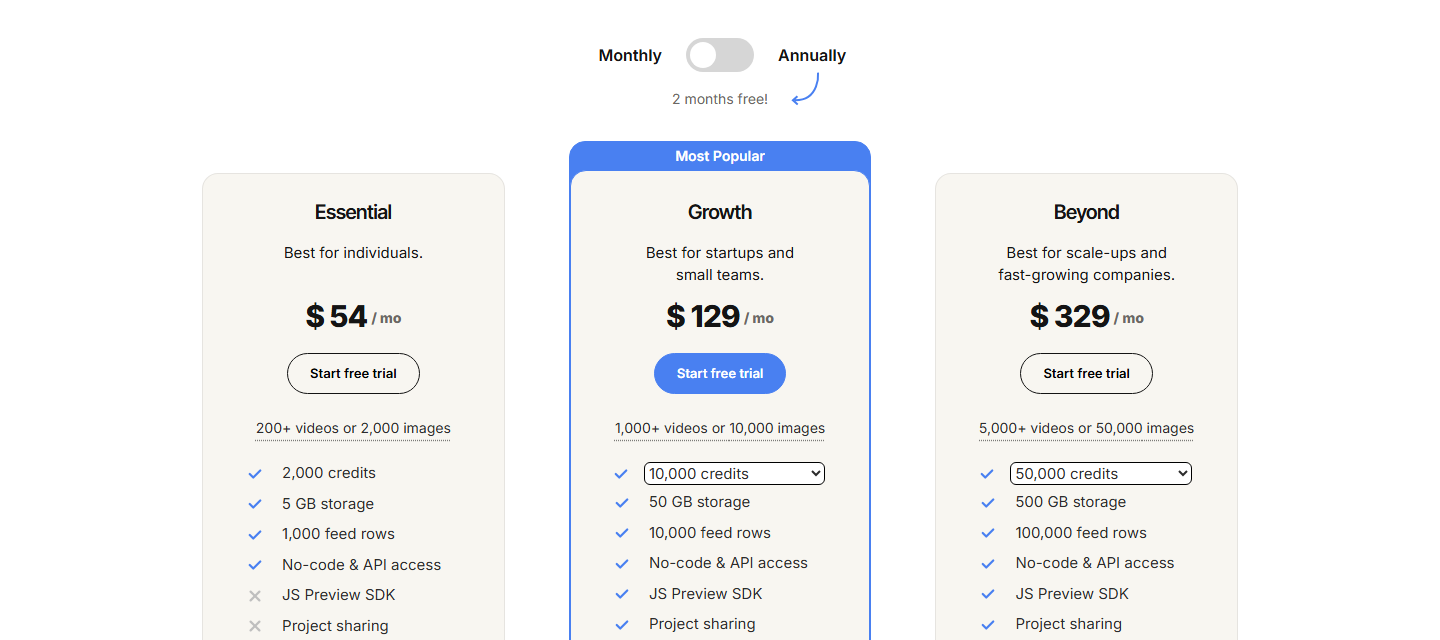
Every plan includes no-code and API access, and an image always costs one credit at any resolution. Yearly billing charges ten months for twelve, which is the "2 months free" on the toggle. That leaves volume and output format as the two things that set your bill, the same two variables that matter when you shortlist video creation and editing APIs.
Build this in Wireflow
Make the same kind of asset on a canvas you control, with a free account and no credit card.
How Creatomate credits are calculated
Creatomate's documentation gives one formula for video: credits equal width times height times frame rate times duration in seconds, divided by 100,000,000. Put simply, one credit buys 100 million rendered pixels, and every video costs at least one credit. Doubling the frame rate doubles the cost, and moving from 720p to 1080p multiplies it by 2.25, so the export format matters as much as the plan for anyone making vertical videos for Shorts and Reels.
| Output format | Resolution | Credits per minute | Credits per 30-second clip |
|---|---|---|---|
| 720p at 25 fps (Creatomate's reference) | 1280 x 720 | 13.8 | 6.9 |
| 720p at 30 fps | 1280 x 720 | 16.6 | 8.3 |
| Square at 30 fps | 1080 x 1080 | 21.0 | 10.5 |
| 1080p at 30 fps, horizontal or vertical | 1920 x 1080 | 37.3 | 18.7 |
| 1080p at 60 fps | 1920 x 1080 | 74.6 | 37.3 |
| 4K at 30 fps | 3840 x 2160 | 149.3 | 74.6 |

This also decodes the plan cards. "200+ videos" on Essential assumes about 10 credits per video, which is a 43-second clip at 720p and 25 fps or a 16-second vertical clip at 1080p and 30 fps. Automatic subtitles cost 10 credits a minute only when that is more than the render itself, so they are free at 720p and above, which helps teams that add captions to social video by default.
Cost per finished minute on every plan
The pricing page shows one credit size at a time behind a dropdown and never states a dollar rate per minute. The table below divides each monthly price by the minutes its credits buy at three common formats. It is the neutral view we use when comparing usage-based AI API pricing across vendors.
| Plan | Credits | Monthly price | 720p at 25 fps | 1080p at 30 fps | 4K at 30 fps |
|---|---|---|---|---|---|
| Essential | 2,000 | $54 | $0.37 | $1.01 | $4.03 |
| Growth 10K | 10,000 | $129 | $0.18 | $0.48 | $1.93 |
| Growth 20K | 20,000 | $179 | $0.12 | $0.33 | $1.34 |
| Growth 30K | 30,000 | $229 | $0.11 | $0.28 | $1.14 |
| Growth 40K | 40,000 | $279 | $0.10 | $0.26 | $1.04 |
| Beyond 50K | 50,000 | $329 | $0.09 | $0.25 | $0.98 |
| Beyond 100K | 100,000 | $639 | $0.09 | $0.24 | $0.95 |
| Beyond 150K | 150,000 | $932 | $0.09 | $0.23 | $0.93 |
| Beyond 200K | 200,000 | $1,209 | $0.08 | $0.23 | $0.90 |
Three patterns stand out for anyone running a bulk video ad API or templated video at volume:
- The big step is Essential to Growth 10K. Five times the credits cost 2.4 times the price, so the rate falls from $27.00 to $12.90 per 1,000 credits.
- Above 50,000 credits the curve is nearly flat. Beyond 200K costs $6.04 per 1,000 credits against $6.58 on Beyond 50K, about 8% less.
- Yearly billing takes about 17% off every rate. Growth 10K drops from $0.48 to $0.40 per 1080p minute. Its card shows $109 a month on yearly billing, but the $1,290 yearly total works out to $107.50.
Rules that change the bill
Credits are monthly and do not carry over, and the pricing page lists no overage rate. To get more credits mid-month you upgrade, the higher plan stays in effect for the rest of the billing period, and a downgrade takes effect the following month. Creatomate also lets you cap credit use per project, a useful guard if you need an AI generation API with spend limits rather than a surprise upgrade.
Throughput has its own ceiling. Creatomate's limits page says each customer can use about 20% of the monthly quota within 24 hours, and the API accepts 30 requests per 10-second window. On Growth 10K that is 2,000 credits a day, about 107 vertical 30-second clips at 1080p, so a 500-clip launch takes close to five days. Teams planning large batch runs on a deadline should size the plan for the daily cap, not only the monthly total.

Rendered files are hosted for up to 30 days and then permanently deleted, and renders do not count toward storage, which covers only the media inside templates and feeds. Creatomate recommends copying every file to your own storage straight after rendering, an extra step to build into any Make.com video automation. Output is capped at 3840 pixels on either side, and trial renders are scaled down so neither side passes 480 pixels.
Creatomate vs the APIs selling against it
Competitor pages such as Orshot's quote Creatomate's plan prices next to their own but stop short of a rate per minute. Below, every tool is converted to one unit: the cost of one finished minute at 1080p and 30 fps on monthly billing. Shotstack and JSON2Video charge a flat rate per minute, and Orshot charges one credit per second of video. Prices are from each pricing page on 21 October 2026, and our roundup of JSON2Video alternatives covers the tools in more depth.
| Tool and plan | Monthly price | Minutes at 1080p, 30 fps | Cost per minute | How it bills |
|---|---|---|---|---|
| Creatomate Essential | $54 | 54 | $1.01 | Pixels x frame rate x seconds |
| Creatomate Growth 10K | $129 | 268 | $0.48 | Pixels x frame rate x seconds |
| Creatomate Beyond 50K | $329 | 1,340 | $0.25 | Pixels x frame rate x seconds |
| Shotstack Starter | $39 | 250 | $0.16 | Flat per minute, 1080p maximum |
| Shotstack Pro | $99 | 750 | $0.13 | Flat per minute, 4K allowed |
| Shotstack Scale | $199 | 2,000 | $0.10 | Flat per minute, 4K allowed |
| JSON2Video Professional | $49.95 | 200 | $0.25 | 1 credit per second, any resolution |
| JSON2Video Startup | $99.95 | 500 | $0.20 | 1 credit per second, any resolution |
| Orshot Launch | $39 | about 25 | $1.56 | 1 credit per second, 3-minute maximum |
| Orshot Grow | $160 | about 333 | $0.48 | 1 credit per second, 5-minute maximum |

At 1080p, Creatomate costs more per minute than Shotstack and JSON2Video at every comparable price, and it only matches JSON2Video's Professional rate on Beyond 50K. At 720p and 25 fps the picture flips: Beyond plans run $0.08 to $0.09 a minute, cheaper than every flat-rate plan in the table, though Shotstack's $499 Volume plan reaches $0.05. Readers weighing a switch on these numbers can also scan our list of Creatomate alternatives.
Per-minute cost is not the whole comparison. Creatomate renders images at one credit each, runs bulk jobs from spreadsheets, and offers an embeddable preview editor, while Shotstack's AI generation is billed per model on top of its minutes and JSON2Video caps videos at 30 minutes. If assembly is the only job, a video assembly API with flat per-minute billing will usually cost less at 1080p.
What Creatomate costs at real volumes
The scenarios below use monthly prices and assume every video renders once, which is optimistic for teams producing video ad variants for testing.
| Scenario | Credits per month | Cheapest plan | Monthly cost | Cost per output |
|---|---|---|---|---|
| 300 vertical Reels, 15 seconds at 1080p and 30 fps | 2,799 | Growth 10K | $129 | $0.43 |
| 1,000 listing videos, 30 seconds at 720p and 25 fps | 6,912 | Growth 10K | $129 | $0.13 |
| 60 explainers, 3 minutes at 1080p and 30 fps | 6,718 | Growth 10K | $129 | $2.15 |
| 5,000 personalized clips, 20 seconds at 1080p and 30 fps | 62,208 | Beyond 100K | $639 | $0.13 |
| 20,000 product images at any size | 20,000 | Growth 20K | $179 | $0.009 |
The first row shows the Essential trap: 2,799 credits is only 40% over the 2,000-credit plan, but the next size up is Growth 10K, so the bill jumps from $54 to $129. Rerenders multiply every figure, since each render is billed on its own pixels, and the fifth row shows why image-heavy teams that also make AI banners get the most from Creatomate's credit model.
What the credit bill does not cover
Creatomate's credits pay for rendering templates. Other costs often decide the real budget, especially once a video generation API enters the pipeline:
- Source media. Creatomate assembles footage, images and audio. If those clips have to be generated first, rendering becomes the smaller cost, which is why teams building an AI video pipeline price both steps together.
- Storage after 30 days. Renders are deleted after a month, so long-term hosting and the transfer step sit on your own cloud bill.
- Template work. Every format needs a template built and maintained in the editor, which no credit table shows.
- Plan-gated features. The Preview SDK and project sharing start on Growth, and priority email support is ticked only on Beyond.
Is Creatomate worth the price?
Creatomate is good value when your output is template-driven, mostly 720p or square, and mixed with static images, because images cost one credit and low-resolution video is cheap per minute. Its no-code connectors and spreadsheet feeds also suit marketing teams that want Zapier video editing without writing code.
The value case weakens for 1080p or 4K at low volume, where Essential works out to $1.01 a minute and $4.03 at 4K, and for long-form video, where flat per-minute APIs are cheaper.
The bottom line
Budget $54 a month for light 720p or image work, move to Growth 10K once you pass about 2,000 credits, and check the daily 20% cap before any large launch. Price your real export format before you pick a plan, since 1080p at 30 fps costs 2.7 times as many credits as Creatomate's 720p reference. If generating the footage is the expensive part, compare the render bill with per-run workflow pricing that covers both steps.
Try it yourself: Build this workflow in Wireflow, the nodes are pre-configured to turn a text brief into a scene image, animate it, and assemble the cut in the Video Editor, so you can compare generation plus assembly against a render-only bill.
FAQ
How much does Creatomate cost per month?
On monthly billing, Essential costs $54 for 2,000 credits, Growth costs $129 to $279 for 10,000 to 40,000 credits, and Beyond costs $329 to $1,209 for 50,000 to 200,000 credits. Yearly billing charges ten months for twelve, so Essential works out to $45 a month.
How many credits does a Creatomate video use?
Credits equal width times height times frame rate times seconds, divided by 100 million, with a minimum of one credit per video. A minute at 720p and 25 fps uses about 14 credits, and a minute at 1080p and 30 fps uses about 37.
Does Creatomate have a free plan?
No. New accounts get a one-time trial of 50 credits with every feature and no credit card, but trial renders are scaled so neither side is larger than 480 pixels.
Do Creatomate credits roll over?
No. Credits are a monthly allowance and unused credits do not carry over to the next month.
What happens if I run out of Creatomate credits?
You upgrade to a larger plan, which stays in effect for the rest of the billing period, then downgrade when you want. Downgrades take effect the following month. The pricing page lists no overage rate.
How long does Creatomate keep rendered videos?
Rendered videos and images are hosted for up to 30 days and then permanently deleted, so files should be copied to your own storage after each render.
Is Creatomate cheaper than Shotstack?
It depends on the format. At 1080p and 30 fps, Shotstack's monthly plans cost $0.05 to $0.16 a minute against $0.23 to $1.01 on Creatomate. At 720p and 25 fps, Creatomate's Beyond plans cost $0.08 to $0.09 a minute, below Shotstack's $0.10 Scale plan but above its $0.05 Volume plan.
Which Creatomate plan includes the Preview SDK?
The JS Preview SDK and project sharing start on the Growth plans. Essential includes no-code and API access but not the SDK.

Co-Founder & Operations at Wireflow
Runs client operations and content strategy at Wireflow. Works directly with creative teams and agencies to build production AI workflows.
- Content Strategy
- Client Operations
Make AI videos and ads.
Start free, no card needed.