
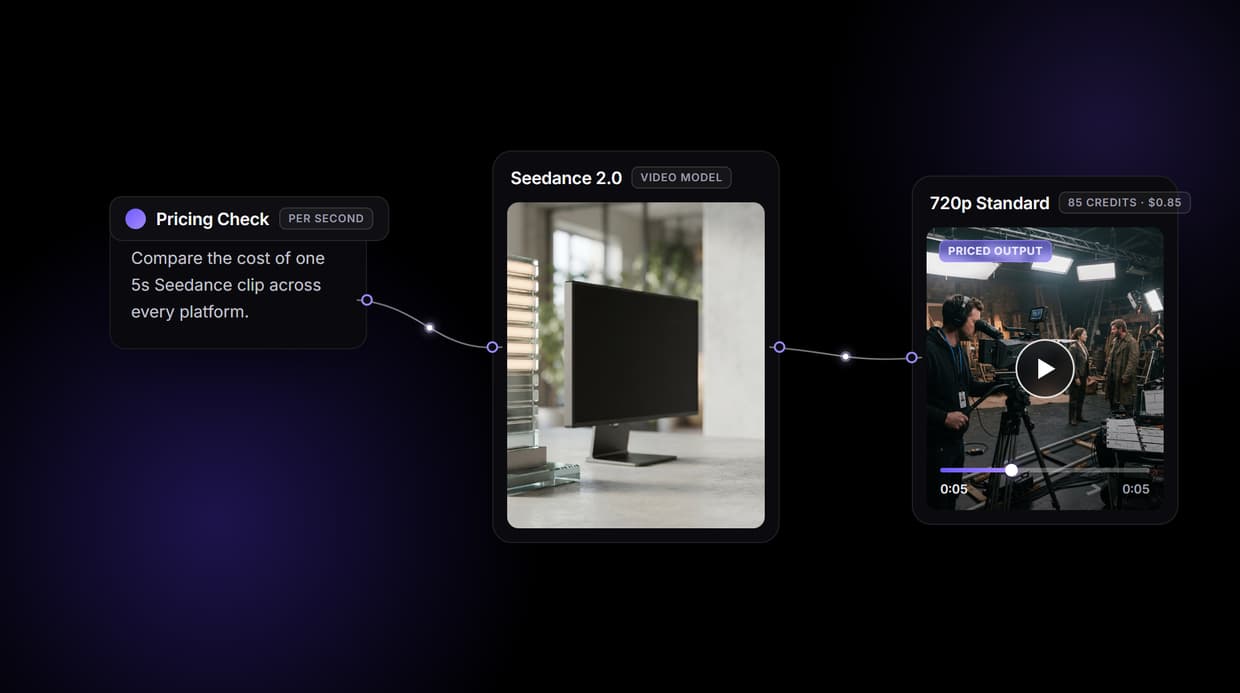
Seedance pricing is hard to compare because platforms bill in different units: per second, per credit, per seat, and some never publish a per-clip rate at all. Across the eight platforms covered below, a 5 second 720p clip runs from $0.85 to about $1.52 wherever a rate can actually be computed, and Wireflow sits at the bottom of that range with published per-second rates for every tier.
Rates were checked in July 2026. A 5 second clip is the cleanest unit of comparison, and the tier you pick moves the bill more than the vendor does. If you want to watch the clips next to each other, our side by side AI video model comparison runs one prompt through several models at once. The Seedance pricing breakdown has the per-tier credit math. Two platforms here, Flora and Figma Weave, do not publish enough detail to compute a per-clip cost at all, which is itself a finding.
Quick Summary
Ranked on value, not raw dollars per second. Value means the effective per-second rate plus what the platform gives you around the model: tier choice, batching, chaining, and whether you can predict a bill before you run a job. A platform you cannot price in advance is not cheap at any number.
- Wireflow - Published per-second rates plus a full workflow canvas - Best Overall Value
- Magnific - Broad creative suite, higher effective per-clip cost - Best Creative Suite
- fal.ai - Clearest first-party rate card, highest rates - Best Developer Experience
- Replicate - Versioned endpoints and a low draft tier - Best for Prototyping
- PiAPI - Mini, Fast, and Standard tiers under one key - Best Aggregator
- Higgsfield - Credit subscriptions rather than usage billing - Best Subscription Option
- Flora - Large model pool, opaque per-clip pricing - Best Model Variety
- Figma Weave - Node canvas, Seedance 1.5 only - Best Design Integration
How the Tiers Actually Work
Most price confusion comes from comparing across variants. Mini is cheapest and lowest fidelity, Fast trades detail for throughput, Standard is default production quality, and 1080p is a separate and far more expensive tier everywhere. Quoting a headline rate without naming the variant is the most common error in usage-based AI API pricing comparisons.
Resolution is the sharpest cost lever. Going from 720p to 1080p roughly triples the per-second rate on most hosts, so one 5 second hero clip can cost more than twenty 480p drafts. That is why the Seedance 2.0 model page lists each variant separately.
1. Wireflow - Best Overall Value
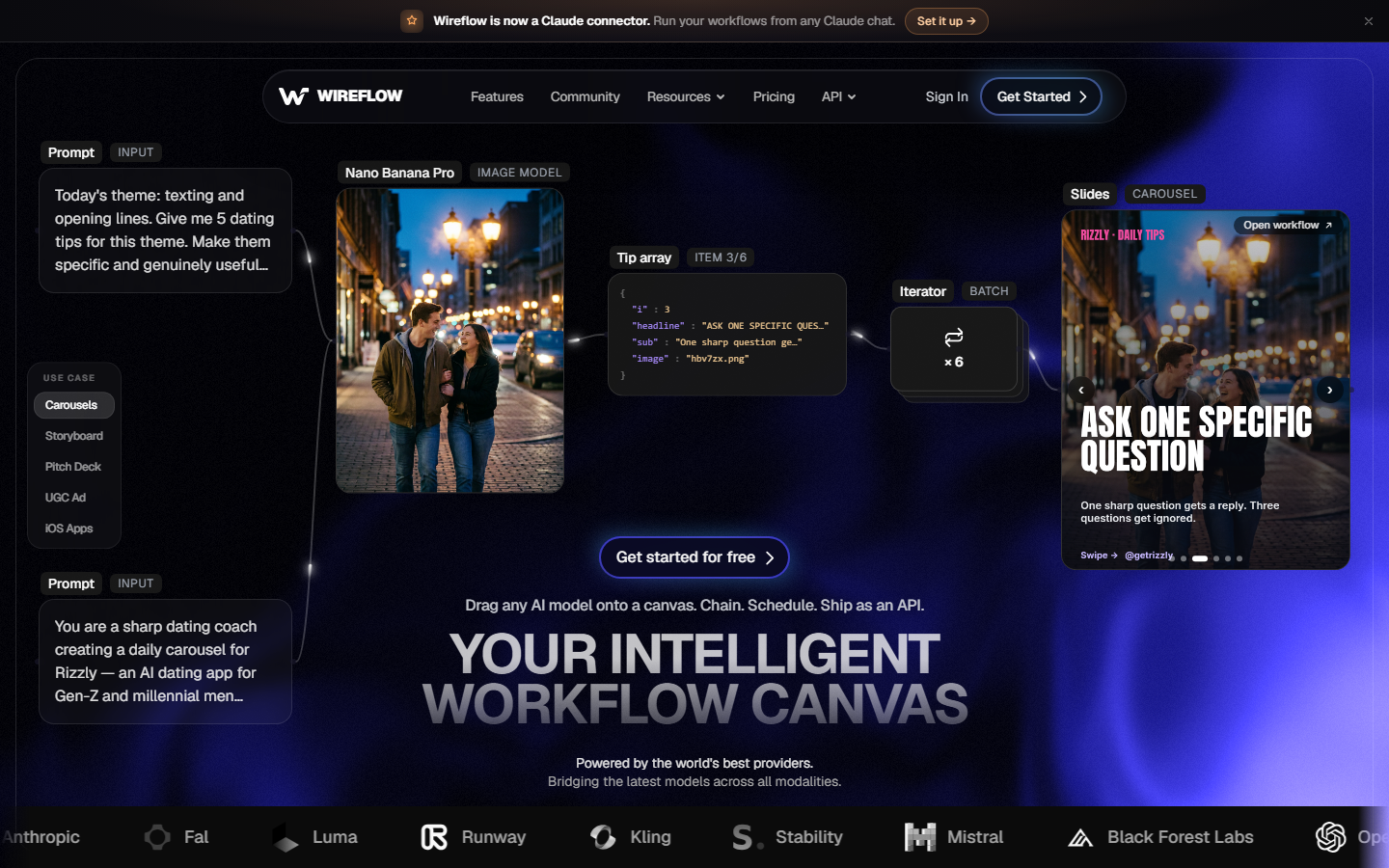
Wireflow prices standard 720p Seedance at $0.17 per second, or 85 credits and $0.85 for a 5 second clip. Fast is about $0.135 per second, Mini about $0.105, the 480p draft tier $0.05, and 1080p $0.52, which is $2.60 for 5 seconds. That draft rate is the cheapest verified 480p tier here, which matters because most production time goes into takes that get discarded, a pattern the AI video generator canvas is built around.
Against fal.ai, the largest Seedance host, Wireflow is cheaper at every tier, and the gap widens at high resolution: $0.52 per second versus $0.682 at 1080p, roughly 24 percent less. Those are the lowest published per-clip rates of the platforms compared here. The more useful property is that they are published at all, per tier and per second, so you can compute a job's cost before running it. The pricing page lists each tier's credit cost so the comparison is checkable.
Value ranks above unit price because of what surrounds the model. Seedance sits on a canvas beside image models, upscalers, and audio nodes, so a keyframe to video to upscale chain is wiring rather than code, and the graph runs from one REST call. On a raw endpoint you build the queueing and retries yourself, the work an AI video pipeline absorbs.
Best for: teams that want predictable published rates without building their own orchestration.
2. Magnific - Best Creative Suite

Magnific carries the widest Seedance selection here, offering 2.0, Fast, Pro, and 2.5 inside a broader creative suite. Billing is credit subscriptions from Essential at $7 per month for 8,000 credits up to Pro at $249 for 300,000, the same shape as other bundled video generation API tools.
Magnific's own docs put Seedance 2.0 Standard 720p at 2,240 credits for 8 seconds, Fast at 1,880, and the 1080p variant at 5,600 credits for 4 seconds. Converting those to dollars depends on your plan, but it works out to roughly $0.97 to $1.23 per 5 second clip at 720p and roughly $5.80 to $6.10 at 1080p. The credit figures are first-party; the dollar conversion is derived, so treat it as an estimate. Either way Magnific is more expensive than Wireflow at both resolutions, and the 1080p gap is wide enough to model against spend limits on generation APIs before committing.
Best for: creative teams who want many Seedance variants inside one broader suite.
3. fal.ai - Best Developer Experience
fal.ai publishes the clearest first-party rate card of the group: standard 720p at $0.3034 per second, Fast 720p at $0.2419, and standard 1080p at $0.682. Those are also the highest per-second rates here, roughly 78 percent above Wireflow at standard 720p and about 31 percent above it at 1080p, a gap examined in this fal.ai pricing analysis.
You are paying for reliability rather than raw inference. The queue plus webhook pattern is the cleanest single-endpoint integration in the category, and capacity holds under launch traffic. What it does not do is orchestrate: chaining a keyframe into Seedance into an upscaler is your job, not the platform's, which is what an AI video workflow platform removes.
Best for: developers who value integration quality over per-second cost.
4. Replicate - Best for Prototyping
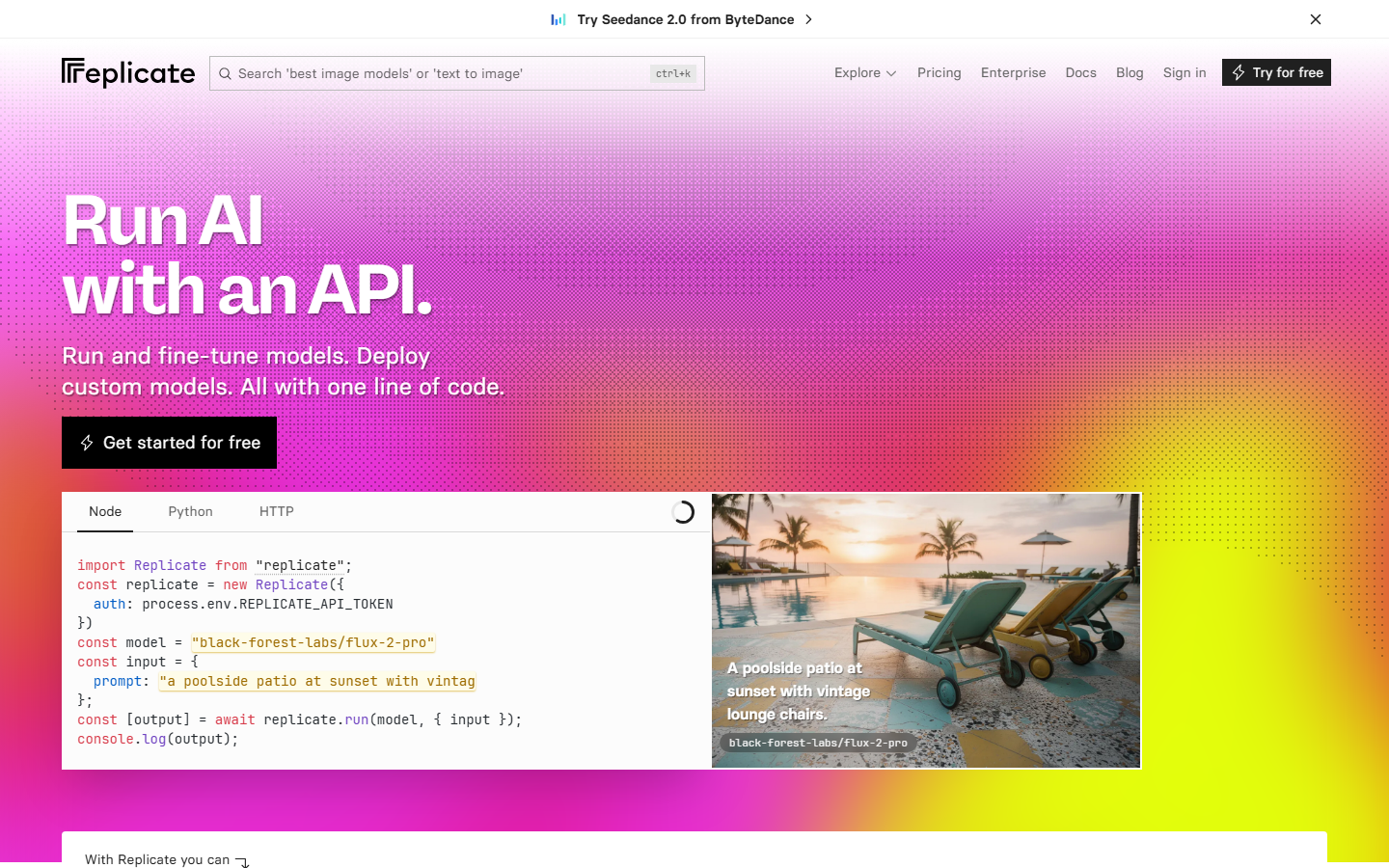
Replicate is reported at around $0.18 per second for standard 720p and around $0.08 at 480p, though figures vary between sources, so treat those as approximate. Its strength is version pinning: every model has an immutable version hash, so an upstream update never silently changes your output, a discipline covered in this Replicate pricing comparison.
Cold starts are the recurring complaint: infrequently called video models take longer to spin up than on always-warm hosts, and that latency is billed as wall time on some configurations. Steady traffic usually graduates to a warmer host, a move covered in this walkthrough on migrating from Replicate to a canvas API.
Best for: prototyping and low-volume products that value reproducibility.
5. PiAPI - Best Aggregator
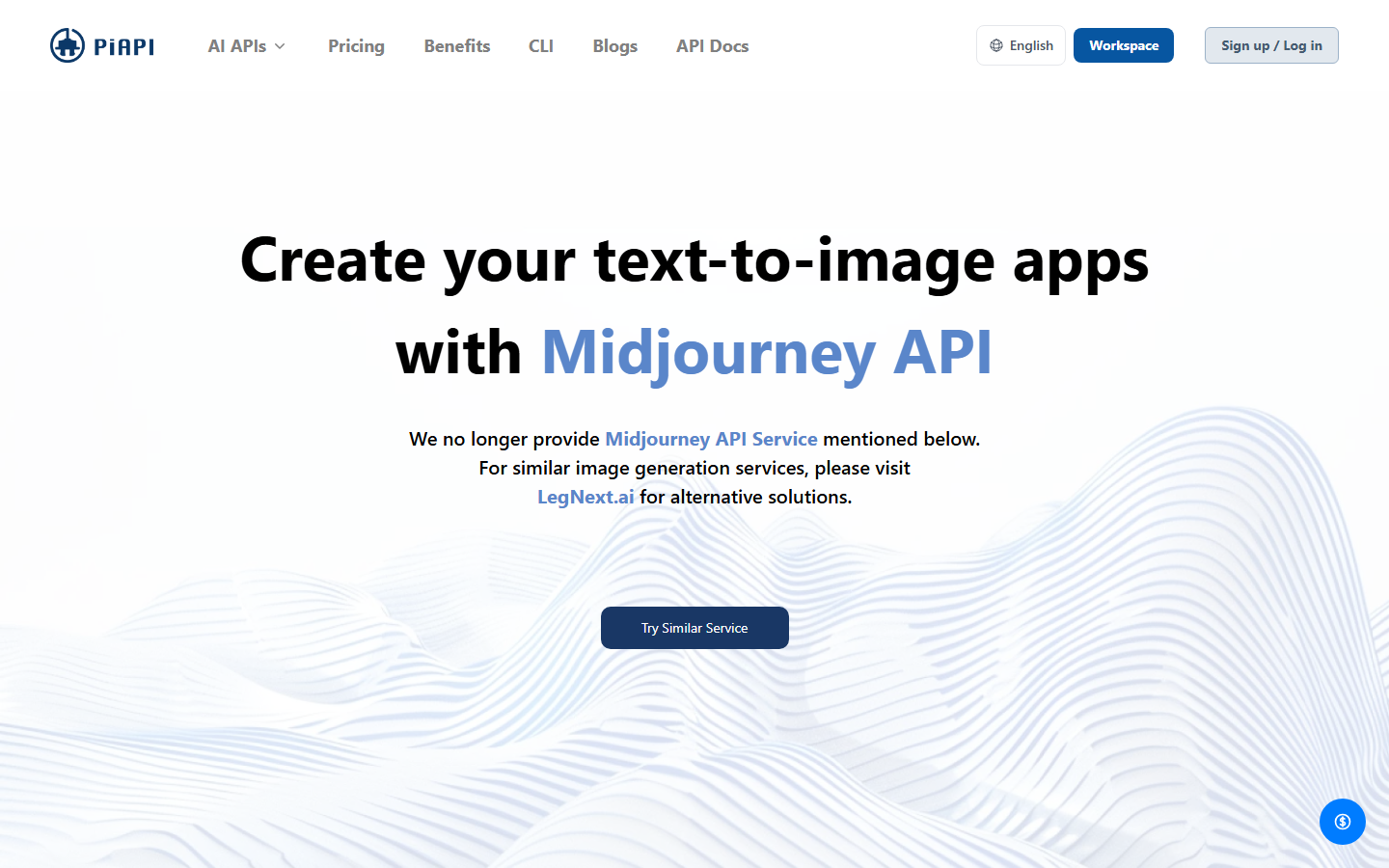
PiAPI is reported to price 720p Seedance at roughly $0.14 per second for Mini, $0.16 for Fast, and $0.20 for Standard. Those figures come from third-party comparisons rather than a first-party rate card, so confirm them against your invoice first. PiAPI's advantage is breadth: Seedance sits alongside Kling, Luma, Hailuo, and a long image catalogue under one key, the logic behind most Seedance API tool roundups.
The trade-off is indirection. Capacity and latency depend on PiAPI's upstream arrangements, and new Seedance capabilities land weeks after the primary hosts get them, as the Seedance 2.1 API documentation shows for the newest release.
Best for: teams already on PiAPI who want video under an existing key.
6. Higgsfield - Best Subscription Option
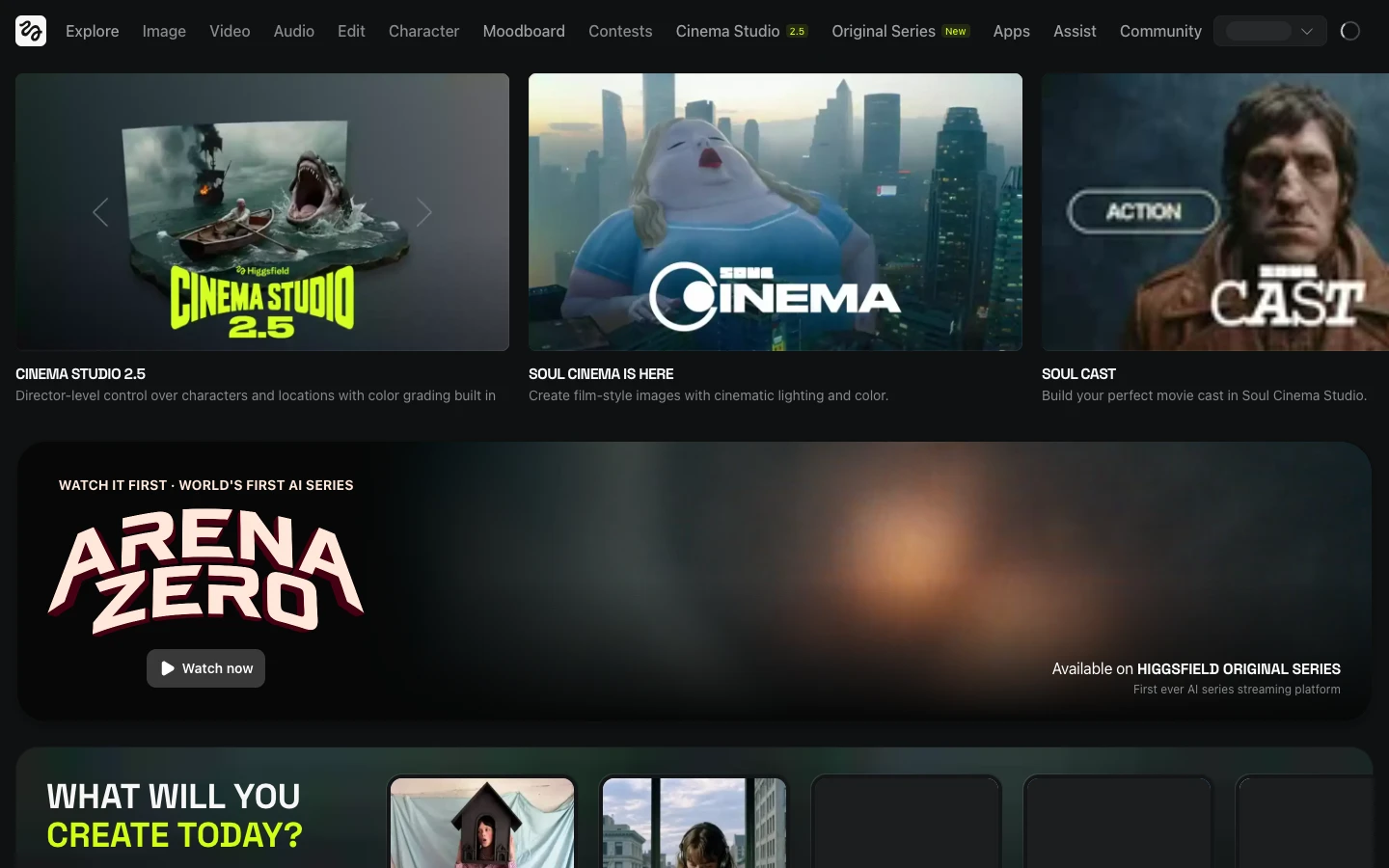
Higgsfield sells subscriptions rather than usage. Plans start around $15 per month and a 5 second 720p clip consumes roughly 22 to 25 credits, but the dollar value of a credit is not published, so a true per-second comparison is not possible from public information. That opacity is a common theme in Higgsfield API alternative research.
Subscriptions suit one profile: solo creators with steady output who prefer a fixed bill. If volume spikes, you either exhaust credits mid-month or pay for headroom you never use, the trade-off examined on this Higgsfield alternative page.
Best for: individual creators with steady monthly volume.
7. Flora - Best Model Variety
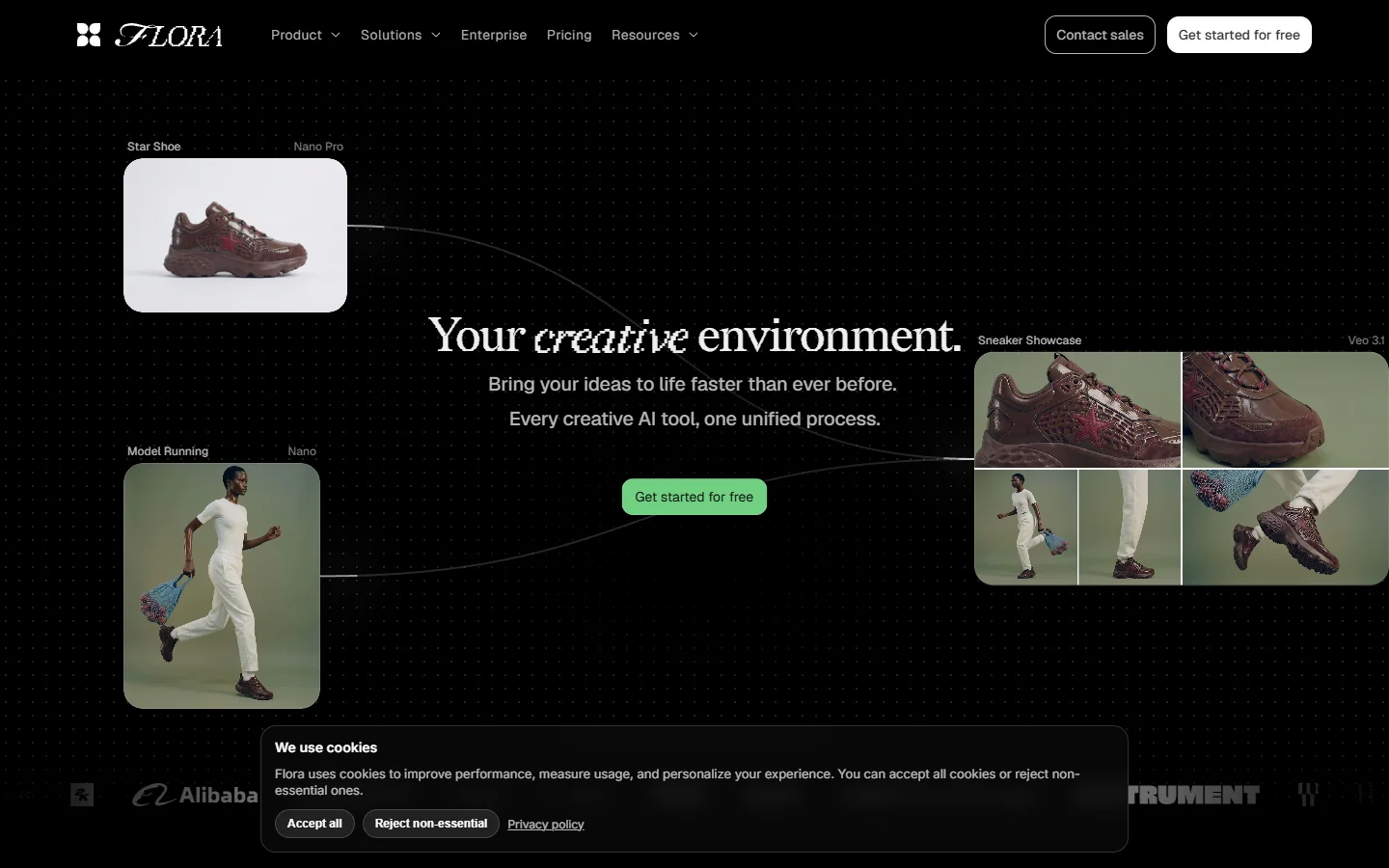
Flora offers Seedance 1.5 and 2.0 inside a pool of more than 60 models, sold as per-seat subscriptions at $18, $50, and $200 per month. Credits are consumed by combined input plus output video duration rather than a flat per-clip rate, an approach also seen in Weavy and Flora API access comparisons.
The problem for anyone budgeting is that Flora publishes no first-party per-clip Seedance rate. Because consumption depends on input duration as well as output, you cannot compute what a job will cost before you run it. That is a different failure mode from being expensive; it is being unpriceable in advance. Teams that need a number before they commit generally prefer node-based video generation setups with explicit rates.
Best for: exploratory work where model variety matters more than cost forecasting.
8. Figma Weave - Best Design Integration

Figma Weave, formerly Weavy, puts a node canvas inside the Figma ecosystem. The limitation here is blunt: it offers Seedance 1.5 only, with no access to 2.0, so it is not a like-for-like option if you need the current model, a gap noted in Figma Weave API tool roundups.
Pricing runs Free at $0 for 150 credits with Seedance not enabled, Starter at $24 for 1,500 credits, Pro at $45 for 4,000, and Team at $60 for 4,500. A Seedance generation costs 48, 129, or 145 credits by tier. Clip duration per generation is not stated, so those credits cannot be converted into a per-clip rate and no honest cost comparison against the per-second platforms is possible. Design teams already inside Figma may still prefer the integration, much as others standardize on a programmatic video generation platform.
Best for: design teams already inside Figma who do not need Seedance 2.0.
Comparison Table
| Platform | Seedance versions | 5s 720p cost | Billing model | Can you price a job first? |
|---|---|---|---|---|
| Wireflow | 2.0 (Mini, Fast, Standard, 1080p) | $0.85 ($0.17/sec) | Usage-based credits | Yes, published per tier |
| Magnific | 2.0, Fast, Pro, 2.5 | ~$0.97-$1.23 (derived) | Credit subscription $7-$249/mo | Partly, credits published |
| fal.ai | 2.0 Standard and Fast | ~$1.52 ($0.3034/sec) | Pay-as-you-go | Yes, published per tier |
| Replicate | 2.0 (reported) | Pay-as-you-go | Roughly, sources vary | |
| PiAPI | Mini, Fast, Standard (reported) | Pay-as-you-go | Roughly, sources vary | |
| Higgsfield | 720p clips | ~22-25 credits, value unpublished | Subscription from $15/mo | No, credit value unpublished |
| Flora | 1.5 and 2.0 | Not published | Per-seat $18-$200/mo | No, depends on input duration |
| Figma Weave | 1.5 only | Not computable | Credit tiers $24-$60/mo | No, clip duration unstated |
How to Choose
Start with a question that has nothing to do with price: can you find out what a job costs before you run it? Three of the eight platforms here cannot answer that, because credit values are unpublished or consumption depends on inputs. If finance needs a forecast, that alone removes them. The Seedance 2.1 review covers where the model has moved since launch.
Then model your real tier mix rather than a single headline rate. Most teams generate five to ten drafts per shipped clip, so the draft tier dominates the bill even though the 1080p rate is what everyone compares. A platform at $0.05 for 480p drafts and $0.52 for 1080p finals usually beats one a cent cheaper at 720p with no cheap draft tier, the argument for usage-based API pricing with a real tier ladder.
Try it yourself: open this video pipeline workflow. A text prompt generates a keyframe, then an image-to-video node animates it, so you can watch credit cost move as you change resolution.
FAQ
How much does Seedance cost per second in 2026?
Among platforms publishing a per-second figure, standard 720p runs from $0.17 to $0.3034: Wireflow $0.17, Replicate reported around $0.18, PiAPI around $0.20, fal.ai $0.3034. Mini and draft tiers run from $0.05 to $0.14.
What does a 5 second Seedance clip actually cost?
At standard 720p, from $0.85 to about $1.52 across the platforms compared here. Wireflow is $0.85, Replicate around $0.90, PiAPI around $1.00, Magnific roughly $0.97 to $1.23, and fal.ai about $1.52.
Why is 1080p Seedance so much more expensive than 720p?
Roughly 2.25 times the pixels per frame costs proportionally more compute, and most hosts add margin at the premium tier on top. fal.ai charges $0.682 per second at 1080p against $0.3034 at 720p; Wireflow charges $0.52 against $0.17.
Which Seedance tier should I use for drafts?
The lowest your review process tolerates. A 480p tier at $0.05 per second costs about a tenth of standard 720p, so iterating there and re-rendering only approved takes is the largest saving available.
Which platforms do not publish enough detail to compare?
Flora, Figma Weave, and Higgsfield. Flora bills on combined input plus output duration with no per-clip rate, Figma Weave publishes credit costs but not clip duration, and Higgsfield does not publish the dollar value of a credit.
Does every platform offer Seedance 2.0?
No. Figma Weave offers Seedance 1.5 only. Flora offers both 1.5 and 2.0, and Magnific carries the widest selection including 2.0, Fast, Pro, and 2.5. Check the version before comparing any rate.
Are these figures first-party or third-party?
fal.ai, Magnific, Higgsfield, Flora, Figma Weave, and Wireflow figures come from the vendors' own pages, though the Magnific dollar conversion is derived from its credit costs. Replicate and PiAPI rates come from third-party comparisons, so verify them on a live invoice first.
Conclusion
Seedance pricing splits into two questions that are easy to confuse. The first is which platform shows the lowest number on a single tier. The second, which decides most real bills, is whether you can predict a cost before the job runs, and then whether the platform gives you the tier ladder and orchestration you would otherwise build. Three of the eight platforms here fail that test outright. That is where Wireflow ranks first: published per-second rates at every tier, the lowest published per-clip rates of the platforms compared here, cheaper than fal.ai at every tier, and the cheapest verified 480p draft tier.
Would you rather we just built it?
We get on a call, learn your style, build the workflow, and ship the deliverables on a schedule. You keep the workflow either way.


