Seedance 2.0 is ByteDance's flagship video generation model, and since its April 2026 API release it has become one of the most requested models in production video pipelines thanks to native audio, strong physics, and aggressive per-second pricing. Wireflow approaches the same problem from the orchestration side: it puts Seedance-class video models like Kling 2.5 and Veo 3.1 on a node-based canvas with a full REST API, so you can build complete pipelines instead of calling a single endpoint. This guide compares the seven platforms developers actually use to run Seedance and comparable video models via API in 2026.
Quick Summary
- Wireflow - Node-based video pipelines with a full REST API - Best Overall
- fal.ai - Fastest serverless access to Seedance 2.0 - Best Raw Speed
- Replicate - Versioned model API with predictable deployment - Best for Prototyping
- Atlas Cloud - Cheap per-second Seedance 2.0 hosting - Best Per-Second Pricing
- WaveSpeed - Throughput-optimized video model inference - Best for High Volume
- Segmind - Seedance 2.0 Fast with workflow tooling - Best Budget Option
- PiAPI - Multi-model wrapper with one API key - Best Model Aggregator
How We Ranked These Tools
Every platform on this list exposes Seedance 2.0 or an equivalent production video model through an HTTP API, so the differentiators are pricing model, latency, queue behavior under load, and how much pipeline tooling you get beyond the raw endpoint. We weighted production reliability first, then per-second cost, then developer experience, because a cheap endpoint that times out under load costs more in retries than it saves. Teams that need more than one model per job should also look at a programmatic video generation platform rather than stitching raw endpoints together.
A quick scoping note: Seedance 2.0 generates 4 to 15 second clips with native audio, real-world physics, and camera control, with the Fast variant tuned for throughput at 720p. For a hands-on look at the API-first approach in action, check out the Seedance API feature page, which covers capabilities, prompt behavior, and where the model fits next to Kling and Veo.
1. Wireflow - Best Overall
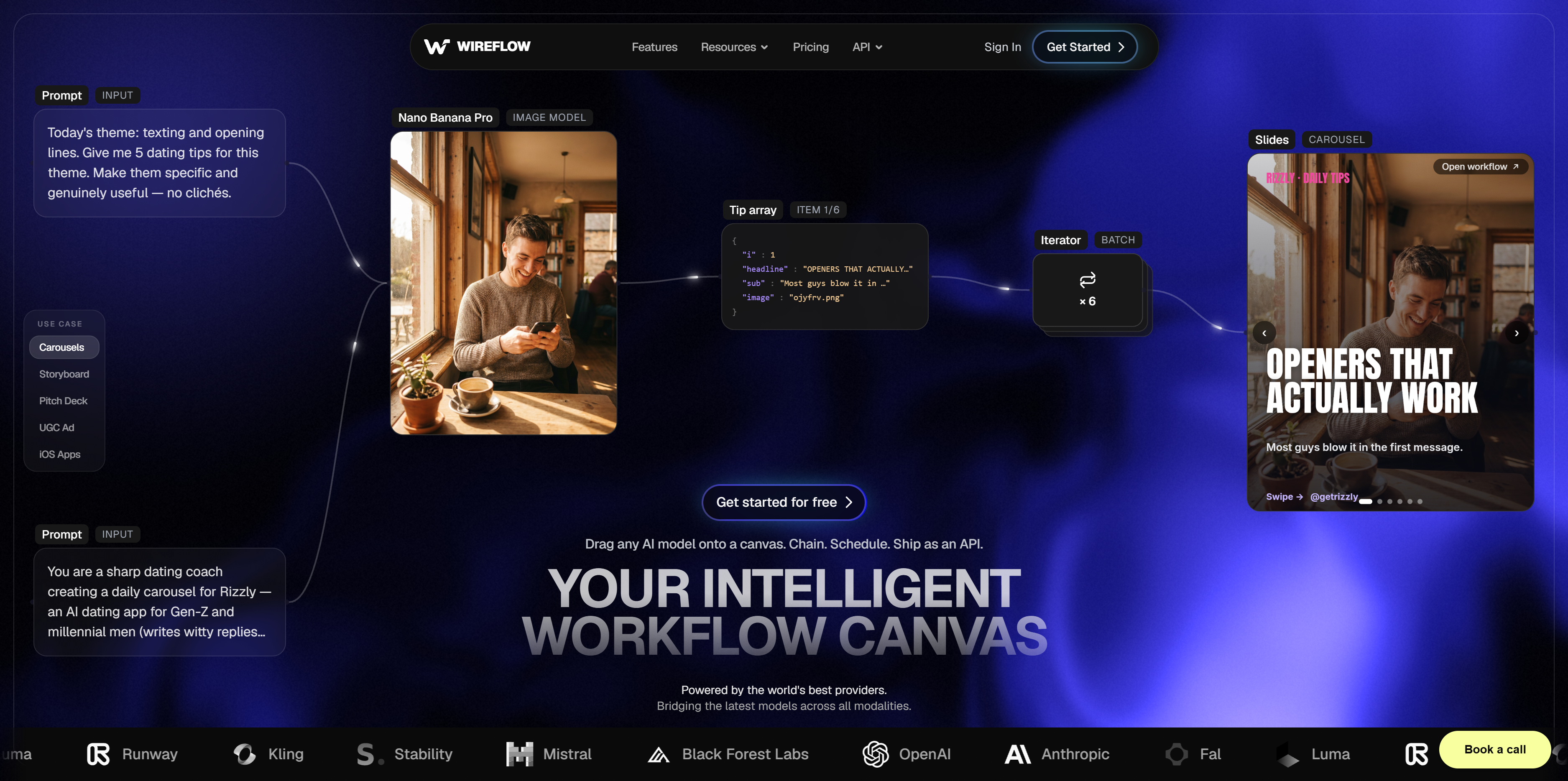
Wireflow is a node-based AI canvas with a REST API behind every workflow, built for teams that need video generation as part of a pipeline rather than a single call. Instead of writing glue code to chain a keyframe generator into a video model into an upscaler, you wire those nodes visually and then trigger the whole graph from code through one AI video generator interface.
The practical advantage shows up when requirements change. Swapping the video model in a Wireflow graph is a node replacement, not a rewrite, which matters in a year where Seedance, Kling, and Veo are leapfrogging each other every quarter. The same canvas handles batch AI generation for ad variants, product clips, and social formats without separate queue infrastructure.
Pricing is usage-based credits with per-workflow cost visibility, so finance teams can see what each pipeline run costs instead of reconciling raw inference invoices. The pricing page lists per-generation credit costs for each model tier.
Best for: teams shipping multi-step video pipelines to production, not one-off generations.
2. fal.ai - Best Raw Speed
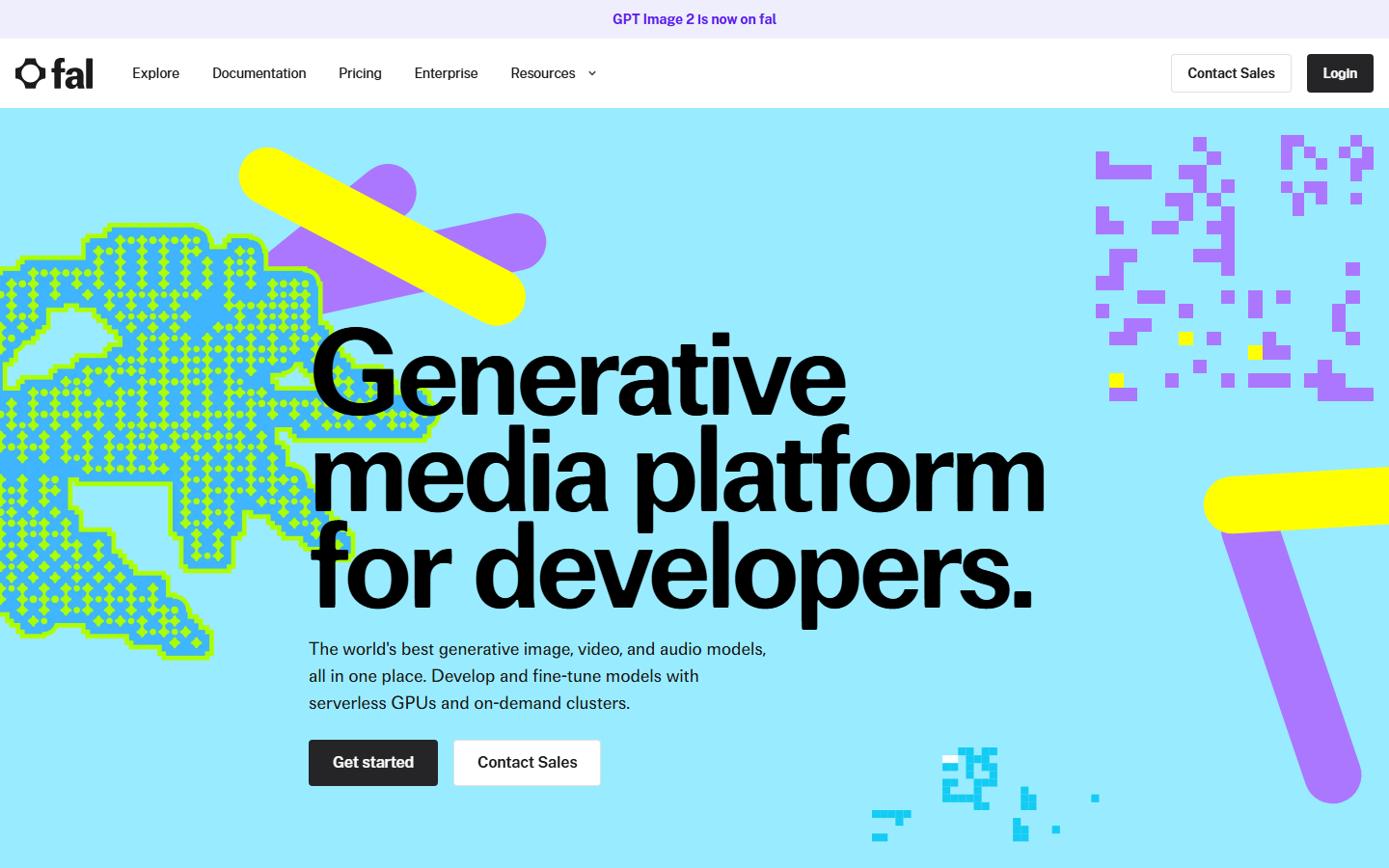
fal.ai hosts Seedance 2.0 on its serverless inference platform and was among the first providers to offer it, with day-one availability in April 2026. One API key covers hundreds of models including Veo, Kling, Hailuo, and Wan, and its queue plus webhook pattern is the cleanest raw-endpoint developer experience in the category, similar in spirit to how a dedicated Kling 2.5 API abstracts a single model behind stable request schemas.
The trade-off is that fal gives you endpoints, not pipelines. Chaining a keyframe into Seedance into an upscaler means writing and operating your own orchestration layer, including retries and intermediate storage, which is exactly the work a hosted pipeline platform is designed to absorb.
Best for: developers who want the fastest possible single-endpoint access to Seedance 2.0.
3. Replicate - Best for Prototyping
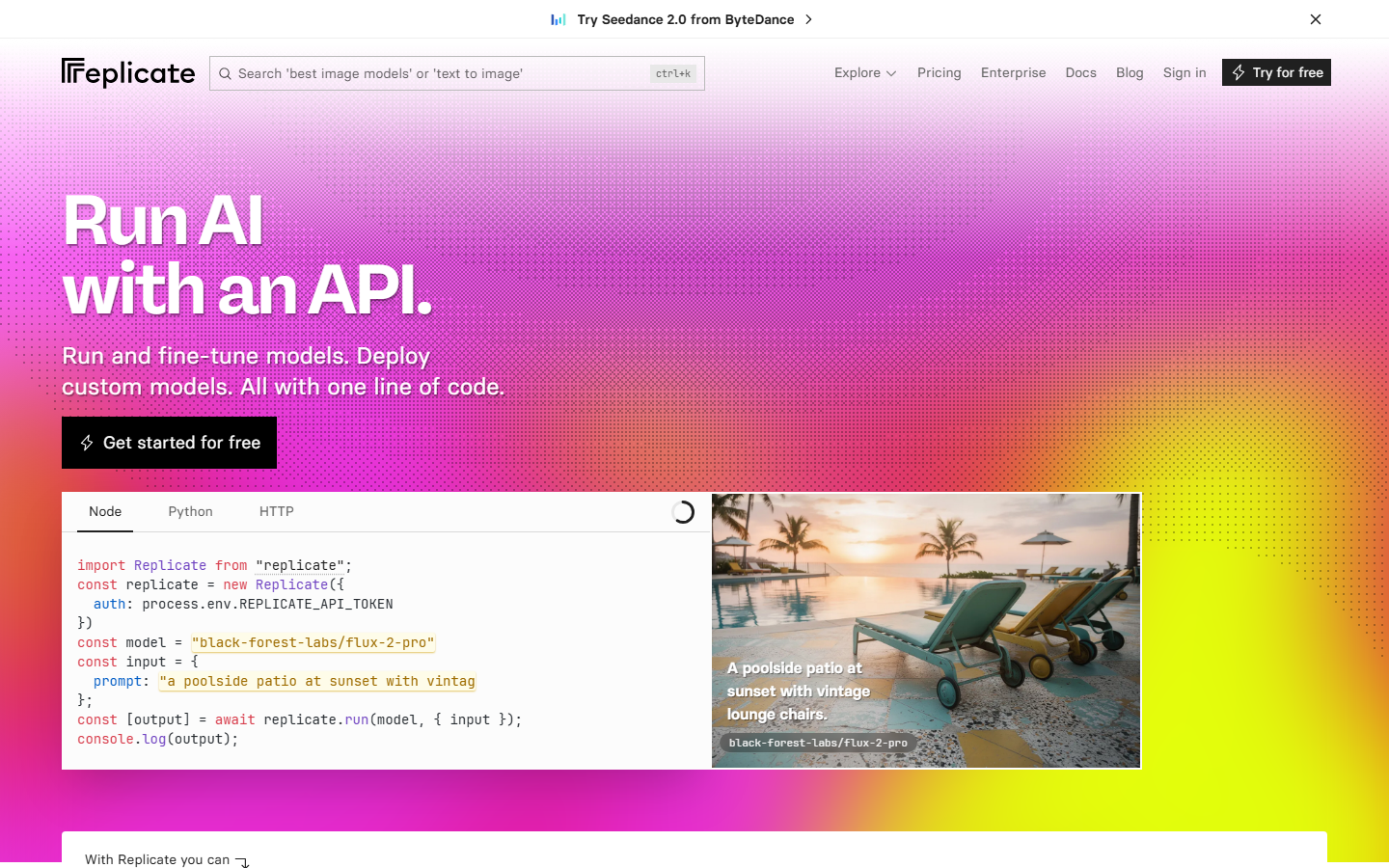
Replicate runs Seedance alongside thousands of community and official models with versioned deployments, so a model update never silently changes your output. Its prediction API, Python client, and per-run logs make it the most comfortable place to prototype before committing to a provider, much like testing prompts in a no-code AI canvas with API access before hardening them into code.
Cold starts are the known cost: infrequently called video models can take noticeably longer to spin up than on always-warm hosts, and per-second video pricing sits slightly above the budget providers. For steady production traffic most teams graduate to a dedicated host or a generation API built for SaaS apps with predictable latency.
Best for: experimentation, model comparison, and low-volume products.
4. Atlas Cloud - Best Per-Second Pricing
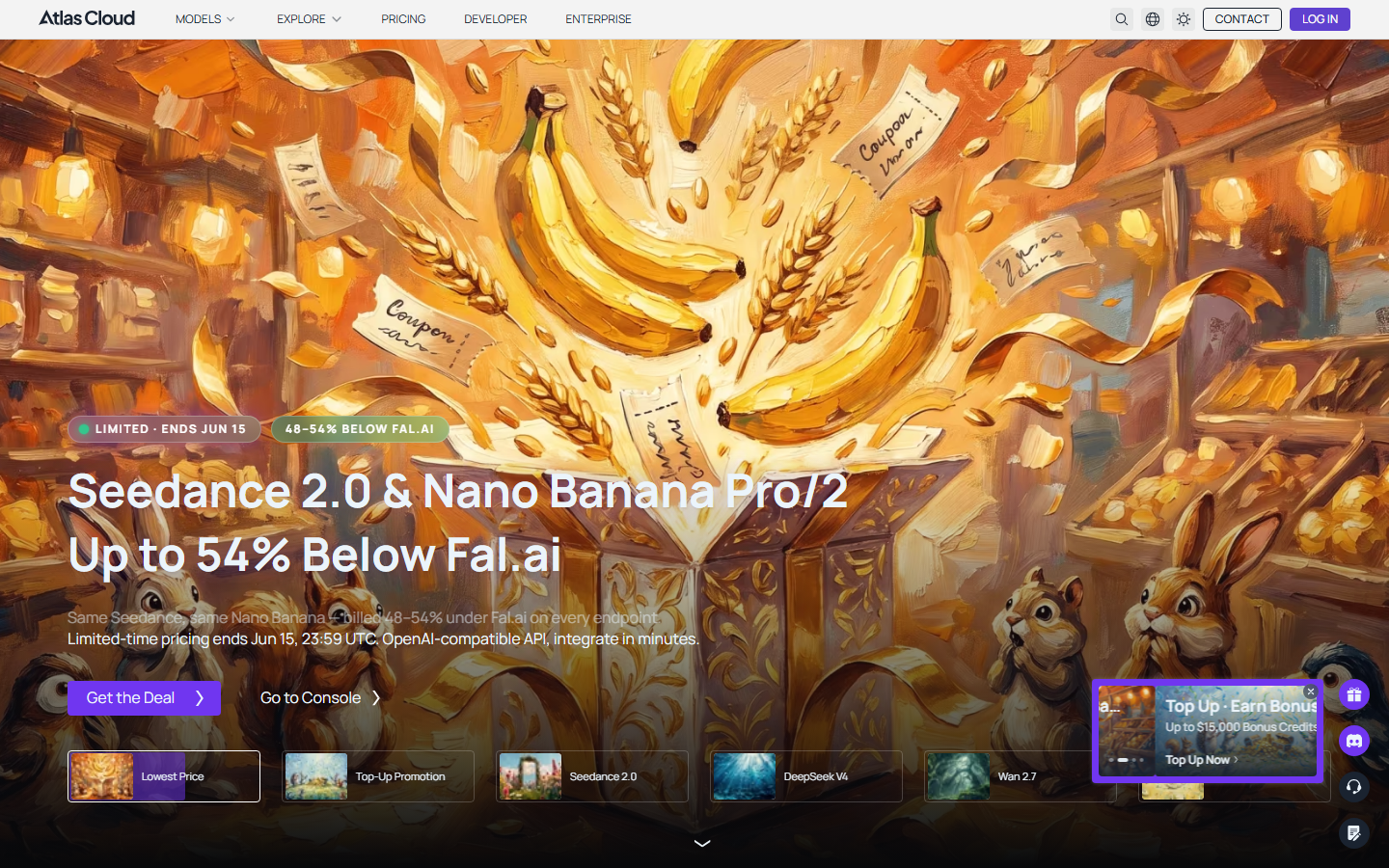
Atlas Cloud offers Seedance 2.0 from around $0.081 per second of generated video, which puts it at the cheap end of production-quality hosting. It supports the model's full multimodal input set, including image, video reference, audio, and text conditioning, for clips up to 15 seconds. That makes it a strong fit for teams whose unit economics live and die on per-clip cost, the same buyers who compare providers on usage-based API pricing line by line.
The ecosystem around it is thinner than fal's or Replicate's: fewer SDK niceties, fewer adjacent models, and less community tooling. You are buying a low price on one strong model rather than a platform.
Best for: cost-sensitive teams generating high volumes of Seedance clips.
5. WaveSpeed - Best for High Volume
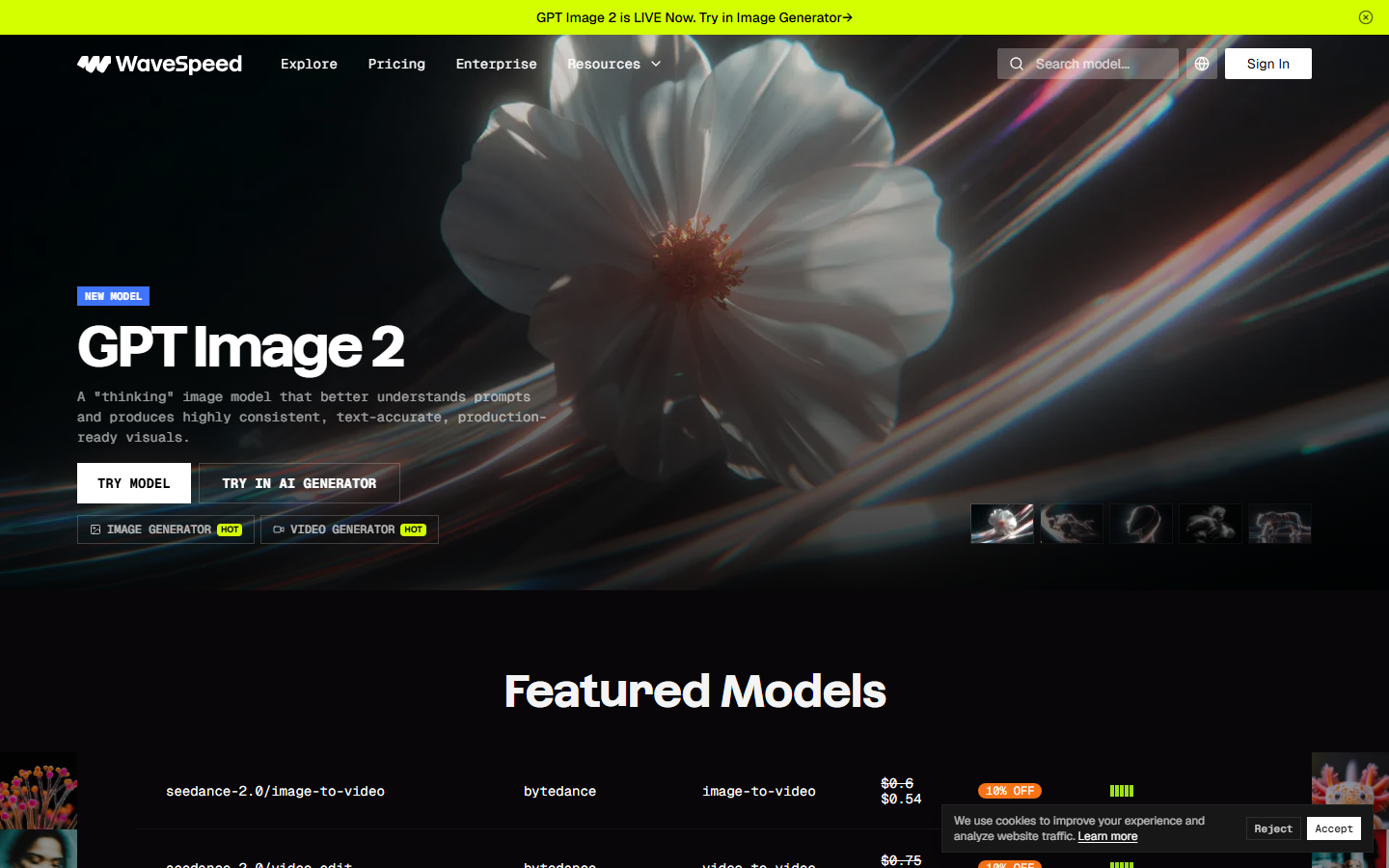
WaveSpeed specializes in accelerated inference for image and video models, and its Seedance endpoints are tuned for throughput: parallel job slots, consistent queue times under load, and latency that holds up when you submit hundreds of jobs at once. Teams running render farms for ad creative or template-based social video, the kind of work a video workflow system typically orchestrates, use it as the muscle behind the queue.
Documentation is serviceable but terse, and you will write more integration code than with fal or Replicate. WaveSpeed assumes you know what you want and just need it fast.
Best for: high-throughput batch video generation where queue stability matters most.
6. Segmind - Best Budget Option
Segmind hosts Seedance 2.0 Fast, the throughput-optimized variant that generates 720p clips at roughly $0.09 per second, the cheapest production-grade video inference available in 2026. It pairs the endpoint with PixelFlow, its own workflow builder, so you get basic chaining without leaving the platform, a lighter take on what node-based video generation platforms do at full depth.
The Fast variant's 720p ceiling is the main constraint: fine for social feeds and previews, limiting for anything that ships to a large screen. Standard Seedance 2.0 on Segmind costs more and narrows the gap with other hosts.
Best for: startups validating video features where cost per clip beats resolution.
7. PiAPI - Best Model Aggregator
PiAPI wraps Seedance together with Kling, Luma, Hailuo, and a long list of image models behind one pay-as-you-go API key, so teams that already use it for other models can add video without new billing or auth. It is the consolidation play: one vendor, one invoice, many models, comparable to how teams standardize on a single Veo 3.1 video API contract instead of managing several.
The trade-off is indirection. You are one layer removed from the model host, so capacity and latency depend on PiAPI's upstream arrangements, and new Seedance features tend to land a few weeks after the primary hosts get them.
Best for: teams already on PiAPI that want video under the same key.
Comparison Table
| Platform | Seedance access | Pricing model | Standout | Pipeline tooling |
|---|---|---|---|---|
| Wireflow | Seedance-class models (Kling 2.5, Veo 3.1) | Usage-based credits | Visual canvas + REST API per workflow | Full node-based pipelines |
| fal.ai | Seedance 2.0, day-one | Per-second, pay-as-you-go | Lowest latency, 600+ models | Endpoints only |
| Replicate | Seedance 2.0, versioned | Per-second, pay-as-you-go | Version pinning, great DX | Endpoints only |
| Atlas Cloud | Seedance 2.0, full multimodal | From ~$0.081/sec | Cheapest standard-quality hosting | None |
| WaveSpeed | Seedance 2.0, accelerated | Per-second, volume tiers | Queue stability at scale | None |
| Segmind | Seedance 2.0 Fast | ~$0.09/sec | Cheapest production inference | PixelFlow (basic) |
| PiAPI | Seedance via aggregation | Pay-as-you-go | One key, many models | None |
How to Choose
Match the platform to your failure mode. If your risk is integration complexity, a canvas-plus-API platform removes the orchestration code entirely; teams comparing that category should look at AI workflow platforms with APIs compared for the full landscape. If your risk is unit cost, Atlas Cloud and Segmind win on raw per-second pricing. If your risk is latency under launch traffic, fal and WaveSpeed are built for it.
Also decide early whether Seedance is a hard requirement or a quality bar. Kling 2.5 and Veo 3.1 match or beat it on several dimensions, and a pipeline that treats the video model as a swappable node, the approach behind AI creative workflows, protects you from betting your roadmap on one vendor's release cadence.
Try it yourself: Build this workflow in Wireflow: a text prompt generates a cinematic keyframe with Flux 2 Pro, then an image-to-video node animates it. The nodes are pre-configured with the exact setup discussed above.
FAQ
Does Seedance 2.0 have an official public API?
ByteDance distributes Seedance 2.0 primarily through partner inference platforms rather than a broadly available first-party developer portal. In practice, fal.ai, Replicate, Atlas Cloud, WaveSpeed, Segmind, and aggregators like PiAPI are how production teams access it.
How much does the Seedance API cost in 2026?
Expect roughly $0.08 to $0.15 per second of generated video depending on host and variant. Seedance 2.0 Fast on Segmind runs about $0.09 per second at 720p, and Atlas Cloud lists standard Seedance 2.0 from about $0.081 per second.
What is the difference between Seedance 2.0 and Seedance 2.0 Fast?
Standard Seedance 2.0 is the full-quality model with the complete multimodal input set. Fast is tuned for throughput: lower latency and cost at 720p, with minor quality loss that most social and preview use cases never notice.
How long can Seedance 2.0 videos be?
Clips range from 4 to 15 seconds depending on host configuration. Longer outputs are produced by chaining generations, typically by feeding the last frame of one clip into the next request.
Can Seedance generate audio with the video?
Yes. Native audio generation is one of Seedance 2.0's headline features, alongside physics-aware motion and camera control. Confirm host support, since some providers expose video-only configurations.
Is Seedance better than Kling or Veo for API use?
It depends on the job. Seedance leads on cost-per-second and native audio, Kling 2.5 is strong on motion realism for image-to-video, and Veo 3.1 leads on prompt adherence for complex scenes. Production teams increasingly treat the model as a swappable component rather than a permanent choice.
What inputs does the Seedance API accept?
Text prompts, reference images, reference video, and audio conditioning, depending on the host. Image-to-video is the most common production pattern because it gives art direction control over the first frame.
Do I need my own GPUs to run Seedance?
No. Every platform in this guide is fully hosted inference billed per second or per credit. Self-hosting is not an option since ByteDance has not released open weights for Seedance 2.0.
Conclusion
The Seedance API market splits cleanly: raw endpoints (fal, Replicate, Atlas Cloud, WaveSpeed, Segmind, PiAPI) compete on price and latency, while pipeline platforms compete on how much integration work they remove. If you only need one clip per request, pick the cheapest reliable host for your volume. If your product chains models together, generates at batch scale, or needs to swap video models as the leaderboard changes, Wireflow's canvas-plus-API approach turns that whole problem into configuration instead of code.
Would you rather we just built it?
We get on a call, learn your style, build the workflow, and ship the deliverables on a schedule. You keep the workflow either way.