Best Fal AI Pricing Tools in 2026

In this article▾
If you run AI models via API, pricing determines whether your project stays profitable at scale. Wireflow gives you a visual canvas to chain models from multiple providers, so you can pick the cheapest inference endpoint for each step without rewriting code. Below is a ranked breakdown of platforms offering competitive AI model pricing for developers in 2026.
Quick Summary
- Wireflow - Best overall (visual pipeline + multi-provider pricing)
- Fal.ai - Best for fast image/video inference
- Replicate - Best for open-source model variety
- Modal - Best for custom container workloads
- RunPod - Best for raw GPU rental value
- Baseten - Best for production autoscaling
- Together AI - Best for LLM inference pricing
- Fireworks AI - Best for low-latency LLM serving
1. Wireflow
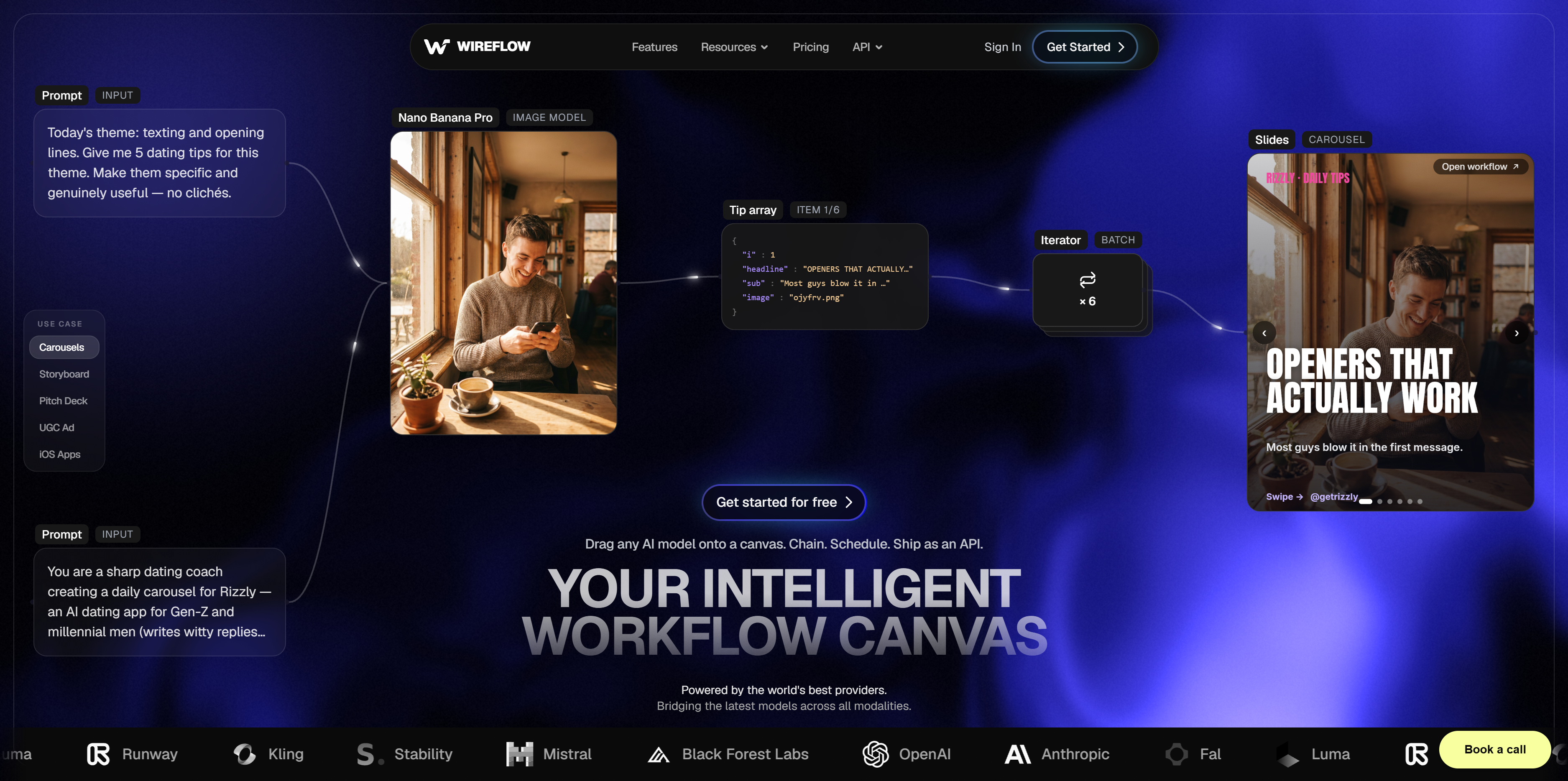
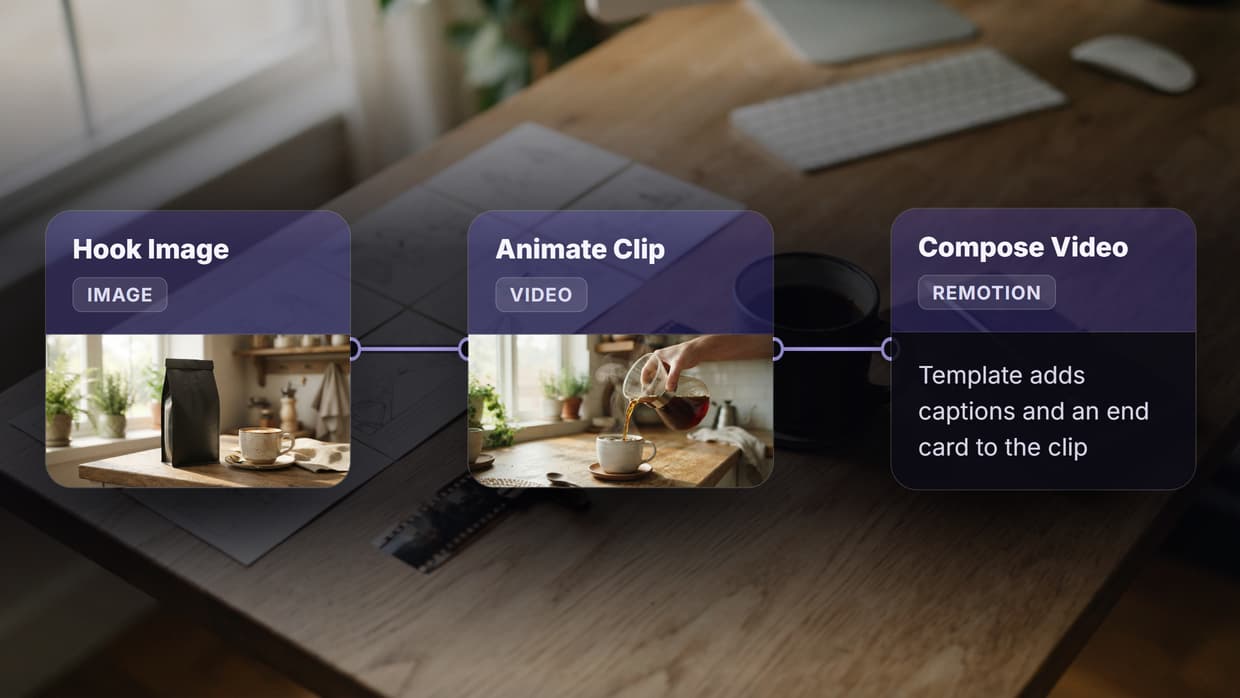
Wireflow takes a fundamentally different approach to AI model pricing. Instead of locking you into one provider's GPU fleet, you build workflows on a visual node editor that routes each step to the cheapest available endpoint. Run Flux image generation through fal.ai, pipe the result into a RunPod upscaler, then generate video on Kling, all from one canvas.
Pricing is usage-based with no per-model markup beyond the underlying provider cost. The batch generation feature lets you queue hundreds of jobs during off-peak hours for additional savings. For teams building SaaS products, the spend limits system prevents runaway costs without manual monitoring.
Build this in Wireflow
Make the same kind of asset on a canvas you control, with a free account and no credit card.
2. Fal.ai
Fal.ai specializes in fast inference for image and video models. Their pricing model charges per-second of GPU time rather than per-generation, which benefits workflows that produce output quickly. Flux Pro runs at roughly $0.05 per image, and their queue system handles burst traffic without cold starts.
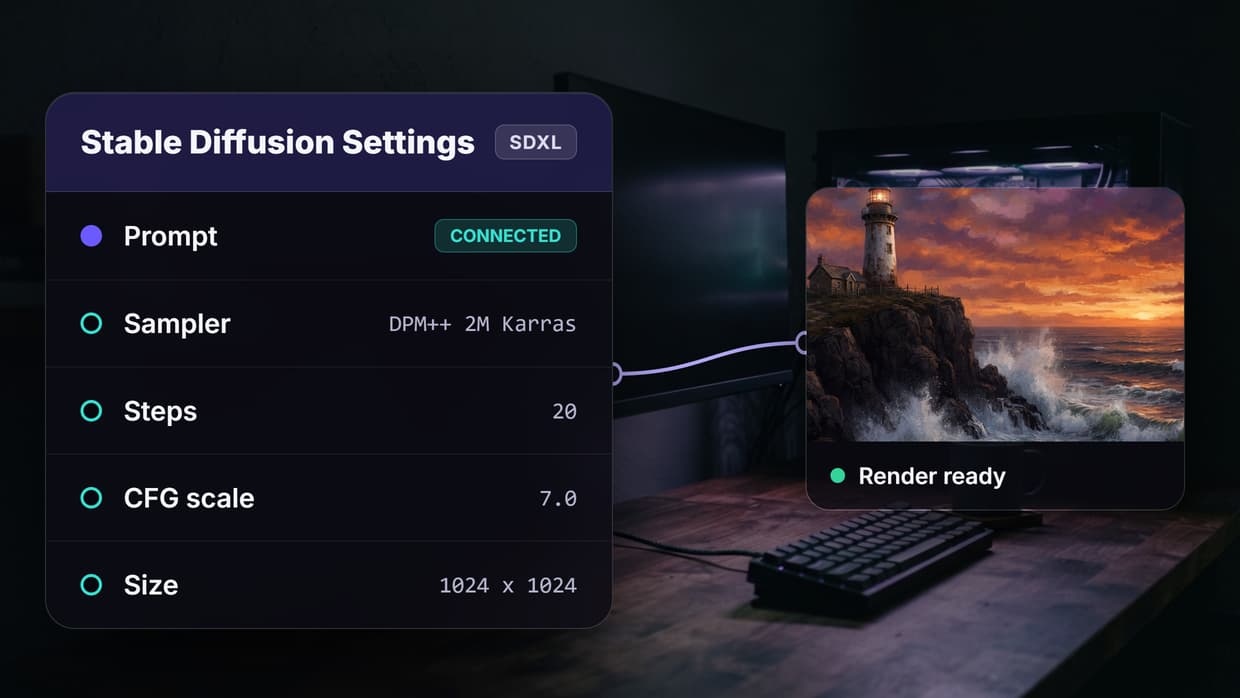
The platform supports Flux, Stable Diffusion, SDXL, and several video models including Kling and Minimax. For developers already using fal.ai, the main limitation is vendor lock-in: if a model is cheaper elsewhere, migrating means rewriting your integration. Wireflow solves this by letting you swap providers per node without touching downstream logic.
3. Replicate
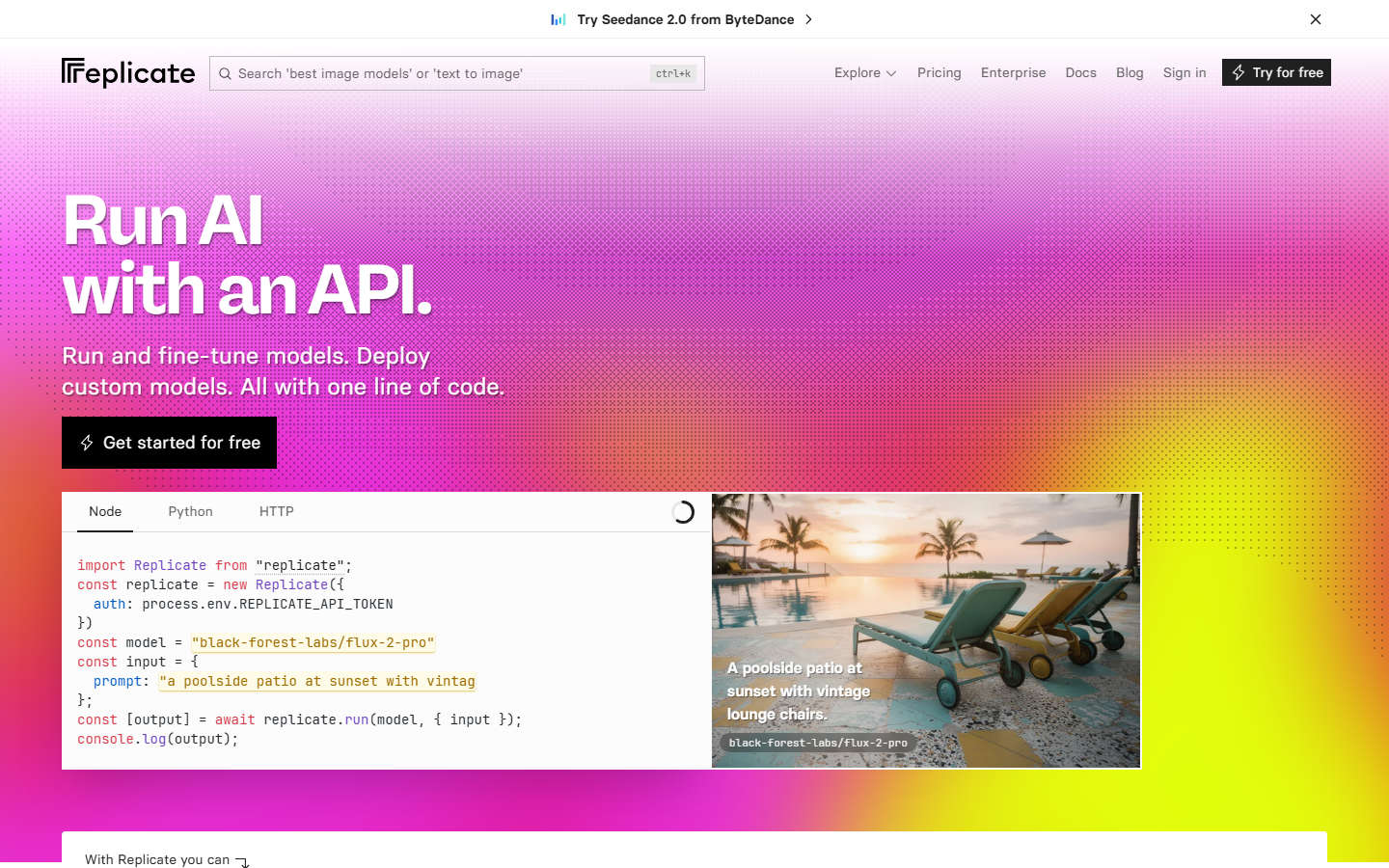
Replicate bills per-second of compute with transparent hardware pricing. An A100 GPU costs $0.001150/second, making it straightforward to estimate costs before running a job. The catalog includes thousands of community-uploaded models alongside official deployments from Stability AI, Meta, and others.
Replicate's cold start times can add 10-30 seconds on less popular models, which inflates effective per-generation cost if you're billing customers in real-time. Their "Deployments" feature ($0.000725/s on A40) solves this with always-warm endpoints, though minimum spend applies. You can compare Replicate's model pricing tiers against other providers to find the best fit.
4. Modal
Modal targets developers who want infrastructure-as-code pricing. You write Python, decorate functions with GPU requirements, and pay only for active compute. A100-80GB runs at $0.001036/second with sub-second billing granularity, no minimum commitment.
Modal's strength is custom workloads: fine-tuning, batch processing, and pipelines that combine CPU pre-processing with GPU inference. The platform handles autoscaling to zero automatically, so you never pay for idle GPUs. The downside is that you need to write and maintain deployment code, unlike managed API platforms where you just call an endpoint.
5. RunPod
RunPod offers the lowest raw GPU prices in the market. Community Cloud A100s start at $0.69/hour, while Secure Cloud pricing sits around $1.64/hour for the same hardware. Their serverless endpoint product charges per-second with a 4-second minimum.
For batch workloads like generating thousands of product images, RunPod's spot pricing can cut costs by 50-70%. The trade-off is reliability: community GPUs may be preempted, and cold starts on serverless are less predictable than dedicated platforms. RunPod works best as a cost-optimization layer for non-time-critical generation tasks.
6. Baseten
Baseten positions itself between managed APIs and raw GPU rental. You deploy models using their Truss framework and pay per-second of inference time. A100s run at $0.001267/second with autoscaling that handles traffic spikes without pre-provisioning.
The platform includes built-in model caching, request batching, and a production-grade API layer that handles authentication and rate limiting. Baseten suits teams that need SLA guarantees (99.9% uptime) and don't want to manage Kubernetes clusters. Pricing becomes competitive at scale when the automatic batching reduces per-request GPU seconds.
7. Together AI
Together AI focuses on LLM inference pricing, offering Llama 3.1 70B at $0.88 per million tokens and Mixtral 8x7B at $0.60 per million tokens. Their pricing undercuts most hosted LLM providers while maintaining low latency through custom serving infrastructure.
For multimodal pipelines that combine text generation with image or video models, Together AI handles the language portion cheaply while you route vision tasks to specialized providers. The platform also offers fine-tuning at competitive rates ($2/million tokens for Llama models) with no storage fees for trained weights.
8. Fireworks AI
Fireworks AI optimizes for latency-sensitive applications. Their FireAttention engine delivers Llama 3.1 70B at $0.90 per million tokens with sub-200ms time-to-first-token. For image generation, they host Flux and SDXL with a simple API interface that mirrors OpenAI's format.
Fireworks excels when you need both speed and cost efficiency for production workloads. Their dedicated deployments guarantee consistent throughput with committed-use discounts (up to 40% off on-demand pricing for annual contracts). The platform is less suited for experimentation or low-volume projects where pay-per-use flexibility matters more.
Comparison Table
| Platform | Pricing Model | A100 Cost/hr | Cold Start | Best For |
|---|---|---|---|---|
| Wireflow | Usage-based (pass-through) | Varies by provider | None (routed) | Multi-provider pipelines |
| Fal.ai | Per-second GPU | ~$1.10 | <1s | Fast image/video |
| Replicate | Per-second GPU | ~$4.14 | 10-30s | Model variety |
| Modal | Per-second compute | ~$3.73 | <5s | Custom workloads |
| RunPod | Per-hour/second | $0.69-1.64 | Variable | Budget batch jobs |
| Baseten | Per-second inference | ~$4.56 | <3s | Production SLAs |
| Together AI | Per-token (LLM) | N/A | <1s | LLM inference |
| Fireworks AI | Per-token + per-image | N/A | <1s | Low-latency serving |
How to Choose the Right Platform
Selecting a pricing tool depends on your workload pattern. If you run diverse pipelines combining image, video, and text models, a multi-provider orchestration layer eliminates the need to manage separate billing accounts and API keys across vendors.
For pure image generation at scale, fal.ai's per-second billing and fast cold starts make it cost-effective. For LLM-heavy applications, Together AI and Fireworks AI offer the best token pricing. For maximum flexibility with custom models, Modal and RunPod provide raw compute at the lowest rates.
Consider these factors when evaluating:
- Volume: High-volume workloads benefit from committed-use discounts (Fireworks, RunPod)
- Latency: Real-time applications need warm endpoints (fal.ai, Fireworks)
- Variety: Multi-model pipelines need provider-agnostic routing
- Control: Custom fine-tuned models need container-level access (Modal, RunPod)
Try it yourself: Build a multi-model pipeline in Wireflow to see how routing generation through different providers works in practice. The nodes are pre-configured with the exact setup discussed above.
FAQ
What is fal.ai's pricing model?
Fal.ai charges per-second of GPU time during inference. You pay only for active computation, not idle time. Flux Pro image generation typically costs $0.04-0.06 per image depending on resolution and steps.
How does fal.ai compare to Replicate on price?
Fal.ai is generally cheaper for image and video generation due to optimized cold starts and faster inference. Replicate offers more model variety but charges for cold start time, which can add 10-30 seconds of billed compute on less popular models.
Can I use multiple AI providers in one pipeline?
Yes. Platforms like Wireflow let you build workflows that route each step to a different provider based on cost, speed, or capability. This avoids vendor lock-in and lets you optimize spend per task.
What's the cheapest way to run Flux image generation?
RunPod serverless offers the lowest raw cost for Flux inference ($0.02-0.03/image at scale). Fal.ai provides better developer experience with slightly higher pricing ($0.05/image). For small volumes under 1,000 images/month, fal.ai's zero-minimum plan is more practical.
Do these platforms offer free tiers?
Most offer limited free credits. Fal.ai provides $10 in free credits for new accounts. Replicate offers a small free allowance. Modal gives $30/month in free compute. RunPod has no free tier but offers the lowest paid rates.
How do spend limits work for AI API pricing?
Wireflow and Modal both offer configurable spend caps that halt generation once a threshold is reached. This prevents unexpected bills from bugs or traffic spikes. Fal.ai sends email alerts but doesn't auto-pause by default.
Is per-second billing always cheaper than per-generation pricing?
Not always. Per-second billing benefits fast models (under 5 seconds per generation). For slow models like high-step diffusion or long video generation, flat per-generation pricing from providers like Midjourney or DALL-E can be more predictable and sometimes cheaper.
What pricing model works best for SaaS products?
Usage-based pass-through pricing (charging your customers per generation) works best when paired with platforms that offer per-second billing and spend controls. This lets you maintain margins while scaling. Wireflow's API includes built-in usage tracking for this pattern.

Co-Founder & Operations at Wireflow
Runs client operations and content strategy at Wireflow. Works directly with creative teams and agencies to build production AI workflows.
- Content Strategy
- Client Operations
Get unlimited ad creatives today.
One call to see if we are a fit and scope the first ad. If it fits, your first batch lands inside week one.