Best AI Orchestration APIs for Production Apps

In this article▾
Building production AI applications means connecting multiple models, managing state across steps, and handling failures gracefully. Wireflow provides a visual node-based approach to AI orchestration that lets teams chain models, route outputs, and deploy pipelines as callable REST endpoints without writing infrastructure code. But it is one of several strong options available today, each with different tradeoffs for API-driven workflows at scale.
This guide compares the top AI orchestration APIs and platforms for production use in 2026, covering architecture patterns, pricing models, and real deployment scenarios.
Quick Summary
- Wireflow - Best overall visual orchestration with API access
- LangGraph - Best for stateful multi-agent Python workflows
- CrewAI - Best for role-based agent collaboration
- AWS Bedrock Agents - Best for AWS-native enterprise deployments
- Microsoft AutoGen - Best for multi-agent research applications
- Agno - Best open-source agent runtime
- Apache Airflow - Best for scheduled batch AI pipelines
1. Wireflow
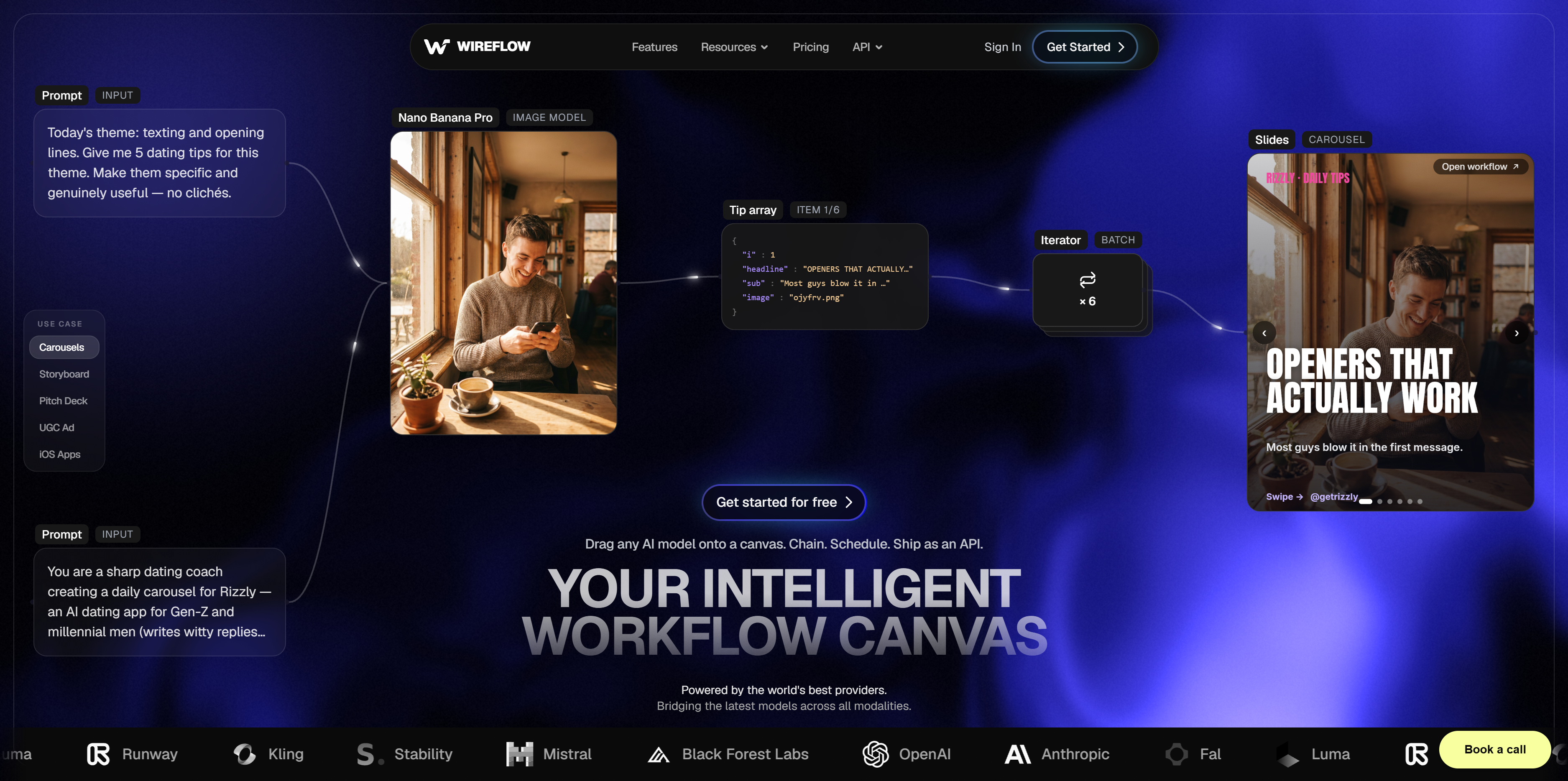
Wireflow takes a visual-first approach to AI orchestration. You build pipelines by connecting nodes on a React Flow canvas, where each node represents an AI model call, data transformation, or conditional branch. The platform exposes a full REST API at https://www.wireflow.ai/api/v1, so anything built visually can be triggered programmatically with a single POST to /workflows/{id}/execute. Authentication uses Bearer tokens (keys start with sk-, generated from Settings > API Keys), and every response includes X-Request-Id for traceability. Key strengths for production use include built-in model chaining across 157+ node types covering image generation (Flux 2, Imagen 4), video (Kling 2.5), audio, and utility operations.
The async execution pattern keeps integrations simple: POST to execute, receive an executionId, then poll /workflows/executions/{id}/poll until the state transitions from RUNNING to COMPLETED or FAILED. For external triggers that should not require API keys, webhook endpoints at /workflow/{webhookId}/trigger accept requests with full CORS support, making them suitable for forms, Zapier, or CI pipelines. The no-code canvas makes it accessible to non-engineers while the API layer satisfies developer requirements for programmatic control.
For a hands-on look at this in action, check out the best AI orchestration APIs for production apps feature page.
Here is a minimal example that executes a workflow and polls for results:
# Execute a workflow
curl -X POST https://www.wireflow.ai/api/v1/workflows/YOUR_WORKFLOW_ID/execute \
  -H "Authorization: Bearer sk-your-api-key" \
  -H "Content-Type: application/json" \
  -d '{ "nodes": [...], "edges": [] }'

# Poll for completion
curl https://www.wireflow.ai/api/v1/workflows/executions/exec_456/poll \
  -H "Authorization: Bearer sk-your-api-key"
Rate limits scale by plan: Free allows 10 requests/minute and 50 daily executions, while Pro supports 60 requests/minute and 1,000 daily executions. All plans cap concurrent executions at 10/minute to prevent automation overload. The Idempotency-Key header on execute requests prevents duplicate runs within a 24-hour window.
Pricing: Free tier available; Pro starts at $29/month with 1,000 daily executions.
Build this in Wireflow
Make the same kind of asset on a canvas you control, with a free account and no credit card.
2. LangGraph
LangGraph is a graph-based orchestration framework from the LangChain team, designed specifically for stateful multi-step agent workflows. It supports cycles, branching, checkpointing, and human-in-the-loop patterns that simpler chain-based frameworks struggle with.
Production deployments benefit from built-in persistence (state survives restarts), streaming support for long-running agents, and tight integration with LangSmith for observability. The Python and TypeScript SDKs cover most backend stacks, and the framework handles complex state transitions that would otherwise require custom graph logic.
The tradeoff is complexity. LangGraph requires significant code to define graph structures, manage state schemas, and handle edge conditions. Teams without Python expertise will face a steeper learning curve compared to visual workflow template solutions that abstract the graph definition behind a drag-and-drop interface.
Pricing: Open-source framework; LangSmith (monitoring) starts at $39/month per seat.
3. CrewAI
CrewAI introduces role-based agent collaboration, where you define agents with specific roles, goals, and backstories, then assign them tasks in a crew. The framework handles delegation, tool usage, and inter-agent communication automatically.
For production APIs, CrewAI offers a managed platform (CrewAI+) with deployment endpoints, execution logs, and batch processing capabilities. The sequential and hierarchical process types give control over execution order, while the kick-off API makes it straightforward to trigger crews from external services.
The framework excels when your orchestration logic maps naturally to team metaphors: a researcher agent gathers data, an analyst agent processes it, and a writer agent produces output. It is less suited for pipelines where strict data-flow graphs matter more than agent autonomy. For those cases, a visual pipeline builder with explicit node connections provides more predictable execution paths.
Pricing: Open-source core; CrewAI+ managed platform has usage-based pricing.
4. AWS Bedrock Agents
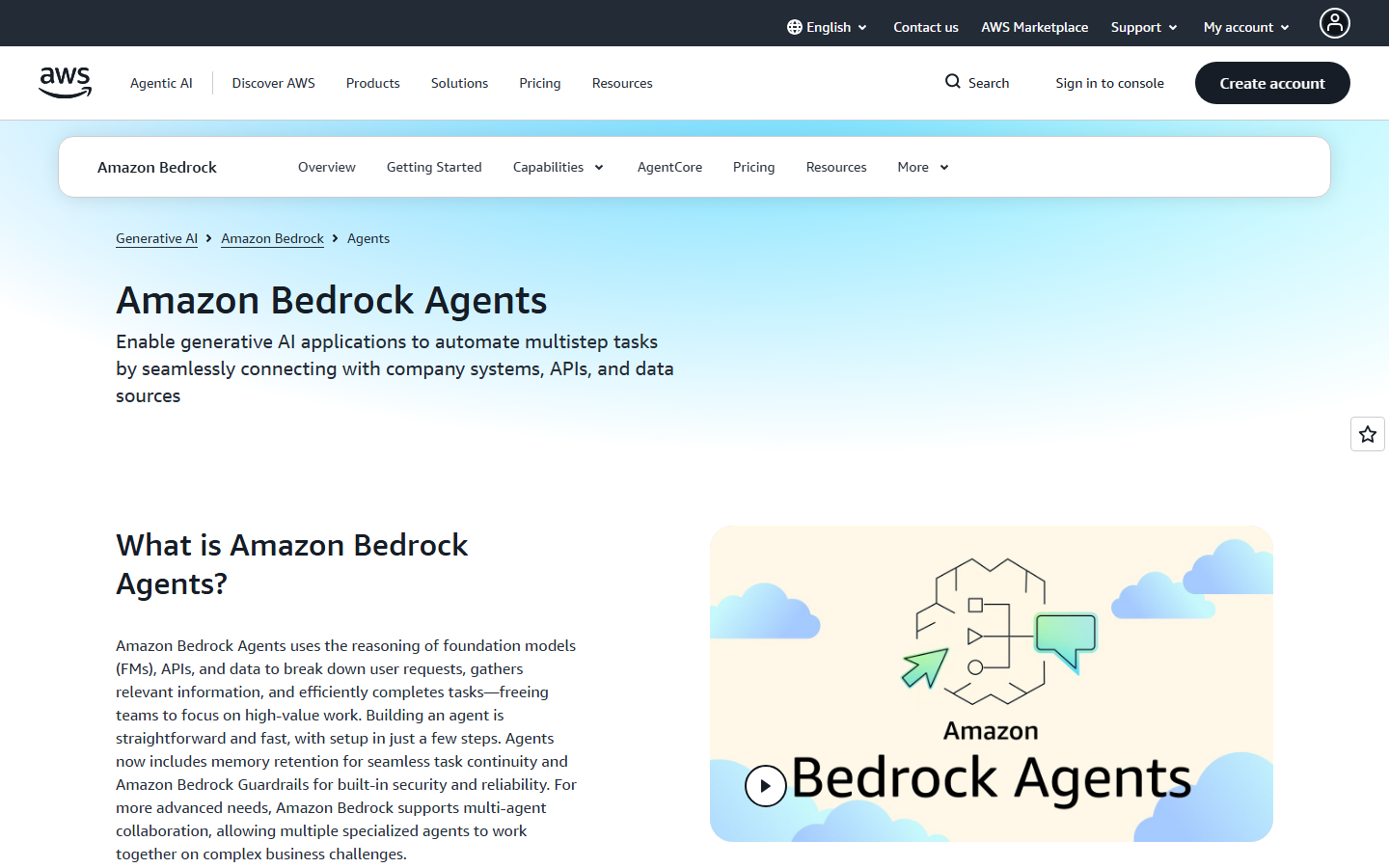
AWS Bedrock Agents is a fully managed service for building autonomous AI agents with API orchestration capabilities. It supports customizable action groups (essentially API endpoints your agent can call), knowledge bases for RAG, and session management with reusable templates for common patterns.
The 2026 release added multi-agent collaboration, code interpretation, and guardrails integration. For teams already on AWS, the tight coupling with Lambda, S3, DynamoDB, and other services reduces integration friction significantly. Enterprise teams with existing AWS infrastructure often find this the path of least resistance for deploying production AI systems.
The downside is vendor lock-in and the relatively rigid agent definition structure. Complex orchestration patterns that need custom execution logic may feel constrained by the declarative configuration approach.
Pricing: Pay-per-use; $0.01-0.03 per agent invocation plus model costs.
5. Microsoft AutoGen
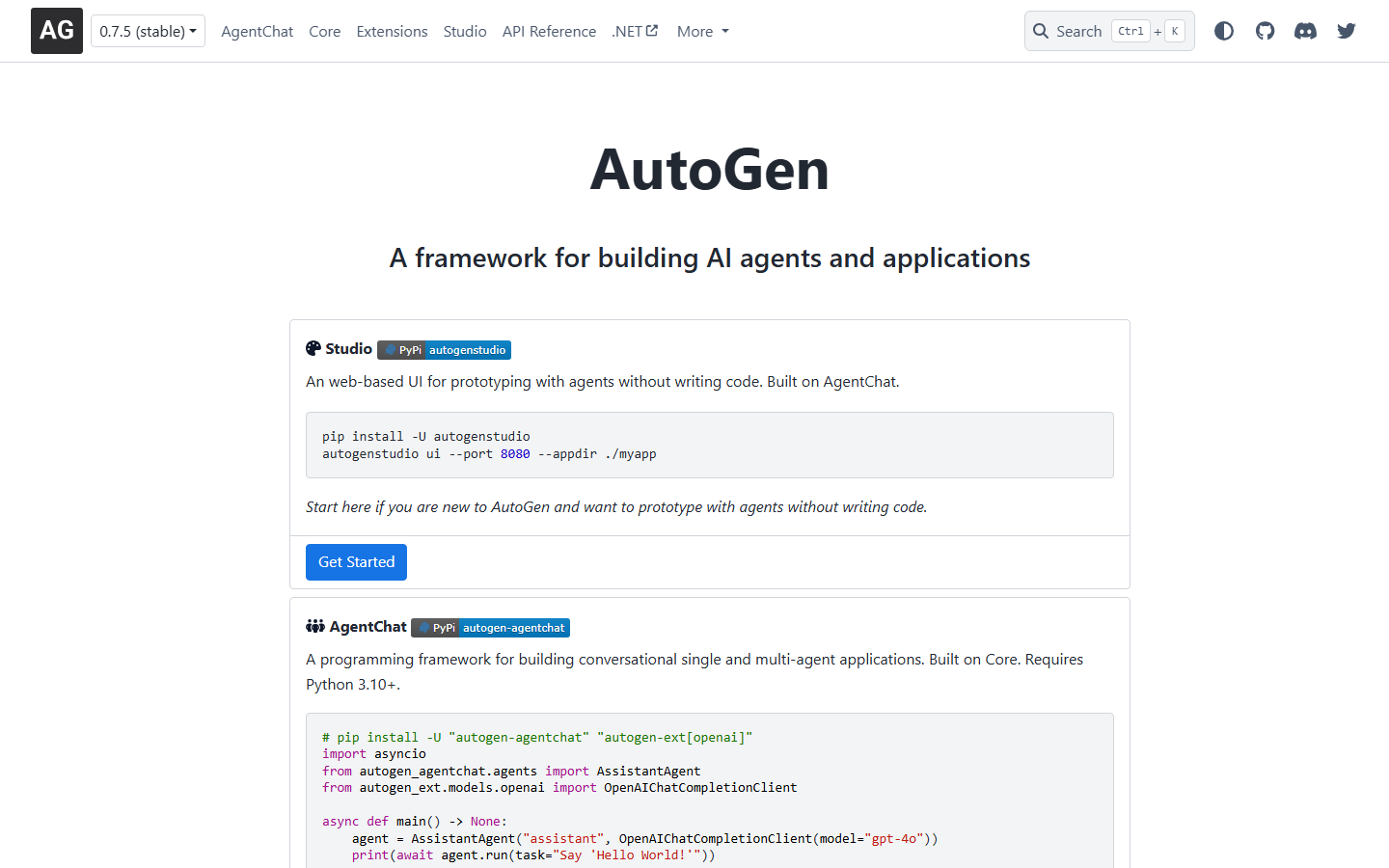
AutoGen is Microsoft's framework for multi-agent AI systems where agents collaborate through conversation. The key differentiator is its conversation-driven orchestration: agents talk to each other in structured dialogues, with the framework managing turn-taking, termination conditions, and group chat patterns.
Production use cases include code generation pipelines (where a coder agent writes, a reviewer agent critiques, and a tester agent validates), research workflows, and creative asset pipelines requiring iterative refinement. The framework integrates with Azure AI services but works with any LLM provider.
AutoGen suits research-heavy applications where the problem benefits from multiple perspectives. It is heavier than needed for simple sequential pipelines where a direct workflow execution API would handle the job with less overhead.
Pricing: Free and open-source; Azure hosting costs apply for managed deployments.
6. Agno
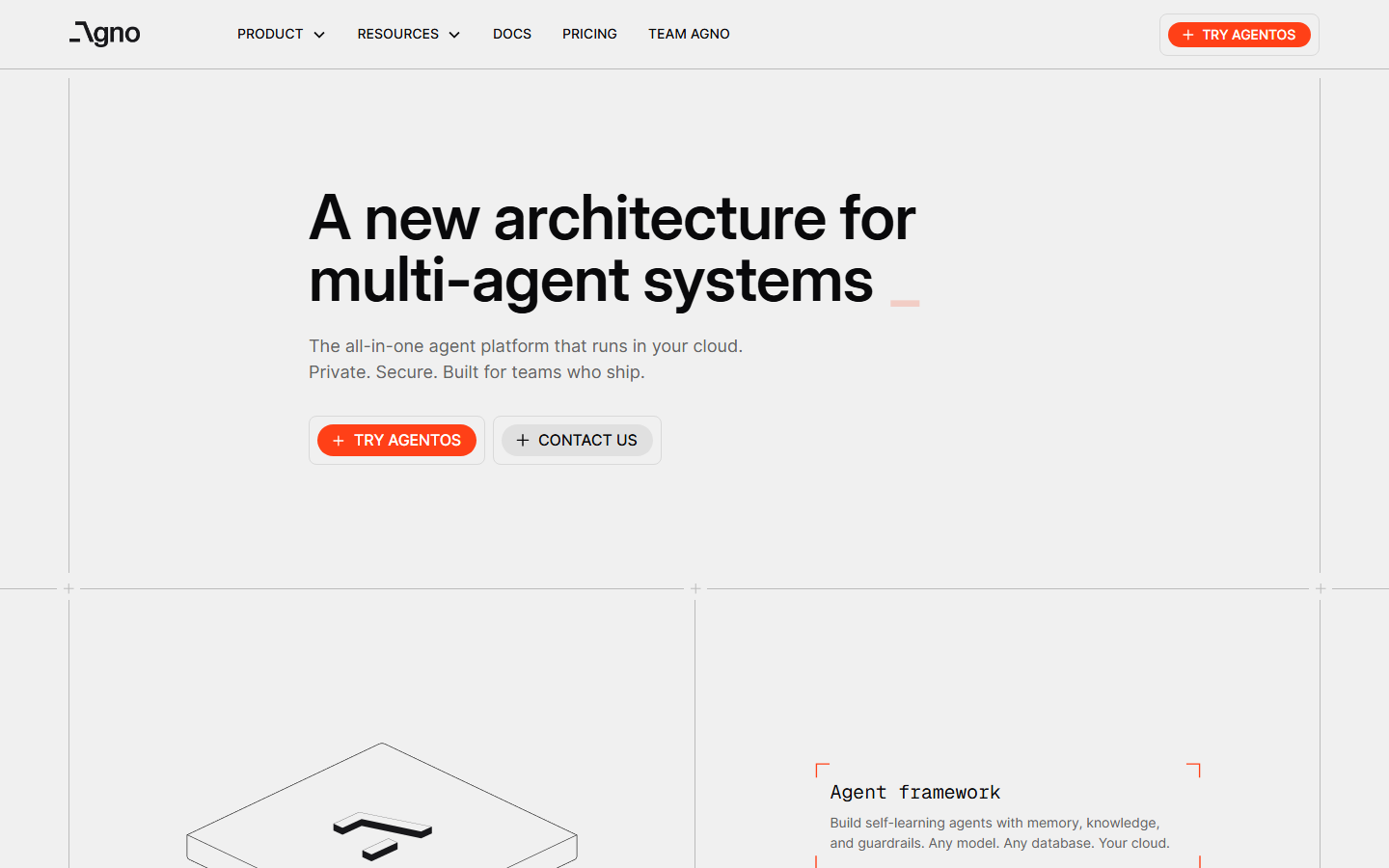
Agno is an open-source multi-agent framework in Python with a built-in production runtime called AgentOS. The integrated control plane manages execution, state, and observability for single agents, teams, and their interconnected workflows.
What sets Agno apart is its focus on production readiness from the start. The runtime includes health checks, graceful shutdown, resource limits, and structured logging out of the box. The visual node editor pattern it follows makes debugging multi-agent interactions transparent.
For teams wanting full control over their orchestration infrastructure without paying for managed services, Agno provides the most complete self-hosted option. It pairs well with external orchestration APIs when you need both agent autonomy and structured pipeline execution.
Pricing: Free and open-source; self-hosted infrastructure costs only.
7. Apache Airflow
Apache Airflow was built for data pipeline orchestration but has become a solid choice for scheduled AI batch processing. The DAG-based workflow definition, built-in scheduling, retry logic, and extensive operator ecosystem make it reliable for production pipelines that run on cron schedules.
AI-specific use cases include nightly model retraining, batch inference jobs, data preprocessing for RAG systems, and periodic content generation. The PythonOperator lets you call any AI API directly, while custom operators wrap common patterns. Teams running both batch and real-time AI workloads often combine Airflow with a real-time orchestration layer for interactive use cases.
Airflow is not designed for real-time, interactive AI applications. If your use case requires sub-second responses or stateful conversations, pair it with a real-time orchestrator and use Airflow for the batch layer.
Pricing: Free and open-source; managed options (Astronomer, MWAA) from $300/month.
Comparison Table
| Platform | Type | Real-time | Multi-agent | Self-hosted | Pricing |
|---|---|---|---|---|---|
| Wireflow | Visual + API | Yes | Yes | No | Free tier + $29/mo |
| LangGraph | Code framework | Yes | Yes | Yes | Free (OSS) |
| CrewAI | Code framework | Yes | Yes | Yes | Free + managed |
| AWS Bedrock | Managed service | Yes | Yes | No | Pay-per-use |
| AutoGen | Code framework | Yes | Yes | Yes | Free (OSS) |
| Agno | Code framework | Yes | Yes | Yes | Free (OSS) |
| Apache Airflow | Batch scheduler | No | No | Yes | Free (OSS) |
How to Choose the Right Orchestration API
Selecting an orchestration layer depends on three factors: your team's technical depth, your latency requirements, and your existing infrastructure.
If your team includes strong Python engineers comfortable with graph abstractions, LangGraph or Agno give maximum flexibility. If you need to ship quickly and prefer visual debugging, a platform like Wireflow with workflow automation reduces time to production. The REST API means you can integrate with any language or framework using standard HTTP calls, no SDK installation required.
For AWS-native companies, Bedrock Agents minimizes integration overhead. For batch workloads that do not need real-time responses, Airflow remains the most battle-tested option with years of production deployments backing its reliability.
Get started: Explore the Wireflow API documentation to see how visual orchestration translates to programmable endpoints, including authentication, rate limits, and webhook triggers.
FAQ
What is AI orchestration?
AI orchestration is the process of coordinating multiple AI models, APIs, and data transformations into a unified pipeline. It handles routing inputs between models, managing state, retrying failures, and producing final outputs from multi-step processes.
Do I need an orchestration layer for a single model call?
No. If your application makes one API call to one model, a simple HTTP client is sufficient. Orchestration becomes valuable when you chain multiple models, need conditional routing, or require reliability features like retries and fallbacks across steps.
Can I mix orchestration tools together?
Yes. Many teams use Airflow for batch scheduling while running LangGraph or Wireflow for real-time interactive pipelines. The batch layer feeds the real-time layer with preprocessed data, embeddings, or cached results.
What latency should I expect from orchestrated pipelines?
Single-model calls typically add 10-50ms of orchestration overhead. Multi-step pipelines depend on the slowest model in the chain. Most production setups target under 5 seconds for interactive use cases and have no latency constraints for batch processing.
Is open-source orchestration production-ready?
LangGraph, Agno, and Airflow all run in production at scale. The tradeoff versus managed platforms is operational burden: you handle scaling, monitoring, and infrastructure yourself. For teams with DevOps capacity, this is often preferred for cost and control reasons.
How do orchestration APIs handle failures?
Most platforms implement retry logic with exponential backoff, circuit breakers for failing providers, and fallback routes to alternative models. Wireflow returns structured error responses with contextual fields (including credit breakdowns on 402 errors) and provides Retry-After headers on rate-limited requests. Framework-based tools like LangGraph require explicit error handling in your graph definition.
What about cost management in multi-model pipelines?
Orchestrated pipelines multiply per-call model costs by the number of steps. Best practices include caching intermediate results, using cheaper models for classification and routing steps, and reserving expensive models for final generation. Those same controls apply when you orchestrate a generative media pipeline that plans with an LLM before spending on image and video models. Wireflow enforces workflow limits of 100 nodes and 500 edges per workflow, which naturally bounds per-execution costs. The API returns 402 with a detailed breakdown array showing per-node credit costs when a workflow would exceed your balance.
Should I build my own orchestration layer?
Only if you have unique requirements that no existing tool addresses. Custom orchestration code becomes technical debt quickly as you add retry logic, state management, monitoring, and scaling. Starting with an existing platform and customizing within it is almost always faster.

Co-Founder & Operations at Wireflow
Runs client operations and content strategy at Wireflow. Works directly with creative teams and agencies to build production AI workflows.
- Content Strategy
- Client Operations
Make AI videos and ads.
Start free, no card needed.