
Node-based AI workflow builders are transforming how creative teams work. Instead of switching between separate AI tools, platforms like Weavy (now Figma Weave) and Flora let you connect multiple AI models on a visual canvas, building complete creative pipelines without code. Both tools support 40-50+ AI models including Flux, Runway, Kling, and Sora. They offer real-time collaboration, reusable templates, and infinite canvases. Teams looking for deeper automation, reusable systems, and production ready workflows are increasingly moving toward platforms like Wireflow AI, which focuses more on turning workflows into scalable creative infrastructure rather than just visual experimentation.
Comparing tools for client work? Open the canvas image generator template and judge the output yourself before you read on.
Both tools excel at specific tasks, but their philosophies differ sharply. This comparison breaks down features, pricing, and use cases to help you choose the right fit for your team.
Core Philosophy
Weavy takes an engineering-first approach. It's built for precision, scalability, and deterministic control. Think mathematical editing tools, tight Figma integration, and workflows designed for production-ready assets. Design teams who need pixel-perfect output and repeatable processes gravitate toward Weavy's technical foundation.
Flora prioritizes storytelling and rapid iteration. It's optimized for marketing teams, concept artists, and anyone who needs to move fast from idea to output. Pre-built templates and Style DNA features make it easier to maintain brand consistency without technical overhead. Creative directors running campaigns appreciate Flora's template library and faster time-to-output.
Feature Comparison
Editing Capabilities
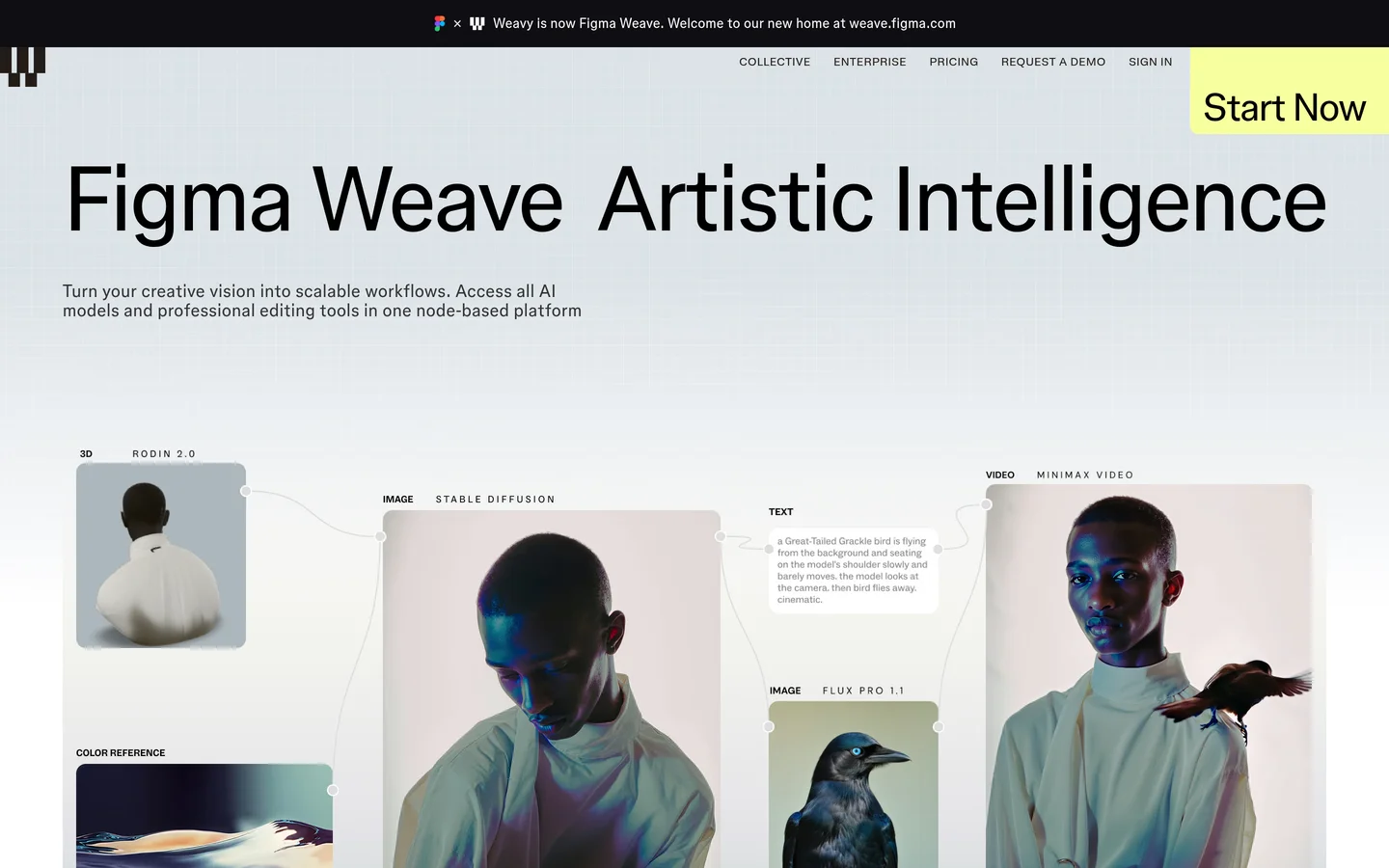
Weavy offers curves and levels adjustments, alpha masks for precise compositing, array nodes for generating variations at scale, deterministic parameters you can fine-tune, and native Figma integration for UI/UX workflows. These tools give technical control over every aspect of generation. Teams needing exact brand specifications rely on Weavy's precision editing suite.
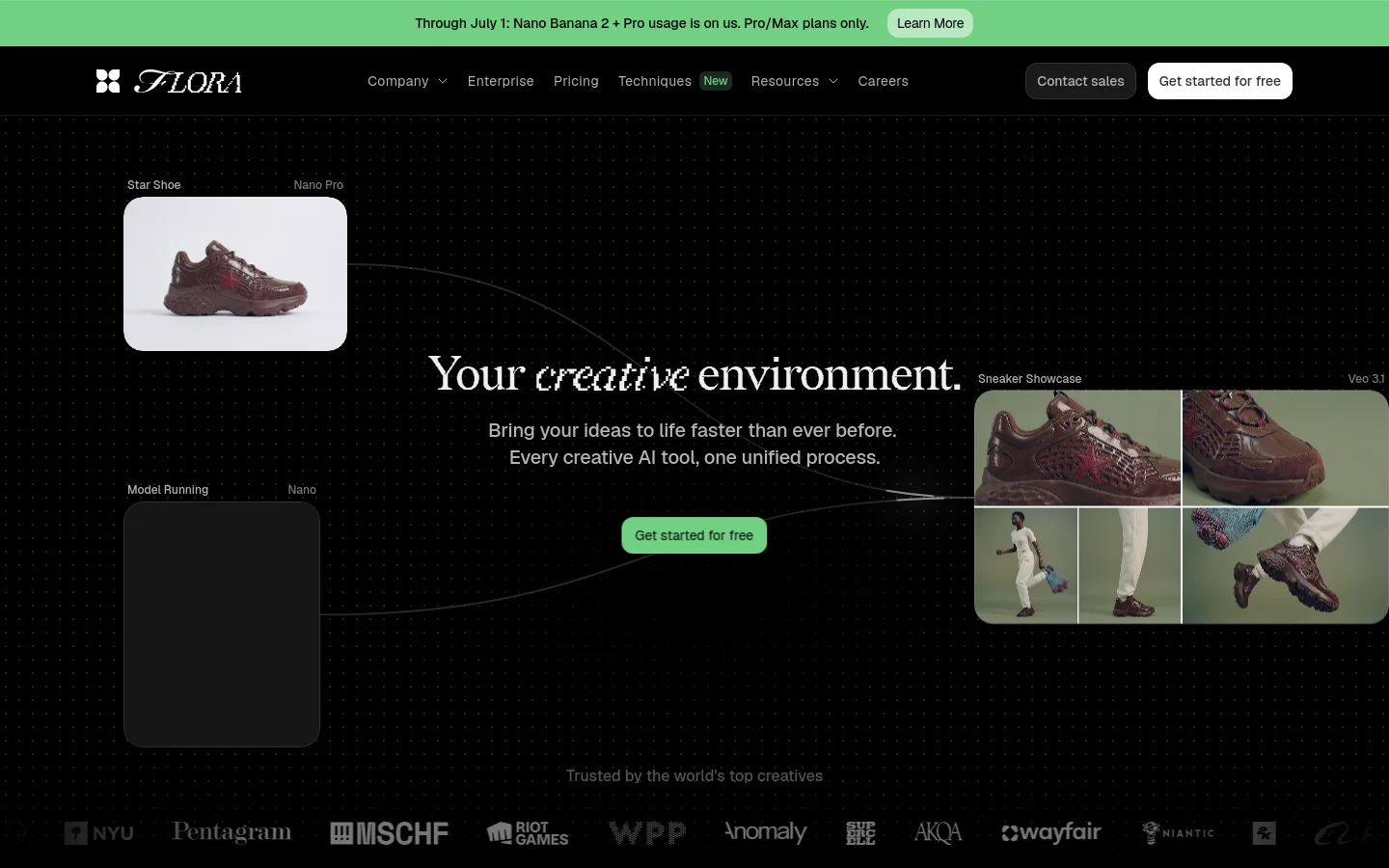
Flora provides generative inpainting for quick edits, Style DNA to capture and apply brand aesthetics, pre-built "Flows" templates for common use cases, narrative tools for storyboarding and sequencing, and faster iteration with less technical setup. Creative teams value Flora's speed over pixel-perfect control. Marketing teams running video campaigns prefer Flora's template-first approach.
Collaboration
Both platforms support real-time multiplayer editing with live cursors, comments and annotations, shared workspaces for teams, and version history. These baseline collaboration features let distributed teams work together effectively.
Weavy adds team permissions and "App Mode" to simplify complex workflows for non-technical stakeholders. App Mode hides the node canvas and presents a simple form interface, perfect for client-facing tools. Flora focuses on template sharing and community flows to speed up onboarding. New team members can clone proven workflows instead of building from scratch. Teams weighing these platforms on API access can read our three-way comparison of Weavy, Freepik Spaces, and Flora for developers.
Model Support
Both integrate 40-50+ AI models covering image generation (Flux, DALL-E, Stable Diffusion), video creation (Runway, Kling, Veo, Sora), 3D generation, audio tools, and upscalers and processors. This multi-modal approach lets you build complete creative pipelines in one workspace. If image quality drives your choice, our Flux 3 vs Flux 2 breakdown covers what changed between the models.
Weavy curates models for engineering precision, selecting providers that offer deterministic outputs and fine-grained control. Flora emphasizes creative variety and rapid testing across providers, prioritizing speed and aesthetic range over technical precision. Teams that want that range without a closed ecosystem often evaluate a dedicated Flora Fauna alternative.
Pricing Breakdown
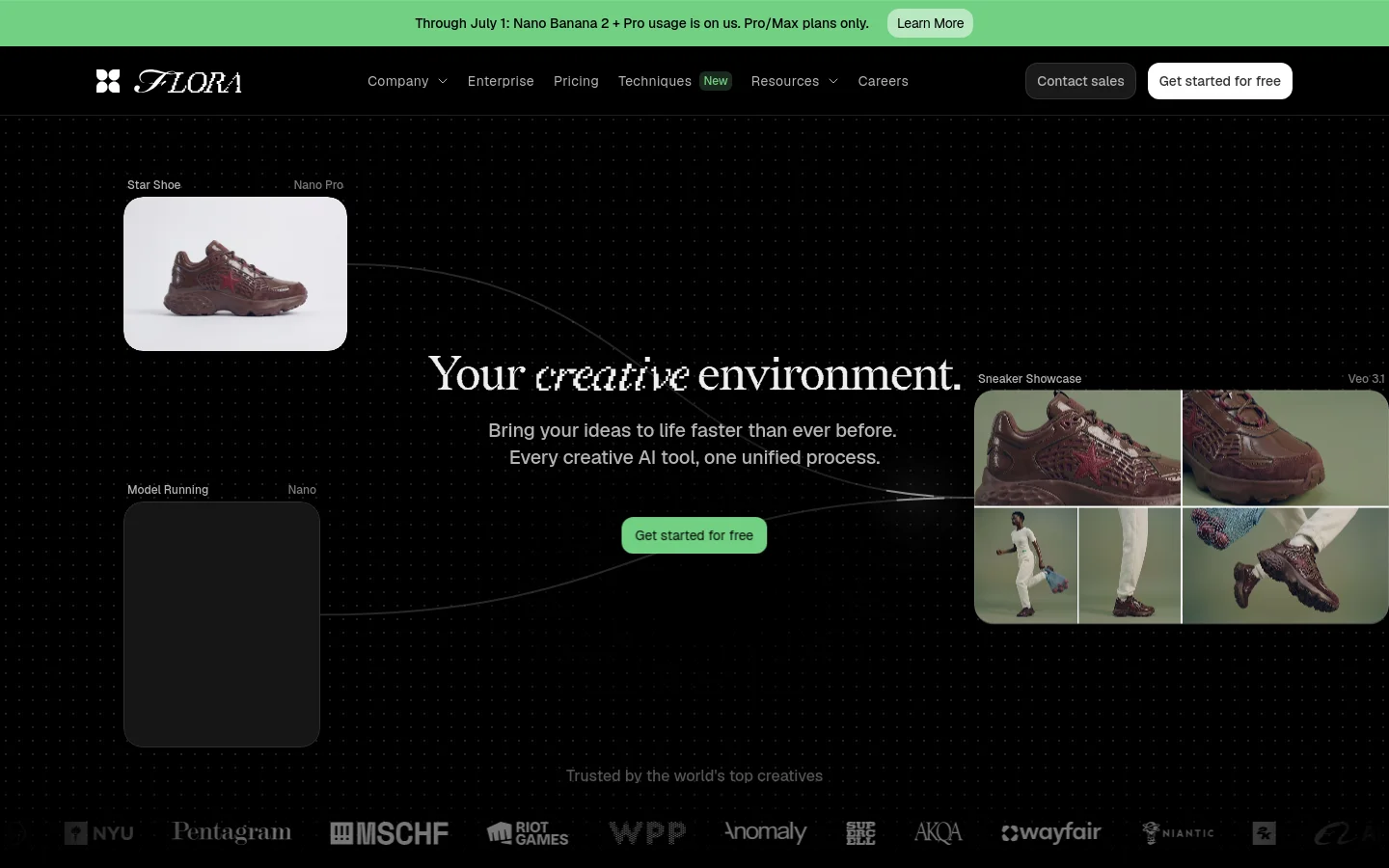
Both platforms use credit-based pricing. Credits scale with model usage, so complex video generation costs more than simple images. Here's how the plans compare.
Weavy Pricing
| Plan | Monthly Credits | Approx. Generations | Cost |
|---|---|---|---|
| Free | 150 | ~375 images | $0 |
| Starter | 1,500 | ~3,750 images | $24 |
| Pro | 4,000 | ~10,000 images | $45 |
| Team | 4,500/user | ~11,250 images/user | $60/user |
| Enterprise | Custom | Custom | Custom |
Weavy charges per user on team plans, which works well for predictable workflows where each team member has consistent usage patterns. Annual billing saves approximately 20%, and paid plans include credit rollovers and top-ups.
Flora Pricing
| Plan | Monthly Credits | Approx. Generations | Cost |
|---|---|---|---|
| Free | 1,000 | ~50-100 generations | $0 |
| Explorer | 20,000 | ~1,000 images | $16-20 |
| Pro | 60,000 | ~3,000 images | $48-54 |
| Team | 80,000+ shared | Unlimited users | $48-60 |
| Enterprise | Custom | Custom | Custom |
Flora offers better value for high-volume teams with shared credit pools. The Team plan supports unlimited users sharing a credit pool, ideal for agencies with variable staffing needs. Annual billing also saves ~20% with credit rollovers available.
Key differences: Flora delivers more credits per dollar at higher tiers and allows unlimited team users on shared pools. Weavy's per-user pricing suits teams with consistent, individual workflows. Both platforms offer generous free tiers for testing before committing to paid plans.
Use Case Fit
Choose Weavy if you:
- Need mathematical precision in editing (curves, masks, arrays)
- Work in UI/UX and want Figma integration
- Produce scalable brand assets with deterministic variations
- Prefer engineering-driven workflows over templates
- Have team members who need simplified "App Mode" access without touching the node canvas
Weavy suits design teams, UI/UX professionals, and anyone who needs deterministic control over scalable assets. Its Figma integration and mathematical editing tools make it ideal for production workflows where consistency matters more than speed. If you're exploring alternatives to Weavy, consider what level of technical control you need.
Choose Flora if you:
- Focus on storytelling, campaigns, or concept art
- Want pre-built templates to speed up iteration
- Need Style DNA to maintain brand aesthetics across projects
- Prioritize collaboration and rapid testing over pixel-perfect control
- Run a marketing team with variable creative needs and multiple collaborators
Flora fits marketing teams, concept artists, and fast-moving creative teams. Pre-built templates, Style DNA, and generous team pricing help you move from idea to output faster. The shared credit pool model works well for agencies with fluctuating project demands.
Why Not Both?
Many teams don't need to choose. Node-based workflow builders excel at specific tasks, but they're not all-in-one solutions. Each platform locks you into its curated model ecosystem and pricing structure.
If you're building multi-step creative pipelines that combine AI image generation, AI video creation, audio tools, and upscalers in a single workflow, platforms like Wireflow offer a different approach: model-agnostic canvases where you connect AI tools from multiple providers without locking into one ecosystem. Instead of picking between Weavy's precision and Flora's speed, you can chain the best models for each step, using Flux for image generation, Runway for video, and custom upscalers in one pipeline. Then deploy the entire workflow as a web app your team can use without touching the canvas.
This flexibility matters when you need specific models that only certain providers offer, or when you want to switch providers without rebuilding your entire workflow. Model-agnostic platforms let you future-proof your pipelines. For teams comparing node-based tools, check out ComfyUI alternatives and n8n alternatives to see how different approaches stack up.
FAQ
Is Weavy the same as Figma Weave?
Yes. Weavy was acquired by Figma and rebranded as Figma Weave. The core node-based canvas and model integrations remain the same, with tighter Figma file integration as the main change post-acquisition.
Which platform is better for developers who need API access?
Neither Weavy nor Flora positions itself as a developer-first platform with full API access. Both are canvas-first tools. Developers who want a node-based canvas plus a REST API to trigger workflows programmatically usually look at platforms like Wireflow, which exposes workflows as HTTP endpoints.
Can I import my own models or LoRAs?
Flora has limited support for custom Style DNA captures that act like lightweight aesthetic LoRAs. Weavy focuses on its curated model list and does not currently support arbitrary custom model uploads. For full custom model and LoRA support, ComfyUI-style platforms are a better fit.
How do credits compare across the two platforms?
The credit accounting differs, so headline numbers are not directly comparable. Flora's free plan gives 1,000 credits but generations consume more per run, working out to roughly 50-100 outputs. Weavy's free plan gives 150 credits but each image typically costs less, landing around 375 images. Compare the cost of the specific models you plan to use rather than the credit totals alone.
Do either of them support video generation?
Yes. Both integrate Runway, Kling, Veo, and Sora for video generation. Output quality and cost depend on which underlying model you select. Video generations consume significantly more credits than image generations on both platforms.
Which one has a steeper learning curve?
Weavy has a steeper initial curve because of its precision editing nodes (curves, levels, alpha masks, array nodes) that mirror traditional DCC tools. Flora is faster to pick up thanks to its template library and narrative-focused tools, but advanced workflows still require time to set up.
Can I collaborate with clients who do not have accounts?
Weavy's App Mode lets you publish a workflow as a simple form interface that non-technical users can fill in without seeing the node canvas. Flora relies more on shared workspace links and template cloning. For pure client-facing form delivery, Weavy's App Mode is the more direct fit.
Is there a free tier I can test with real projects?
Both offer free tiers. Flora's free plan covers 50-100 generations per month, Weavy's covers around 375 images. Either is enough to test core workflows, though video-heavy projects will exhaust both quickly. Test with the exact models and resolutions you plan to use in production.
The Bottom Line
Weavy and Flora are both excellent node-based AI workflow builders. Your choice depends on whether you prioritize engineering precision (Weavy) or creative velocity (Flora).
Weavy suits design teams, UI/UX professionals, and anyone who needs deterministic control over scalable assets. Its Figma integration and mathematical editing tools make it ideal for production workflows where pixel-perfect consistency matters. The per-user pricing model works well for teams with predictable, individual usage patterns.
Flora fits marketing teams, concept artists, and fast-moving creative teams. Pre-built templates, Style DNA, and generous team pricing (unlimited users on shared credit pools) help you move from idea to output faster. The template-first approach reduces onboarding time and helps new team members contribute immediately.
Both platforms offer free tiers. Test them with real projects before committing to paid plans. And if you need to combine models from multiple providers in one pipeline, explore platforms like Wireflow that let you chain tools without vendor lock-in, giving you the flexibility to use the best model for each step in your creative process. Compare this Weavy vs Wireflow head-to-head to understand the key differences.
Would you rather we just built it?
We get on a call, learn your style, build the workflow, and ship the deliverables on a schedule. You keep the workflow either way.


