 Andrew Adams · Co-Founder & Operations at Wireflow ·
 video editing agent
Build a video editing agent as a visual node graph: brief in, Claude-powered editing director plans the cuts, generation models render the frames, Compose Video assembles the output.
Every graph runs as a REST endpoint and MCP tool your agent can call on demand.
Free to build · no credit card · See how it works ↓
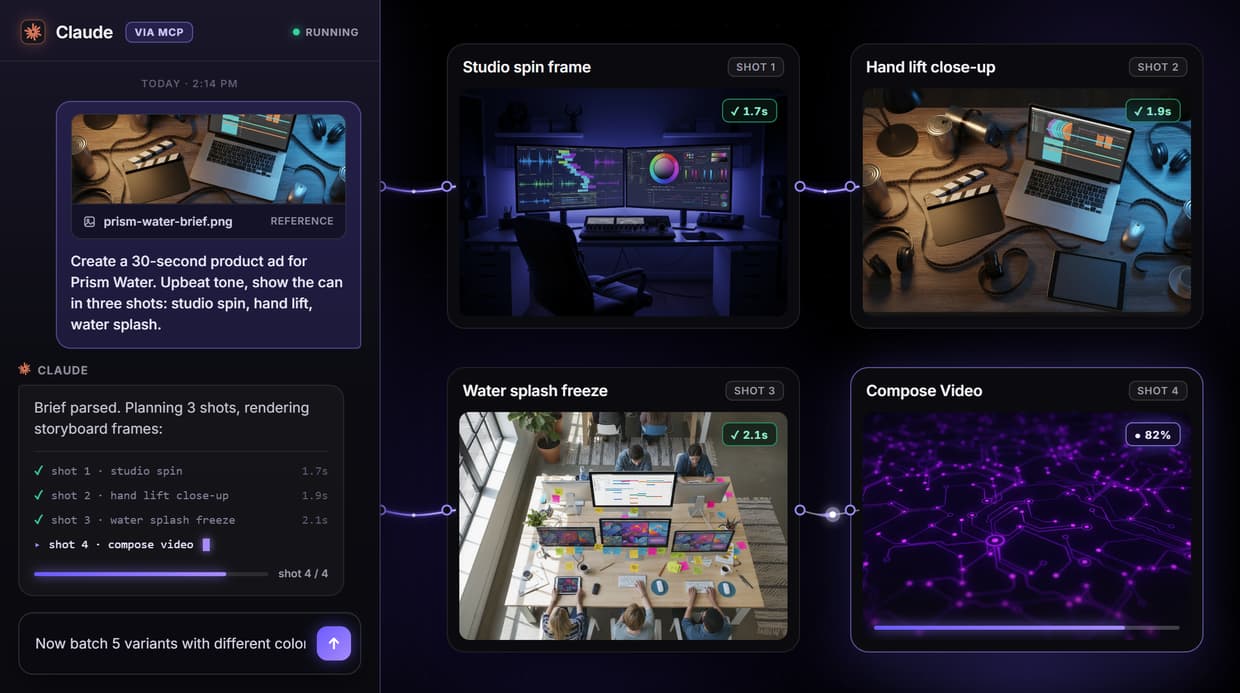
How to Use video editing agent
Steps to get you started in Wireflow.
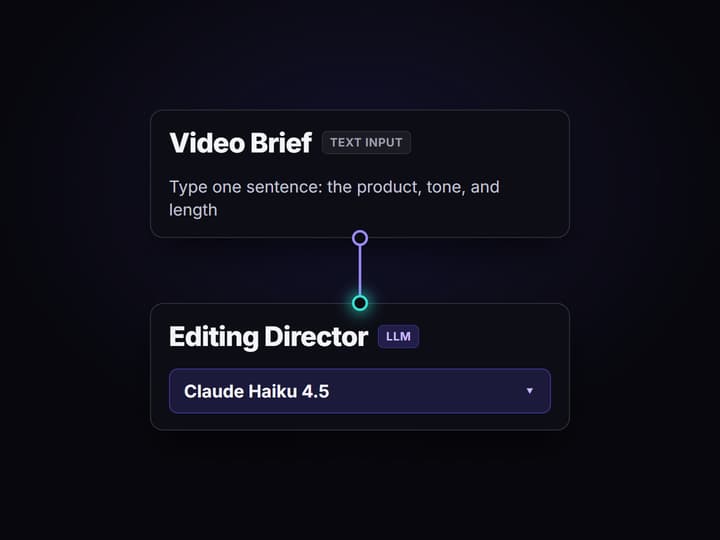
Open the flow and type the brief
Open the published workflow and click the Video Brief node. Type one sentence: the product, the tone, and the length. The default reads: create a 30-second product ad for Prism Water.
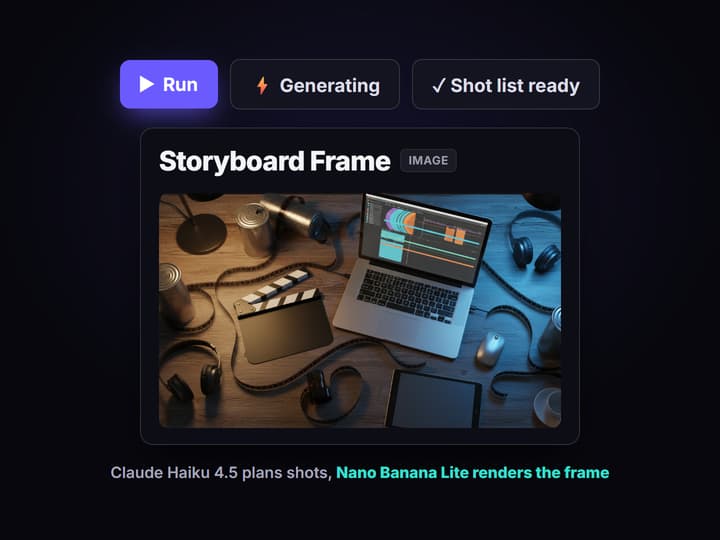
Run and watch the agent direct
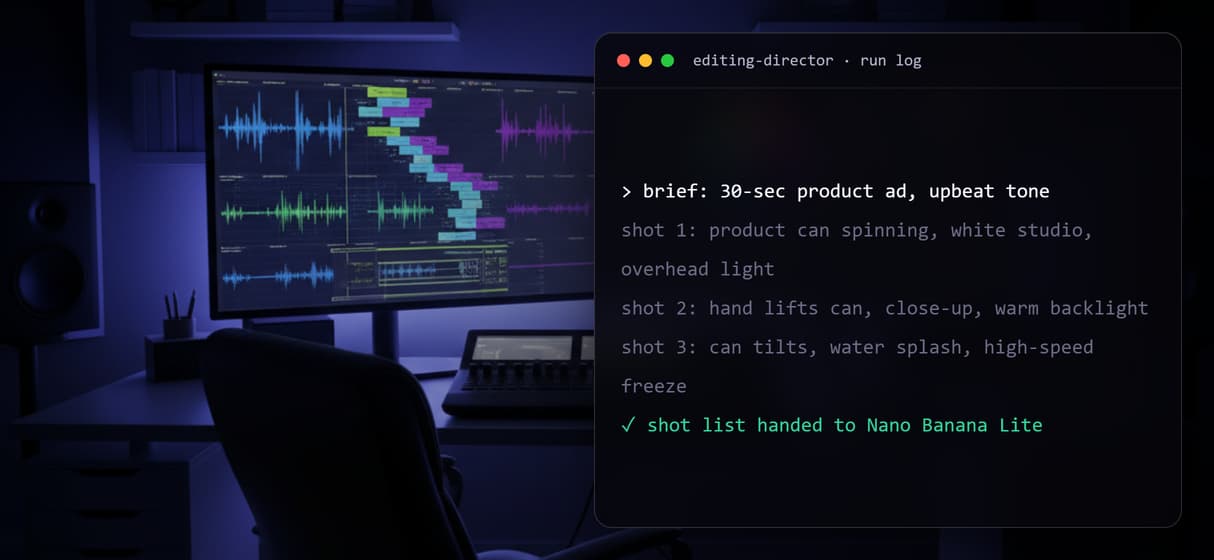
Press Run. The Editing Director node runs Claude Haiku 4.5 and returns three numbered shot descriptions. Nano Banana Lite renders a storyboard frame from those descriptions on hosted compute.
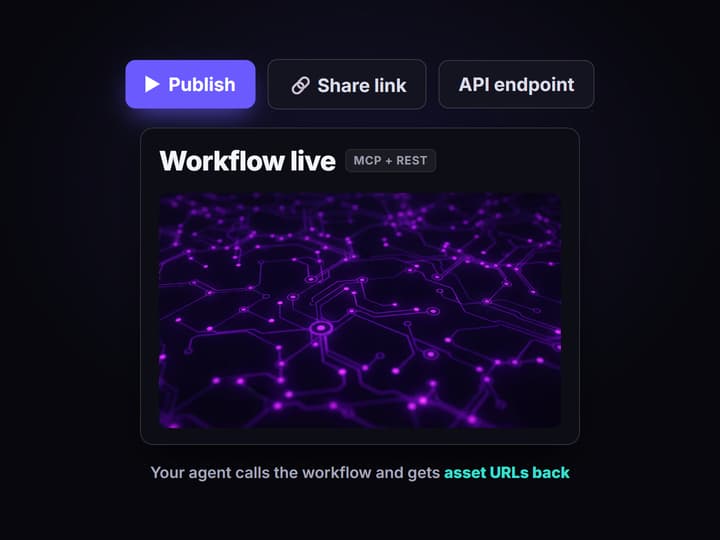
Publish the graph so your agent can call it
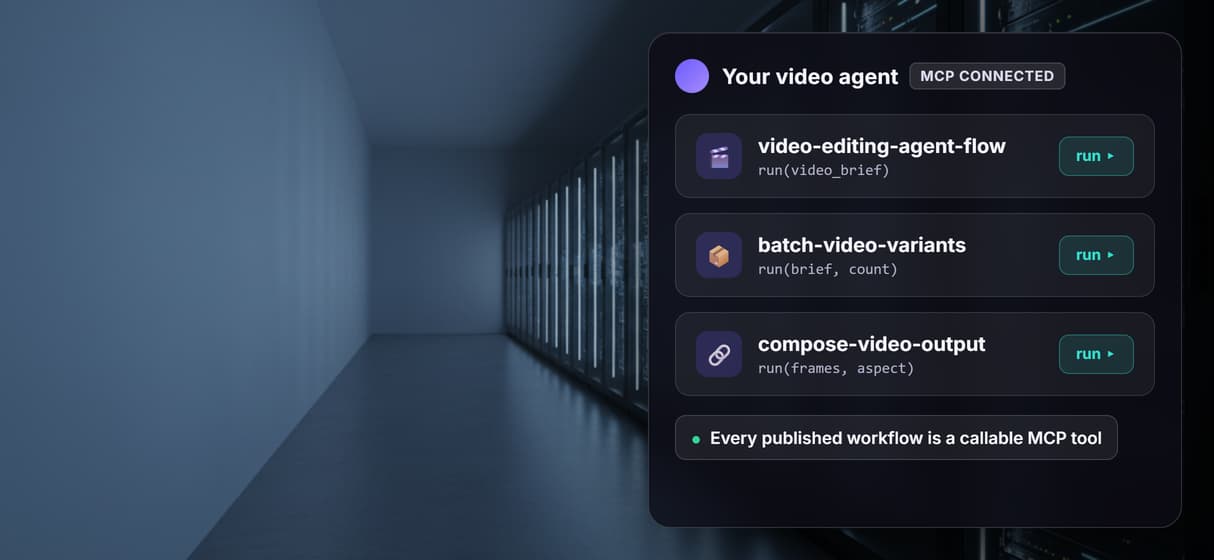
Click Publish. The graph becomes a REST endpoint and MCP tool with a typed input schema. Your agent sends the video brief, the pipeline runs, and asset URLs come back in the response.
What a video editing agent actually does
Most tools marketed as video editing agents are glorified trimmers: they detect silence, cut the pauses, maybe add captions. Useful, but the output is structurally identical to the raw footage. A real video editing agent does something different: it takes a production brief and makes editorial decisions, not just cuts.
The pattern has three moving parts. A planning layer (an LLM acting as editing director) reads the brief and writes a shot list: subject, composition, lighting, mood. A generation layer renders or assembles the frames. A composition layer stitches the cut. On Wireflow each layer is a node on a canvas you can inspect and change, so the agent's choices are never hidden inside a black box. The same graph your team runs by hand is the one your AI workflow builder exposes as a callable tool.
What the video editing agent pipeline can do
Brief drives the whole cut
One sentence about tone, product, and length is enough to run the pipeline. The agent expands it into a full shot list.
LLM editing director
Claude Haiku 4.5 reads the brief and returns numbered shot descriptions: subject, composition, lighting, and mood for each frame.
Frame rendering in seconds
Nano Banana Lite renders each storyboard frame from the shot description in under two seconds, on hosted compute with no local GPU.
REST API and MCP control
Every published graph is a REST endpoint and an MCP tool. Your agent sends the brief, the pipeline runs, and asset URLs come back.
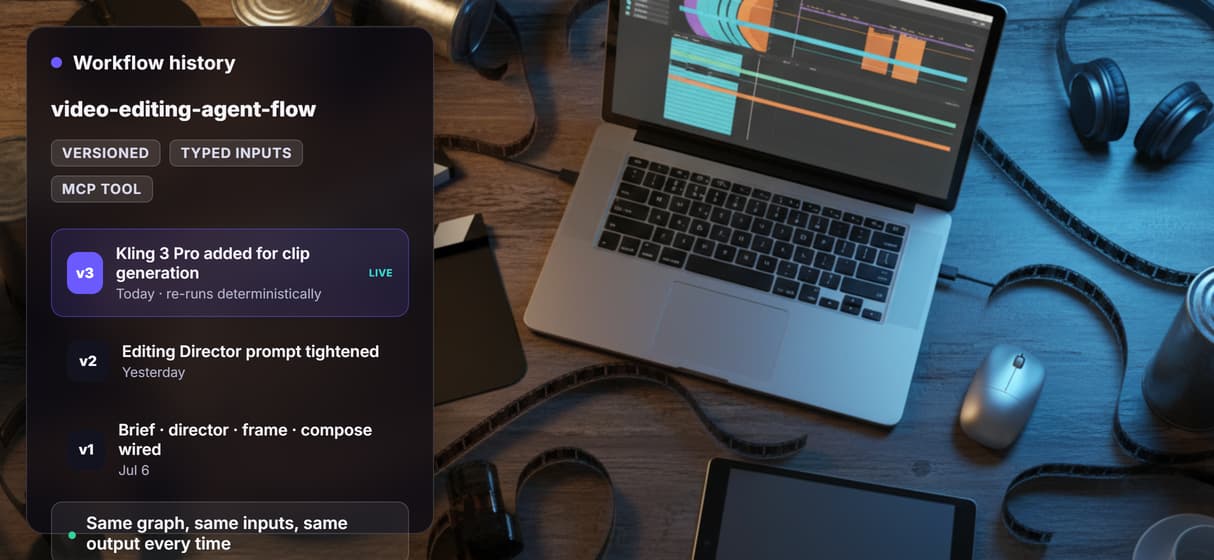
Deterministic re-runs
Same graph, same inputs, same structure every time. Swap the brief and re-run; swap one model node and keep everything else.
Swap any model
Replace Nano Banana Lite with Flux 2, Seedream V4.5, or Kling for video clips without touching the director or composition layer.
The video editing agent pipeline, node by node
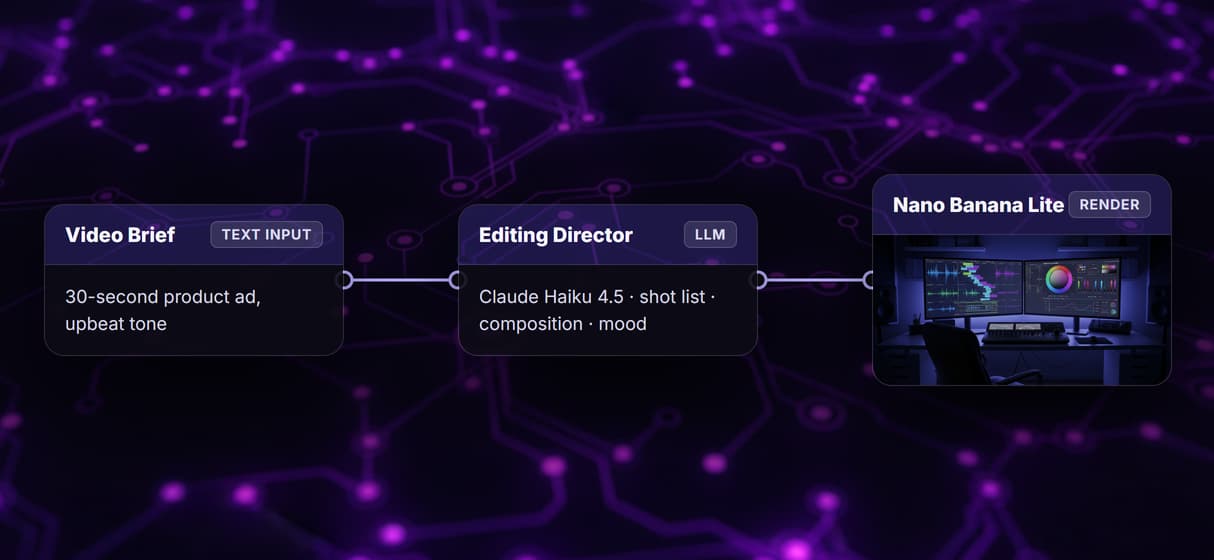
The flow on this page is the minimal video editing agent pattern as a literal graph. Open it and you see four nodes.
- Video Brief holds the intent. A Text Input node with the production brief, the only field a person has to touch. The default reads: create a 30-second product ad for Prism Water.
- Editing Director plans the cut. A Run any LLM node running Claude Haiku 4.5, system-prompted as an editing director. It reads the brief and returns three numbered shot descriptions for storyboard frames, each naming subject, composition, lighting, and mood.
- Storyboard Frame renders the visual. A Nano Banana Lite node takes the shot descriptions as a prompt and renders a storyboard frame image on hosted compute in under two seconds. No local GPU, no CUDA, no setup.
- Compose Video assembles the output. The final node in a multi-model video workflow always ends in the Compose Video node, which stitches the generated frames into the final cut.
Putting the director inside the graph is the point. Briefs typed into chat sessions are gone when the session ends; an Editing Director node is versioned with the workflow, so every output can be traced back to the exact shot descriptions that produced it. That traceability is what makes the loop safe to hand to an agent and what separates a reproducible pipeline from a lucky one-off.
Call it from code or from Claude
Every workflow published on Wireflow is simultaneously a REST endpoint and a hosted MCP tool. That means the same pipeline your team runs by clicking Run is the one a Claude agent, a Python script, or a no-code automation can call with a single POST request.
From an agent perspective: the agent lists your published workflows, reads the typed input schema, sends the video brief as a string, and polls the execution until it gets asset URLs back. No scraping, no browser automation, no custom infrastructure. The AI video editing API returns the same structured JSON whether a person ran it or an agent did. For teams building video production into a SaaS product, that means one pipeline powers both the manual canvas and the programmatic API, with no duplication.
When a video editing agent on Wireflow is not the right fit
Wireflow is the generation and orchestration layer, not the reasoning brain. The Editing Director node plans the shot list, but narrative arc, pacing instinct, and creative taste still come from you or from an agent you design. If you need a tool that watches your existing footage and makes autonomous trim decisions based on content, that is a different product category.
Wireflow also does not ingest raw footage for semantic analysis or transcription. The pipeline here generates frames from prompts; it does not cut real video files. If your workflow is ingest-heavy (talking-head footage, podcast trimming, subtitle extraction), look at tools built for that job first. See the best AI video editing API tools roundup for where each approach wins. Runs are metered too: building the canvas graph is free, every generation costs credits, so an unattended agent loop needs a spend cap before you delegate it.
More Than Just video editing agent
Brief to cut in four nodes
Video Brief to Editing Director to Nano Banana Lite to Compose Video: the full auditable video-editing agent graph.
LLM director writes the shot list
Claude Haiku 4.5 reads the brief and returns numbered shot descriptions for each frame: subject, composition, lighting, and mood, the planning half of the AI workflow builder loop.
REST and MCP, one typed graph
Publish once; your agent sends the brief to the AI video editing API and gets asset URLs back.
Server-versioned, repeatable runs
Server versions keep the graph stable. Change the brief and rerun, or swap one model node and keep the rest.
Embed into your own product
Flows publish as shared links and REST APIs. Each tenant gets a flow; cap spend. Backend calls the headless platform.
AI Models Available
Automate Any Workflow
Included in Every Plan
FAQs
A video editing agent on Wireflow is a node graph pipeline: a Video Brief node feeds a Claude-powered Editing Director, which writes shot descriptions that Nano Banana Lite renders as frames, and the Compose Video node assembles the final output.
Discover related AI tools
More From Wireflow
Written by
Andrew Adams · Co-Founder & Operations at Wireflow
Runs client operations and content strategy at Wireflow. Works directly with creative teams and agencies to build production AI workflows.
Run the video editing agent yourself
The flow behind this page is public: a Video Brief, a Claude-powered Editing Director, Nano Banana Lite, and a Compose Video node in one graph. Type your brief, press Run, and watch the agent plan the shots before the frames render. The canvas is free to explore; generations are pay per run.