Best AI Generated Ads Tools in 2026


In this article▾
- Quick Summary: The 9 Best AI Ad Tools in 2026
- How We Ranked These Tools
- 1. Wireflow: Best Overall
- 2. Zeely.ai: Best for Ecommerce Ad Workflows
- 3. AdCreative.ai: Best for Creative Scoring
- 4. Creatify: Best for UGC Video
- 5. Arcads: Best AI Actors
- 6. Omneky: Best for Enterprise
- 7. Pencil: Best for Brand Teams
- 8. Predis.ai: Best for Social Volume
- 9. Canva: Best for Non-Designers
- Comparison Table
- Which Tool Fits Which Team
- Frequently Asked Questions
- Conclusion
AI generated ads became a standard line item in most performance budgets during 2025, and the tooling split into two camps: template platforms that turn a product photo into a finished ad in about a minute, and workflow platforms that chain image, video, and voice models into a repeatable creative pipeline. Wireflow sits in the second camp, running models like Recraft V4, Nano Banana, Seedance, and ElevenLabs on one canvas so a single ad concept can fan out into dozens of variants. This guide ranks nine tools that produce shippable ad creative in 2026, with pricing, output quality, and the kind of team each one fits.
Quick Summary: The 9 Best AI Ad Tools in 2026
- Wireflow (Best Overall): chain multiple AI models into one repeatable ad pipeline.
- Zeely.ai (Best for Ecommerce Ad Workflows): product URL in, static or UGC-style video ads out, then launch on Meta from the same tool.
- AdCreative.ai (Best for Creative Scoring): predicts which static will perform before you spend.
- Creatify (Best for UGC Video): product URL in, avatar-read video ad out.
- Arcads (Best AI Actors): large roster of licensed AI presenters for scripted ads.
- Omneky (Best for Enterprise): creative production tied to platform performance data.
- Pencil (Best for Brand Teams): brand-safe generation with predictive ranking.
- Predis.ai (Best for Social Volume): high-volume social ad and post generation.
- Canva (Best for Non-Designers): template-first design with AI generation added.
How We Ranked These Tools
Ranking criteria were kept narrow, because "AI ad tool" now covers everything from a caption writer to a full media buying agent. Each tool here had to generate the actual creative asset, export at ad-platform specs, and support more than one output per brief. Pricing had to be public. Anything that only optimized budgets or wrote copy without producing visuals was excluded, which is why several tools that appear on other 2026 lists are missing here. Our guide to ad creative testing at scale covers the measurement side. For a free, forkable way to make static ads from one product photo, our Higgsfield Ads Studio comparison walks through a 39 credit run with three finished ads.
The second filter was variant economics. A tool that makes one good ad is a design tool; an ad tool has to make the fifteenth variant nearly as cheaply as the first, because creative fatigue on Meta and TikTok burns through a winning concept in two to three weeks. That is the practical dividing line between the template platforms and the pipeline platforms below, and it is covered in more depth in our breakdown of scaling ad creative production.
Build this in Wireflow
Make the same kind of asset on a canvas you control, with a free account and no credit card.
1. Wireflow: Best Overall
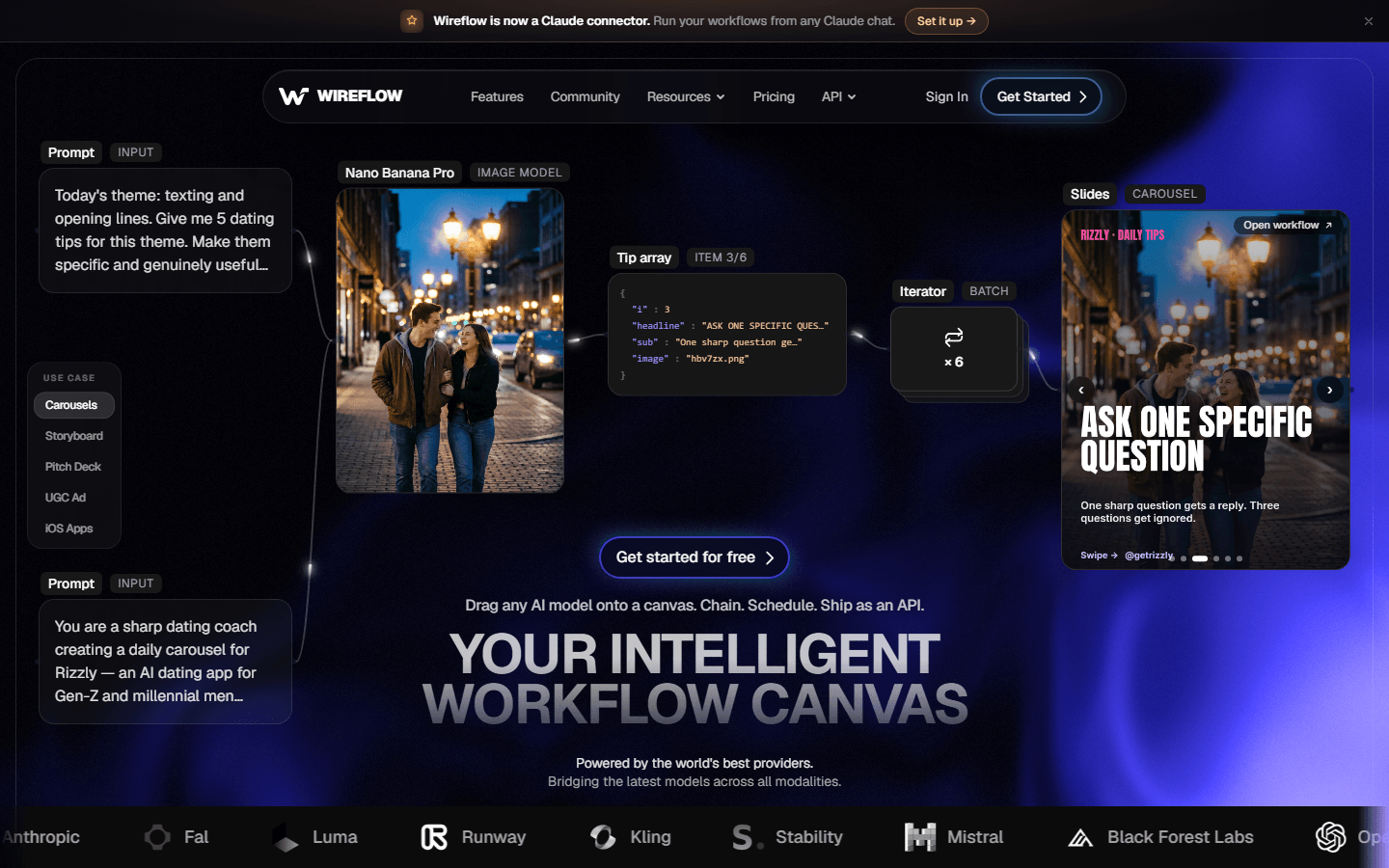
Wireflow is a node-based canvas where each node is an AI model and the connections define the ad pipeline. A typical ad build is four nodes: a product image input, an image model that places the product in a scene, a video model that animates the result, and a voice model that adds the read. Once the graph works, swapping the input product photo regenerates the whole chain, which is how one concept becomes twenty variants without rebuilding anything. Model coverage includes Recraft V4, Nano Banana, Seedream, Seedance, Kling, Veo, and ElevenLabs, so you are not locked to whichever single model the vendor licensed.
The tradeoff is honest: building the first ad takes longer than on a template tool, because you are assembling a pipeline rather than filling a form. The payoff shows up on ad five and compounds from there. Pricing is credit-based and published on the pricing page, and you pay per model run rather than per seat, which matters for agencies producing across several clients. Teams who want the same idea as a single-purpose tool can use the AI ad generator instead of building the graph from scratch.
Verdict: best for anyone who needs the same ad concept produced repeatedly across products, formats, and languages.
2. Zeely.ai: Best for Ecommerce Ad Workflows
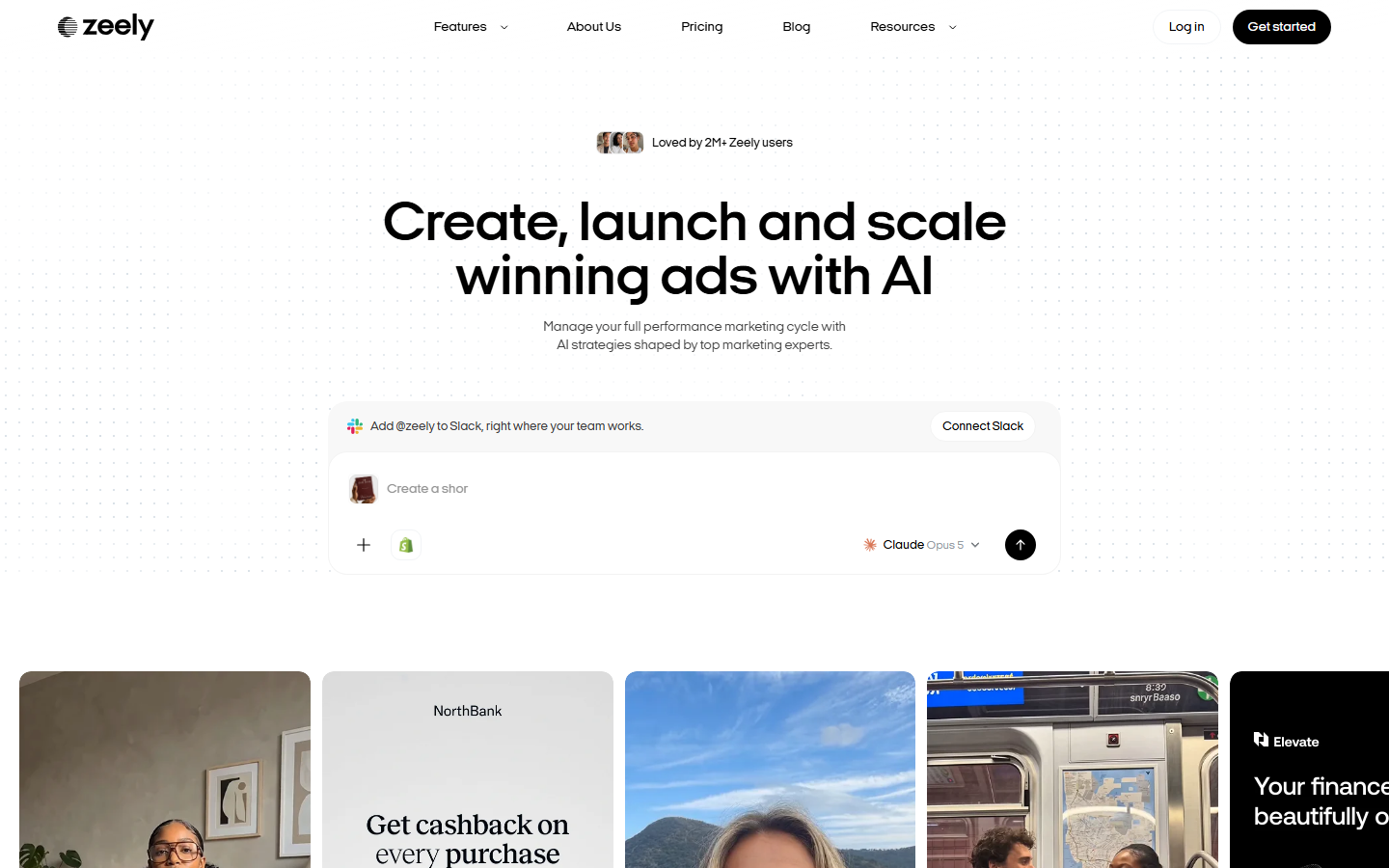
Zeely is built around the shortest path from a product page to finished ad creative. Paste a product URL and it pulls in the product images, title, pricing, and description, then turns that material into static ads or short-form video with AI-written hooks, scripts, captions, music, and UGC-style presenters. The avatar library includes 150+ options, and batch generation makes it practical to test several hooks or creative directions without setting up a shoot or rebuilding each version manually.
The main advantage is how far the workflow extends after generation. Zeely can connect directly to a Meta account, so a team can move from creating the ad to launching a paid campaign without rebuilding everything in a separate tool. That makes it especially useful for ecommerce brands and lean performance teams that need both static and video output but do not want to maintain a separate stack for creative production and campaign setup. Plans start at $29.95 per month and scale through Plus and Growth tiers, with generation controlled through credits.
Verdict: best for ecommerce and performance teams that want to go from product URL to static or UGC-style video ads and then into Meta campaign launch from one workflow.
3. AdCreative.ai: Best for Creative Scoring
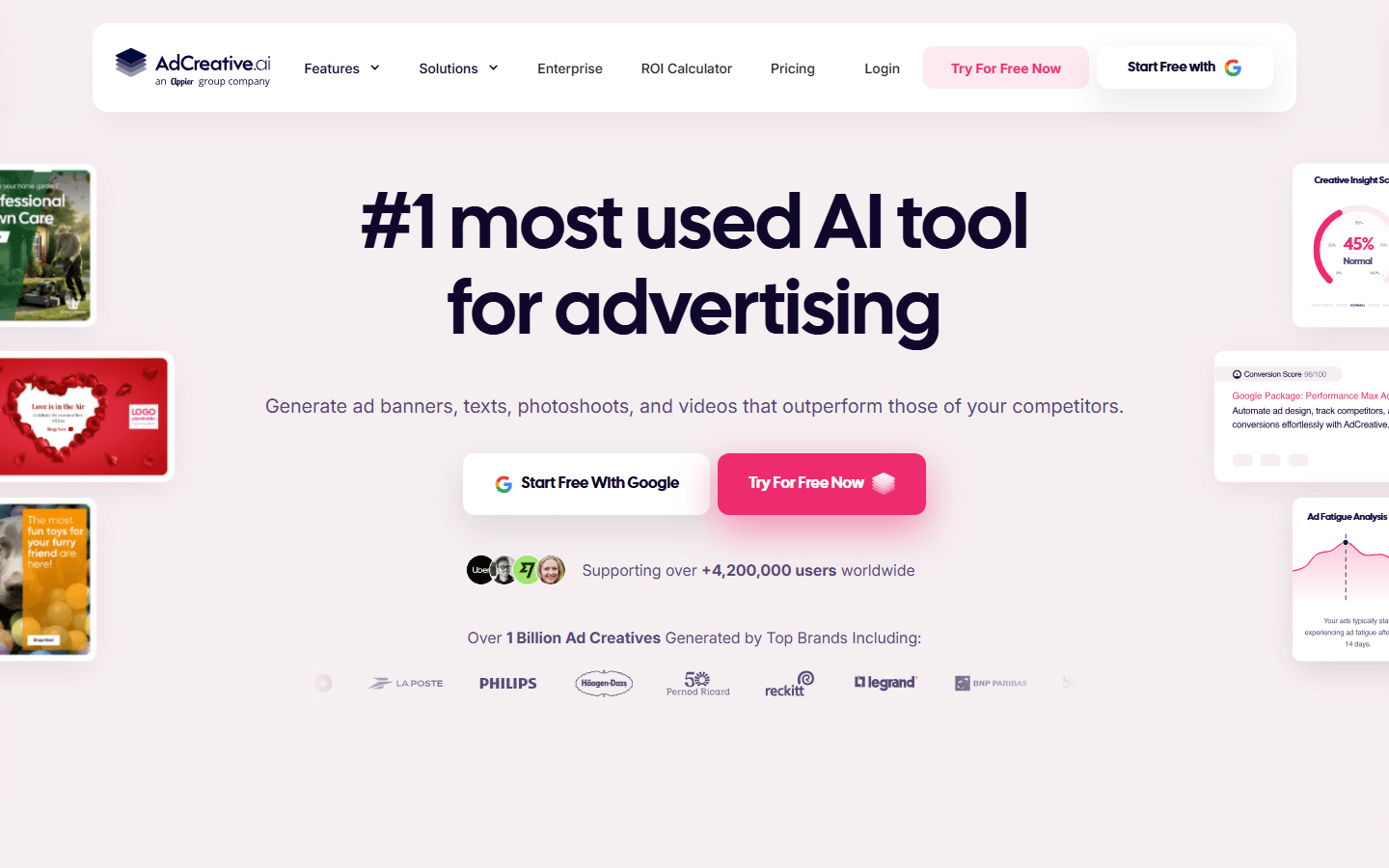
AdCreative.ai generates banner and social ad sets from a brand kit, then scores each output with a model trained on past ad performance. The scoring is the reason to use it: instead of choosing between twenty statics by taste, you get a ranked shortlist. Output is strongest on clean, text-heavy statics for Meta and Google Display, where layout conventions are stable.
Video output is weaker and mostly stitches stock or uploaded footage rather than generating new motion. Plans start around $39 per month with credit limits that most teams outgrow quickly, and higher tiers climb fast. It fits in-house performance teams running heavy static creative who want a defensible ranking before spend, rather than studios that need generated video. For a broader look at that category, see our roundup of AI ad generators for social media.
Verdict: best when you need static ad volume plus a performance prediction attached to each output.
4. Creatify: Best for UGC Video
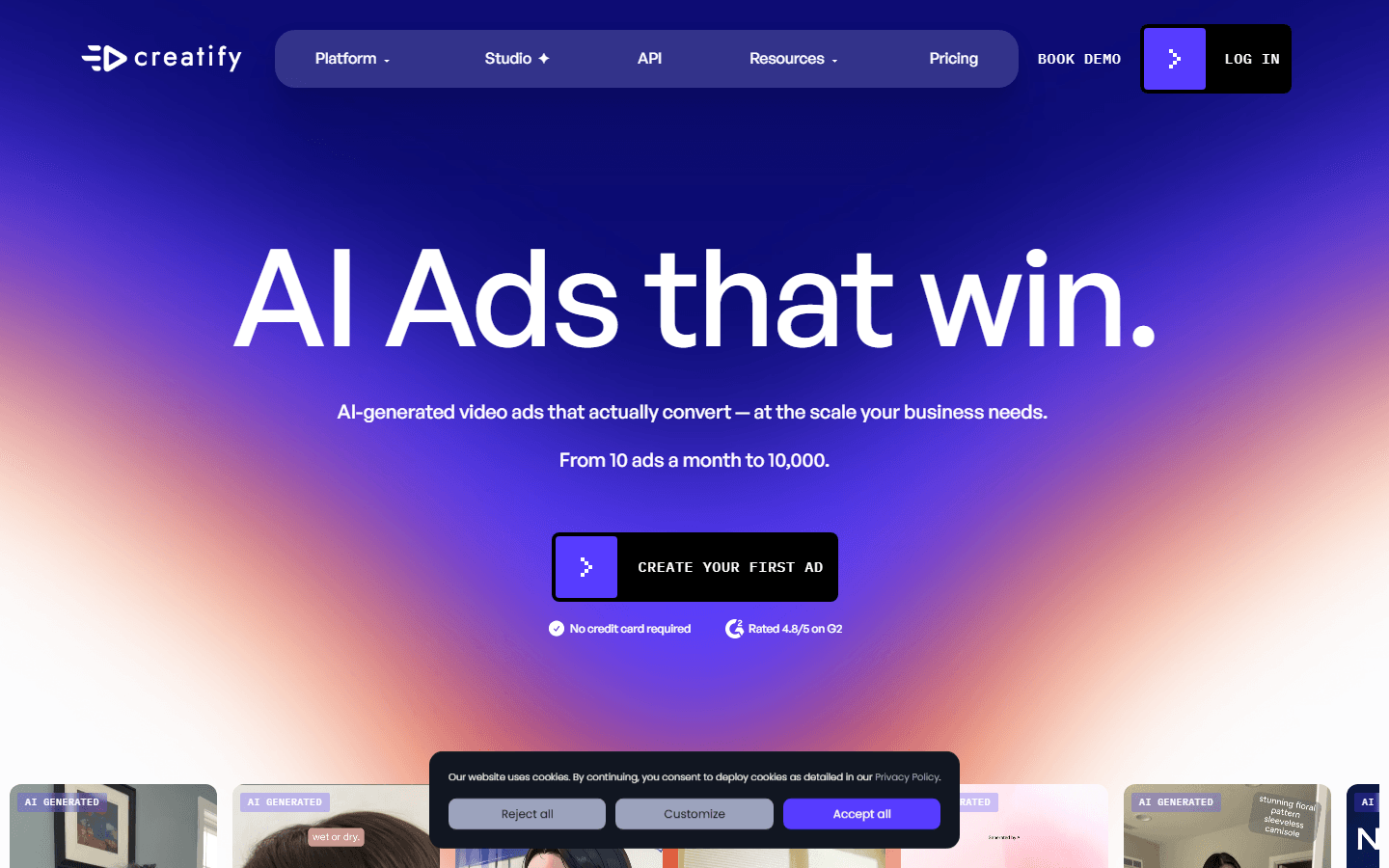
Creatify takes a product URL, scrapes the images and copy, writes a script, and renders a UGC-style video ad with an AI presenter. For ecommerce this is the shortest path from listing to ad in the entire list, and batch mode produces several script and avatar combinations in one run so you can test hooks rather than guess. Resolution and lip sync are good enough for feed placements, which is where these ads live anyway.
The limits are the avatars and the pacing. Presenters are recognizable across brands, so the format works better for direct response than for brand work. Pricing starts near $39 per month for a modest render allowance. Teams comparing this class of tool directly should read our Arcads vs Creatify comparison, which covers avatar quality and script control side by side.
Verdict: best for ecommerce teams that want UGC-style video ads generated straight from product pages.
5. Arcads: Best AI Actors
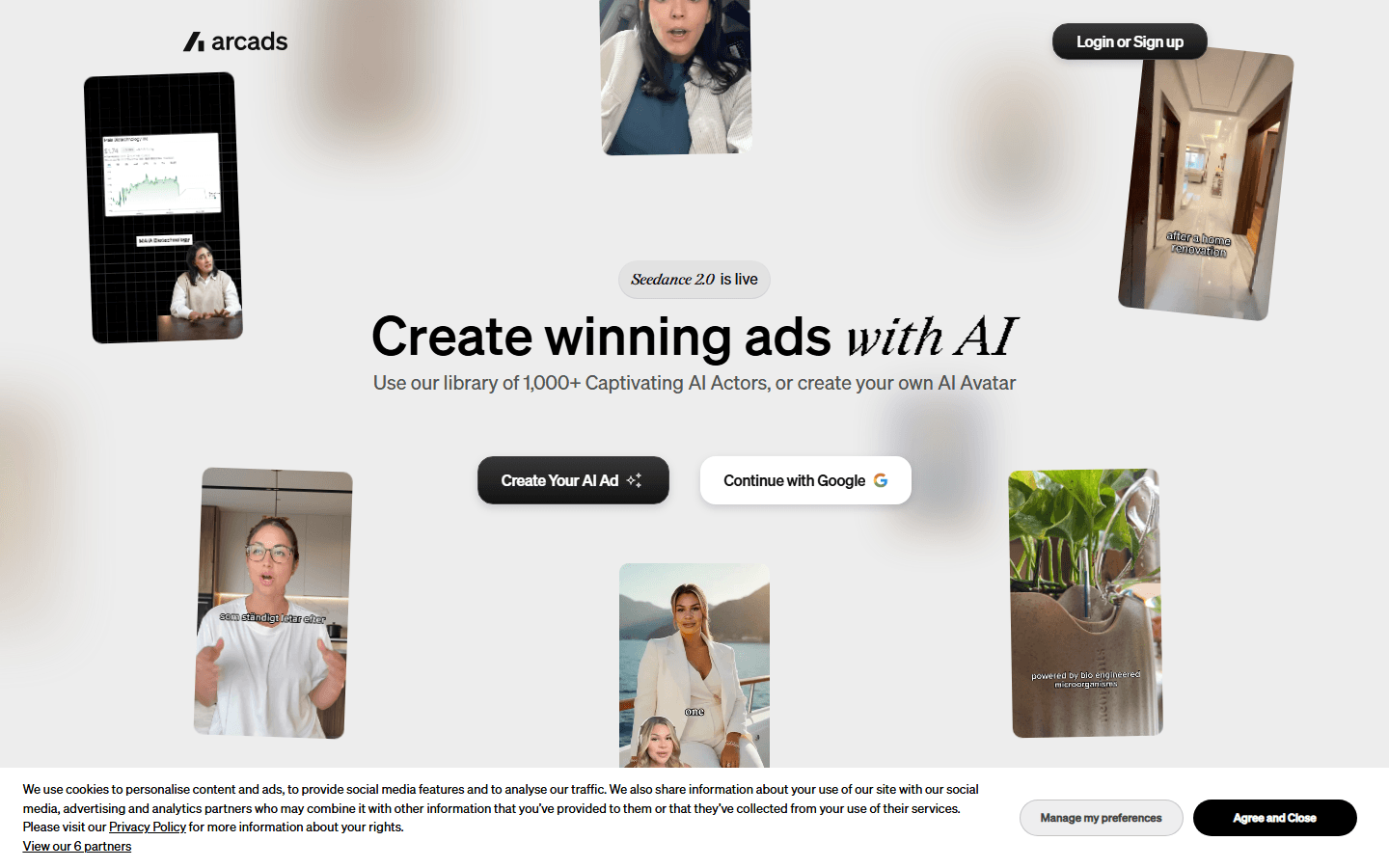
Arcads is built around a large roster of licensed AI actors reading scripts you supply. You write or generate the script, choose the presenter and the delivery, and get a talking-head ad in a few minutes. The actor library is the differentiator, with enough range in age, look, and accent that a brand can keep a consistent spokesperson across a campaign.
It is script in, video out, so it does not generate product visuals, b-roll, or scenes; you supply those or go without. Pricing is one of the higher entries here, starting around $110 per month, which is the main objection for small teams. Our Arcads pricing breakdown covers what each tier includes, and agencies pricing this into client work can reference what to charge for AI UGC ads.
Verdict: best when the ad is carried by a person talking and the script already exists.
6. Omneky: Best for Enterprise
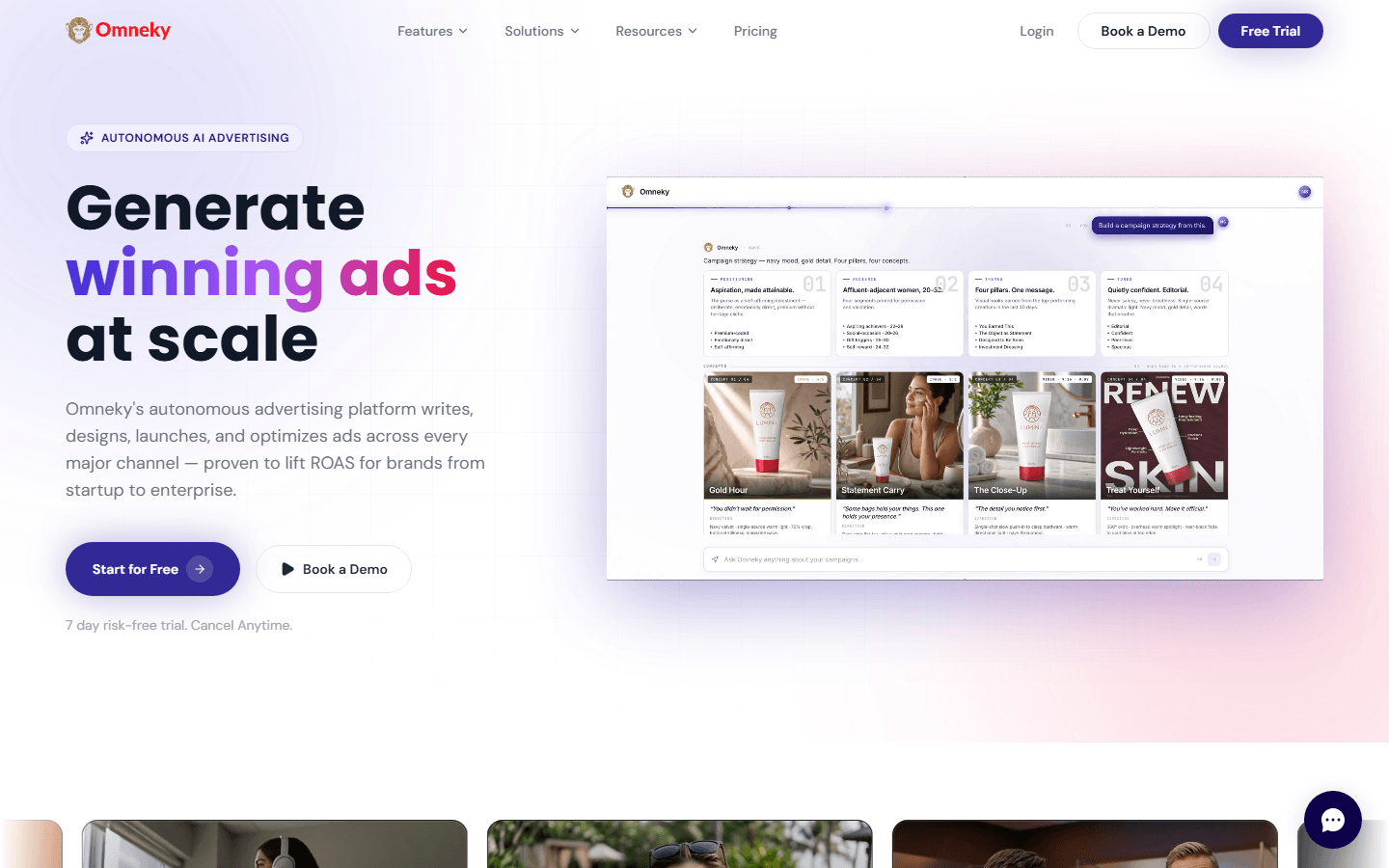
Omneky connects creative generation to the ad accounts themselves, pulling performance data back in so the next generation round is informed by what converted. That closed loop is what enterprise buyers pay for, along with brand governance, approval flows, and managed onboarding. It handles static and video across Meta, Google, TikTok, and LinkedIn from one workspace.
It is not self-serve in any meaningful way. Pricing is quote-based and typically lands in the four-figure monthly range, and onboarding takes weeks rather than minutes. For a company running seven-figure annual spend across several brands that overhead is reasonable; below that, the same loop can be assembled from cheaper parts. The pattern is close to what we describe in agentic advertising, where generation and measurement run as one system.
Verdict: best for large advertisers who need creative production, governance, and performance feedback in one contract.
7. Pencil: Best for Brand Teams
Pencil generates ad variants inside brand guardrails, which is its whole reason to exist. You load fonts, colors, logo rules, and approved product imagery, and generation stays inside those constraints, so output does not need a brand review round before it ships. Predictive ranking sits on top, scoring variants against historical performance in your category.
Because the guardrails are tight, the creative is safe rather than surprising, and teams looking for a genuinely new visual idea will find it conservative. Pricing is quote-based on most plans and aimed at brands and agencies rather than solo operators. Teams who want the variant mechanic without the brand layer can look at the video ad variant generator.
Verdict: best for brand teams that need on-guideline ad variants without a manual approval bottleneck.
8. Predis.ai: Best for Social Volume
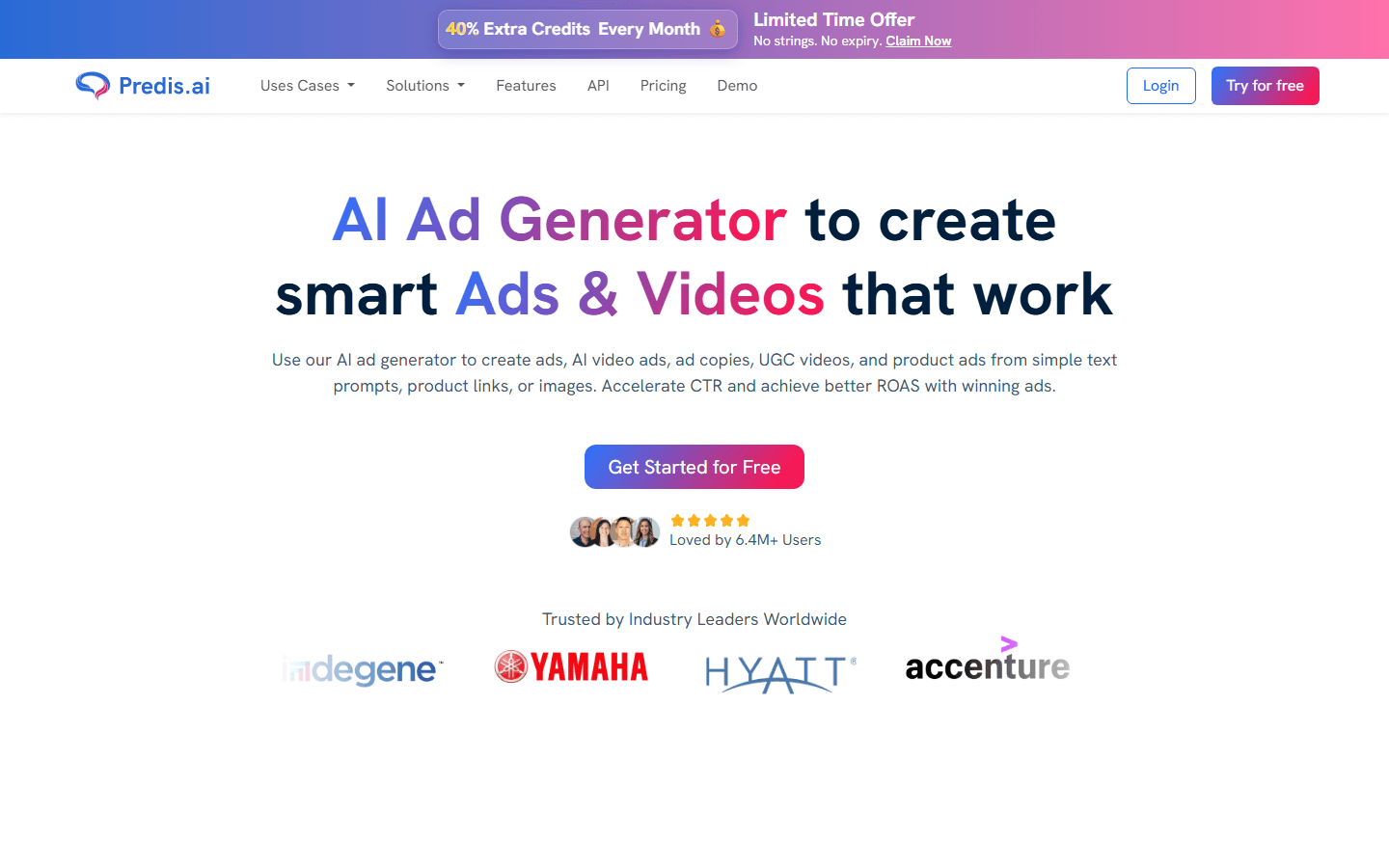
Predis.ai is built for organic and paid social volume: give it a product or a topic and it produces carousels, single images, short videos, and the captions and hashtags to go with them. For small businesses running their own social plus a modest ad budget, one subscription covers the output need, and the scheduling and competitor analysis features remove a second tool from the stack.
Creative depth is the tradeoff. Output reads as templated on close inspection, and the video generation is closer to animated slides than to generated footage. Plans start around $32 per month, the cheapest real entry point here. It suits solo marketers and small agencies producing a lot of mid-quality social creative. Agencies at higher volume should look at the bulk video ad API approach instead.
Verdict: best for small teams that need high social output volume at the lowest monthly cost.
9. Canva: Best for Non-Designers
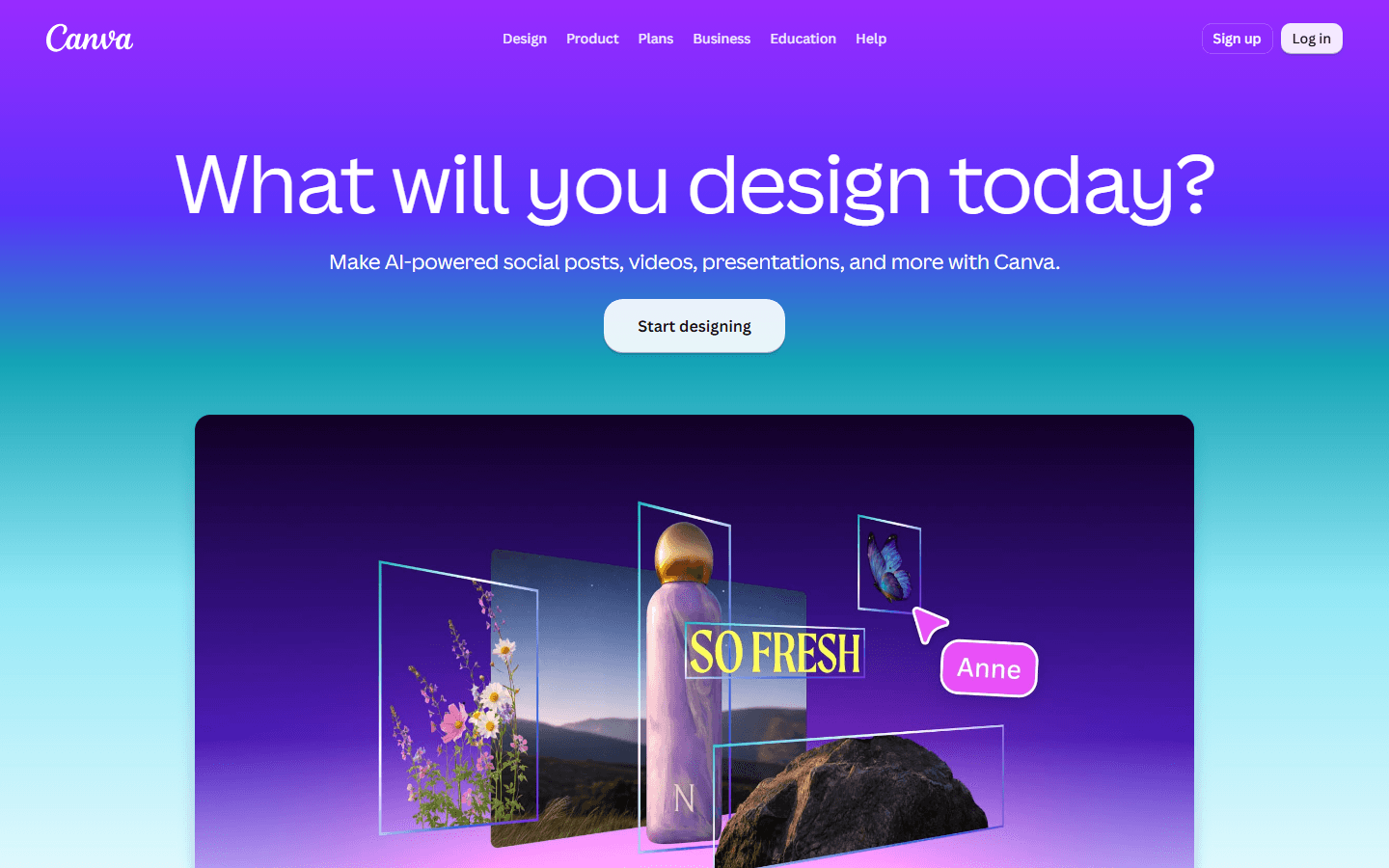
Canva earns its place because most ad creative is still assembled by someone who is not a designer, and Canva is where that person already works. Magic Media generates images and short clips, Magic Switch resizes a finished ad into every placement spec in one click, and the template library covers every ad format worth running. Brand kits keep colors and fonts consistent across a team.
It is a design tool with AI features, not an ad system: no performance scoring, no variant economics, no connection to your ad accounts. Generation quality also sits below the dedicated image models the other tools use. The free tier is genuinely usable and Pro runs about $15 per month per user. For teams making a handful of ads a month that is the correct answer, and everything above it is overhead.
Verdict: best for small teams making a few ads a month who want templates and resizing over generation depth.
Comparison Table
| Tool | Best For | Starting Price | Generates Video | Performance Scoring |
|---|---|---|---|---|
| Wireflow | Multi-model ad pipelines | Credit-based | Yes | No |
| Zeely.ai | Ecommerce ad workflows | $29.95/mo | Yes | No |
| AdCreative.ai | Static ad volume | ~$39/mo | Limited | Yes |
| Creatify | UGC video from product URLs | ~$39/mo | Yes | No |
| Arcads | Scripted AI presenters | ~$110/mo | Yes | No |
| Omneky | Enterprise creative ops | Quote | Yes | Yes |
| Pencil | Brand-safe variants | Quote | Yes | Yes |
| Predis.ai | Social volume | ~$32/mo | Basic | Limited |
| Canva | Non-designer assembly | Free / ~$15/mo | Basic | No |
Which Tool Fits Which Team
Solo operators and small businesses should start at the bottom of the list and move up only when volume forces it, because Canva or Predis.ai will cover a few ads a month at a fraction of the cost. Ecommerce teams testing hooks weekly get the most from Creatify or Arcads, where the bottleneck is presenter and script variety rather than visual production. In-house performance teams running heavy static rotation get the clearest value from AdCreative.ai scoring, since the ranking removes the slowest decision in the process.
Agencies producing across multiple clients or products land in different territory, because the cost that matters is per variant rather than per seat. That is where a pipeline that regenerates from a swapped input beats a form you refill by hand, and it is the same logic behind our AI UGC ads for agencies setup. Teams replacing an existing avatar tool usually start from the Arcads alternative comparison.
Try it yourself: Build this ad creative workflow, where the nodes are pre-configured with the ad concept and image model setup described above.
Frequently Asked Questions
What is the best AI ad generator in 2026?
For repeatable, multi-format ad production, Wireflow ranks first because it chains several AI models into one pipeline you can rerun with new inputs. For single statics with a performance prediction attached, AdCreative.ai is the stronger pick, and for UGC-style video from a product page, Creatify is fastest.
Can AI generated ads actually be used on Meta and TikTok?
Yes. Both platforms allow AI generated creative and neither requires disclosure for standard commercial ads, though Meta labels some AI-edited content in organic contexts. The practical constraints are the usual ones: no misleading claims, no unlicensed likenesses, and correct aspect ratios and durations per placement.
How much do AI ad tools cost?
Entry plans cluster between $30 and $50 per month for template-based tools, avatar video platforms start closer to $110 per month, and enterprise creative systems are quote-based in the four-figure monthly range. Credit-based platforms charge per model run instead, which usually works out cheaper for irregular volume.
Do AI generated ads perform as well as human-made ads?
In direct response the tested results are close, and volume tends to win: teams that ship fifteen variants and kill the losers usually beat teams that ship three polished ads. For brand campaigns where a single execution carries the whole spend, human-led creative still holds an advantage.
Can these tools use my own product photos?
Most can. Creatify, Pencil, and Canva accept uploads directly, and node-based tools accept a product image as the input to the whole chain, which keeps the real product in every generated variant. Tools that generate the product visual from a text prompt alone are risky for ecommerce, because the rendered product will not match the listing.
What is the difference between an AI ad generator and an AI ad agent?
A generator produces the creative asset when you ask for it. An agent decides what to produce, launches it, reads the results, and iterates without a fresh prompt each time. The distinction is covered in detail on our AI ad agent page.
How many ad variants should I generate per concept?
Ten to fifteen per concept is the common working range for Meta and TikTok, split across hooks, formats, and aspect ratios. Below five you cannot tell a bad variant from a bad concept, and above twenty the incremental learning per variant drops off sharply.
Do I need separate tools for static and video ads?
Not any more. Most platforms here produce both, though quality is rarely even across the two, so check the format you actually run most. Pipeline tools avoid the issue by letting you pick a different model for each output type inside the same build.
Conclusion
The AI ad tooling market in 2026 rewards matching the tool to your variant economics rather than chasing the highest-rated option. If you ship a few ads a month, a template platform is the right call and anything heavier is wasted spend. If you ship dozens across products, clients, or languages, the cost that matters is what the fifteenth variant costs to produce, and that is where model-chaining pipelines pull ahead of form-based generators. Start with the cheapest tool that clears your volume bar, and move up only when the manual work becomes the bottleneck.

Co-Founder & Operations at Wireflow
Runs client operations and content strategy at Wireflow. Works directly with creative teams and agencies to build production AI workflows.
- Content Strategy
- Client Operations
Make AI videos and ads.
Start free, no card needed.