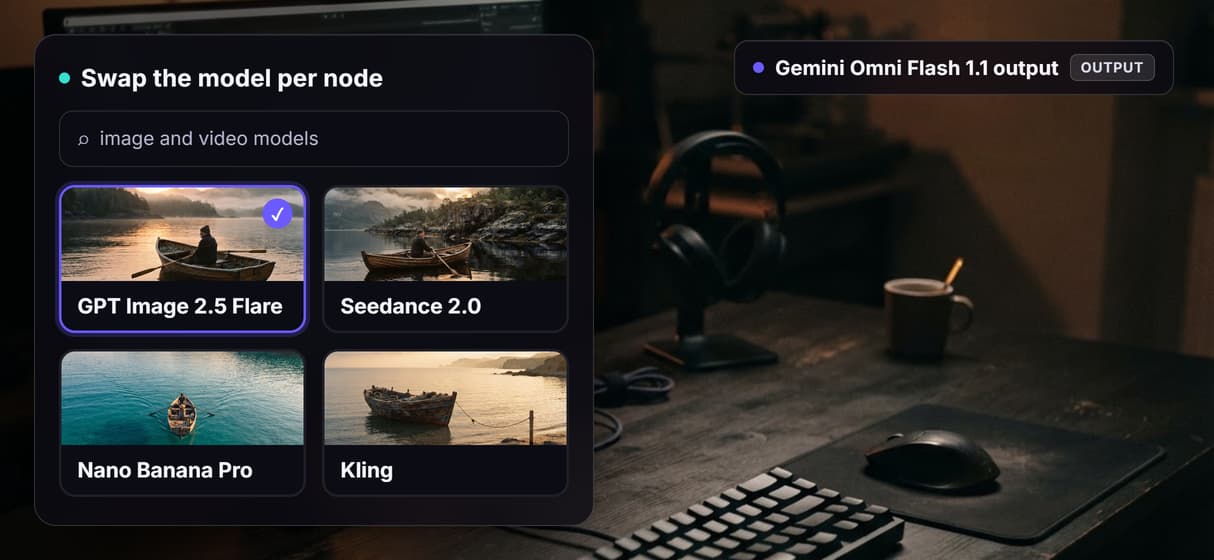
Wireflow gives developers REST API access to 150+ AI models for image generation, video synthesis, and multi-model pipelines through a single authenticated endpoint. Whether you are building ad creative automation, product catalog generators, or custom design tools, the right creative AI API determines how far you can scale. This guide ranks seven platforms in the same space as Krea AI's API by model selection, API quality, pricing, and developer experience.
For full request/response formats, polling patterns, and rate limit documentation, the Wireflow API documentation is the authoritative reference used throughout this article.
Quick Summary
- Wireflow: Best Overall; 150+ models, single REST endpoint, webhook triggers
- Krea AI: Best for creative professionals needing compute credits across image and video
- Replicate: Best for open-source model access via API
- Leonardo AI: Best for artistic image generation with fine-tuning support
- Runway: Best for cinematic AI video generation via API
- Ideogram: Best for text rendering accuracy inside generated images
- Freepik AI: Best free starting point for licensed image generation
What to Look for in a Creative AI API
The best creative AI APIs share a few core properties: they use async execution patterns so your application does not block on generation, they provide predictable pricing tied to model runs, and they support building AI pipelines where outputs from one model feed inputs to another.
Beyond the core pattern, pay attention to webhook support for no-auth triggers, native batching for running image generation at scale, and how the rate limit system surfaces remaining capacity. An API that fails silently or returns opaque 429s without retry guidance costs engineering time you cannot recover.
1. Wireflow: Best Overall

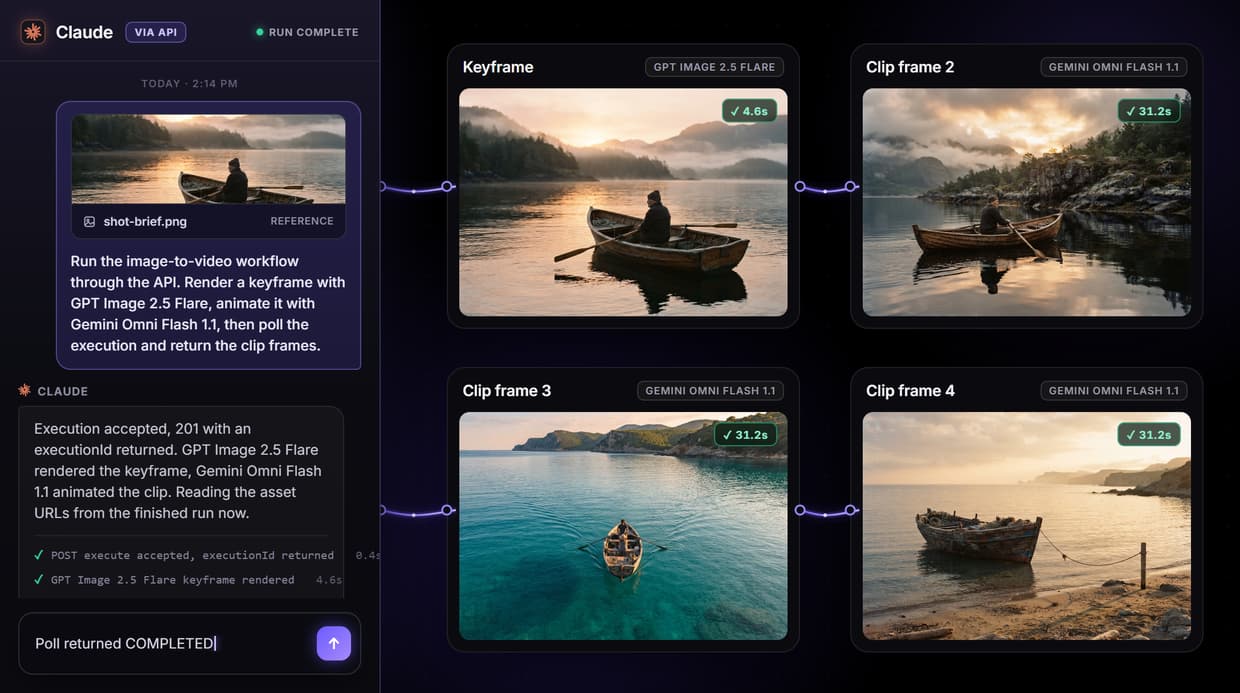
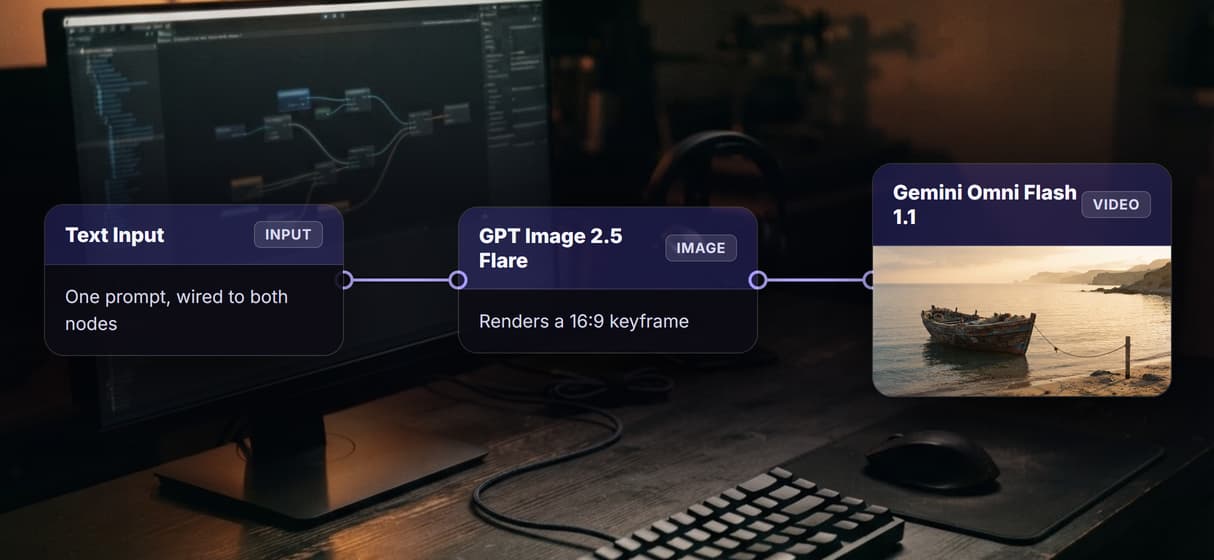
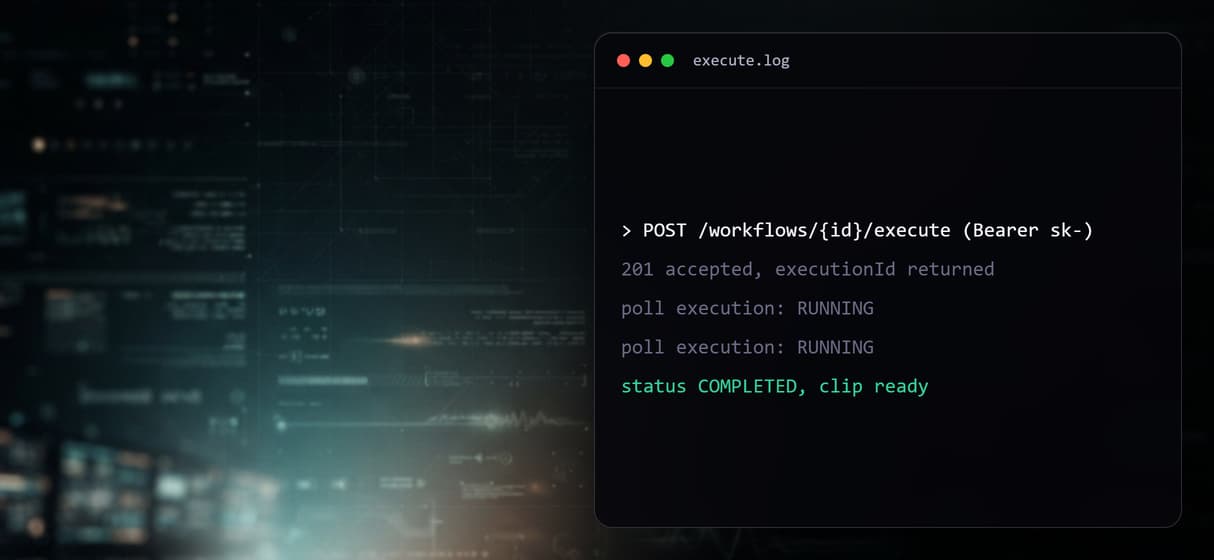
Wireflow is a visual workflow platform with a full AI workflow API that gives you authenticated REST access to every model on the canvas. You build a node graph in the UI, publish it, and call the resulting workflow endpoint with a single POST request. The API returns an executionId, which you poll until status reaches COMPLETED.
The execution model is straightforward: POST to /api/v1/workflows/{id}/execute, poll /api/v1/workflows/executions/{id}/poll, then read node outputs from the response. The platform includes an AI orchestration layer that handles model routing, retries, and output normalization so you do not write that logic yourself.
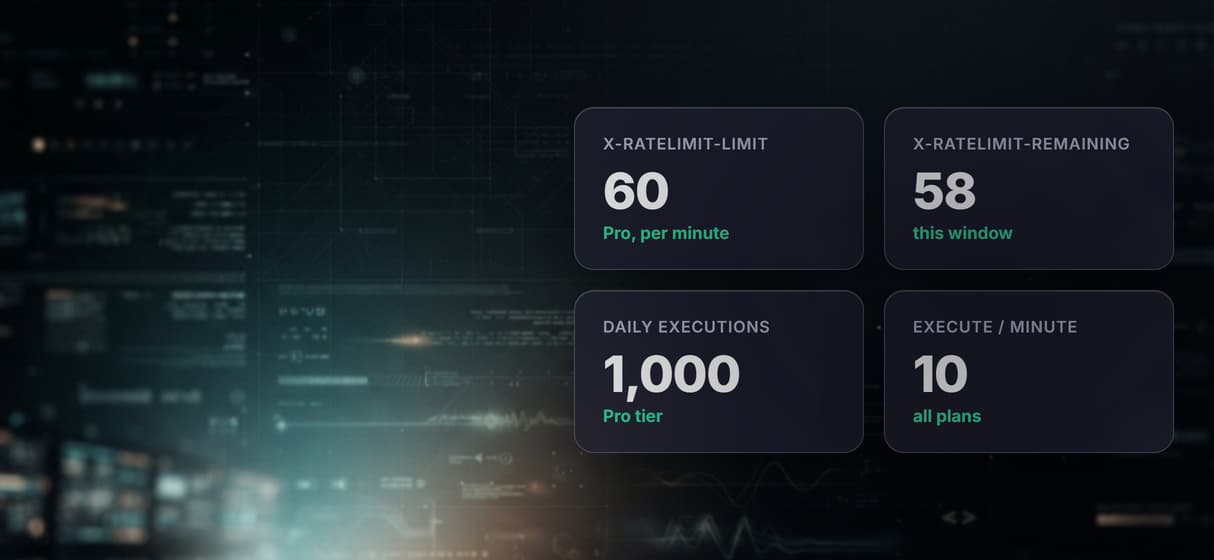
Pricing ranges from 50 daily executions on the Free plan to unlimited on Enterprise. The pricing page breaks down credit costs per model, which matters if you are running video generation at scale since heavier models consume more credits per execution.
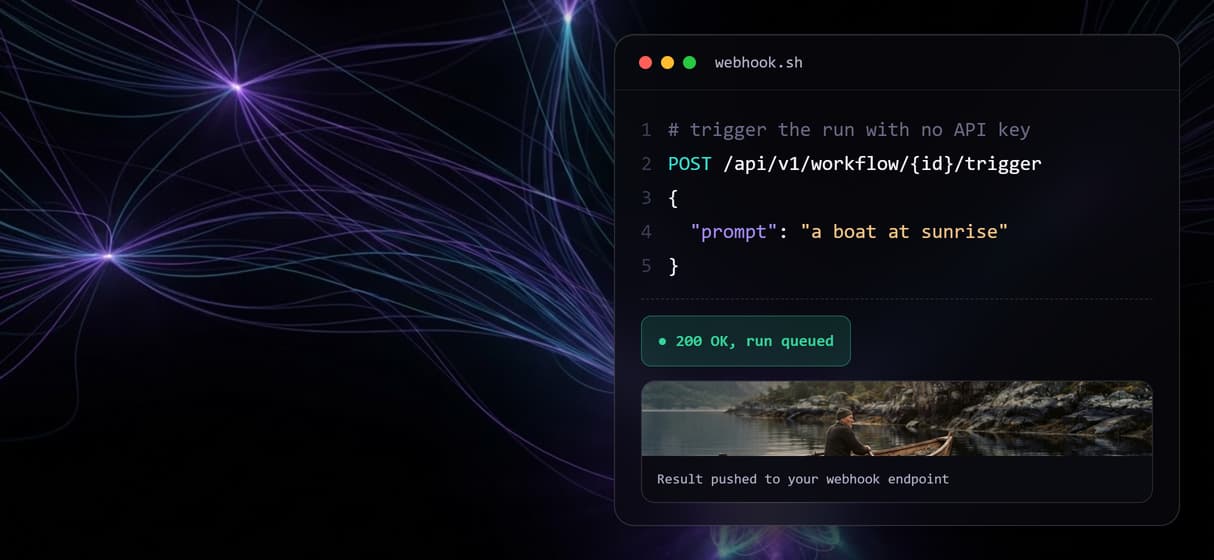
Key strengths: webhook triggers with no API key required, idempotency headers to prevent duplicate runs on retry, and a node catalog that includes models from Black Forest Labs, Google DeepMind, ByteDance, and Kling.
2. Krea AI: Best for Creative Professionals

Krea AI offers API access to 20+ image models, video generators, and upscalers through a compute credit system. Each model has a fixed credit cost: Flux sits around 5 CU, while Veo 3 runs around 1,017 CU. The API accepts model name, prompt, and optional parameters, returning an async job ID you poll for results.
The platform is strongest for teams already using Krea's GUI tools who also need access to AI content generation options programmatically. Developers who need multi-step pipelines or webhook triggers will find Krea's API surface less composable than platforms built API-first, since there is no native workflow chaining or no-auth trigger system.
Pricing: Compute-based with packages starting around $35/month. A free tier includes limited credits.
3. Replicate: Best for Open-Source Models

Replicate runs open-source models as managed API endpoints. Any model pushed to the Replicate registry becomes callable via a standardized REST interface, making it the default choice for teams that want community models, including fine-tuned SDXL variants, experimental generators, and research models, that commercial platforms do not host.
The async pattern mirrors other platforms: POST to create a prediction, poll for completion, retrieve output URLs. The limitation is that Replicate does not support workflow-level orchestration natively, so multi-step pipelines require custom application code. If you want to compare which production-grade models are available as pre-wired workflows, the Wireflow model catalog lists all supported node types.
Pricing: Per-second compute billing. Lightweight image models run fractions of a cent per run.
4. Leonardo AI: Best for Artistic Generation

Leonardo AI provides text-to-image and image-to-image APIs with strong support for custom LoRA fine-tuning. You can train a model on your brand's visual style, then call that model through the API to produce on-brand images at scale. The platform also covers inpainting, outpainting, and upscaling through separate endpoints.
For developers building a product that needs a custom AI face generator or character art pipeline, Leonardo's fine-tuning route is a meaningful differentiator. The REST API is well-documented with clear parameter schemas and consistent response shapes.
Pricing: Subscription-based with token allocations. Plans start free with 150 tokens per day.
5. Runway: Best for Video Generation

Runway offers API access to Gen-4 and Gen-4 Turbo for text-to-video and image-to-video generation. The async pattern is the same as image platforms but with longer poll windows, since video generation typically takes 30–90 seconds per clip. Outputs are returned as MP4 URLs at up to 1080p resolution.
For applications that need to turn product photos into short promotional clips, Runway is one of the more reliable commercial video API providers. Teams that want video generation alongside image models in a single workflow can use the Kling AI API node in Wireflow, which follows the same polling interface without requiring a separate API account.
Pricing: Credits-based. Starter plans run around $12–15 per month.
6. Ideogram: Best for Text in Images

Ideogram specializes in image generation where readable, accurate text inside the image is a requirement, including ad creatives, banners, social posts, and branded visuals. Text rendering accuracy is consistently higher than general-purpose models for this specific use case.
The API supports text-to-image, remix (image-to-image with prompt guidance), and inpainting. If your pipeline generates images with embedded copy for ad campaigns or social media, Ideogram is worth benchmarking before committing to another provider. Note that there is no native batch image generation API endpoint, so high-volume generation requires sequential calls.
Pricing: Token-based with a free tier of 25 slow-queue generations per day.
7. Freepik AI: Best Free Starting Point

Freepik AI provides image generation API access backed by commercially licensed training data. For teams with IP requirements around output ownership, Freepik's licensing position reduces legal risk compared to models trained on scraped data.
The Freepik Spaces API is a related product that adds canvas-style collaboration to image generation. Both work best as a starting point for teams evaluating API-driven creative workflows before investing in a platform like Wireflow for headless AI workflow automation.
Pricing: Free tier available. Paid plans start around $8/month.
Comparison Table
| Platform | Multi-model | Webhook | Batch | Video | Free Tier | Starting Price |
|---|---|---|---|---|---|---|
| Wireflow | Yes (150+) | Yes (no-auth) | Yes | Yes | Yes (50 runs/day) | Free |
| Krea AI | Yes (20+) | No | Limited | Yes | Yes | ~$35/mo |
| Replicate | Yes (open-source) | Yes | No | Yes | No | Per-second |
| Leonardo AI | Yes | No | Limited | No | Yes (150 tokens/day) | Free |
| Runway | No (video only) | No | No | Yes | No | ~$12/mo |
| Ideogram | No (image only) | No | No | No | Yes (25/day) | Free |
| Freepik AI | Limited | No | No | No | Yes | ~$8/mo |
The comparison above covers the primary decision factors. For a full breakdown of API authentication methods across platforms, see the Wireflow authentication docs; the Bearer token pattern described there is representative of how most platforms above structure their auth.
Try it yourself: Build this workflow in Wireflow. The nodes are pre-configured with a text prompt feeding directly into a Flux 2 Pro generation node, producing the same output style discussed throughout this article.
FAQ
What is the difference between Krea AI's API and Wireflow's API? Krea AI calls individual models through a compute endpoint with fixed credit costs per model. Wireflow executes node-based workflows, so you can chain models, add conditional routing, and trigger runs via webhook, all through the same execute endpoint.
Does Wireflow support webhook triggers without an API key?
Yes. POST to the workflow's webhook URL with no authentication to start a run. The webhook returns a 202 and an executionId, which you then poll using your API key. Full details are in the webhook documentation.
How do I prevent duplicate executions when retrying failed requests?
Send an Idempotency-Key header on POST requests to /execute. Any repeat request with the same key within 24 hours replays the original response rather than triggering a new run.
What rate limits should I plan for in production?
Wireflow rate limits depend on plan: 10 requests/min on Free, up to 200 on Enterprise, with a consistent cap of 10 executions/min across all tiers. See the rate limits reference for headers that surface remaining capacity on every response.
Which platforms support multi-step AI pipelines natively? Among the seven platforms above, only Wireflow supports native workflow chaining through its node graph system. Replicate and Krea AI require you to handle orchestration in application code.
Can I use these APIs in commercial products? Most platforms allow commercial use on paid plans. Freepik AI is notable for training on licensed data, which reduces output IP risk. Check each platform's terms, particularly around output ownership and model-specific restrictions.
What is the async execution pattern and why does it matter? AI generation tasks typically take 5–60 seconds. An async API lets you POST a job and continue processing, polling for results instead of holding an open HTTP connection. This is necessary for scalable applications where synchronous calls would time out.
How do credits differ across model types on Wireflow?
Each model node consumes a fixed number of credits per execution. Lightweight image generators consume far fewer credits than video models. You can review per-model credit costs in the execution documentation.
Conclusion
The seven platforms above cover the main paths developers take when building AI-powered creative applications in 2026. Model selection, pipeline flexibility, and pricing transparency vary significantly across them. For teams evaluating AI orchestration APIs that can handle multi-model workflows without custom middleware, the platforms that support native chaining and webhook triggers offer the clearest path to production.