Gemini Omni Flash 1.2 Pricing: Cost per Second and per Clip (2026)

In this article▾
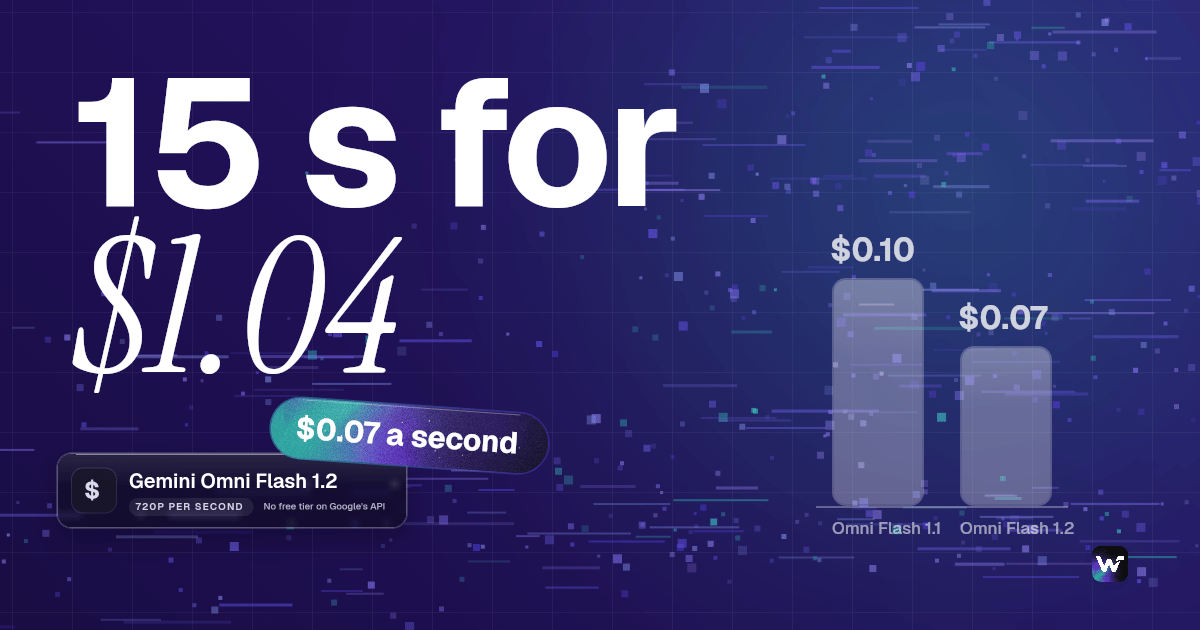
Gemini Omni Flash 1.2 pricing on Google's API is about $0.07 a second at 720p, so a full 15 second clip costs about $1.04, and Google has no free tier for it. We read these prices on 6 November 2026, the day after Google launched the model as Gemini Omni 1.2 Flash. This guide covers the rate at each resolution, what changed from 1.1 and three worked budgets. It also prices the same model in credits on Wireflow, which runs it as a node next to 100+ AI models.
On Wireflow, Gemini Omni Flash 1.2 costs about 89 credits for an 8 second clip at the default 720p and up to about 167 credits for 15 seconds. At about 1.35 cents a credit on monthly plans, or about 1.13 cents on yearly billing, that's $1.00 to $1.20 for 8 seconds and $1.88 to $2.26 for 15. That's about 1.8 to 2.2 times Google's own price per clip, depending on plan.
That 8 second figure is 30% below Gemini Omni Flash 1.1 in the same catalog. It matches the cut Google made on its own API. Our page on Gemini Omni Flash on Wireflow covers the model family as a whole. It shows each mode and how to test one prompt on Veo 3.1 and Seedance 2.5 as well.
Gemini Omni Flash 1.2 prices per second on Google's API
Google bills the model's video output at $12.00 per million tokens. Its pricing page turns that into a rate per second for each resolution. Google lists 1080p and 4K as upsampled output, which is why they cost more per second. The rates below come from Google AI Studio's pricing page on 6 November 2026, and we worked out the clip prices from them.
| Resolution | Price per second | 8 second clip | 15 second clip |
|---|---|---|---|
| 360p | about $0.023 | about $0.18 | about $0.35 |
| 720p | about $0.07 | about $0.55 | about $1.04 |
| 1080p, upsampled | $0.104 | about $0.83 | $1.56 |
| 4K, upsampled | $0.209 | about $1.67 | about $3.14 |
There is no free tier on the Gemini API or in Google AI Studio, so every clip bills to a paid account. On Google Cloud the model runs on Standard pay as you go or Provisioned Throughput, in the global region only. It has no batch mode, so a big overnight run costs the same per second as a single test.
Clips come in 16:9 or 9:16 at any whole-second length from 3 to 15 seconds. Google also puts an invisible SynthID watermark on every clip it makes.
Build this in Wireflow
Make the same kind of asset on a canvas you control, with a free account and no credit card.
What changed from Gemini Omni Flash 1.1
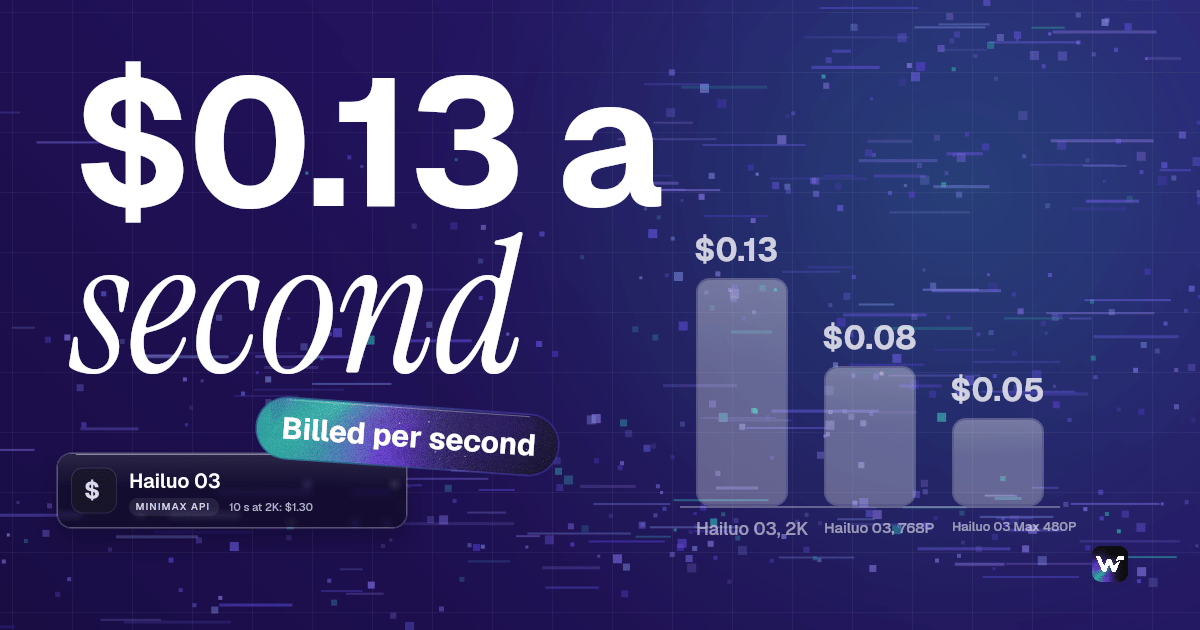
Google cut the 720p price by about 30% in 1.2. It went from about $0.10 a second on Gemini Omni Flash 1.1 to about $0.07. A 10 second clip at 720p, the longest 1.1 could make, now costs about $0.69 instead of about $1.00.
- Clips now run up to 15 seconds, where 1.1 stopped at 10.
- From 3 December 2026, Google routes API requests for gemini-omni-1.1-flash to 1.2 and bills them at 1.2 rates, so old code gets the lower price and also the newer model's output.
- Google says you can draft at 360p or 720p and upscale the take you keep to 1080p or 4K.
- Google also claims steadier characters and products across a clip, fewer jump cuts and clearer lip-sync, though we haven't seen an independent test of any of that yet.
On Wireflow the three versions are separate nodes, each with its own rate. The catalog quotes video rates per second at a 5 second reference clip. The dollar column uses Starter's $36 for 2,660 credits.
| Node on Wireflow | Credits a second, 5 second rate | 8 second clip at default settings | 8 second clip, Starter monthly |
|---|---|---|---|
| Gemini Omni Flash 1.2 | about 14 | 89 credits | about $1.20 |
| Gemini Omni Flash 1.1 | 16 | 128 credits | about $1.73 |
| Gemini Omni Flash, the original | 20 | 160 credits | about $2.17 |
Shorter clips cost a bit more per second on 1.2. Its rate of about 14 credits a second at 5 seconds falls to about 11 at 8 and 15 seconds.
What Gemini Omni Flash 1.2 costs on Wireflow
Wireflow bills the model in credits from your plan. On 6 November 2026 the plans were Starter at $36 a month for 2,660 credits and Professional at $59 for 4,370. Team was $299 for 22,140 credits, and all three come to about 1.35 cents a credit. On yearly billing, $360 a year for Starter or $590 for Professional, a credit costs about 1.13 cents. Credits you don't use carry over to the next month on every plan.
| Clip at 720p | Credits on Wireflow | Starter monthly, about 1.35 cents a credit | Starter yearly, about 1.13 cents a credit | Google's API |
|---|---|---|---|---|
| 8 seconds | about 89 | about $1.20 | about $1.00 | about $0.55 |
| 15 seconds | up to about 167 | about $2.26 | about $1.88 | about $1.04 |
| 30 seconds, two 15 second clips | up to about 334 | about $4.52 | about $3.77 | about $2.08 |
Wireflow publishes no separate credit figure for 360p, 1080p or 4K, so we quote only the 720p default here. The board shows the estimate for your length and resolution before you run, and you're charged for the real length.
The node takes a prompt, a start frame with an optional end frame, or up to 6 reference images. It also takes reference videos of up to 3 seconds each, or a clip of up to 15 seconds to edit. It switches mode by what you wire in. Every clip comes with native audio and there's no switch to turn sound off. If nobody should speak, the prompt needs to say "No dialogue".
Per clip, Google's API costs less, about $1.04 for 15 seconds at 720p against $1.88 to $2.26 in credits. On Wireflow you don't need a Google Cloud project, an API key or any code. You run the node on the canvas, or from Claude through the Wireflow connector, and one credit balance covers it and the rest of the 100+ AI models on Wireflow. You can compare video models side by side on one prompt and cut the takes in the Video Editor, whose exports use no credits.
Our page on making Gemini Omni Flash 1.2 clips in Claude shows the Claude route step by step.
What a 15 second ad, a 30 second spot and a draft-first clip cost
A 15 second ad
One 15 second clip at 720p costs about $1.04 on Google's API, or $1.56 if you want 1080p. On Wireflow the same clip at 720p costs about 167 credits, which is about $2.26 on Starter monthly or $1.88 on yearly billing. Fifteen seconds is also the longest single take 1.2 can make.
A 30 second spot from two clips
Since 1.2 tops out at 15 seconds, a 30 second spot is two clips cut together. That comes to about $2.08 at 720p on Google's API. On Wireflow it costs about 334 credits, which is about $4.52 on a monthly plan or $3.77 on yearly billing, and both clips feed the Video Editor on the same board. Wiring the same reference images into both clips keeps the product and the presenter matching across the cut. Our page on multi-shot video stitching walks through that job.
With one retake of each clip, the spot comes to about $4.16 on Google's API or about 668 credits on Wireflow.
Draft at 360p, then finish at higher resolution
On Google's API, three 15 second drafts at 360p cost about $1.04 in total. Upscaling the one you keep to 1080p adds about $1.56, assuming the upscale bills at Google's listed 1080p rate. On that assumption the finished clip comes to about $2.60, where four takes rendered at 1080p would cost $6.24.
Wireflow's model guide says 1080p and 4K make a new take from the same prompt, which won't match your draft. So on Wireflow you use 360p drafts to settle the prompt, then run the final at 720p as a new take for up to about 167 credits. To get more pixels from that exact take, you can upscale it with the Topaz Upscale Video node, estimated at about 4 credits a second, or roughly 60 credits for 15 seconds.
Ways to spend less on Gemini Omni Flash 1.2
- A 360p draft on Google's API costs about a third of the 720p price, about $0.35 for 15 seconds.
- Billing is per second, and 1.2 takes any whole second from 3 to 15, so a 6 second product shot at 720p is about $0.42 on Google's API instead of $1.04 for the full length.
- Reference images cut down on re-rolls when a character or product has to look the same. Google's Cloud docs list up to 10 images a prompt and Wireflow's node takes 6, with up to 3 per character, and the guide suggests saying in the prompt what each image is for.
- The model cuts between shots by default, so writing "single continuous shot, no scene cuts" saves the takes you'd throw away for an unwanted cut.
- On Wireflow you can run one prompt into Gemini Omni Flash 1.2 and a second model and keep whichever earns its credits.
Of the five video nodes below, Gemini Omni Flash 1.2 has the lowest rate per second. The figures are from the catalog on 6 November 2026.
| Model on Wireflow | Credits a second, 5 second rate | Catalog example clip |
|---|---|---|
| Gemini Omni Flash 1.2 | about 14 | 89 credits for 8 seconds |
| Veo 3.1 Lite | 16 | 128 credits for 8 seconds |
| Kling 4.0 | 19 | 91 credits for 5 seconds |
| Seedance 2.5 | 27 | 135 credits for 5 seconds |
| Veo 3.1 | 64 | 417 credits for 8 seconds |
For what Google's Veo costs outside Wireflow, our guide to Veo 3.1 pricing has the per-second rates and code examples.
Kling sells its newest model through monthly plans, which our breakdown of Kling 4.0 pricing lists plan by plan.
FAQ
How much does Gemini Omni Flash 1.2 cost?
Google's API charges about $0.023 a second at 360p and about $0.07 at 720p. It charges $0.104 a second at 1080p and $0.209 at 4K, with no free tier. On Wireflow it costs about 89 credits for an 8 second clip at 720p and up to about 167 credits for 15 seconds.
How much is a 15 second Gemini Omni Flash 1.2 video?
It costs about $1.04 at 720p on Google's API, $1.56 at 1080p and about $3.14 at 4K. On Wireflow a 15 second clip at 720p costs about 167 credits, which is about $2.26 on Starter monthly or $1.88 on yearly billing.
Is Gemini Omni Flash 1.2 cheaper than 1.1?
Google cut the 720p price by about 30%, from about $0.10 a second to about $0.07. On Wireflow an 8 second clip costs 89 credits on the 1.2 node, against 128 credits on the 1.1 node.
What happens to Gemini Omni Flash 1.1 on 3 December 2026?
Google says API requests for gemini-omni-1.1-flash will route to 1.2 from that date and bill at 1.2 rates. Your clips will then come from the newer model, so it's worth retesting your prompts before the switch.
Is Gemini Omni Flash 1.2 free?
Google's API has no free tier for it, and Google AI Studio runs it on paid accounts only. Android Authority reports that Google Vids lets free users make up to three 15 second videos a month with the new model.
Is Wireflow free?
You can open and change a workflow for free, and new accounts get a free video. More videos after the free one need a paid plan, from $36 a month for 2,660 credits.
How many reference images does Gemini Omni Flash 1.2 take?
Google's Cloud docs list up to 10 images a prompt. Wireflow's node takes up to 6, with up to 3 per character. It also takes up to 3 reference videos of 3 seconds each, or 1 for clips over 10 seconds.
Does Gemini Omni Flash 1.2 make sound?
Every clip comes with native audio, which can include speech, music and sound effects. Wireflow's node has no switch to turn it off. If nobody should speak, add "No dialogue" to the prompt and describe the sound you want instead.
Conclusion
Gemini Omni Flash 1.2 costs about $0.07 a second at 720p on Google's API, about 30% less than 1.1. A full 15 second clip comes to about $1.04 there. Wireflow charges about 89 credits for 8 seconds and up to about 167 for 15, the lowest of its three Omni nodes. That's $1.20 and $2.26 on monthly plans, or $1.00 and $1.88 on yearly billing. It suits a clip that's one step in a longer job with other models and the editor, starting from the AI video generator.

Co-Founder & Operations at Wireflow
Runs client operations and content strategy at Wireflow. Works directly with creative teams and agencies to build production AI workflows.
- Content Strategy
- Client Operations
Ask Claude for your next ad.
Connect once. Ask any time.
- No credit card
- You keep the rights to what you make
- Cancel anytime