Freepik has built a solid reputation for stock assets, but its AI image generation API options remain limited for developers who need programmatic access and flexible model routing. Wireflow fills that gap by letting you chain 30+ image models (including Flux 2 Pro, Recraft V4, and SDXL) inside a visual canvas and call the entire pipeline through a single REST endpoint. Below, we compare seven platforms that offer Freepik-style AI image generation with proper API support, so you can pick the tool that fits your stack.
Quick Summary
- Wireflow - Best overall: visual canvas + full REST API, 30+ models
- Freepik AI - Best for stock-native workflows: built-in asset library, limited API
- Replicate - Best pay-per-run pricing: open-source model hosting, cold starts
- Stability AI - Best for fine-tuning: Stable Diffusion family, enterprise SDK
- Leonardo AI - Best for game/concept art: alchemy engine, real-time canvas
- Fal AI - Best for speed: serverless GPU inference, sub-second latency
- GetImg AI - Best budget option: simple API, 60+ models, affordable credits
1. Wireflow
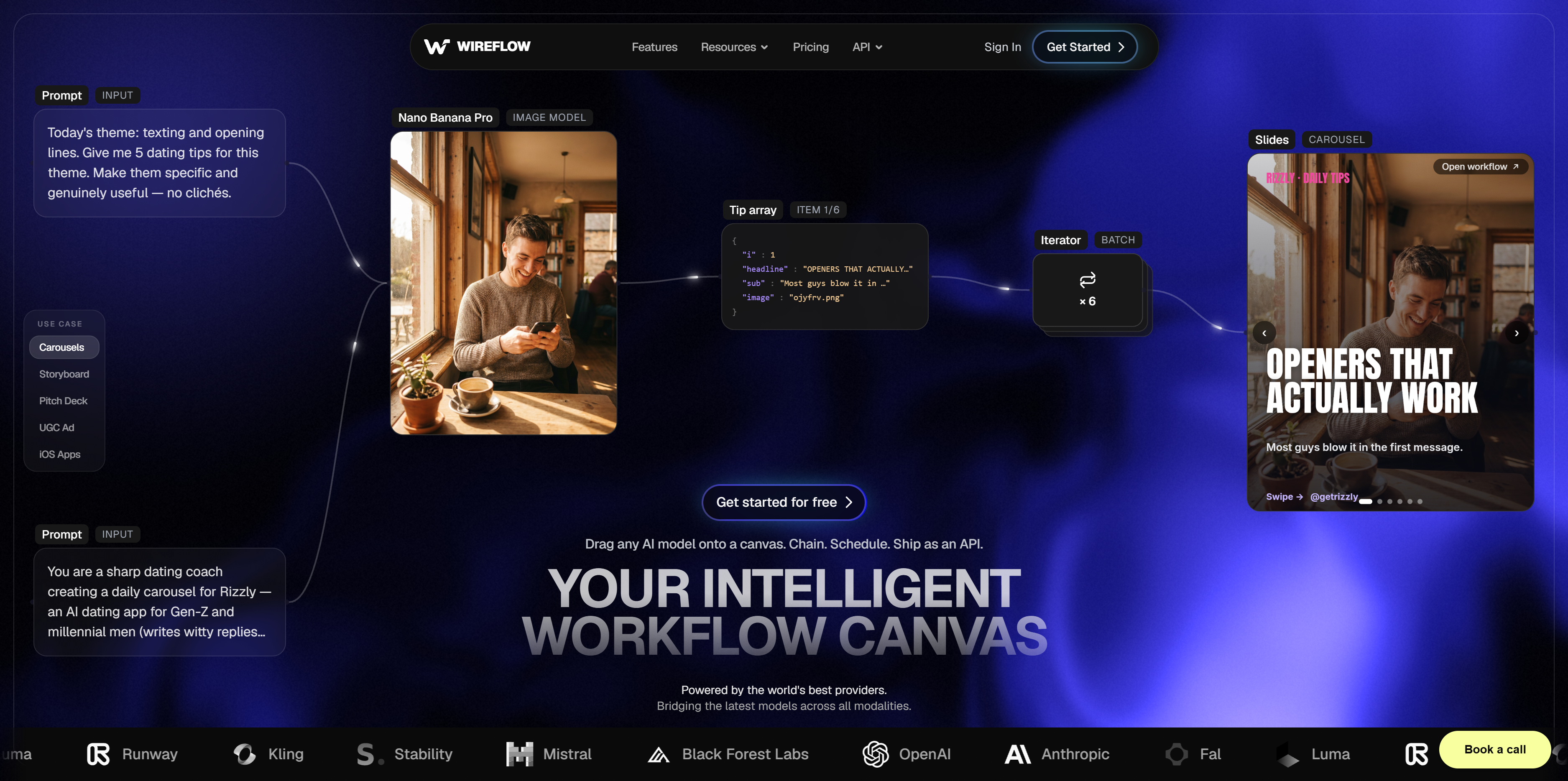
For a hands-on look at how these tools compare, check out the Freepik AI Image Generation API feature page. Wireflow gives you a drag-and-drop node editor where you wire up text inputs, image models, upscalers, and post-processing steps into reusable pipelines. Every workflow you build is callable through a REST API, which means your frontend or backend can trigger complex multi-model generations with a single POST request.
Pricing is usage-based with no per-seat fees. You pay only for the GPU seconds each node consumes. The platform supports Flux 2 Pro, Recraft V4, SDXL, Nano Banana 2, and video models like Kling 2.5 and Seedance 2.1. For teams building SaaS products that need embedded AI generation, Wireflow's white-label option lets you ship the canvas under your own brand.
| Feature | Detail |
|---|---|
| Models | 30+ (Flux 2 Pro, Recraft V4, SDXL, Nano Banana 2, more) |
| API | REST, webhook callbacks, batch endpoints |
| Canvas | Visual node editor with real-time preview |
| Pricing | Usage-based, no seat fees |
Build this in Wireflow
Make the same kind of asset on a canvas you control, with a free account and no credit card.
2. Freepik AI
Freepik AI bundles AI image generation into its existing stock platform. You get access to models like Flux Schnell, Flux Pro, Imagen, and Freepik's proprietary Mystic model, all through a single subscription. The free tier offers 20 generations per day using their in-house model only.
For developers, Freepik's API coverage is the main limitation. The platform focuses on its web UI and creative workflow tools rather than headless API access. Enterprise plans include API endpoints, but documentation is sparse compared to purpose-built API platforms. If your use case is primarily UI-based design with occasional programmatic access, Freepik delivers strong value through its massive asset library integration.
| Feature | Detail |
|---|---|
| Models | Flux Schnell, Flux Pro, Imagen, Mystic, Hyperflux |
| API | Limited (enterprise tier) |
| Free tier | 20 generations/day (in-house model) |
| Pricing | From €6/month |
3. Replicate
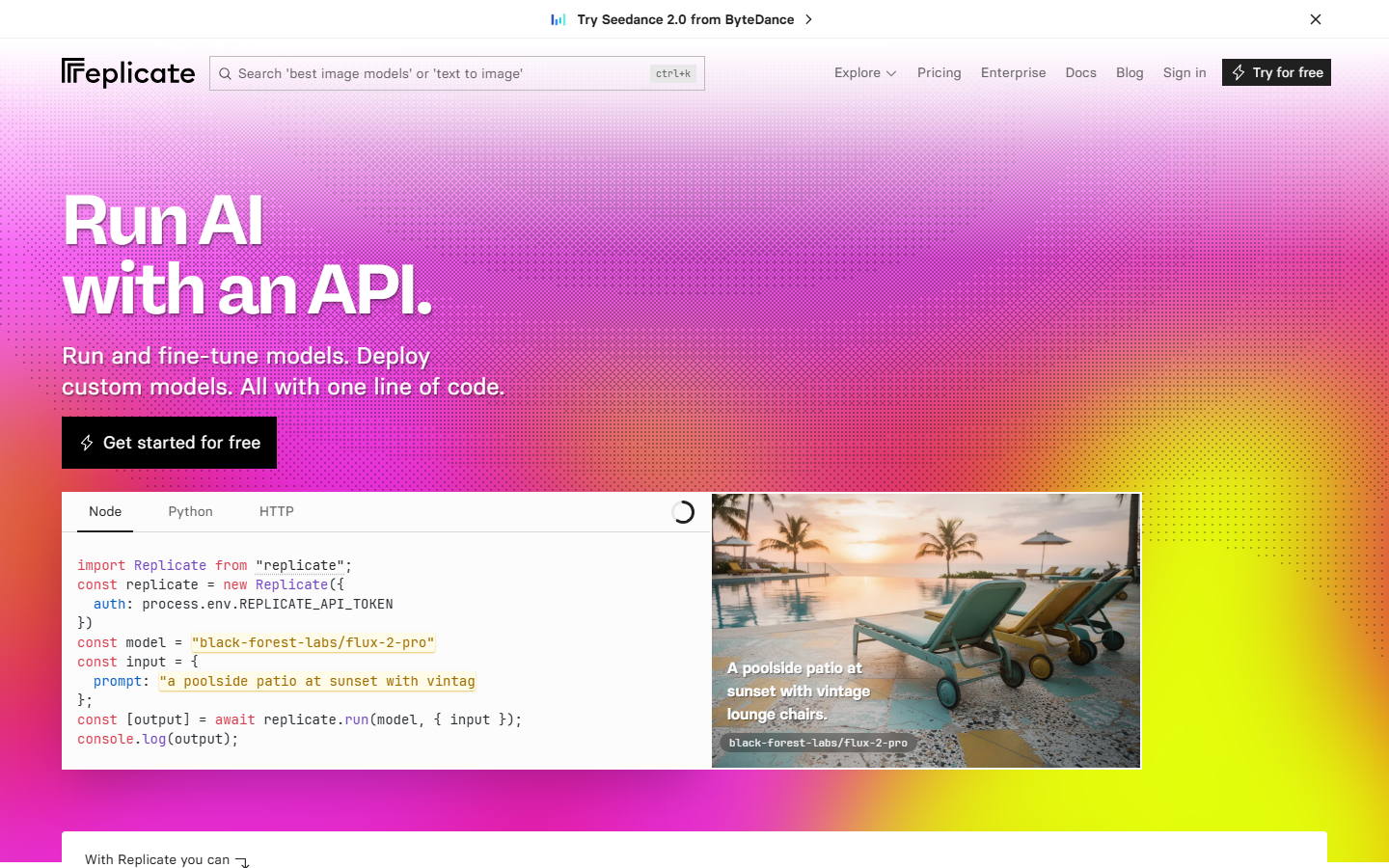
Replicate hosts thousands of open-source models behind a unified API. You push a model to their infrastructure or pick from the community library, then call it via a simple HTTP endpoint. The pay-per-second billing model keeps costs predictable for batch image generation workloads.
The trade-off is cold starts. Less popular models can take 10-30 seconds to spin up on first request. For latency-sensitive applications, you will want to keep models warm or use their dedicated hardware option. Replicate supports SDXL, Flux, and hundreds of community fine-tunes, making it ideal for teams that need variety without managing GPU clusters. If you want that same no-cluster setup with a visual build step, a node canvas with the GPU handled for you pre-wires the models and turns each pipeline into a REST endpoint and an MCP tool.
| Feature | Detail |
|---|---|
| Models | 1000+ open-source (SDXL, Flux, community fine-tunes) |
| API | REST with webhooks |
| Cold starts | 10-30s for idle models |
| Pricing | Pay-per-second GPU time |
4. Stability AI
Stability AI builds and maintains the Stable Diffusion model family. Their API gives you direct access to SD3, SDXL, and specialized models for inpainting, outpainting, and image upscaling. Enterprise customers can fine-tune models on proprietary datasets and deploy them on dedicated infrastructure.
The developer experience is polished: SDKs for Python, Node.js, and Go, plus comprehensive documentation. Pricing follows a credit-based system where different models and resolutions consume different amounts. For teams that need the Stable Diffusion ecosystem specifically, Stability's first-party API removes the latency and compatibility issues you would hit running models through third-party hosts.
| Feature | Detail |
|---|---|
| Models | SD3, SDXL, inpainting, outpainting, upscale |
| API | REST, Python/Node/Go SDKs |
| Fine-tuning | Yes (enterprise) |
| Pricing | Credit-based |
5. Leonardo AI
Leonardo AI targets game developers and digital artists with its Alchemy engine, a fine-tuned pipeline that excels at character art, environments, and concept design. The real-time canvas lets you sketch rough compositions and watch the AI refine them on the fly.
Leonardo's API supports image generation, variation, and programmatic image creation at scale. The model training feature lets you create custom models from as few as 10 reference images, which is useful for maintaining visual consistency across a game or brand. Free accounts get 150 daily tokens; paid plans start at $12/month with higher throughput limits.
| Feature | Detail |
|---|---|
| Models | Alchemy, Phoenix, custom fine-tunes |
| API | REST with generation + training endpoints |
| Real-time canvas | Yes |
| Pricing | Free (150 tokens/day), paid from $12/month |
6. Fal AI
Fal AI focuses on serverless GPU inference with sub-second cold starts. Their infrastructure pre-warms popular models like Flux Pro and SDXL so you get responses in 1-3 seconds instead of the 10-30 second waits common on other platforms. For content generation APIs that need to feel instant, Fal is a strong choice.
The API follows a simple request-response pattern with optional webhook callbacks for longer generations. Pricing is purely usage-based with no minimums or commitments. Fal also hosts video models (Kling, Seedance, Veo) if your pipeline extends beyond still images.
| Feature | Detail |
|---|---|
| Models | Flux Pro, SDXL, Recraft V4, video models |
| API | REST, webhooks, streaming |
| Cold starts | Sub-second for popular models |
| Pricing | Usage-based, no minimums |
7. GetImg AI
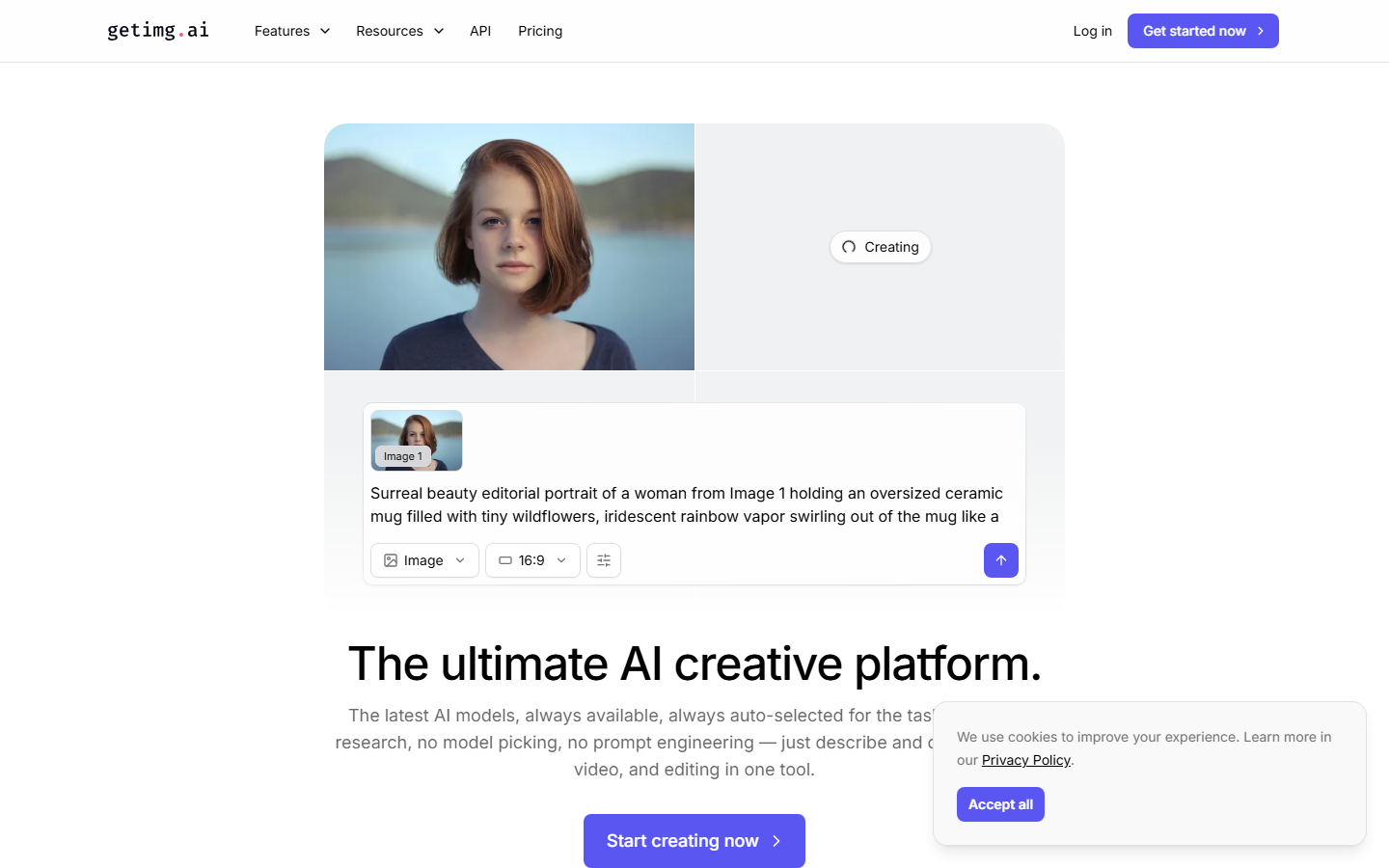
GetImg AI offers a straightforward API with 60+ models at competitive rates. The platform supports text-to-image, image-to-image, inpainting, and background generation through a consistent endpoint structure. Each model version gets its own endpoint, so you can pin your integration to a specific checkpoint.
GetImg's pricing is among the lowest in the space, making it a good fit for startups and side projects that need API access without enterprise budgets. The control panel includes usage dashboards and API key management with per-key spending limits.
| Feature | Detail |
|---|---|
| Models | 60+ (SDXL, Flux, DreamShaper, custom) |
| API | REST with model-specific endpoints |
| Inpainting | Yes |
| Pricing | Credit-based, budget-friendly |
Comparison Table
| Platform | Models | API Quality | Free Tier | Cold Starts | Best For |
|---|---|---|---|---|---|
| Wireflow | 30+ | Full REST + canvas | Usage-based trial | None | Multi-model pipelines |
| Freepik AI | 6+ | Limited | 20/day | N/A | Stock + AI hybrid |
| Replicate | 1000+ | REST + webhooks | Pay-per-use | 10-30s | Open-source variety |
| Stability AI | 5+ | REST + SDKs | Credits trial | Low | SD ecosystem |
| Leonardo AI | 3+ | REST | 150 tokens/day | Low | Game art |
| Fal AI | 10+ | REST + streaming | Pay-per-use | Sub-second | Speed-critical apps |
| GetImg AI | 60+ | REST | Credits trial | Low | Budget projects |
How to Choose the Right Platform
Picking the right Freepik AI alternative depends on your integration needs. If you want a visual workflow builder that doubles as an API, Wireflow covers both. If you need raw model variety and don't mind cold starts, Replicate's open-source library is hard to beat. For Stable Diffusion-specific work with fine-tuning, go with Stability AI directly.
Budget-conscious teams should look at GetImg AI or Fal AI. Leonardo AI is the strongest pick for game and concept art workflows. And if your team already uses Freepik for stock assets, keeping AI generation inside the same platform simplifies licensing.
Try it yourself: Build this workflow in Wireflow, the nodes are pre-configured with the exact setup discussed above.
FAQ
What is the Freepik AI image generation API?
Freepik AI provides image generation through its web platform using models like Flux Pro, Imagen, and Mystic. Full API access is currently limited to enterprise plans, which is why many developers look for API-first alternatives.
Can I use Freepik AI for commercial projects?
Yes. Paid Freepik plans include a commercial license for AI-generated images. Check the specific plan terms, as the free tier has restrictions on commercial use and usage-based pricing models differ per tier.
Which platform has the fastest image generation API?
Fal AI consistently delivers the lowest latency with sub-second cold starts on popular models. Wireflow and Stability AI also offer fast inference for their supported models, while Replicate can be slower due to cold starts on less popular models.
How much does AI image generation via API cost in 2026?
Costs vary widely. Replicate charges $0.0023-0.05 per image depending on the model. Fal AI uses per-second GPU billing. Stability AI uses credits. Wireflow's usage-based pricing charges only for GPU seconds consumed, with no per-seat fees.
Can I fine-tune models on these platforms?
Stability AI and Leonardo AI both offer model fine-tuning. Replicate supports custom model deployments. Wireflow lets you plug fine-tuned models hosted elsewhere into your visual pipeline. Fal AI and GetImg AI focus on inference rather than training.
What is the best Freepik alternative for developers?
For developers who need full API access with visual workflow building, Wireflow is the closest match to Freepik's creative tools while offering a proper REST API. Replicate and Fal AI are better picks if you need raw API access without a canvas UI.
Do these platforms support video generation too?
Yes. Wireflow supports Kling 2.5, Seedance 2.1, and Veo 3 for video generation. Fal AI also hosts video models. The other platforms on this list focus primarily on still image generation, though Leonardo AI has introduced motion features.
How do I migrate from Freepik AI to another platform?
Most platforms accept standard text prompts, so migration is straightforward. Export your prompts and settings from Freepik, then test them on your new platform's API. Wireflow's no-code canvas lets you visually rebuild your generation workflow and compare outputs before committing to a full switch.
Would you rather we just built it?
We get on a call, learn your style, build the workflow, and ship the deliverables on a schedule. You keep the workflow either way.