Best Multi Shot Video Stitching API Tools in 2026


In this article▾
Stitching multiple video shots into one finished clip used to require a timeline editor and a human operator. In 2026, teams generate individual shots with AI models like Kling, Seedance, and Sora, then need to join those clips programmatically, often inside agent-driven pipelines. Wireflow lets you chain generation models and composition nodes on a visual canvas, so the stitch step lives next to shot generation and the whole pipeline runs through one API call.
Below are the seven best multi-shot video stitching API tools available today.
Quick Summary
For broader context, see our video assembly API comparison. Here are the top multi-shot stitching tools ranked:
- Wireflow - Best overall for stitching AI-generated clips in a visual pipeline with full API access
- Shotstack - Best for JSON-defined timeline assembly at scale
- Creatomate - Best for template-driven multi-clip automation
- Remotion - Best for developers who want code-level control over every frame
- JSON2Video - Best for simple data-driven clip sequences
- Plainly - Best for After Effects template rendering at volume
- Segmind - Best for joining AI-generated clips with a dedicated stitch endpoint
1. Wireflow
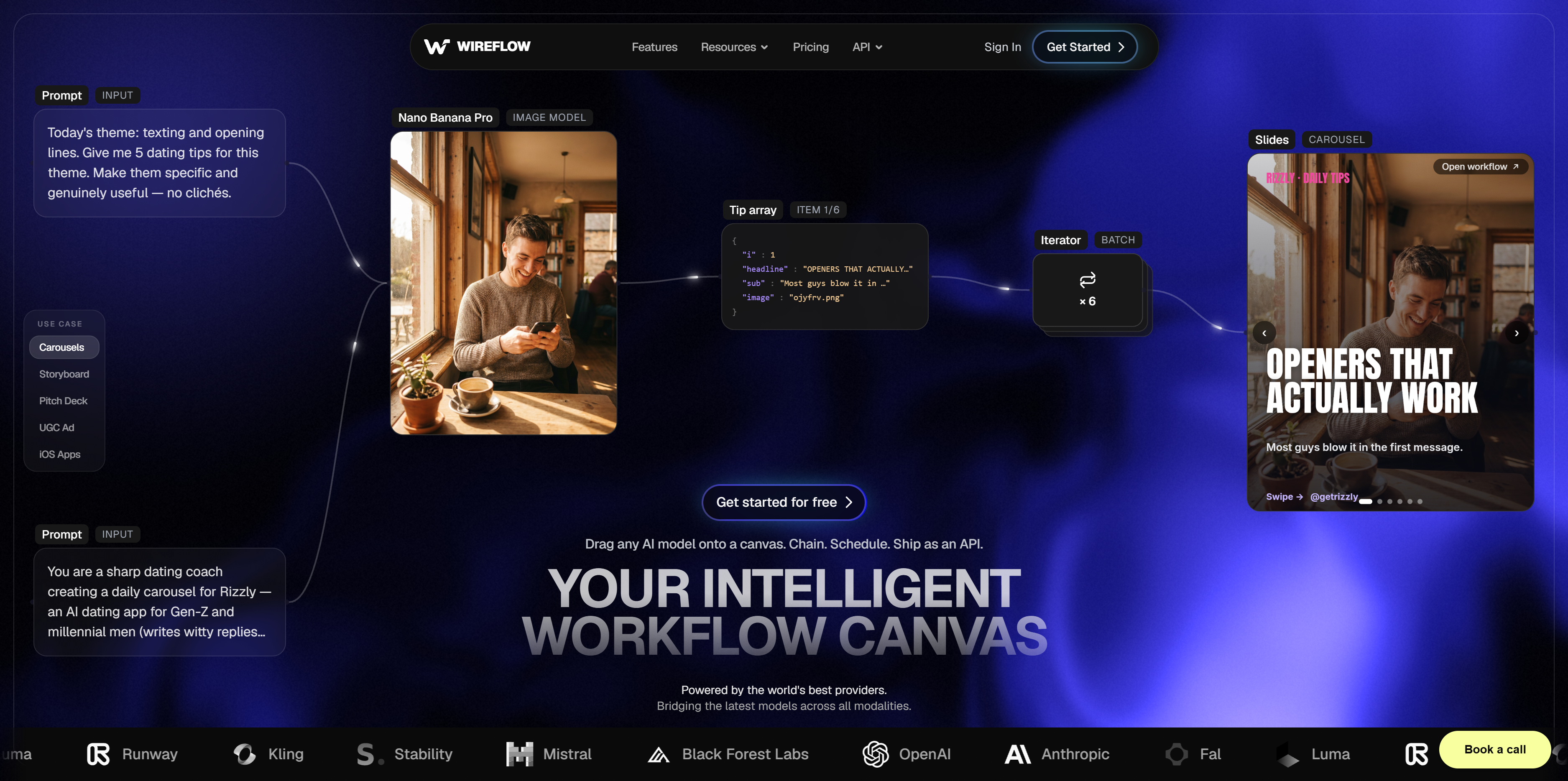
Wireflow is a node-based canvas where you build AI video pipelines visually. You place Kling, Seedance, or Sora nodes for each shot, connect outputs to a Compose Video node, and the pipeline executes as one unit. See the multi shot video stitching API feature page for a deeper walkthrough.
Key strengths:
- Generate and stitch in one canvas; no separate render step
- 30+ AI models as drag-and-drop nodes
- MCP connector for triggering workflows from AI agents
- Visual prototyping, then one REST endpoint for production
Pricing: Usage-based with a free tier. See pricing details.
Best for: Teams generating shots with multiple AI models that need assembly in one tool.
Build this in Wireflow
Make the same kind of asset on a canvas you control, with a free account and no credit card.
2. Shotstack
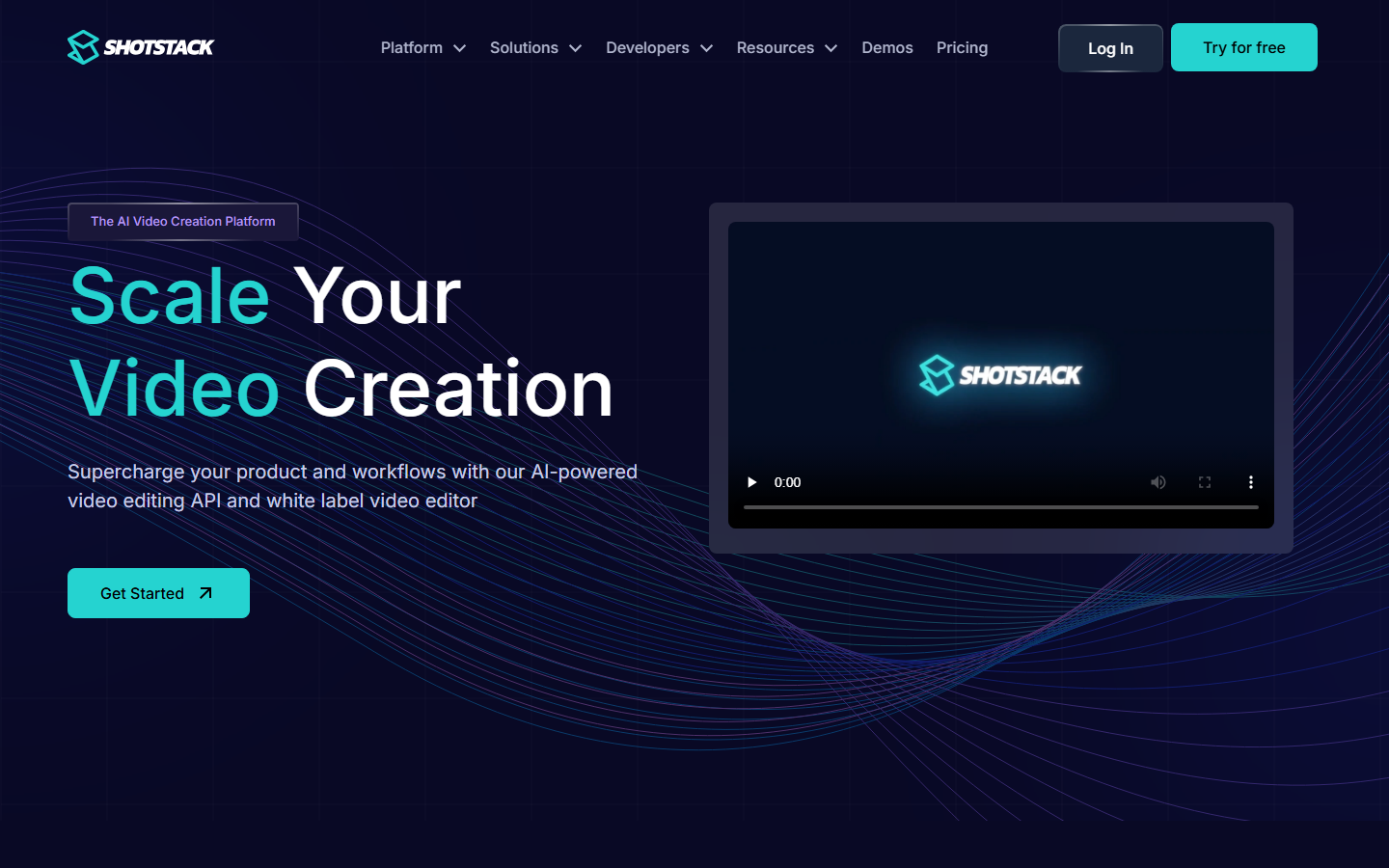
Shotstack provides a JSON-to-video render API built around a timeline metaphor. You describe each clip (source URL, start time, duration, transitions) in structured JSON, POST it, and receive a rendered MP4. Their Probe API queries clip durations before assembly, simplifying video generation pipelines where shot lengths vary.
Key strengths:
- Timeline-based JSON schema for precise clip ordering
- Probe API returns clip metadata before render
- Built-in transitions, text overlays, and audio mixing
- Webhook callbacks for async completion
Pricing: $49/month for approximately 200 render-minutes at 720p.
Best for: SaaS products that stitch user-uploaded or pre-rendered clips into personalized videos.
3. Creatomate
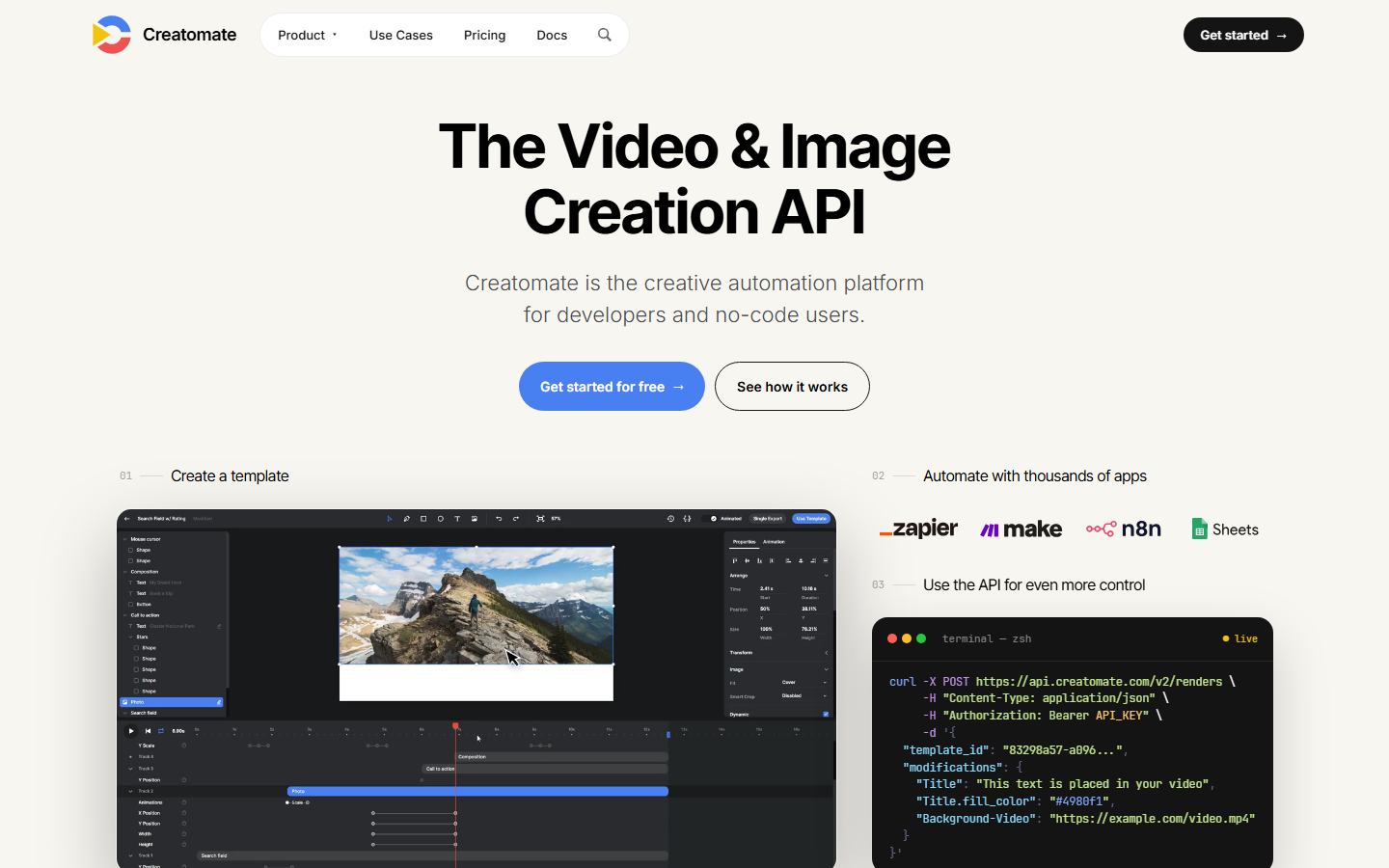
Creatomate handles multi-shot assembly through templates. You design a composition in their visual editor with placeholder slots, then call the API with clip URLs. Creatomate supports keyframes, masking, and blend modes, making it stronger than most template tools for social media video. CSV batch mode renders hundreds of variations from a spreadsheet.
Key strengths:
- Visual template designer with variable slots
- Keyframe animation, masking, and blend modes
- CSV batch rendering for campaigns
- Auto-resize for Instagram, TikTok, YouTube Shorts
Pricing: ~$41-54/month for approximately 144 render-minutes. No free tier; 7-day trial.
Best for: Marketing teams and agencies producing branded multi-clip content at scale.
4. Remotion
Remotion is an open-source React framework for building videos in code. Each shot is a React component composed into a sequence with frame-accurate timing. Remotion gives total control over transitions and data-driven overlays, which makes it a strong fit for programmatic video generation where stitching logic is complex.
Key strengths:
- React component model for video composition
- Frame-accurate sequencing and transitions
- Open source; commercial license for companies
- Self-hosted rendering via Lambda or custom infra
Pricing: Free for personal use. Commercial license required for companies.
Best for: Engineering teams that want code-level control and already have rendering infrastructure.
5. JSON2Video
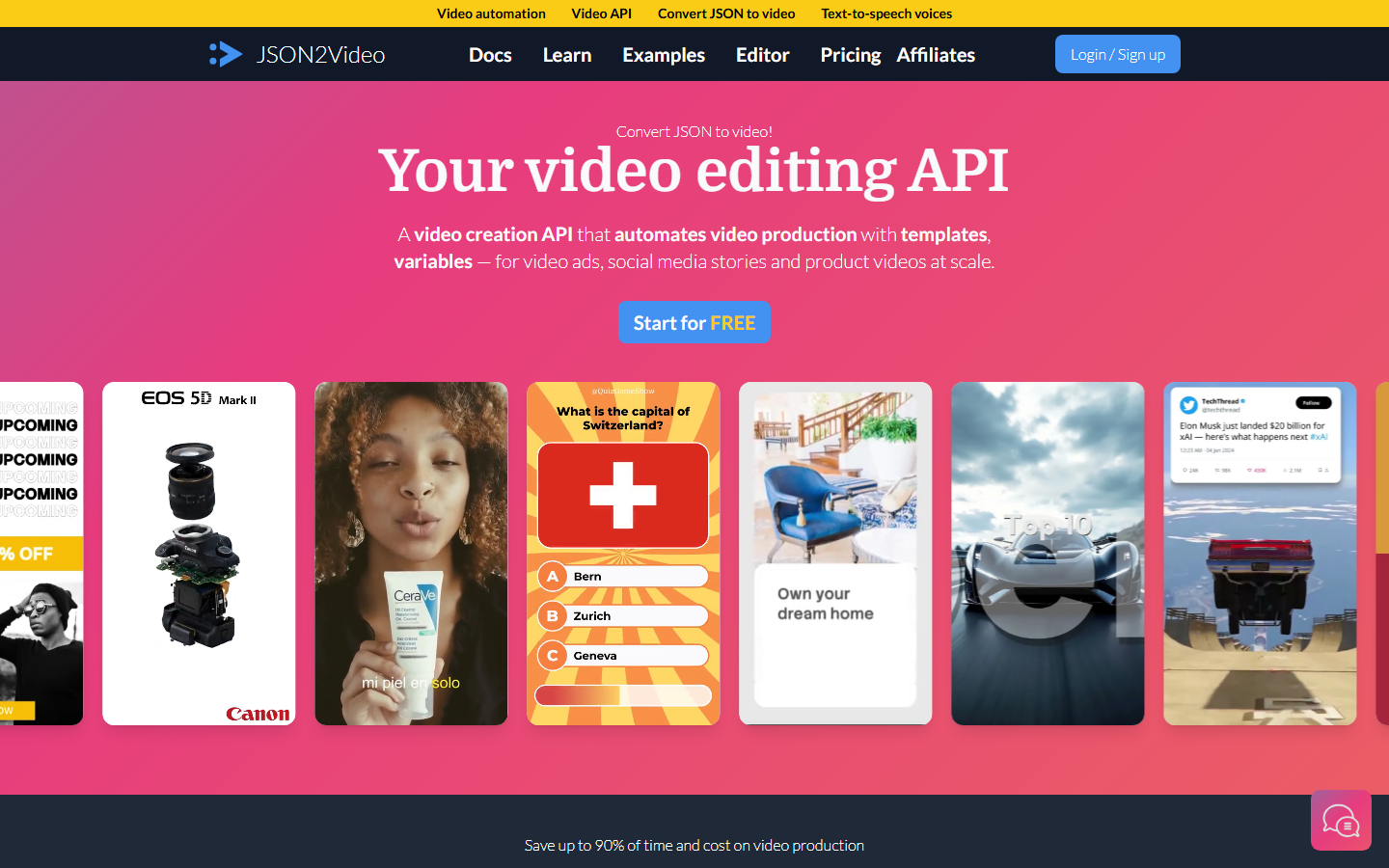
JSON2Video takes a simple JSON scene schema and renders it into video. You define scenes (clip, image, or text overlay), set order and duration, and POST the payload. The learning curve is shallower than Shotstack's timeline model, making JSON2Video appealing for teams that need basic video creation via API without deep editing knowledge.
Key strengths:
- Scene-based JSON schema with a low learning curve
- Data-driven rendering from feeds or databases
- Built-in text, image, and audio overlays
- Hosted rendering, no GPU management
Pricing: $49.95/month. Free trial with watermarked output.
Best for: Teams that need straightforward data-driven clip assembly without complex motion graphics.
6. Plainly
Plainly automates After Effects template rendering via API. You design your composition in AE, upload it as a template, then trigger renders with clip URLs through Plainly's endpoint. This is the strongest option for teams with existing AE-based brand content automation that need to scale without manual exports.
Key strengths:
- Full After Effects rendering via API
- Brand-consistent templates with variable slots
- Batch rendering for large content libraries
Pricing: $69/month. Higher tiers for volume rendering.
Best for: Production teams with existing AE templates that need to render variations at scale.
7. Segmind
Segmind is a multi-model AI API hub with a dedicated Video Stitch endpoint for joining AI-generated clips. You generate shots through Segmind's model catalog (Stable Video Diffusion, AnimateDiff, others), then call the stitch endpoint to concatenate them. The value is keeping generation and assembly in one API surface, which fits model chaining workflows where each shot comes from a different model.
Key strengths:
- Dedicated Video Stitch API endpoint
- Large model catalog for generation and post-processing
- Pay-per-inference, no monthly minimum
Pricing: Pay-per-inference. Varies by model and resolution.
Best for: Teams that want one API surface for both generation and stitching.
Comparison Table
Pricing model matters as much as features. Some platforms charge per render-minute, others per API call, and some use usage-based pricing tied to inference time.
| Tool | Stitching Method | AI Generation Built In | Timeline Control | Pricing | Free Tier |
|---|---|---|---|---|---|
| Wireflow | Canvas + Compose Video node | Yes (30+ models) | Via node connections | Pay-per-run | Yes |
| Shotstack | JSON timeline API | No | Full timeline | $49/mo (200 min) | Watermarked |
| Creatomate | Template slots | No | Via keyframes | ~$41-54/mo | No |
| Remotion | React components | No | Frame-accurate | OSS / commercial | Yes (OSS) |
| JSON2Video | JSON scene schema | No | Scene sequence | $49.95/mo | Watermarked |
| Plainly | After Effects templates | No | Full AE timeline | $69/mo | Trial |
| Segmind | Stitch API endpoint | Yes (multi-model) | Basic concat | Pay-per-inference | Yes |
How to Choose the Right Multi-Shot Stitching API
The right tool depends on where your clips come from. If shots are AI-generated from different models, a platform that combines generation and stitching saves you from managing intermediate storage. If clips already exist, a workflow API builder or JSON timeline API is more direct.
Key tradeoffs:
- Generation + assembly vs. assembly only: Wireflow and Segmind generate and stitch in one pipeline. The others require clips to exist first.
- Template vs. code: Creatomate and Plainly swap clips into fixed templates. Remotion and Shotstack offer more flexibility.
- Scaling: Self-hosted (Remotion) means you own infrastructure costs. Hosted APIs charge per render but handle scaling.
- Agent integration: For teams building AI orchestration pipelines, triggering stitching from an LLM agent is a key factor.

Try it yourself: Build this workflow in Wireflow: the nodes are pre-configured with the exact multi-shot stitching setup discussed above.
FAQ
What is a multi-shot video stitching API?
A multi-shot video stitching API lets you join multiple video clips into a single output file through HTTP requests. You send clip URLs, define order and transitions, and receive a rendered video back, replacing manual timeline editing with automated pipelines.
What is the cheapest video editing API for high-volume stitching?
Shotstack ($49/month for 200 render-minutes) and JSON2Video ($49.95/month) offer the most predictable costs at volume. Wireflow and Segmind use pay-per-run models that can be cheaper for irregular workloads. Remotion is free to self-host, but you pay for your own compute infrastructure.
Can I stitch AI-generated clips from Kling, Seedance, and Sora in one pipeline?
Yes. Wireflow supports Kling, Seedance, Sora, and other video models as canvas nodes. You connect outputs to a Compose Video node and the pipeline stitches them into one file. Segmind also supports multi-model generation and stitching. The other tools require you to generate clips externally and pass the URLs in.
Do I need After Effects for multi-clip timeline control?
No. Shotstack and Remotion provide full timeline control through code (JSON or React). Plainly is the only tool here that uses After Effects, best suited for teams with existing AE templates.
Can I batch-render stitched videos from a data feed?
Yes. Creatomate supports CSV batch rendering where each row produces a variation. JSON2Video accepts data-driven scene definitions. Shotstack handles batches through parallel API calls. All three suit batch generation workflows producing dozens or hundreds of stitched videos from structured data.
How do video stitching APIs fit into AI agent workflows?
An AI agent can call a stitching API as one step in a larger automation. Wireflow's MCP connector lets agents trigger full generation-and-stitch workflows directly. Shotstack and Creatomate provide REST endpoints any agent framework can call. The stitching API acts as the assembly layer after the AI content generation step.
Is there a free multi-shot video stitching API?
Remotion is free and open source for personal use. Wireflow offers a free tier with usage-based pricing. Shotstack and JSON2Video provide free trials with watermarked output. Creatomate and Plainly require paid plans, though both offer short trials.
How do render-minute costs compare across these APIs?
Shotstack charges roughly $0.25 per render-minute on its $49/month plan. Creatomate runs about $0.28-0.38 per render-minute depending on tier. JSON2Video and Plainly do not publish per-minute rates. Wireflow and Segmind price by model inference rather than render time, so cost scales with the AI models used, not output duration.
Conclusion
Multi-shot video stitching APIs solve a growing problem in 2026: assembling AI-generated clips into polished videos without manual editing. For teams generating shots from multiple models, Wireflow is the strongest option because it keeps generation and composition on one canvas. For teams with pre-existing clips, Shotstack and Creatomate offer mature alternatives. The choice comes down to whether your clips already exist or whether you generate them as part of the same workflow.

Co-Founder & Operations at Wireflow
Runs client operations and content strategy at Wireflow. Works directly with creative teams and agencies to build production AI workflows.
- Content Strategy
- Client Operations
Get unlimited ad creatives today.
One call to see if we are a fit and scope the first ad. If it fits, your first batch lands inside week one.