White label AI SaaS tools let you sell an AI product under your own brand, domain, and pricing without building the models or the infrastructure yourself. This guide ranks seven platforms used by agencies and software founders in 2026, covering what each one actually rebrands, where resale rights start, and what you still have to build. Wireflow leads the list because it hides the whole generation layer behind your own API, so your customers never see which models are running underneath.
Quick Summary
- Wireflow - Best Overall. White label generation backend behind your own API.
- GoHighLevel - Best for Agency Resale. Full SaaS storefront with your branding.
- Botpress - Best for Custom Chat Agents. Low-code bots on your own domain.
- CustomGPT.ai - Best for Branded Knowledge Bots. Rebranded dashboards per client.
- Pickaxe - Best for Fast Launches. No-code AI tools embedded in your site.
- Voiceflow - Best for Conversational Design. Team workflows for scripted agents.
- Stack AI - Best for Enterprise Deployments. Governed agents inside your stack.
What Makes a Tool Genuinely White Label
Most vendors use the phrase loosely, and a logo upload is not white labeling. The test that matters is whether a customer can use the product for a month without meeting the vendor's name: on the domain, in the emails, inside exported files, and on the billing statement. Hosted canvases usually fail that test, while API-first products pass it, which is why a white label AI generation platform looks different from a rebranded dashboard.
The second thing to check is tenancy. If every client shares one account, you cannot separate usage, throttle a heavy user, or hand a client their own credential. Tools that support multi-tenant AI image generation let you issue per-client keys and attribute spend accurately, which is the difference between a reseller business and a shared login you are quietly rationing.
Third is pricing structure. Resale rights are frequently gated behind a higher plan, and your margin depends on whether the underlying cost is a flat fee, a per-seat fee, or metered compute. All three appear below.
1. Wireflow
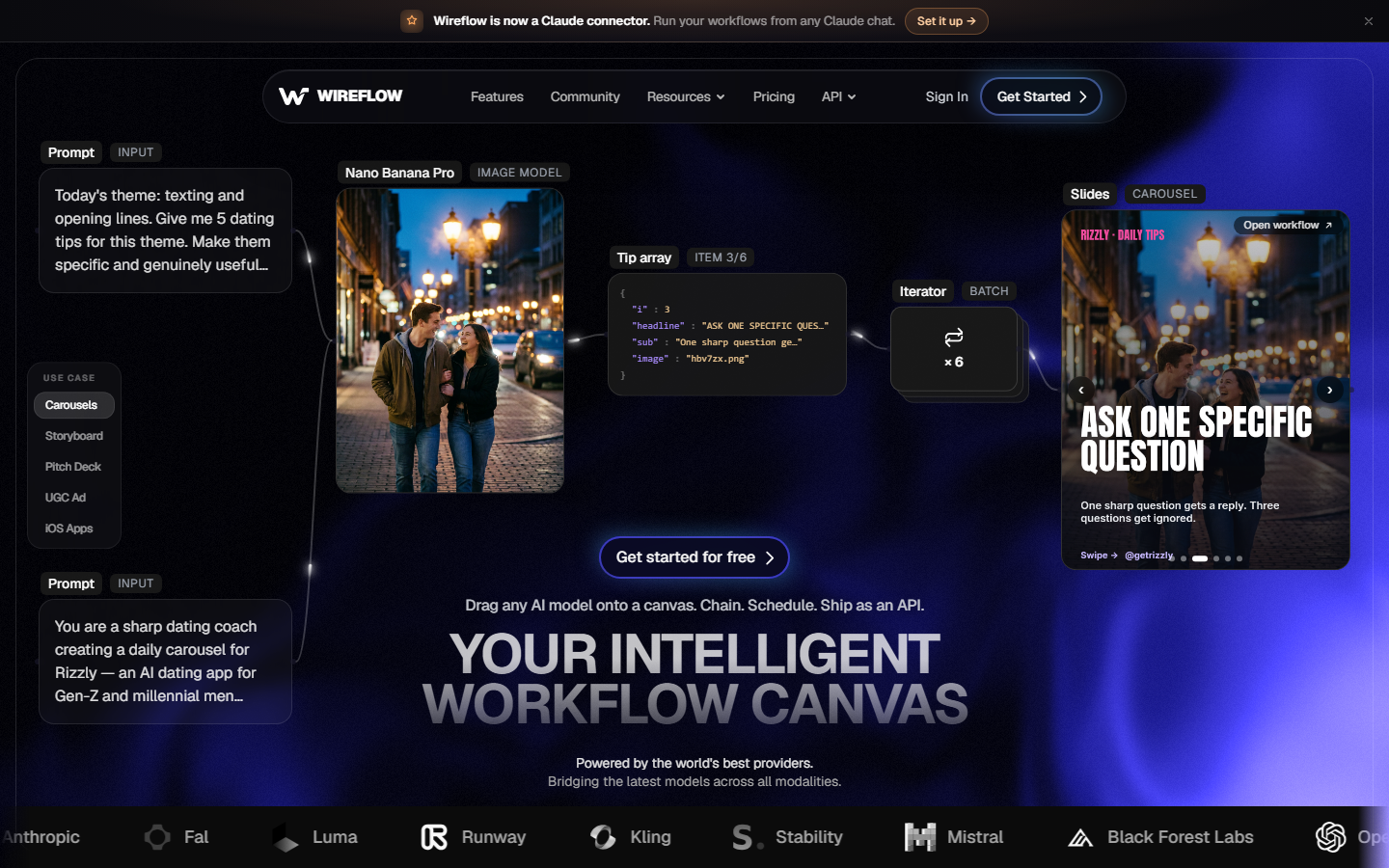
Best Overall. A node canvas where you chain image, video, and language models into one pipeline, then publish that pipeline as a REST endpoint your own application calls. The customer-facing product is yours; the canvas is the build tool you never have to show anyone. Because the models sit behind your endpoint, you can swap a generation model for a cheaper or newer one without your customers noticing anything except the bill, and that flexibility is what an AI orchestration API is for.
The practical fit is agencies and small software teams shipping an AI feature quickly while keeping the margin. A typical setup is one workflow per client offering: product photography, ad variants, or short-form video, each exposed as its own endpoint with its own key, which the agency use case page covers in more detail.
Pricing is credit based rather than per seat, so cost tracks generation volume instead of headcount. A client who generates nothing costs nothing, and a heavy client is visibly a heavy client on the pricing page math. The tradeoff is that you build the customer-facing interface yourself: this is the engine and the endpoint, not a storefront.
2. GoHighLevel
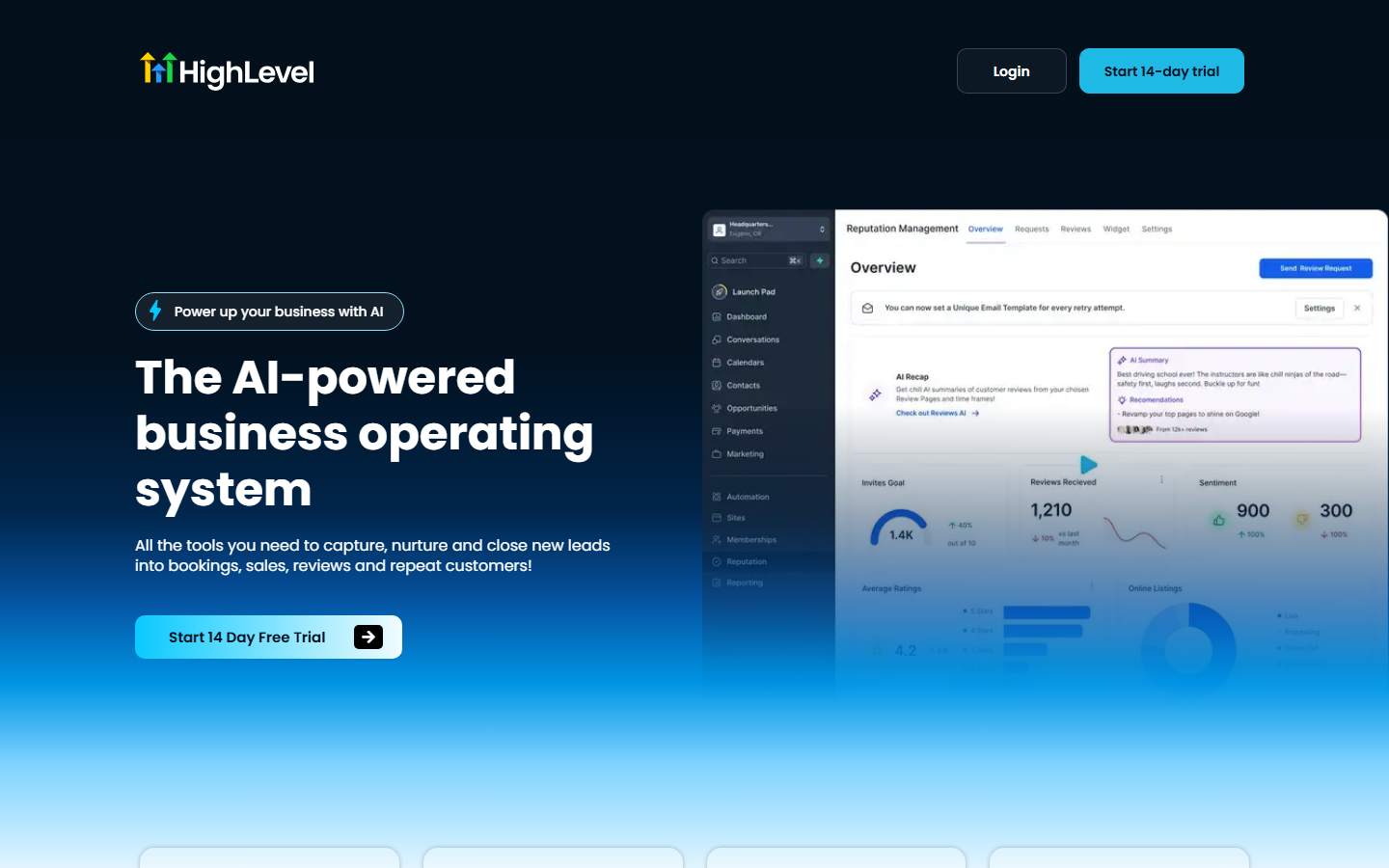
Best for Agency Resale. GoHighLevel is the closest thing to a turnkey SaaS business in a box: CRM, funnels, scheduling, and AI assistants, all rebrandable onto your own domain with your own pricing tiers. SaaS resale rights start on the Agency Pro plan at $497 per month, which is the real entry cost if reselling is the point. Marketing agencies bundle it with retainer work in the same way they bundle video content automation for agency clients.
The strength is breadth. The weakness is a shallow AI layer compared with dedicated platforms, plus you inherit the roadmap of a company serving tens of thousands of agencies. If your differentiation is the AI itself rather than the client management around it, this is the wrong base layer.
3. Botpress
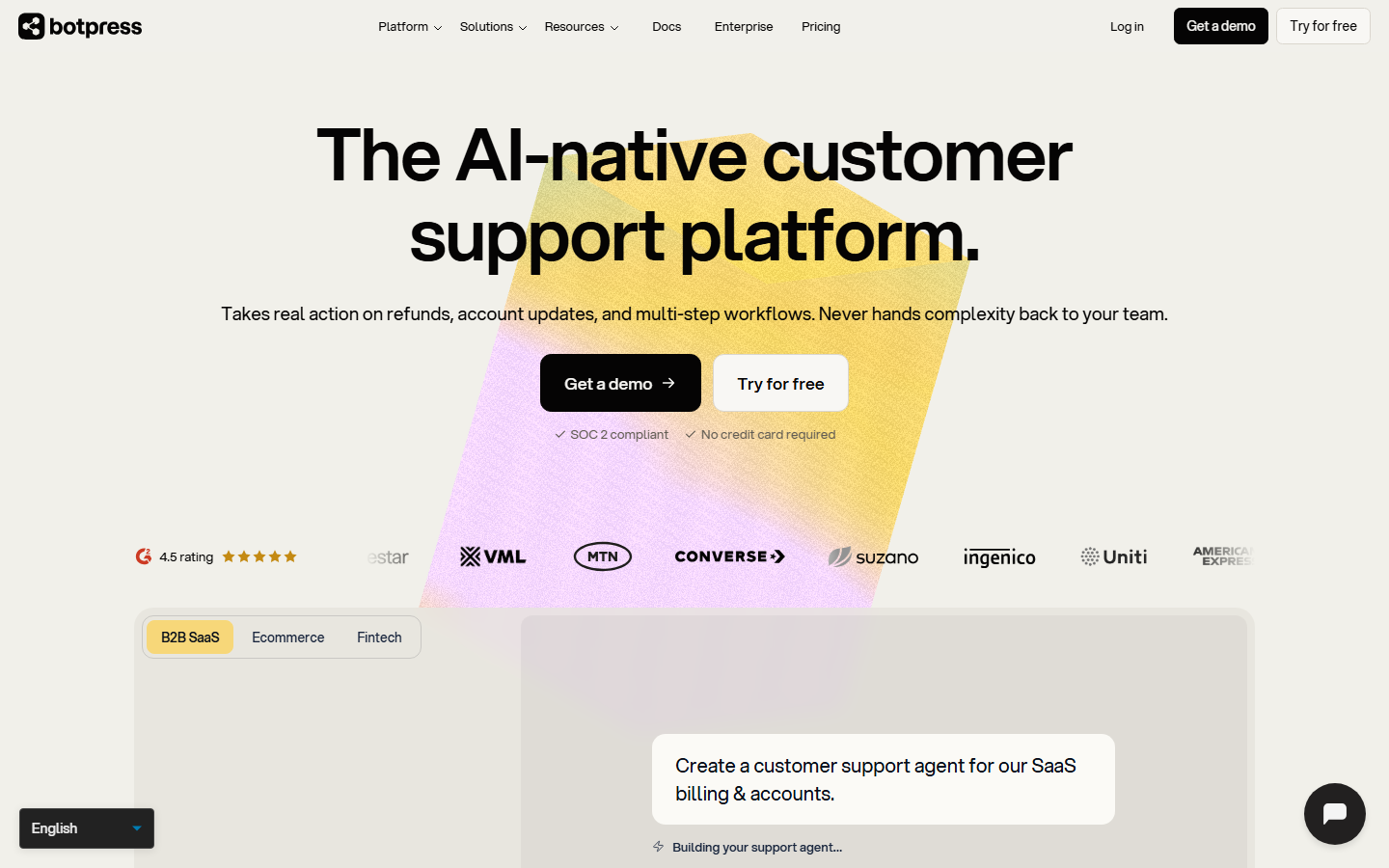
Best for Custom Chat Agents. Botpress is a low-code builder for conversational agents that deploy to web, WhatsApp, Slack, and custom channels. Paid plans start near $89 per month and generally permit resale, and the widget can be styled and hosted so the Botpress name never reaches end users. Agents can call external tools, which pairs naturally with an MCP integration when the bot needs to trigger generation or data lookups.
It suits teams selling support automation or lead qualification to multiple clients. The constraint is that everything is conversation shaped: if the deliverable is a batch of assets or a document rather than a dialogue, you are fighting the tool.
4. CustomGPT.ai
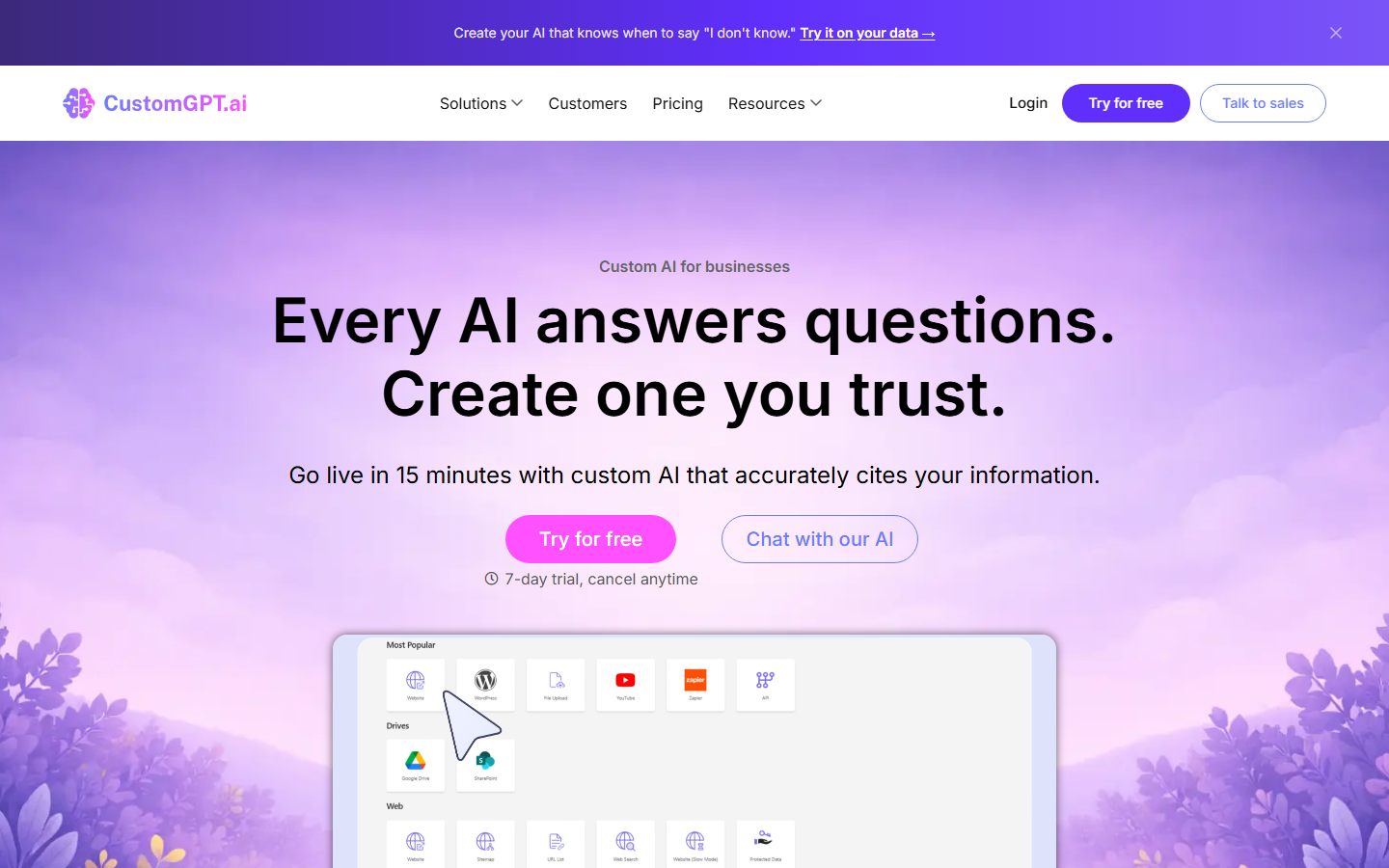
Best for Branded Knowledge Bots. CustomGPT.ai builds retrieval bots over a client's own documents, site, and help center, then serves them from a custom domain with your logo and your dashboard. Reseller controls let one agency account manage many client bots separately, which removes the shared-login problem described earlier. Teams that want the same separation for generation rather than retrieval usually reach for an AI generation API for SaaS apps.
Answer quality depends almost entirely on the source material, so onboarding is front loaded. Expect to spend real time cleaning a client's documentation before the bot is worth demoing.
5. Pickaxe
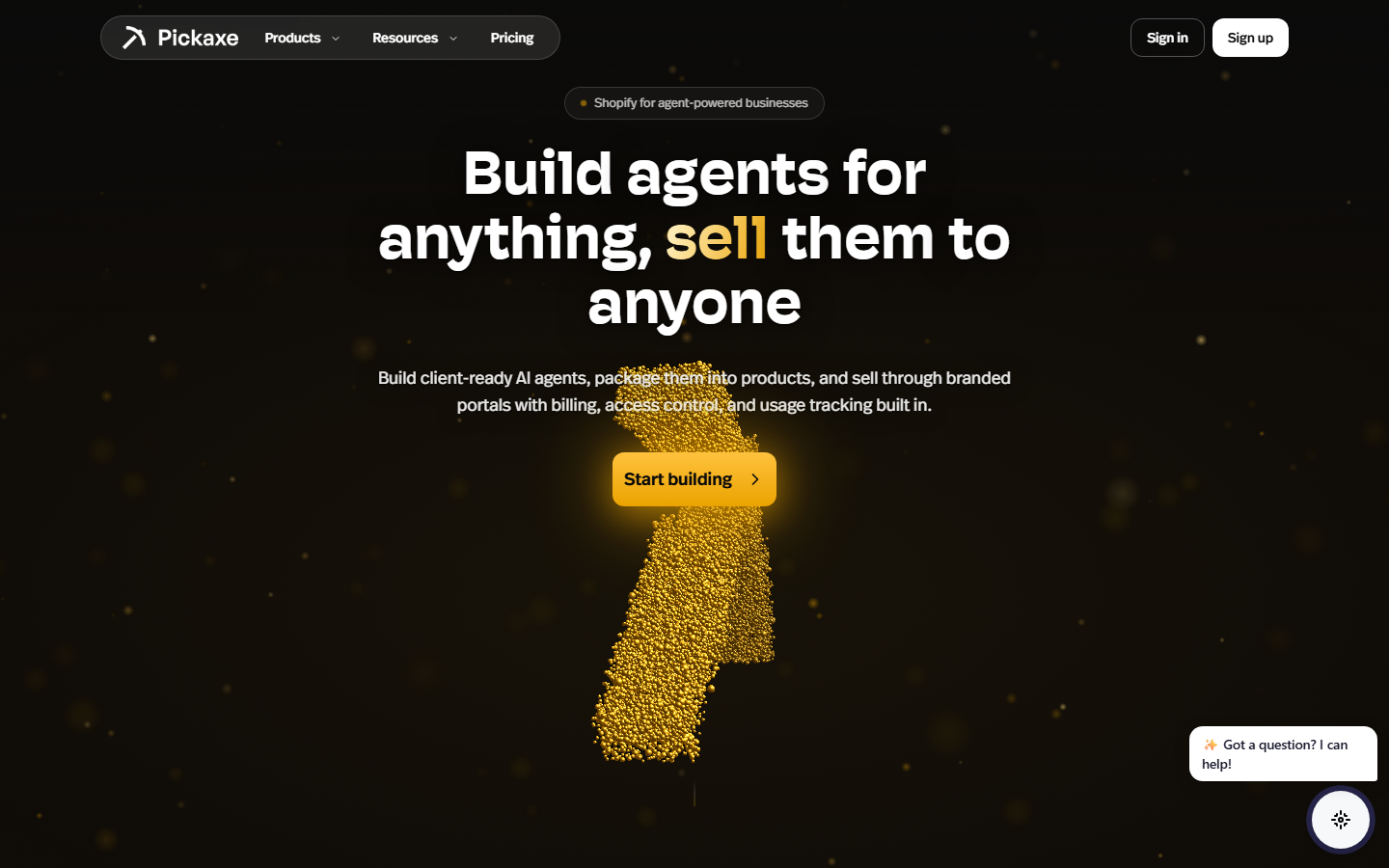
Best for Fast Launches. Pickaxe turns prompts into embeddable AI tools with their own forms, gated access, and payment collection, which makes it the shortest path from idea to a paid AI micro-product. Branding, domain, and paywall are all configurable, so a solo founder can launch something sellable in an afternoon. That speed is why it shows up so often in founder stacks.
The ceiling is low by design. Complex multi-step pipelines, long-running video jobs, and heavy per-client customization are not what it is built for. Treat it as a fast front end rather than a platform you grow into.
6. Voiceflow
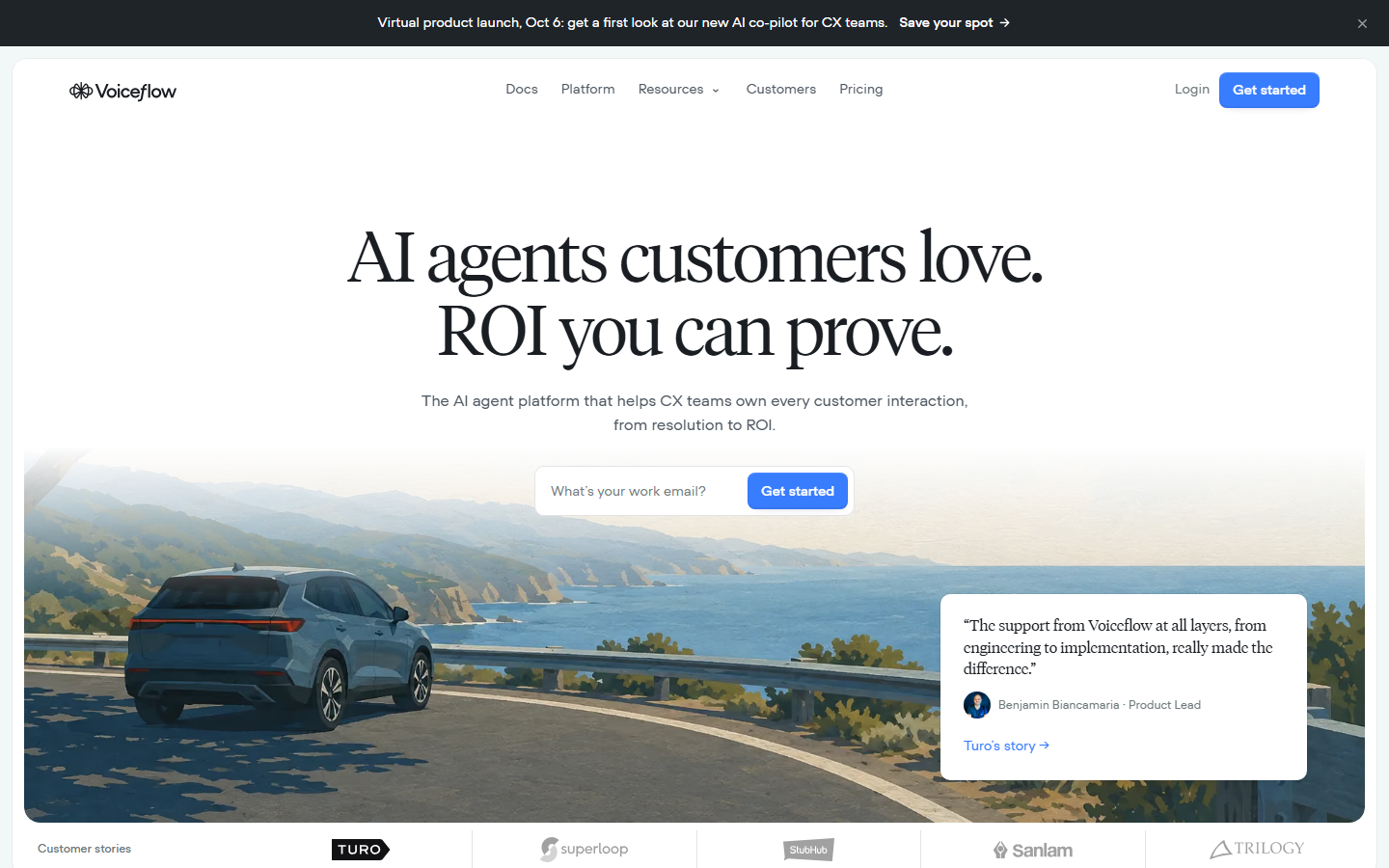
Best for Conversational Design. Voiceflow is built for teams rather than individuals: designers map the conversation visually, developers wire the backend, and both work on the same flow with versioning and review. Higher tiers support removing Voiceflow branding and deploying under your own domain. The reusable-template approach is similar in spirit to starting from blueprints instead of a blank canvas.
It is strongest when several people own different parts of the same agent. For a one-person shop, the collaboration features are overhead you pay for and rarely use.
7. Stack AI
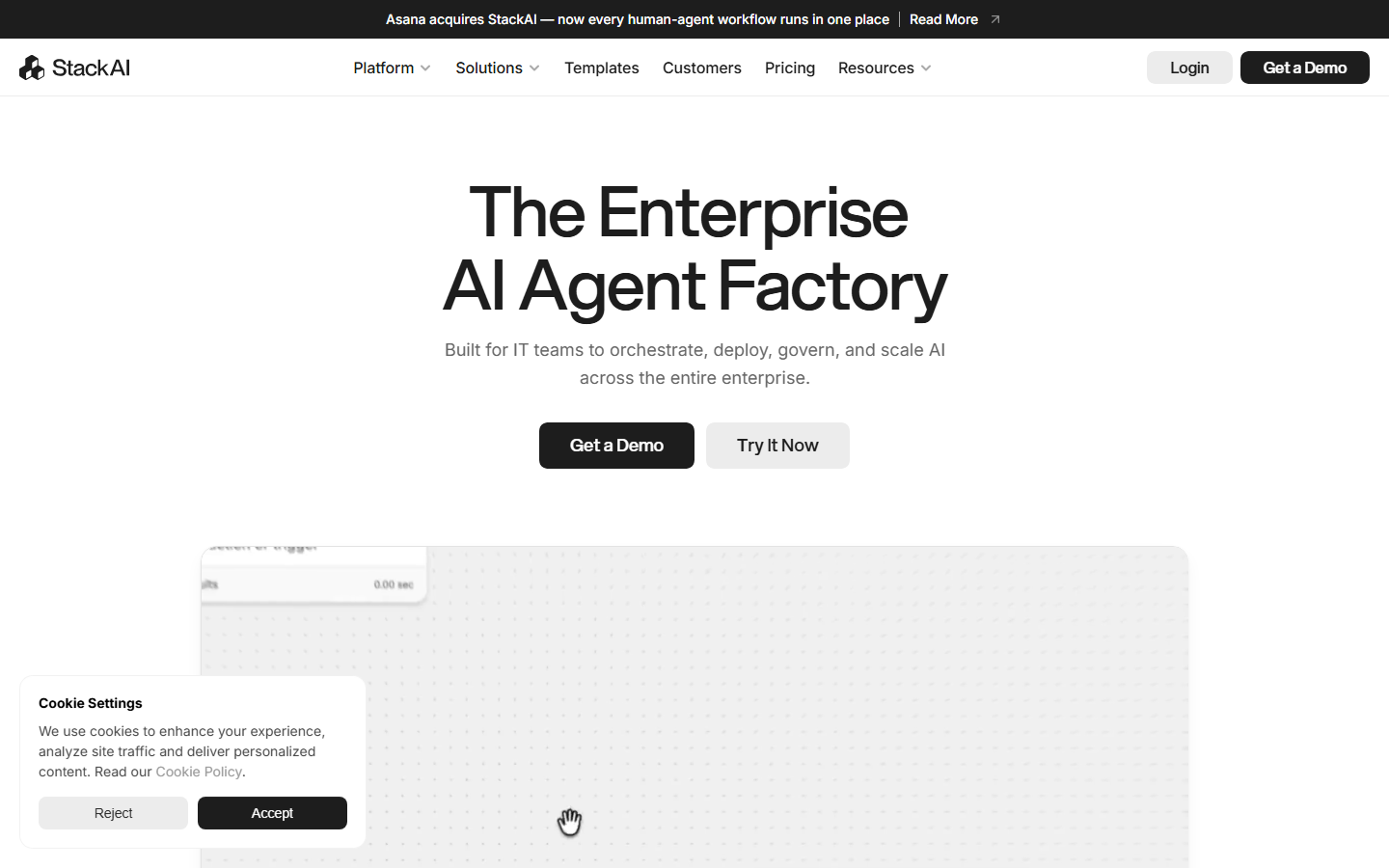
Best for Enterprise Deployments. Stack AI targets IT teams that need agents with permissions, audit trails, and deployment options that satisfy a security review. Workflows connect to internal data sources and can run inside your own environment, which is often the only way a regulated client will sign. The orchestration model overlaps with other AI workflow orchestration platforms with an API.
Pricing and onboarding are enterprise shaped, meaning sales calls rather than self-serve signup. For a small agency selling a $200 per month product, the governance layer is weight you do not need yet.
Comparison Table
A similar breakdown for video-first stacks appears in our roundup of white label AI video platform tools.
| Tool | Best For | What You Rebrand | Pricing Shape | Resale Ready |
|---|---|---|---|---|
| Wireflow | Generation backend | Your API, your app, models hidden | Credit based | Yes |
| GoHighLevel | Agency SaaS resale | Whole platform, domain, billing | Flat, from $497/mo | Yes, Agency Pro |
| Botpress | Chat agents | Widget, domain, channels | From ~$89/mo | Yes, paid plans |
| CustomGPT.ai | Knowledge bots | Dashboard, domain, logo | Per plan and client | Yes |
| Pickaxe | Micro-products | Embed, paywall, branding | Tiered subscription | Yes |
| Voiceflow | Team-built agents | Widget, domain | Per seat | Higher tiers |
| Stack AI | Enterprise agents | Deployment and UI | Enterprise quote | Case by case |
How to Choose
Start from what the customer is buying. If they are buying output such as images, video, or copy, pick a platform that exposes generation as an endpoint and keep the interface yours. If they are buying a system of record or an ongoing workflow, a full platform like GoHighLevel saves months of front-end work that you would otherwise write from scratch.
Then model the unit economics. A $497 monthly floor is trivial across thirty clients and fatal across three, and metered platforms invert that risk, which is the core argument in our guide to usage-based AI API pricing. Write down the cost of one average client month on each option, then multiply by the client count you expect in ninety days, not the count in your pitch deck.
Finally, check the exit path. Products that embed AI generation in SaaS through a thin API layer are easier to repoint at a different provider than products where the vendor owns the interface your users log into. Ask whether prompts, data, and flows can be exported before you migrate a client onto anything.
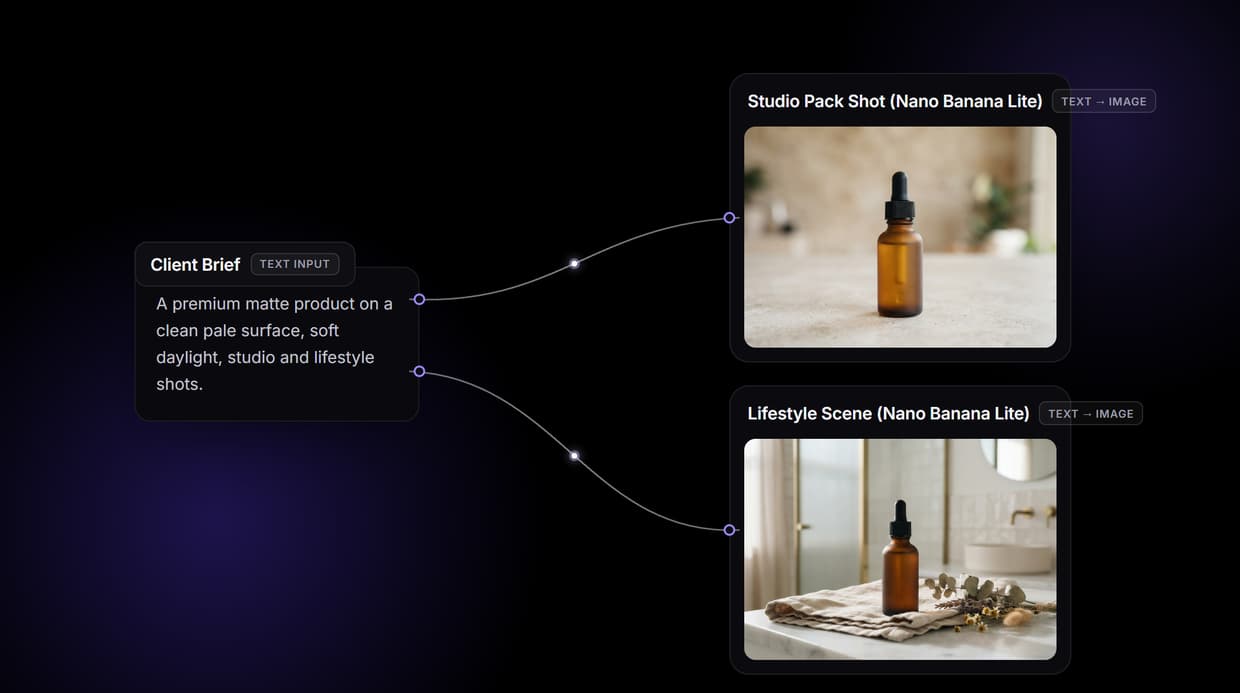
Try it yourself: Build this workflow in Wireflow. It takes a single client brief and returns a studio pack shot plus a lifestyle scene, which is the shape of a white label generation endpoint you can put behind your own app.
Frequently Asked Questions
What does white label mean for AI software? You resell the software under your own brand, domain, and pricing while the original vendor stays invisible to your customers. The strongest versions hide the underlying model providers too, so switching models later is your decision rather than a customer-facing change.
Do I need resale rights to white label an AI tool? Yes. Rebranding without explicit reseller rights usually breaches the terms of service. GoHighLevel gates them at Agency Pro, Botpress includes them on paid plans, and enterprise platforms negotiate per contract, so confirm the clause in writing before you sell anything.
How much does it cost to start a white label AI business? Entry costs in 2026 run from roughly $50 per month for an embeddable tool builder to $497 per month for a full agency platform, plus the generation cost itself. Metered platforms in our white label AI generation platform roundup start closer to zero fixed cost.
Can I white label image and video generation, not just chatbots? Yes, and it is usually easier, because generation is a request-and-response operation that fits cleanly behind your own API. Chat requires hosting a live interface, which gives vendor branding more surface to leak through.
How do I keep clients separated on one platform? Use per-client API keys or sub-accounts rather than a shared login. That gives you per-client usage data, lets you rate limit one heavy account without affecting others, and makes handover or shutoff straightforward when a contract ends.
What margin can I expect reselling AI tools? Flat-fee platforms produce high margin at volume and losses at low client counts, while metered platforms hold a steadier percentage because cost moves with usage. Most agencies price at two to four times underlying cost once support time is included.
Do I need developers to launch a white label AI product? Not for tool builders and agency platforms, which are genuinely no-code. API-first setups need some development capacity, typically a few days of front-end work rather than a full build, as the developer overview shows.
Which models can I run under my own brand? That depends on the platform's catalog and each model's licensing. Check commercial-use terms before reselling output, and prefer platforms that publish a supported model list.
Conclusion
The right choice comes down to what you are selling and how many clients you have. Agency platforms win when the product is client management with AI attached, tool builders win when speed matters more than depth, and API-first platforms win when the output itself is the product and you want to keep both the interface and the margin. Wireflow sits in that last group, and the credit-based model on its pricing tiers is what makes small client counts survivable while you grow. Whichever you pick, confirm the resale terms in writing and model the cost of one average client month before you commit to a plan.
Would you rather we just built it?
We get on a call, learn your style, build the workflow, and ship the deliverables on a schedule. You keep the workflow either way.