 Andrew Adams · Co-Founder & Operations at Wireflow ·
 AI Video Production Software for Agencies
Most AI video tools are built for one person making one video.
An agency makes the same video forty times, for eleven clients, on a deadline. Wireflow gives you the production line instead: one node graph per client brand, versioned and rerunnable, callable from your stack, billed per generation.
Free to build · no credit card · See how it works ↓
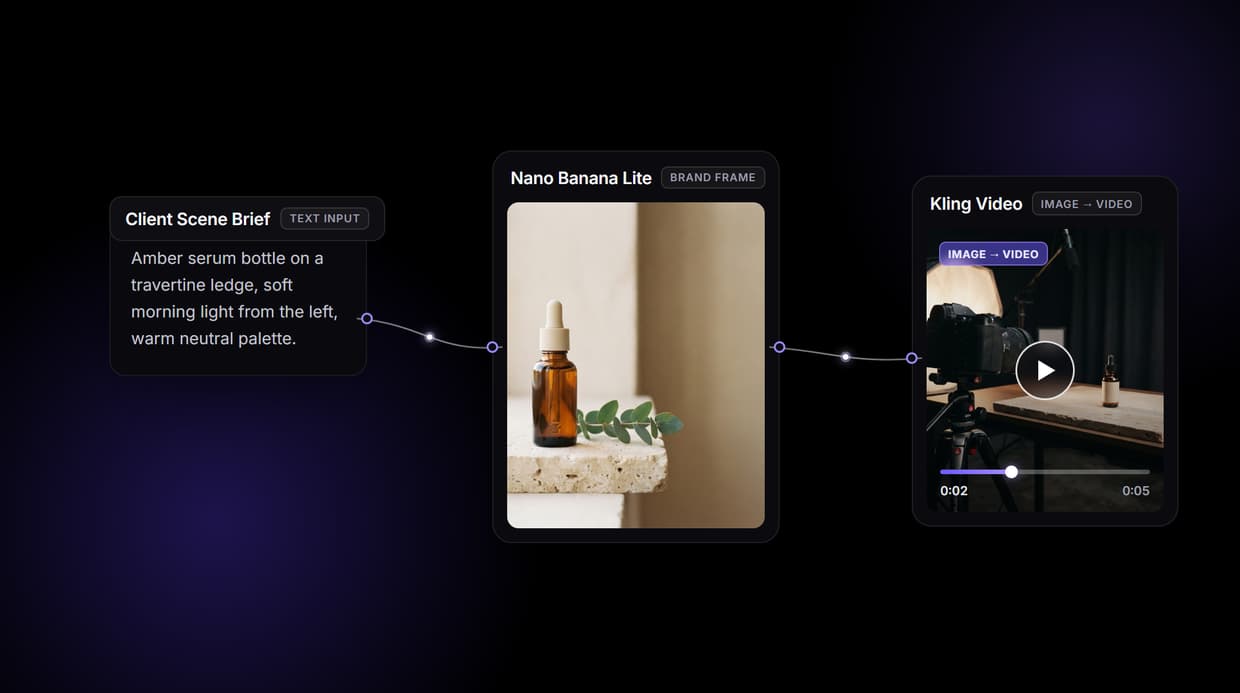
How to Use AI Video Production Software for Agencies
Steps to get you started in Wireflow.
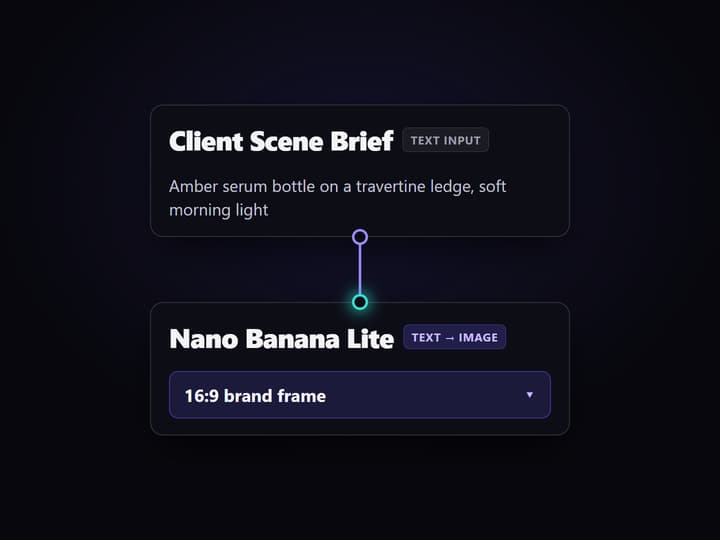
Put the client's brief and script into the two inputs
Open the flow and fill the Client Scene Brief node with the shot you need and the Voiceover Script node with the words. Everything downstream reads from those two boxes, which is the whole point: the next client is a text edit, not a rebuild.
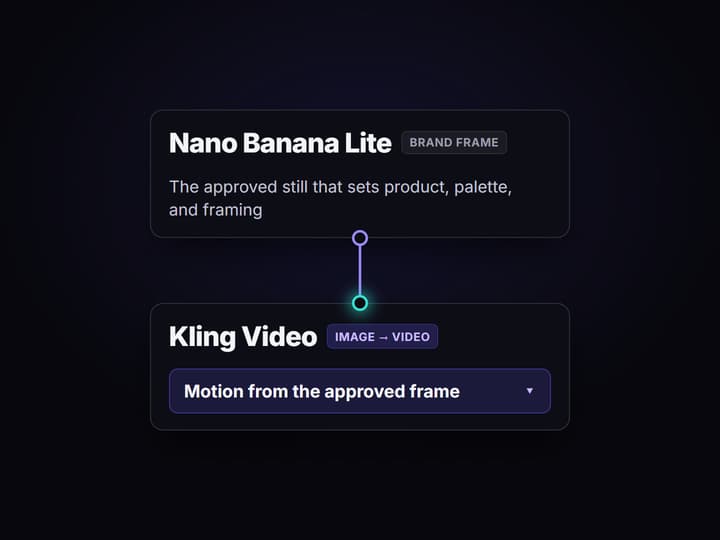
Run the graph and watch each hop land
Nano Banana Lite renders the brand frame, ElevenLabs TTS records the voiceover from your script, Kling Video animates the frame into a clip, and the video editor node assembles the frame, clip, and audio into one cut.
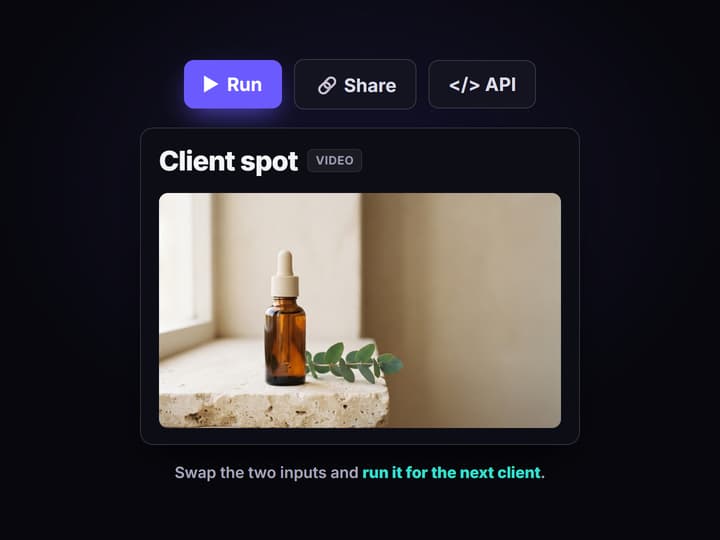
Lock it, then run it for the rest of the roster
Workflows are versioned server side and shareable by link, so a producer reruns the exact graph without asking you. When volume arrives, drive the same flow from a REST call or an MCP tool instead of clicking it client by client.
Why agency video breaks differently than solo video
Every roundup of AI video tools is written for a person making a video. Agencies do not have that problem. They have a roster of clients, each with a brand guide, each expecting the same look in October that they approved in June, and a producer who has to hit that bar without the founder in the room. The failure mode is not bad output, it is drift: take twelve looks slightly off, nobody can say why, and the revision round eats the margin.
Wireflow treats the pipeline as the deliverable. A client's video job lives on a node canvas as a graph: brief in, brand frame, voiceover, motion, finished cut. Because the graph is versioned server side, run fifty comes out like run one. Because it runs on hosted compute in the browser, no one on the team installs a GPU stack. And because the same canvas backs your other jobs, an AI video agent can drive it when a human does not need to. It will not write the script or pick the better cut, that judgment stays with your team; it just keeps every run on brand once the direction is set.
What an agency actually gets
A graph per client
One canvas holds one client's look. Duplicate it for the next brand instead of rebuilding.
Brand frames
Nano Banana Lite renders the frame that sets product, palette, and framing before motion costs anything.
Voiceover in the graph
ElevenLabs TTS turns the approved script into narration on the same run, no handoff.
Motion you can swap
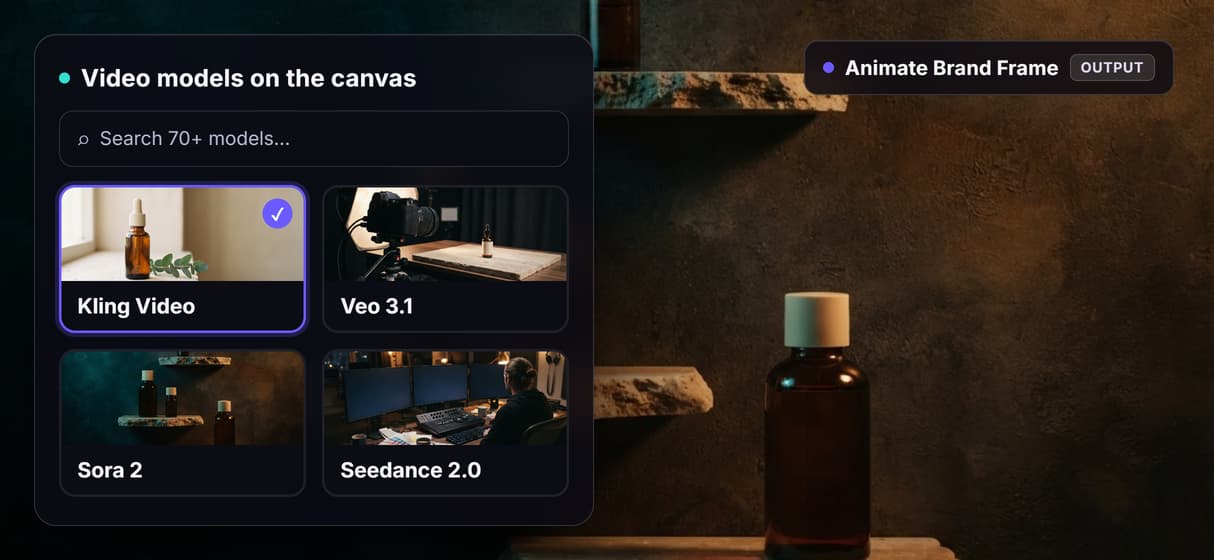
Kling Video animates the frame today. Veo 3.1, Sora 2, or Seedance 2.0 swap in as one node.
Versioned reruns
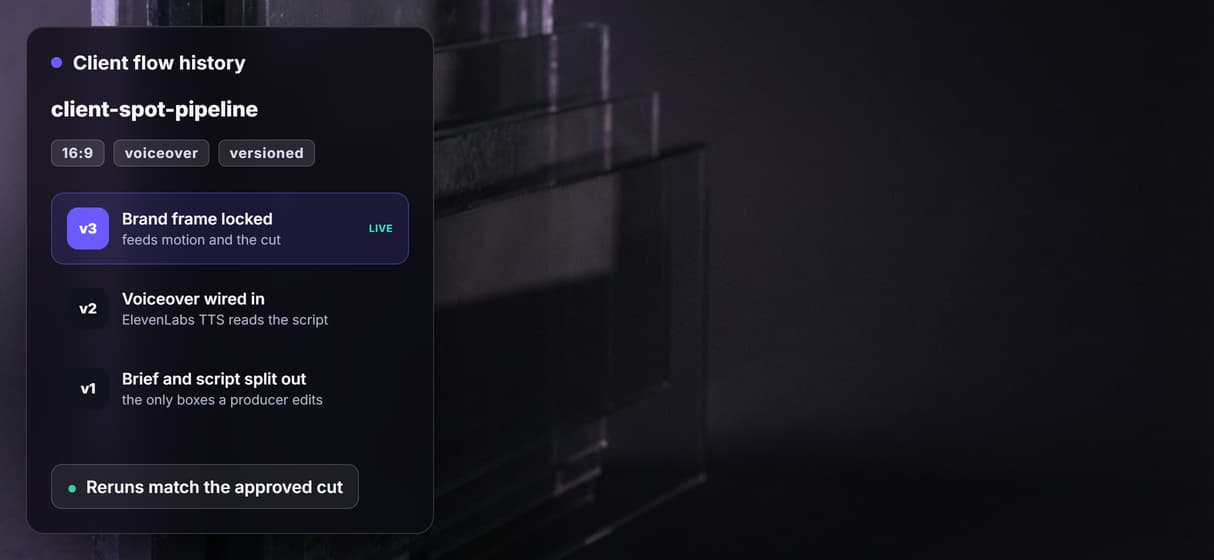
Workflows are versioned and shareable by link, so a producer reruns the approved graph.
REST and MCP
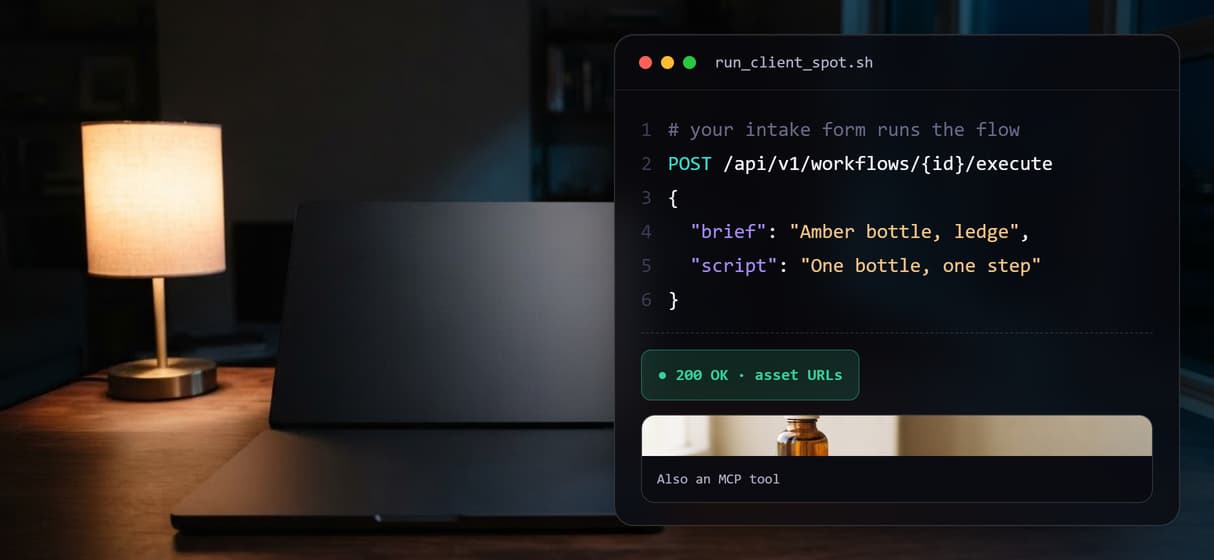
Every published workflow is a REST endpoint and an MCP tool, so intake can trigger production directly.
How the flow behind this page runs
The flow behind this page's button builds one client's ad spot, kept deliberately small so it stays readable at a glance.
- Two Text Input nodes hold the job. Client Scene Brief describes the shot; Voiceover Script holds the words. These are the only two boxes a producer edits between clients.
- Nano Banana Lite renders the brand frame. The frame is where product, palette, and composition get approved, before any motion spend.
- ElevenLabs TTS reads the script. The voiceover runs off the same brief, in the same pass, so audio and picture never drift out of sync across revisions.
- Kling Video animates the approved frame and the video editor node assembles the frame, the clip, and the voiceover into one cut.
The detail worth stealing is that the frame feeds both the motion node and the final assemble. The still that got approved is the still that ends up on screen, which is what keeps take twelve from drifting. From there the same shape scales: point an iterator at a client list to fan out video ad variants, or wire the flow into broader AI pipeline automation so intake triggers the render.
When this is not the right tool for your agency
If what you need is a project management layer, a client approval portal, or billing, this is not that. Wireflow is the generation layer. It does not track a job through review, it does not host your client's feedback threads, and it does not invoice anyone.
It also will not do the thinking. Wireflow does not write your script, choose the strategy, or tell you which cut is better. If your agency's value is creative direction, this makes the execution cheaper and more repeatable; it does not replace the direction. Two more honest limits: everything runs hosted, so there is no offline or on-premise mode and no local checkpoints, and there is no real time multiplayer co-editing of a canvas, so two people should not drive one graph at the same moment.
Finally, if your agency's whole model is reselling video under your own brand with your own client logins, look at the white label AI video platform page first, because that is a different question than production tooling.
More Than Just AI Video Production Software for Agencies
One locked graph per client brand
Workflows are versioned server side, so a client's fiftieth spot matches the first. Lock the graph once and any producer can rerun that AI video workflow. If you resell these clips under your own name, the white label video software page covers that setup.
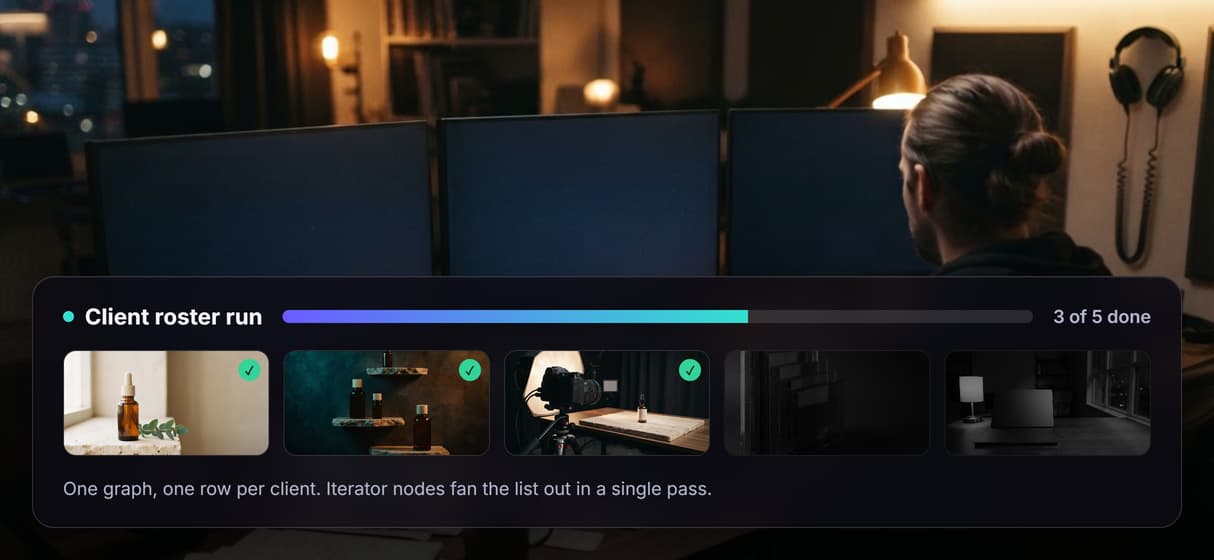
Run the roster, not one brief at a time
Iterator nodes drive one graph across a whole client list, so a month of spots queues in a pass instead of a week of clicking. That is batch AI generation.
Call the same flow from your own stack
Every published workflow is both a REST endpoint and an MCP tool, so your intake form or your agent can chain AI models and get asset URLs back.
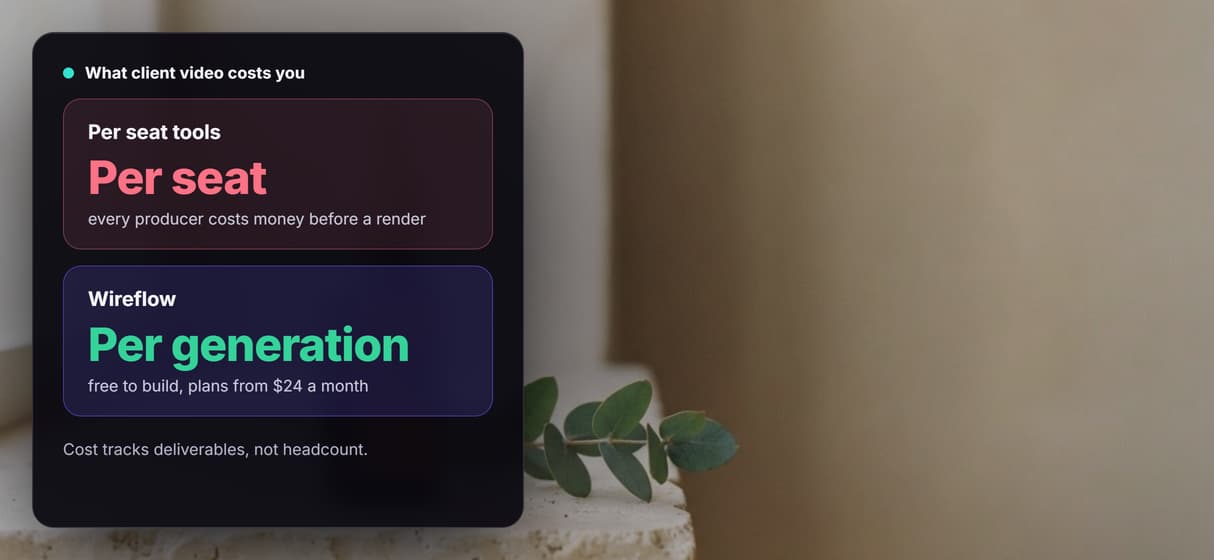
Margin you can actually calculate
Building on the canvas is free and only generations are metered, so cost tracks deliverables shipped, not how many seats you add. Compare the leading tools in our guide to the best AI video production software for agencies.
Swap models without rebuilding the pipeline
70+ hosted models sit behind swappable nodes, so a better video model is a node change, not a migration, on the node based platform.
Build Any AI Workflow
AI Models Integrated
Full Commercial License
FAQs
The one that makes the eleventh client as cheap as the first. Wireflow does that by making the pipeline the asset: a client's video job is a node graph you build once, version, and rerun. Reruns are reproducible, the graph runs from a REST call or an MCP tool as well as the canvas, and pricing is per generation instead of per seat.
Discover related AI tools
More From Wireflow
Written by
Andrew Adams · Co-Founder & Operations at Wireflow
Runs client operations and content strategy at Wireflow. Works directly with creative teams and agencies to build production AI workflows.
Build the client pipeline once
Open the flow, swap in your client's brief and script, then run it. Building on the canvas is free; you pay per generation, not per seat.