 Andrew Adams · Co-Founder & Operations at Wireflow ·
 TopView AI Alternative
Searching for a TopView AI alternative usually means you want UGC-style product videos without a black box.
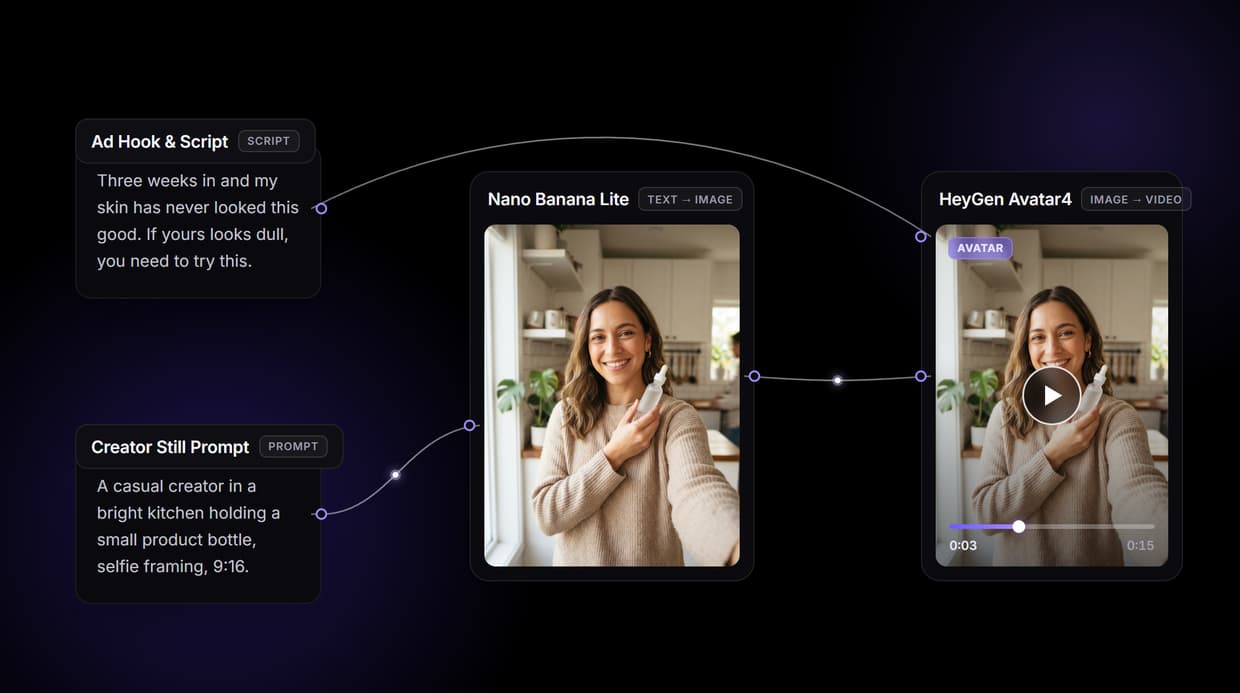
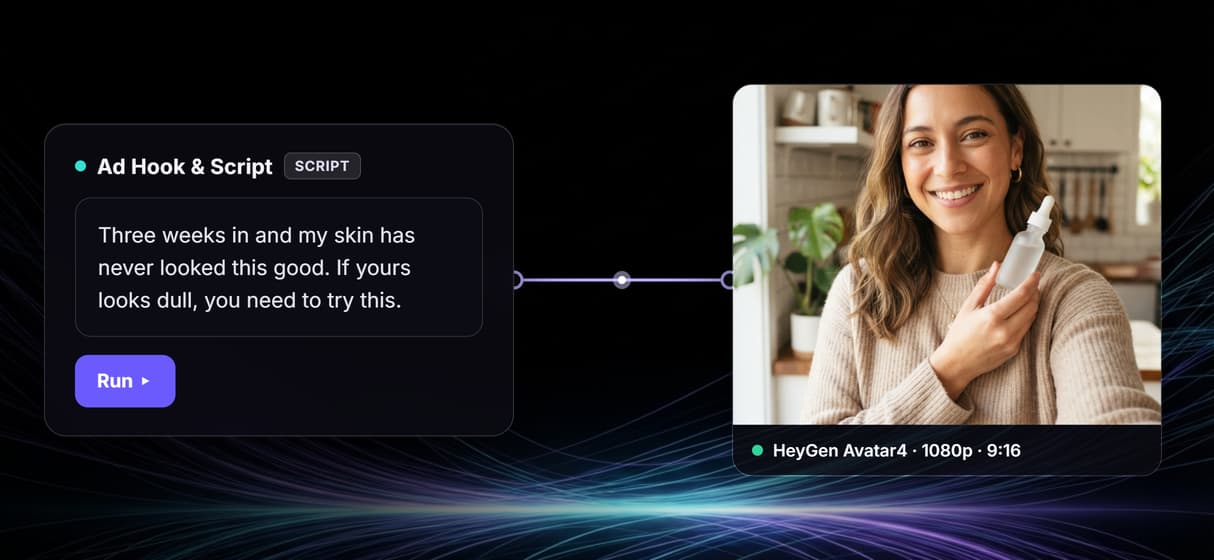
Here's the actual workflow: a script and a look prompt render a creator still on Nano Banana Lite, then HeyGen Avatar4 turns that still into a talking testimonial.
Free to build · no credit card · See how it works ↓
How to Use TopView AI Alternative
Steps to get you started in Wireflow.
Write the script and the creator look
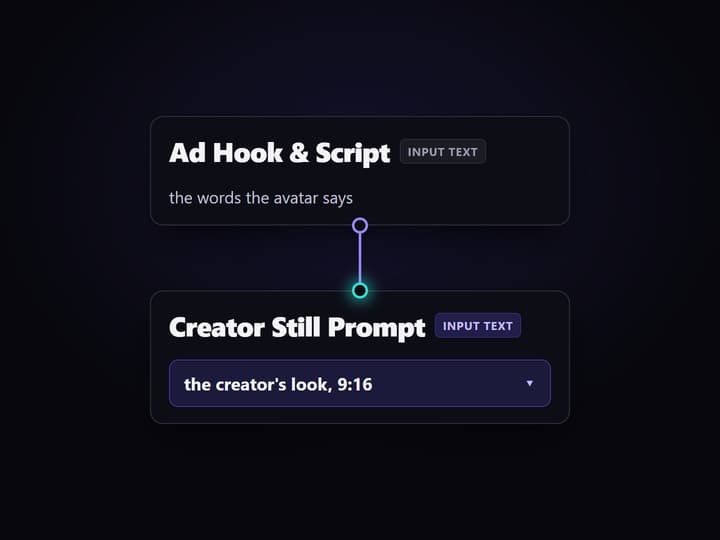
Two text nodes hold the inputs: an Ad Hook and Script node with the words the avatar will say, and a Creator Still Prompt node describing the creator, a casual person holding your product in a bright room, 9:16.
Render the still, then make it talk
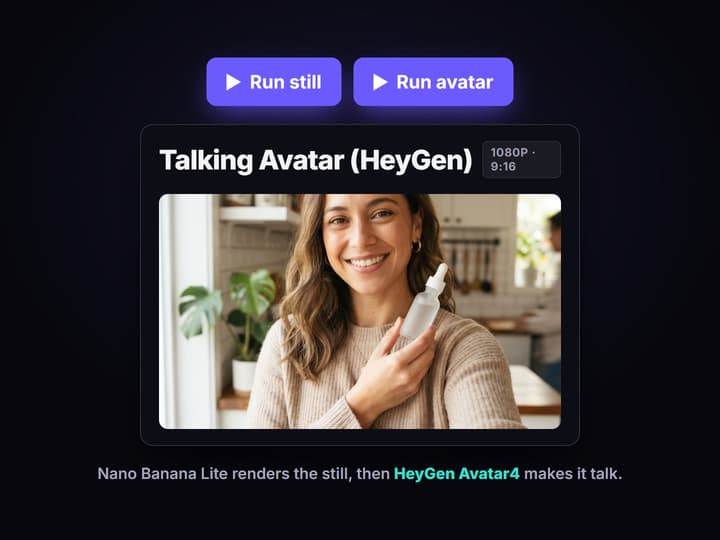
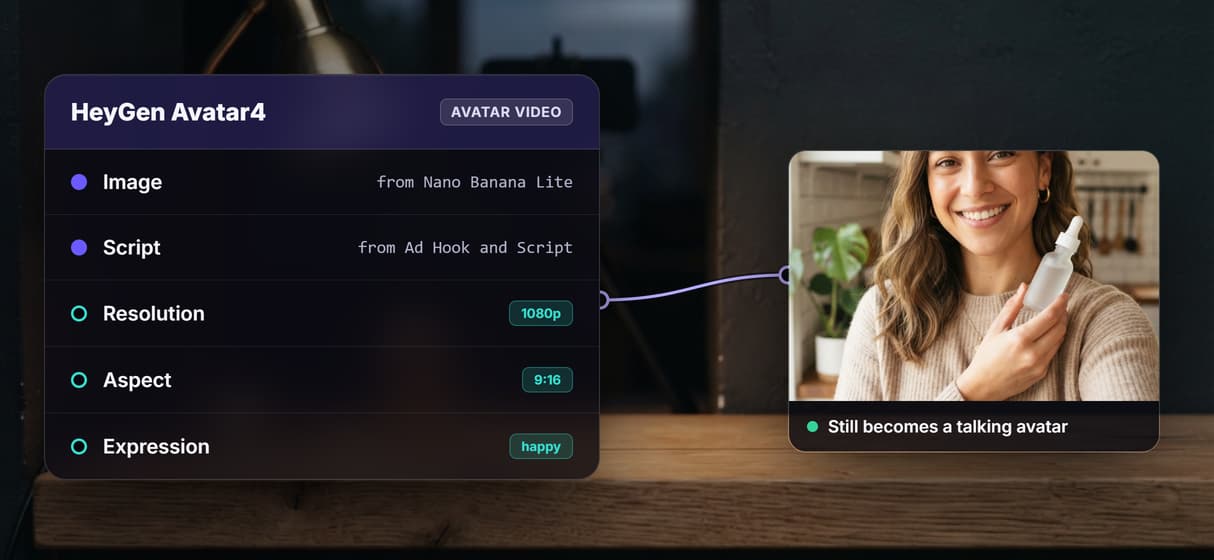
The look prompt drives a Nano Banana Lite node that renders the 9:16 creator still. That still and the script both feed a HeyGen Avatar4 node, which animates the face into a talking-avatar testimonial at 1080p.
Publish it and call it from code
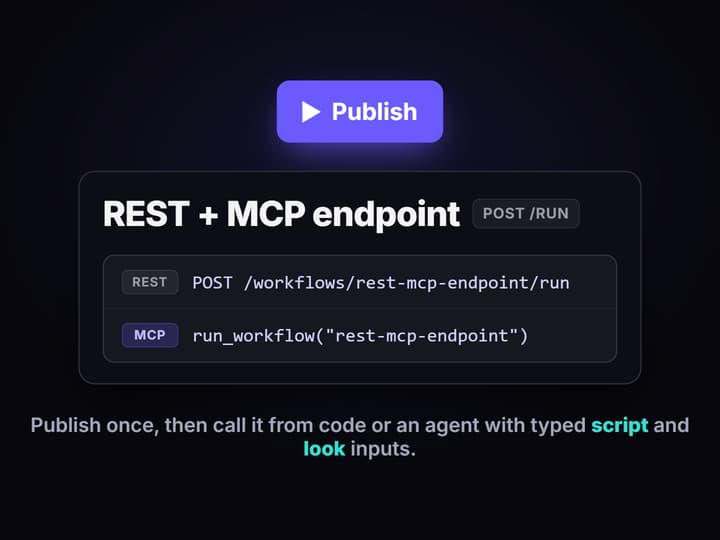
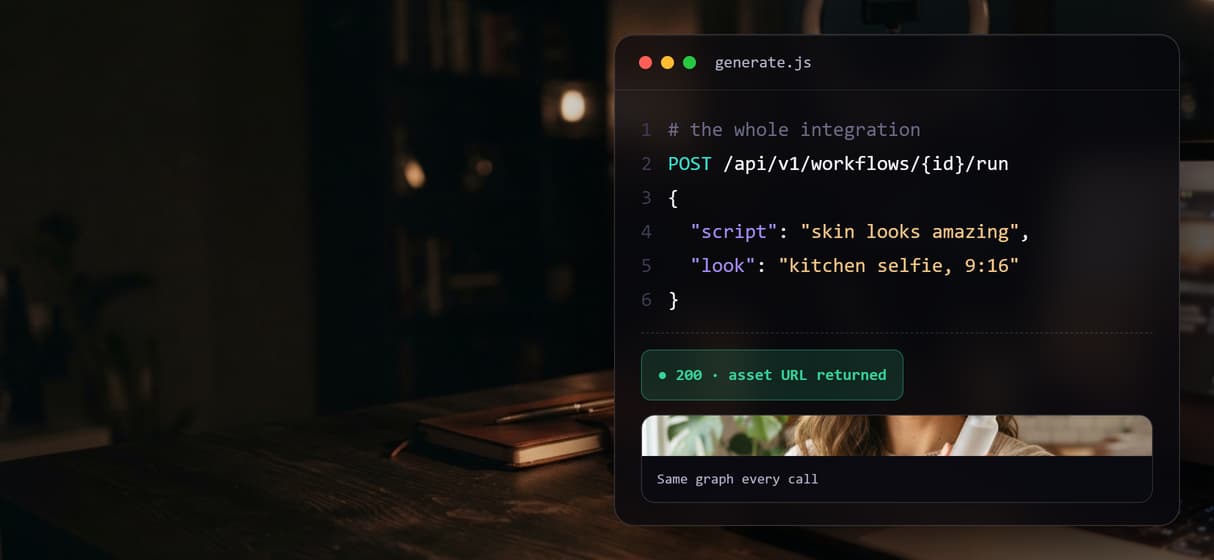
Publish the flow and it becomes a REST endpoint and an MCP tool with typed script and prompt inputs. Your app or an agent posts the fields and gets asset URLs back, and you can swap the avatar model without changing the call.
An honest answer to the TopView AI alternative search
TopView is its own product for turning products and scripts into videos. If that specific product is what you want, use it, and Wireflow will not pretend otherwise: it does not host, wrap, or resell TopView, and the two are not affiliated.
What most teams typing this search actually want is UGC-style video they control: a real model, a script they wrote, a look they chose, and the freedom to swap the pieces when a better one ships. That is what the workflow above is. Two text inputs feed a Nano Banana Lite node that renders the creator still, then a HeyGen Avatar4 node animates it into a talking testimonial, and publishing the graph turns it into the AI video generator endpoint your product calls. You iterate on the canvas; your codebase keeps one URL.
What the UGC video workflow can do
Script to talking avatar
Nano Banana Lite renders the creator still and HeyGen Avatar4 speaks your script as a 9:16 vertical testimonial.
70+ swappable models
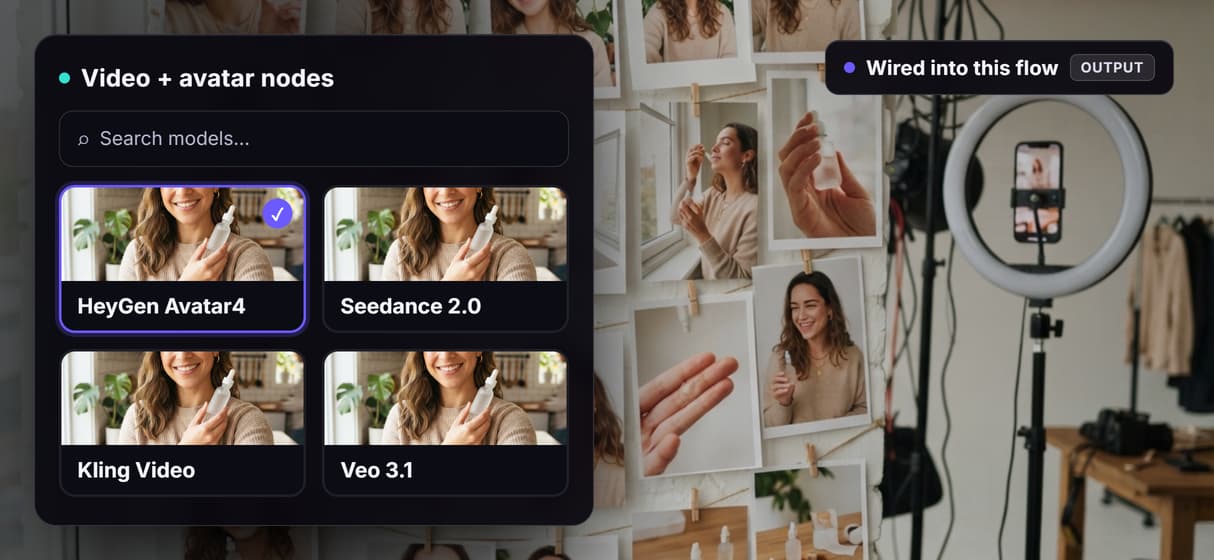
Trade the avatar node for Seedance 2.0, Kling, or Veo 3.1, or the image node for Nano Banana Pro, without touching your code.
Your product stays consistent
Feed the same product shot into the still node so every render keeps the object, its shape, and its label consistent.
Batch over a hook list
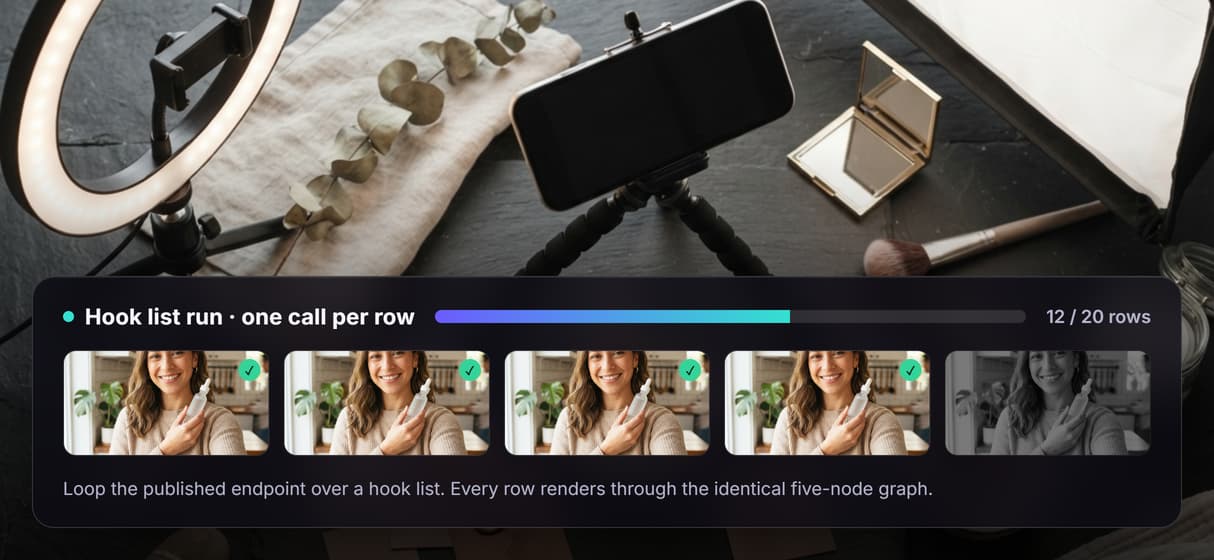
Loop one workflow across a list of scripts or products and render every row through the same graph.
Canvas-first testing
Dial in the still and the script visually, then publish; the endpoint serves exactly the graph you tested.
REST and MCP built in
Every published workflow is an endpoint and an MCP tool with typed inputs and asset URLs back.
Why the model node beats a locked pipeline
Video and avatar models age in months. The one that wins on realism today loses to a release that ships next quarter, and a one-click generator welded to a fixed pipeline inherits that decay. On a canvas the model is one node in a graph: unplug HeyGen Avatar4, drop in Seedance 2.0 or Veo 3.1, run the same script, and keep whichever wins.
Reproducibility is what makes the swap safe. Workflows are versioned server-side, so the five hundredth render walks the same graph as the first, and a model change is a deliberate new version instead of silent drift. The honest tradeoff: every generation spends credits and a video render costs more than a still, so a batch over a large hook list is a budgeting decision, and building the graph itself costs nothing.
When TopView is the better pick
If you want a one-click product, paste a link and get an ad, with a ready-made avatar library and no graph to build, then a dedicated tool like TopView fits that shape better and this page will not talk you out of it. Wireflow asks you to build and run a visible workflow, and it is not a wrapper that proxies another vendor's product.
Wireflow earns its place when the job is bigger than one fixed template: when you want to see and swap the exact model behind each step, keep one endpoint while avatar and video models rotate underneath it, batch a whole hook list through the identical graph, or hand the workflow to an agent as an MCP tool. It is also the generation layer, not the writer: you bring the script and the strategy. If that is the shape of your problem, the five-node flow above is the smallest honest start.
More Than Just TopView AI Alternative
One script in, a vertical ad out
Five nodes: a look prompt makes the creator still in Nano Banana Lite, then the still and your script drive HeyGen Avatar4 to talk, one UGC workflow.
Swap the avatar model, keep the flow
The animator is a node, not a contract. Trade HeyGen Avatar4 for Seedance 2.0, Kling, or Veo 3.1 on a HeyGen alternative canvas and rerun.
The talking-avatar node, wired and visible
HeyGen Avatar4 takes the still on one port and the script on another, set to 1080p and 9:16, the same idea as an AI talking photo you control.
One flow, a week of hooks
Call the published endpoint once per row of a hook list and each render walks the same graph, which is what a bulk video ad API looks like.
Grow the graph, not your client code
Add captions, music, or an upscaler after the avatar and republish; your app still makes one call to a programmatic video platform.
AI Models Available
Automate Any Workflow
Included in Every Plan
FAQs
For the job of making UGC-style product videos, Wireflow is a strong alternative: it runs models like Nano Banana Lite and HeyGen Avatar4 as nodes on a visual canvas and publishes any workflow as one REST endpoint. It is not affiliated with TopView and does not resell it.
Discover related AI tools
- AI Video Generator: 12 Video Models, One Canvas (2026) | Wireflow
- TapNow AI Alternative
- Opencreator AI Alternative
- AI Video Workflow
- AI UGC Workflow
- Faceless AI Video Generator
- Text to Video
- Text to Video AI
- Happy Horse 1.0
- Free AI Video Generator Online
- Best AI Video Generators 2026
- Video Maker: One Prompt to a Finished Clip on a Canvas
More From Wireflow
Written by
Andrew Adams · Co-Founder & Operations at Wireflow
Runs client operations and content strategy at Wireflow. Works directly with creative teams and agencies to build production AI workflows.
Open the five-node UGC flow behind this page
It is live on the canvas: two text inputs, a Nano Banana Lite still, and a HeyGen Avatar4 talking testimonial. Run it, watch the still render, then publish your own copy as the endpoint your code calls. Building is free; generations are pay per run.