 Andrew Adams · Co-Founder & Operations at Wireflow ·
 AI Young Filter
Most young filters are a one-tap novelty you cannot steer.
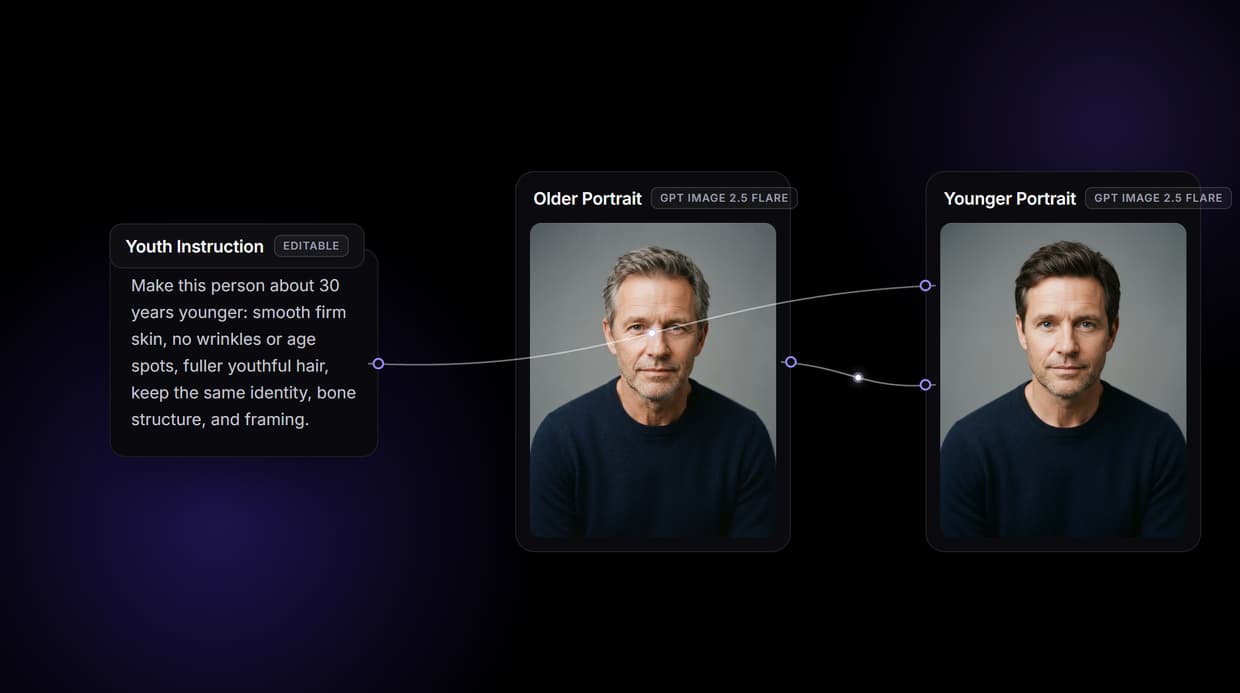
Wireflow makes de-aging a face a small graph you own: a GPT Image 2.5 Flare edit node reads the portrait and the youth instruction you write, then returns the same person looking decades younger with identity, bone structure, and framing kept. Free to build, pay per generation.
Free to build · no credit card · See how it works ↓
How to Use AI Young Filter
Steps to get you started in Wireflow.
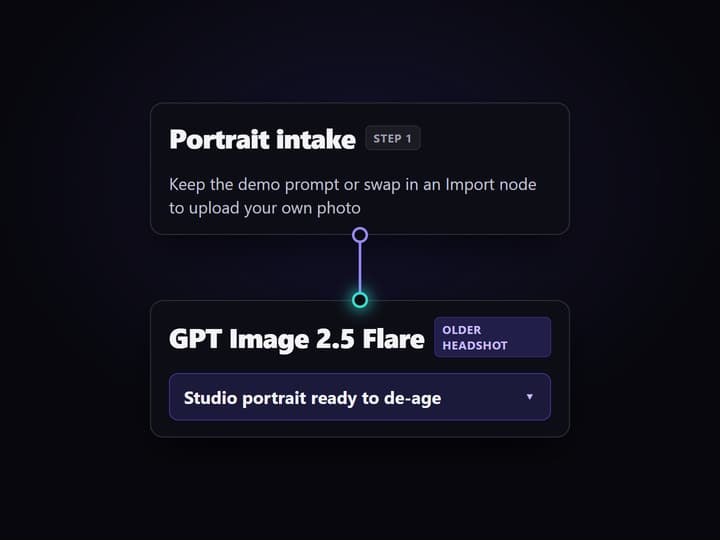
Point the flow at a portrait
Open the flow. Keep the demo Text Input to generate an older studio headshot, or follow the sticky note and swap the first node for an Import node to upload your own photo.
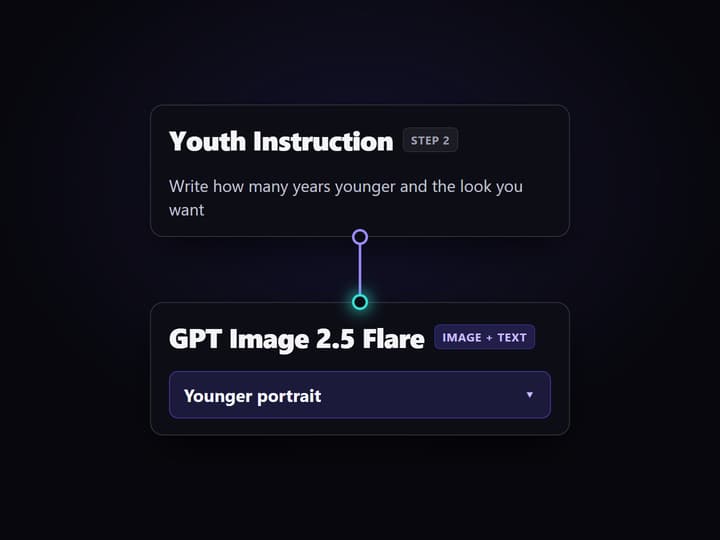
Write the youth instruction and run
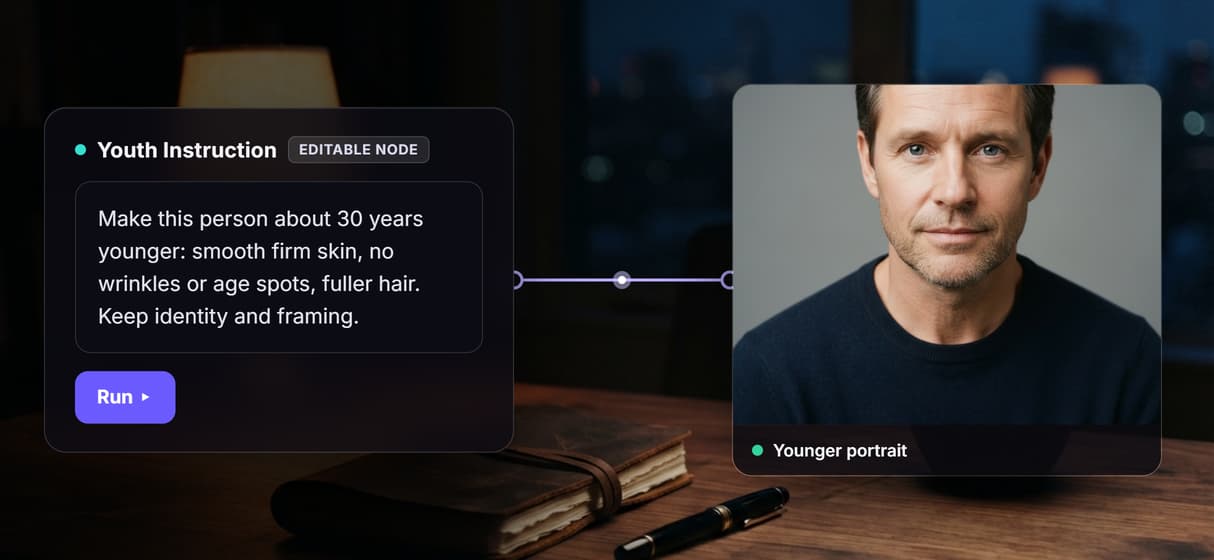
Edit the Youth Instruction node with the amount and look you want, for example about 30 years younger with smooth firm skin, no age spots, and fuller hair. Run the graph and the GPT Image 2.5 Flare edit node returns the younger face in seconds.
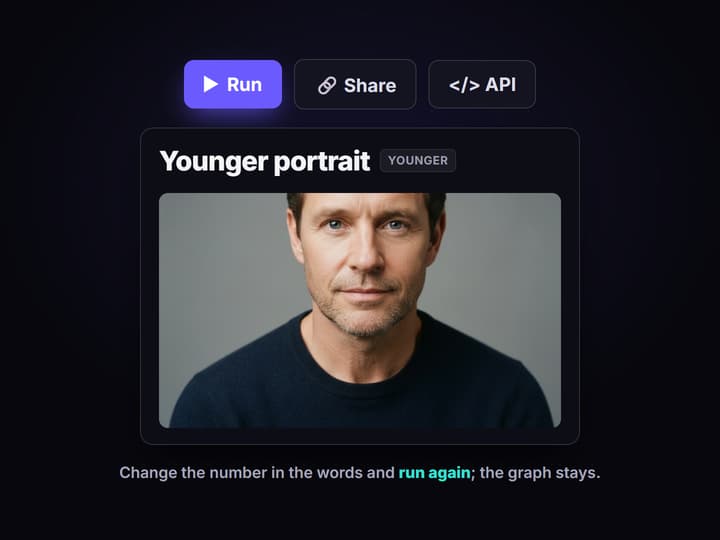
Dial it, rerun, or chain the next hop
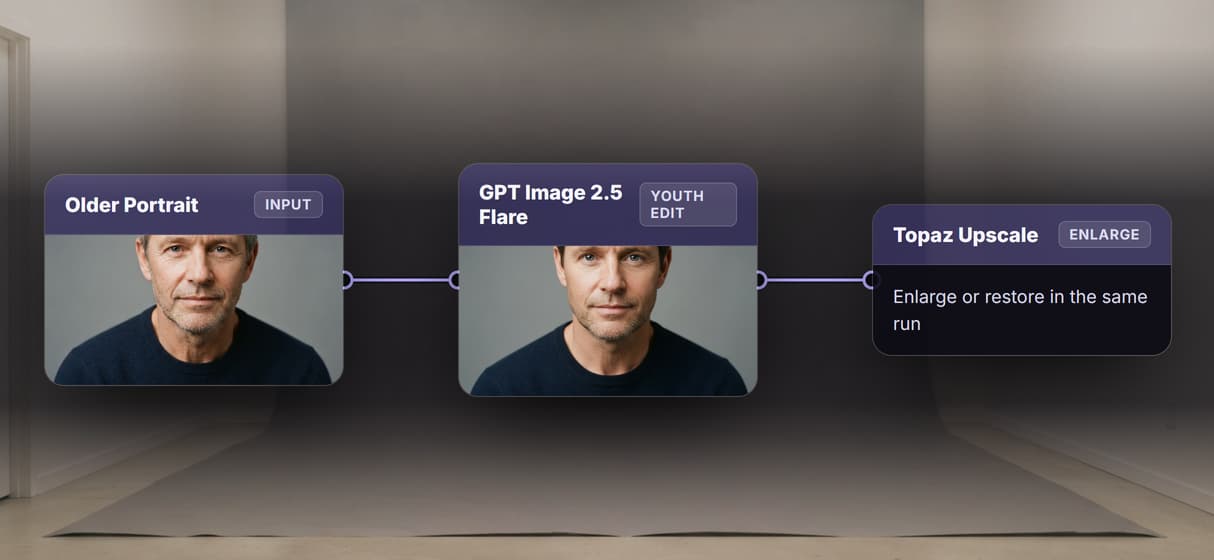
Too much or too little? Change the number in the words and run again. Wire the younger portrait into an upscaler or a restoration node to enlarge or clean up the same face in one pass.
Why one-tap young filters hit a ceiling
Upload a selfie, tap the young button, download one guess: most AI young filters work the same way, and the first result is often fun. The ceiling arrives fast. You cannot dial how much younger you want, you cannot batch a set of photos, you cannot reproduce the exact look on a new face, and the output often goes waxy or quietly stops looking like you. The filter is a black box with one button.
Wireflow answers with a different shape. De-aging a face is a small workflow you own on a node canvas: a GPT Image 2.5 Flare node renders an older studio headshot (or you upload your own), and a GPT Image 2.5 Flare edit node reads that portrait plus a youth instruction you write, then returns the same person looking decades younger while keeping identity, bone structure, and framing intact. Because the instruction is an editable node, you steer the amount in words instead of re-rolling a guess, and the same canvas runs every other AI image editor job, from upscaling to restoration, in one graph.
What the de-aging graph gives you
Portrait intake
Keep the demo prompt for an older studio headshot, or swap in an Import node and upload your own photo.
Editable youth step
The GPT Image 2.5 Flare instruction is a Text Input; write how many years younger and the look you want.
Identity kept intact
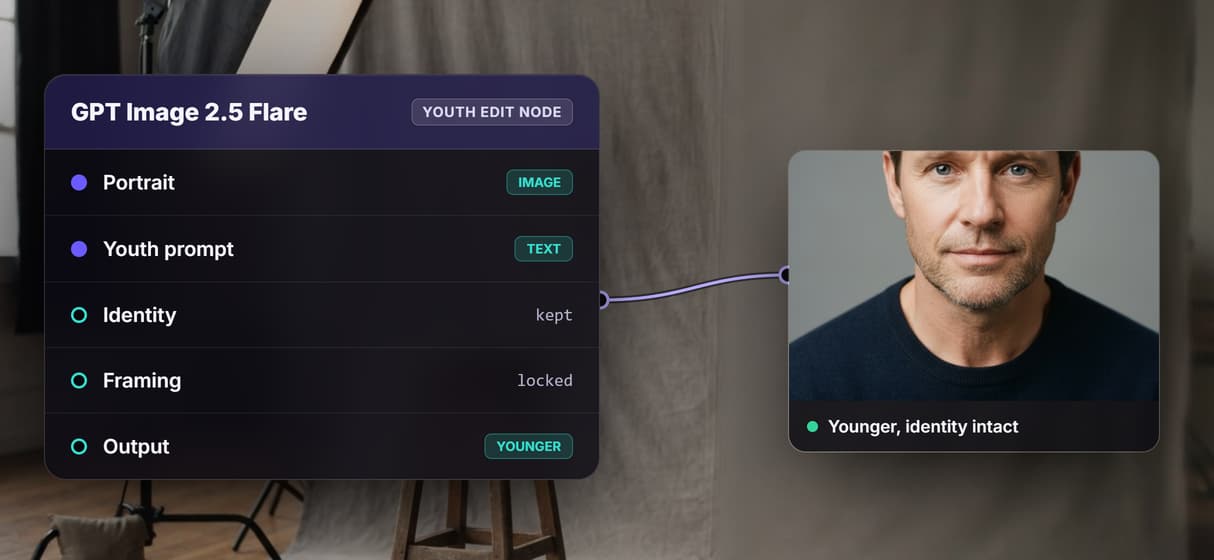
The instruction keeps identity, bone structure, and framing fixed, so only the age markers soften.
Upscale and restore nodes
Wire an upscaler or a restoration node after the youth step to enlarge or clean up the same face.
Rerun and swap models
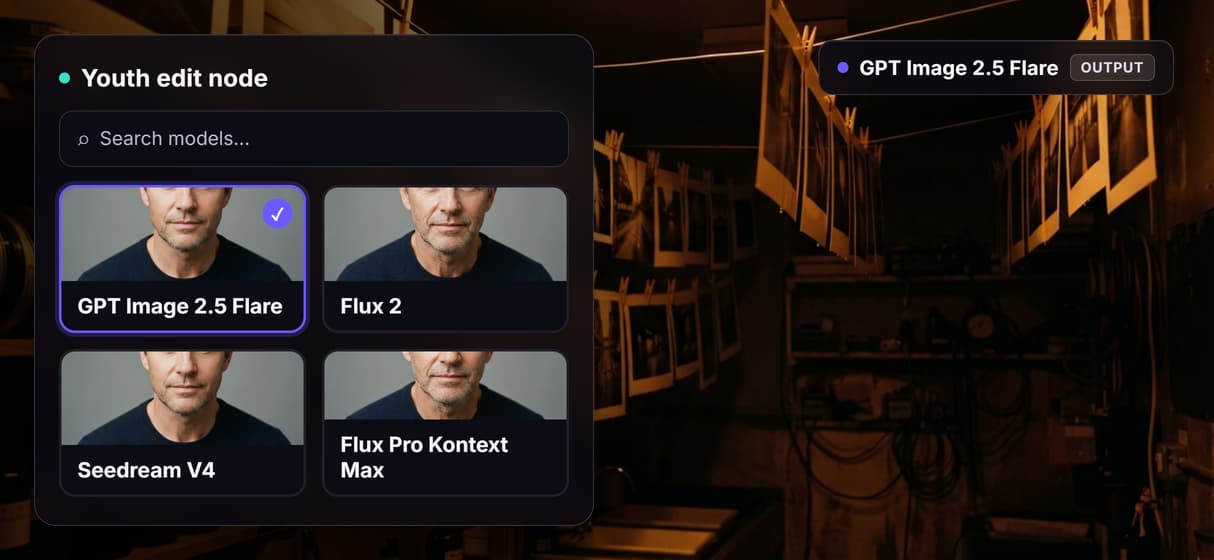
Workflows are versioned and shareable by link; swap the edit model as better ones ship.
REST and MCP
Every published flow is a REST endpoint and an MCP tool an agent can call over a batch of portraits.
How the de-aging graph actually runs
The workflow behind this page's button is deliberately small: a Text Input, two image nodes, and one more Text Input for the youth instruction.
- GPT Image 2.5 Flare makes the source portrait. The demo generates an older studio headshot so you can run the flow with nothing to upload. Swap this node for an Import node to de-age your own photo.
- GPT Image 2.5 Flare takes years off the face. The edit node reads the portrait on one port and the youth instruction on another, then returns the same person looking decades younger with identity, bone structure, and framing preserved.
- The instruction is yours to dial. Ask for about 30 years younger with smooth firm skin, no wrinkles or age spots, and fuller hair, and rerun until the amount is right. The same node can run the reverse edit and age a face older when you rewrite it.
Because the de-aging lives in a node instead of a hidden slider, the same portrait can roll straight into a longer chain, an AI headshot generator and an upscale, without leaving the browser. The whole graph is one of 70+ hosted model nodes you can rewire.
When a one-tap young filter app is the better call
If you want to laugh at one selfie of your younger self and post it in a single tap, a free mobile young filter app is the faster path, and this page will not pretend otherwise. Wireflow asks you to assemble a small graph on a canvas; that is the cost of getting a dial you can turn, a look you can reproduce, and a pipeline you can rerun on a whole cast of faces or from inside your own app.
Two honest limits worth stating plainly. This is a creative, identity-preserving age edit, not a forensic prediction of how someone really looked years ago, so the result is a likeness, not a guarantee, and very large age jumps can drift. And it is built for consensual creative, film, and marketing use: de-age only portraits you have the right to change, never to impersonate real people or make nonconsensual deepfakes. What Wireflow adds is ownership of the pipeline, 70+ hosted models to swap between including a chained AI image restoration pass, and per generation pricing.
More Than Just AI Young Filter
Dial how young by writing it
The youth step is a Text Input you own, not a fixed slider. Ask for 30 years younger with smooth skin and fuller hair, then rerun.
Chain de-aging into an upscale or restore
De-aging is one hop on the canvas. Wire the younger portrait into an AI image upscaler or a restore pass so one run de-ages and cleans it up.
Identity and framing stay locked
The instruction keeps identity, bone structure, and framing, so only the years drop away. Compare it beside an AI photo enhancer pass.
Reruns are identical, upgrades are one node
Workflows are versioned and shareable by link, so your fiftieth younger portrait runs like the first. Swap the edit node when a better model ships.
Per generation pricing, batch over REST and MCP
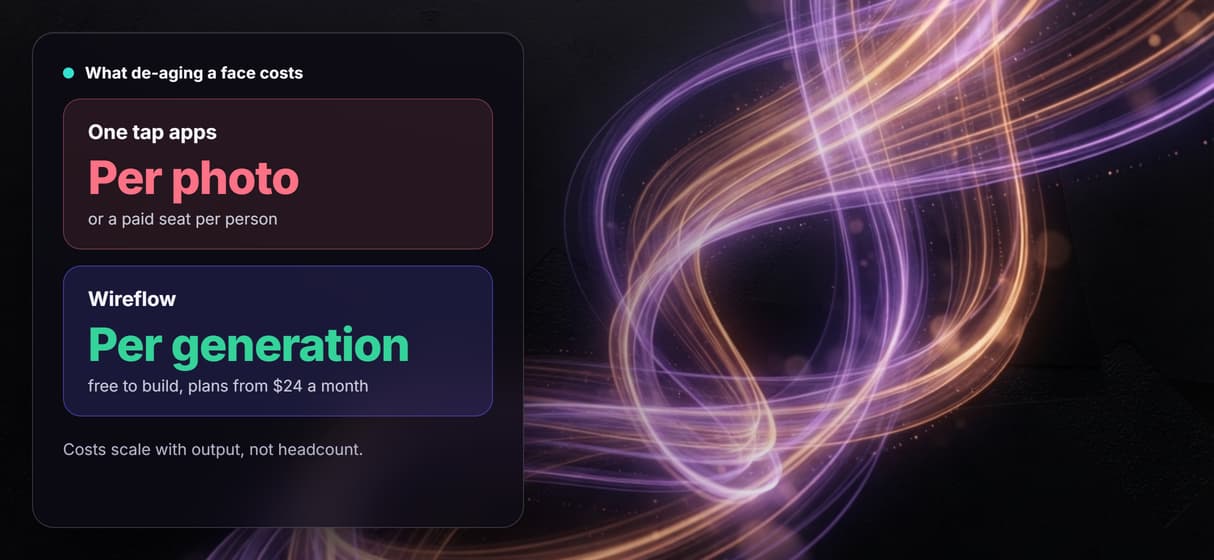
One tap apps charge per photo or per seat. Building is free and every flow is a REST endpoint and MCP tool, so batch a folder via the Nano Banana 2 API.
Young filter Workflows
No Code Required
API & Batch Processing
FAQs
An AI young filter takes a portrait and edits it to look younger. On Wireflow the portrait flows into a GPT Image 2.5 Flare edit node that reads a plain text youth instruction and smooths wrinkles, firms skin, and restores fuller hair while keeping the face, bone structure, and framing fixed, so the result reads as the same person at a younger age.
Discover related AI tools
- AI Image Upscaler: Upscale to 4K in a Visual Workflow
- AI Background Remover
- AI Image Generator: Flow-Based Canvas, 31 Models
- ComfyUI Alternative
- AI Face Swap Online: Photos and Video in Your Browser
- Virtual Try On
- AI Thumbnail Generator
- AI Photo Generator
- AI Image Editor
- AI Art Generator
- Midjourney Alternative
- AI Headshot Generator
More From Wireflow
Written by
Andrew Adams · Co-Founder & Operations at Wireflow
Runs client operations and content strategy at Wireflow. Works directly with creative teams and agencies to build production AI workflows.
Take years off a face on a canvas you control
Open the flow, write how many years younger you want, and run it: a portrait becomes the same person looking decades younger, identity intact. Building is free; you pay per generation, not per seat.