Best AI Ad Makers in 2026

In this article▾
- Quick summary
- How we ranked these AI ad makers
- 1. Wireflow: Best Overall
- 2. AdCreative.ai: Best for Paid Social Volume
- 3. Creatify: Best for UGC Video
- 4. Arcads: Best for Actor Style Ads
- 5. Creatopy: Best for Multi Size Banners
- 6. Predis.ai: Best for Small Teams
- 7. TopView AI: Best for Product Video
- 8. Canva: Best Free Option
- Comparison table
- How to pick one
- FAQ
- Conclusion
An AI ad maker turns a product page, a photo, or a short brief into finished ad creative, and in 2026 the eight tools below cover the realistic range: canvas based pipelines, UGC video generators, banner factories, and free starter editors. The split that matters is whether a tool hands you a finished file or a repeatable production line, because most teams stop being limited by a single ad and start being limited by variant count. Wireflow sits at the top of this list because it chains image, video, and voice models into one ad workflow you can rerun with new inputs, while the rest of the field is stronger at single purpose output. Pricing below is list pricing checked in September 2026 and every tool here produces ads without a designer in the loop.
Quick summary
- Wireflow: chain multiple AI models into one repeatable ad pipeline. Best Overall
- AdCreative.ai: high volume banner and static ad generation with scoring. Best for Paid Social Volume
- Creatify: product URL to AI UGC video ad in minutes. Best for UGC Video
- Arcads: scripted AI actor ads that read like real creator footage. Best for Actor Style Ads
- Creatopy: one design automatically resized into every placement. Best for Multi Size Banners
- Predis.ai: social ads plus scheduling in one small team stack. Best for Small Teams
- TopView AI: turns product listings into performance video ads. Best for Product Video
- Canva: free Magic Studio ad templates for teams starting out. Best Free Option
How we ranked these AI ad makers
Four criteria decided the order. First, output range: does the tool produce statics only, video only, or both. Second, variant throughput, meaning how many usable versions of one concept you can produce in an hour without redoing the setup. Third, control over the underlying models, since ad creative quality in 2026 is mostly a function of which image and video model runs each step. Fourth, whether the tool exposes an API, because agencies and product teams eventually want ad generation to run from their own systems rather than a dashboard. Tools that scored well on throughput and model control ranked higher than tools with larger template libraries, which is why the bulk video ad API category has pulled ahead of classic template editors.
Everything below was tested on the same brief: a consumer skincare product with one hero photo, three claims, and a requirement for both a 9:16 video ad and a set of feed statics.
Build this in Wireflow
Make the same kind of asset on a canvas you control, with a free account and no credit card.
1. Wireflow: Best Overall
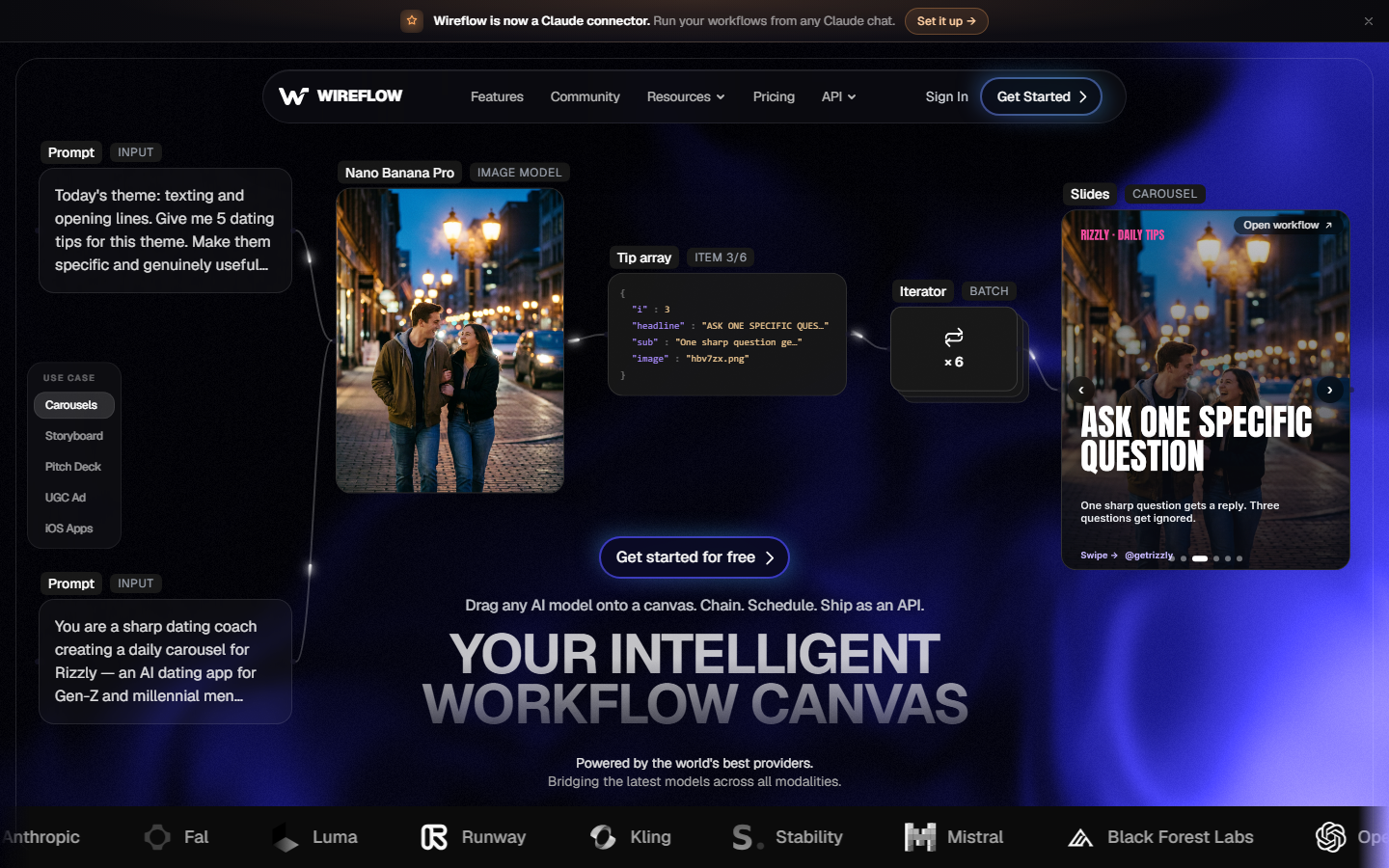
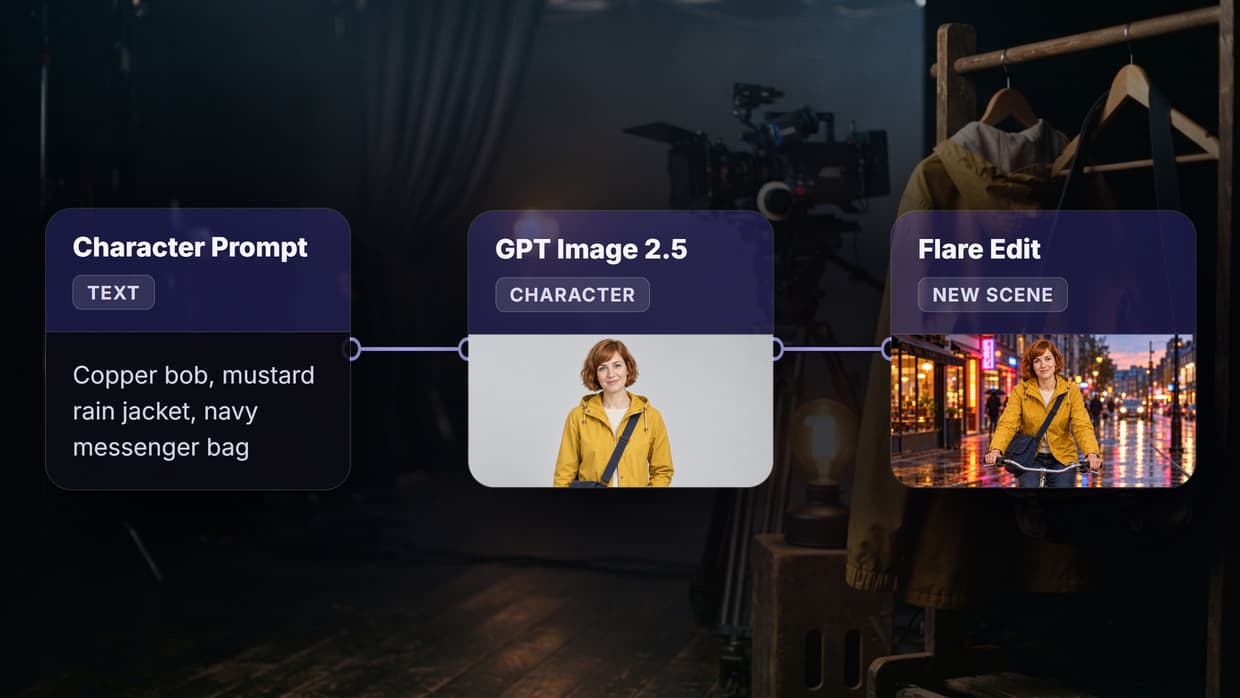
Instead of one model behind one button, this is a visual canvas where each node is a model call and the nodes pass output to each other. A typical ad build looks like this: a text node holds the brief, an image node generates or edits the product shot, a video node animates it, a voice node adds the read, and a compositor node assembles the final cut. Change the product photo at the top and the whole chain reruns, which is what turns a single ad into a batch. That structure is the reason it handles both halves of the test brief in one pass rather than in two separate tools.
The practical advantage over the rest of this list is model choice. Ad tools that wrap a single video model inherit that model's weaknesses on hands, text, and product fidelity. A canvas lets you swap the generation step when a better model ships, which happens several times a year now. The same graph is callable over HTTP, so the pipeline you build by dragging nodes becomes the pipeline your backend runs, a pattern covered in more depth in how to chain multiple AI models in one API call.
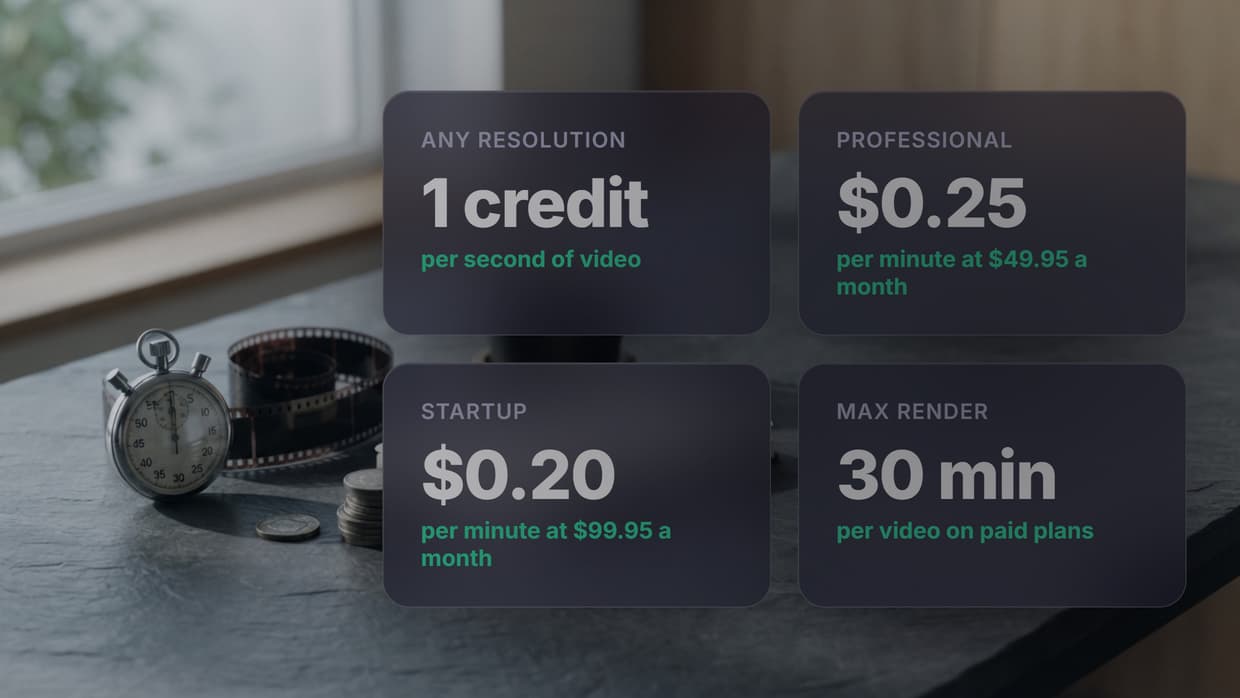
Pricing is credit based with a free tier for testing, and current rates are on the pricing page. Best for: agencies and in house teams producing more than a handful of ad variants per week. Weakest for: someone who wants one banner in two minutes and never wants to see a node.
2. AdCreative.ai: Best for Paid Social Volume
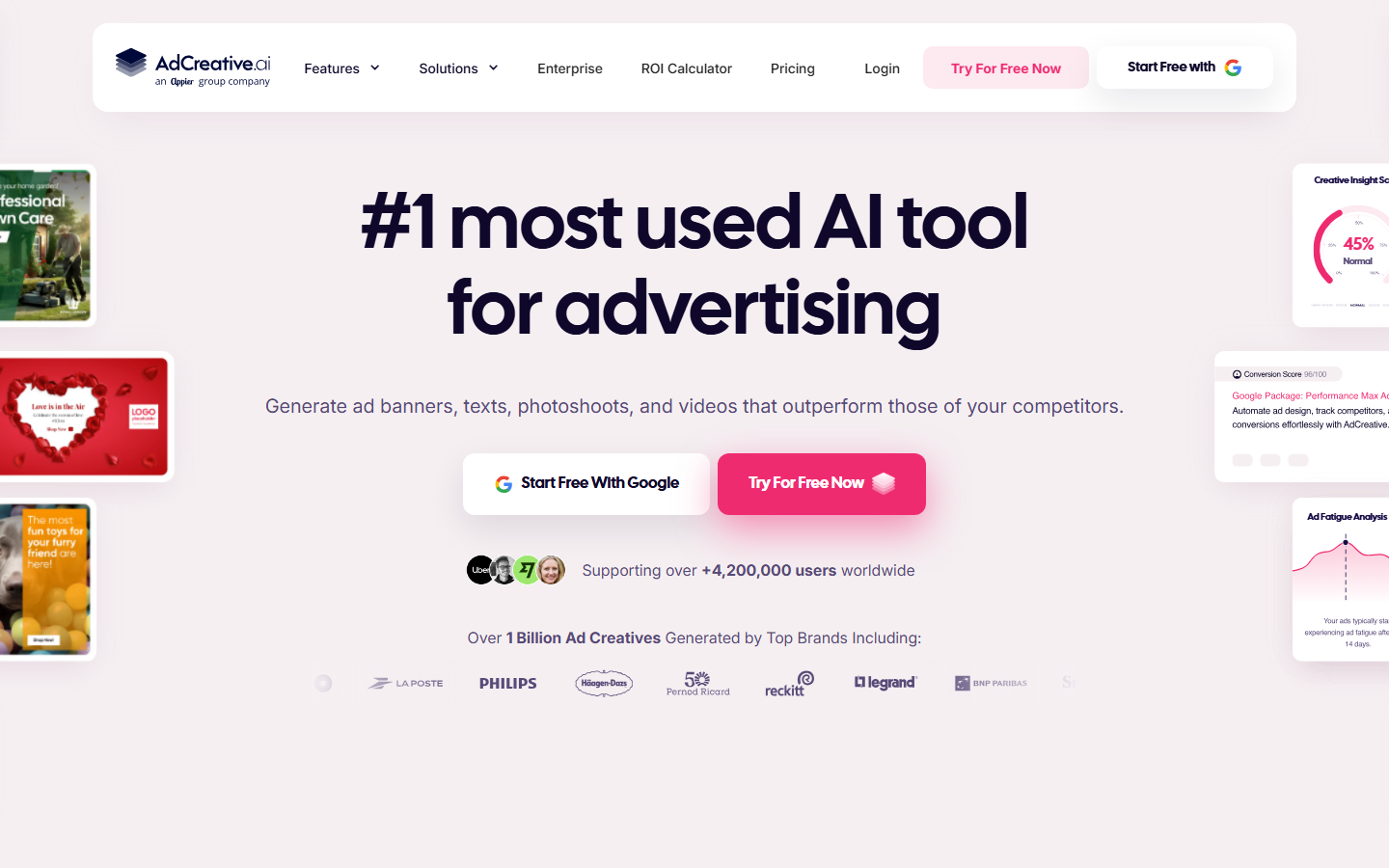
AdCreative.ai is built around one job: produce large batches of on brand static ads and rank them by a predicted conversion score before you spend budget. You upload brand colors, fonts, and logo once, point it at a product, and it returns dozens of banner variants sized for Meta and Google placements. The scoring model is the differentiator; it is trained on past ad performance and gives each creative a number, which is useful as a triage step even if you do not treat it as truth.
Its weakness is video. The video output is competent but template shaped, and it will not match a dedicated UGC generator on realism. Pricing starts around 39 dollars a month for the entry plan and rises steeply with credit volume and user seats. Best for: performance marketers who need fifty statics a week and want a shortlist before launch. Teams already running ad creative testing at scale will find the scoring fits naturally into an existing test cadence.
3. Creatify: Best for UGC Video
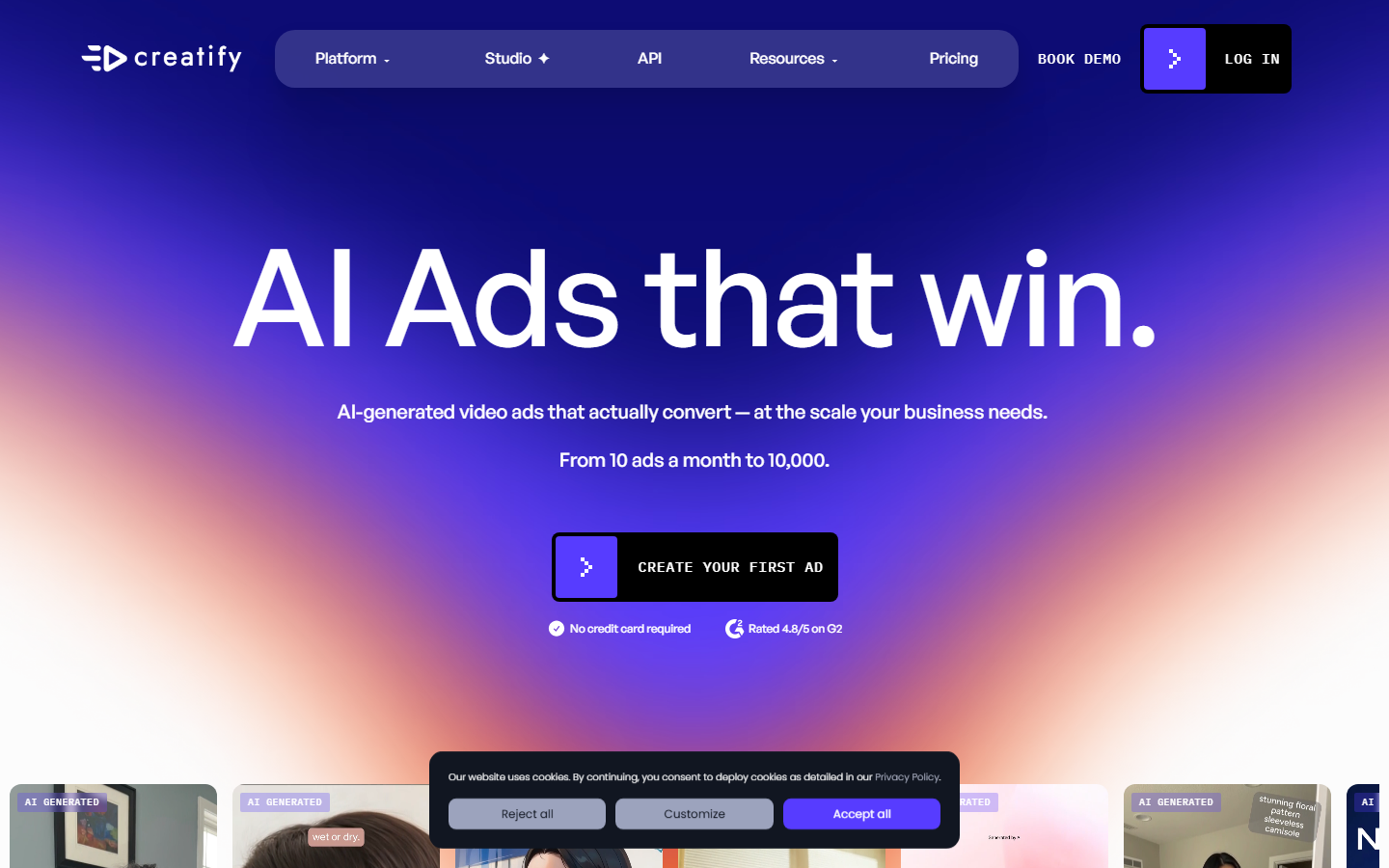
Creatify takes a product URL, scrapes the images and copy, and generates a short vertical video ad with an AI presenter reading a generated script. It is the fastest path from a listing to something postable on TikTok or Reels, and the avatar library is large enough that you can rotate faces across a campaign rather than repeating one presenter. Batch mode generates multiple hook variants of the same script, which is where most of the performance lift comes from.
The limits show up on control. You get the script and the avatar, but fine adjustments to pacing, b roll, and product close ups are constrained by the template. Pricing starts near 39 dollars a month, with higher tiers unlocking batch generation and longer videos; a fuller breakdown lives in our Creatify pricing writeup. Best for: DTC brands testing hooks quickly.
4. Arcads: Best for Actor Style Ads
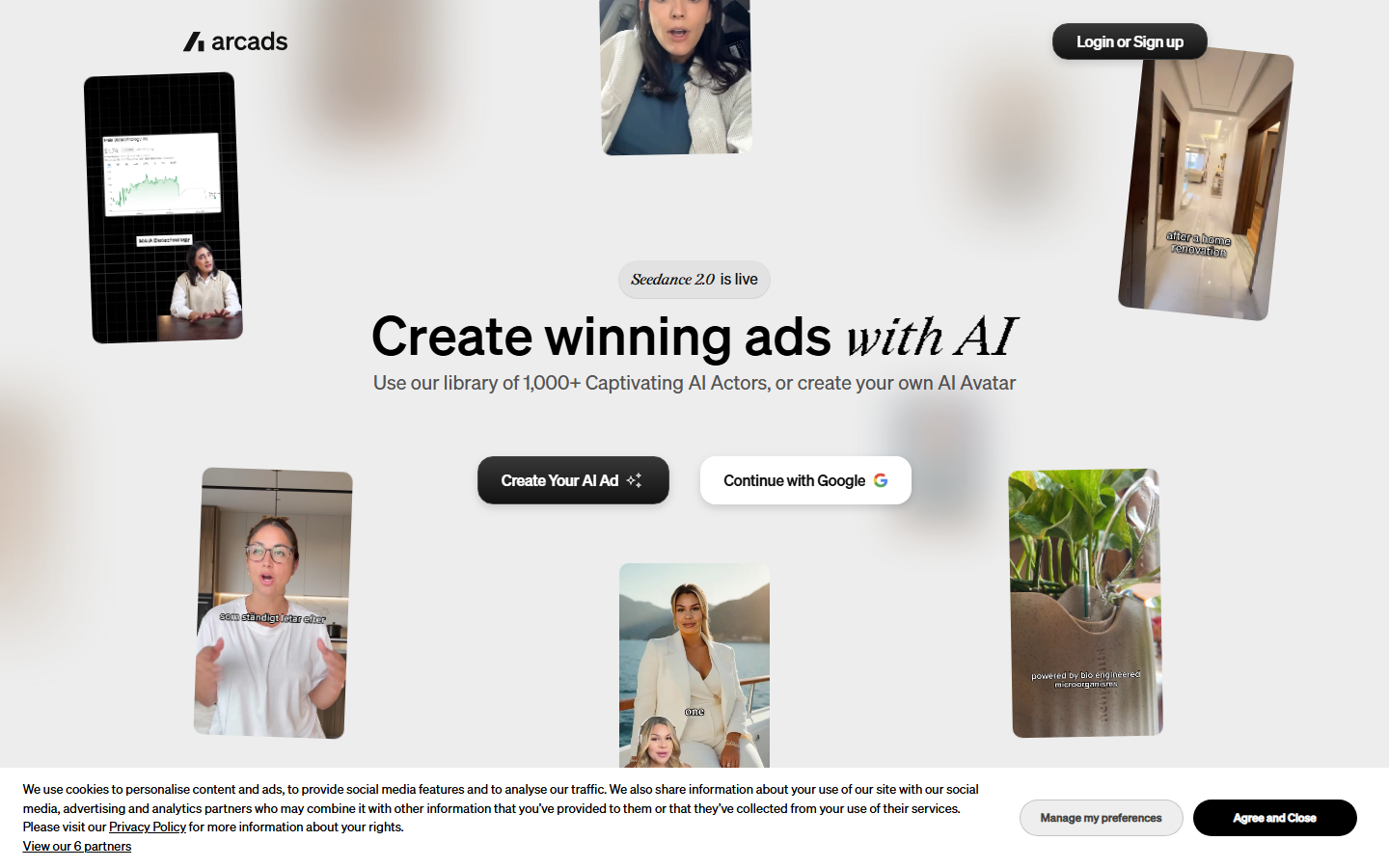
Arcads is narrower than Creatify and better at the narrow thing. You write or generate a script, pick from a roster of AI actors filmed in realistic settings, and get a delivery that reads closer to genuine creator footage than a studio avatar on a flat background. For ad accounts where UGC style outperforms polished production, that realism gap is the whole point.
There is no static ad output and no media buying layer, so it is a component in a stack rather than a stack. Entry pricing sits around 110 dollars a month for a fixed number of videos, which is steep at low volume and reasonable at high volume; see Arcads pricing for the tier detail. Best for: teams that already know UGC works for their offer and need consistent volume of it.
5. Creatopy: Best for Multi Size Banners
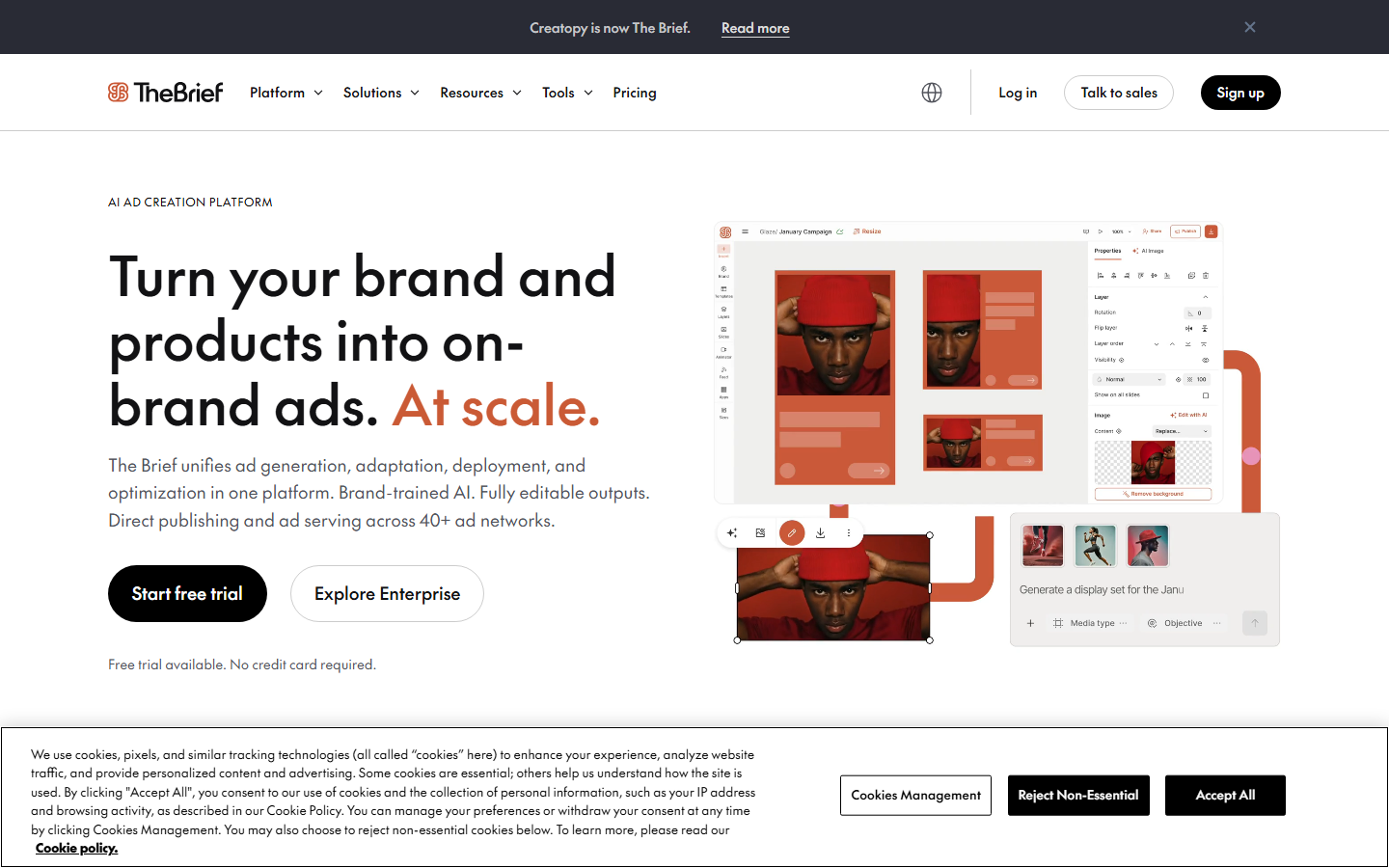
Creatopy, which rebranded to The Brief in 2026, solves the boring problem properly. Build one ad design, and it adapts that design across every standard placement, from Instagram Stories to the full Google Display banner set, keeping type hierarchy and safe areas intact instead of naively cropping. It also handles animated HTML5 banners, which most AI first tools skip entirely.
The AI here assists a design tool rather than replacing the designer, so it produces fewer surprises and fewer breakthroughs. Plans start around 36 dollars a month per user. Best for: display heavy advertisers and agencies delivering full size sets to clients, which is a common ask in AI video production software for agencies evaluations too.
6. Predis.ai: Best for Small Teams
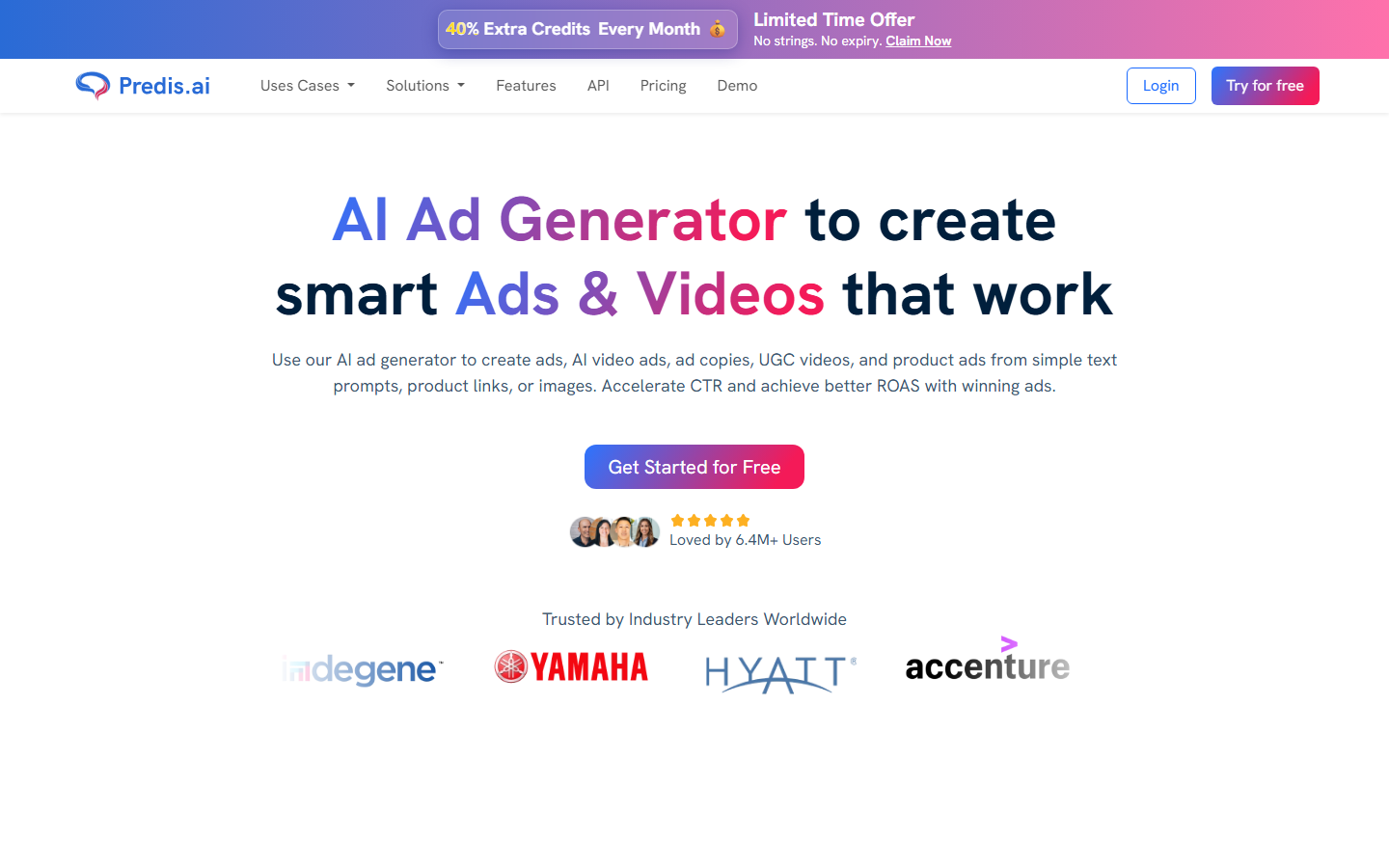
Predis.ai bundles ad generation with the parts around it: caption writing, hashtag suggestions, a content calendar, and direct publishing to connected accounts. For a one person marketing team, having generation and scheduling in one login removes real friction, and the free tier is generous enough to evaluate properly.
Quality is a step below the specialists on both statics and video, and the templates are recognizable if you look at enough of them. Paid plans start near 32 dollars a month. Best for: small businesses and solo marketers who want a whole social workflow rather than a creative engine, and who are closer to the automate UGC video creation end of the spectrum than the enterprise end.
7. TopView AI: Best for Product Video
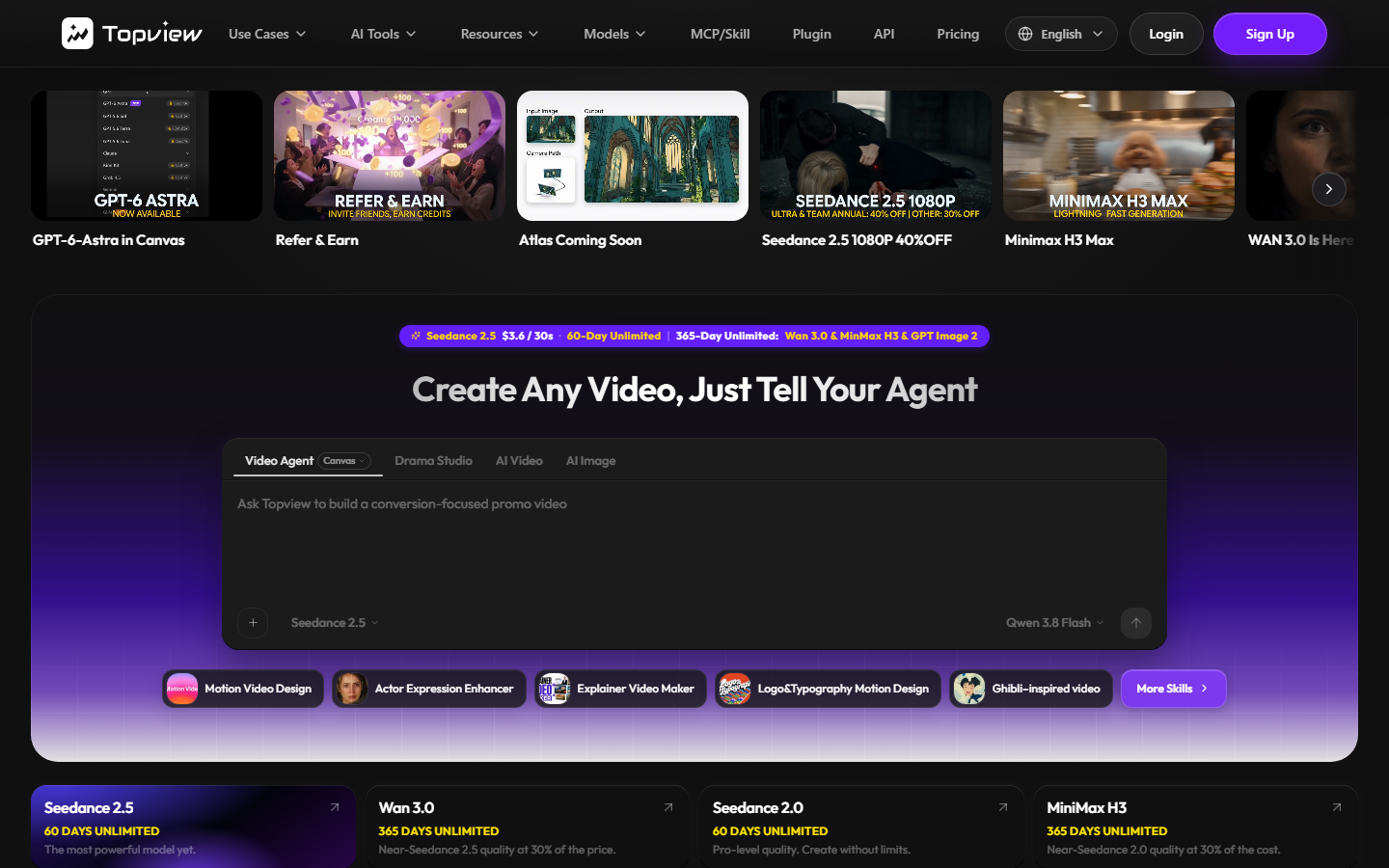
TopView AI converts a product link or a set of product photos into a performance style video ad, with automatic scene cuts, captions, and music. The 2026 interface is agent led: you describe the promo you want in a canvas prompt box and pick which video model runs it, currently Seedance, Wan, or MiniMax. Its avatar and voice cloning options let you reuse a founder's face and voice across a campaign, which is useful for brands where the founder is the marketing asset. Output leans toward the fast cut TikTok format rather than brand film.
Static output is minimal and brand controls are lighter than AdCreative.ai. Pricing starts around 20 dollars a month, one of the cheaper entry points here. Best for: ecommerce sellers who need product video ads at low cost, particularly those working through AI tools for TikTok UGC ads.
8. Canva: Best Free Option
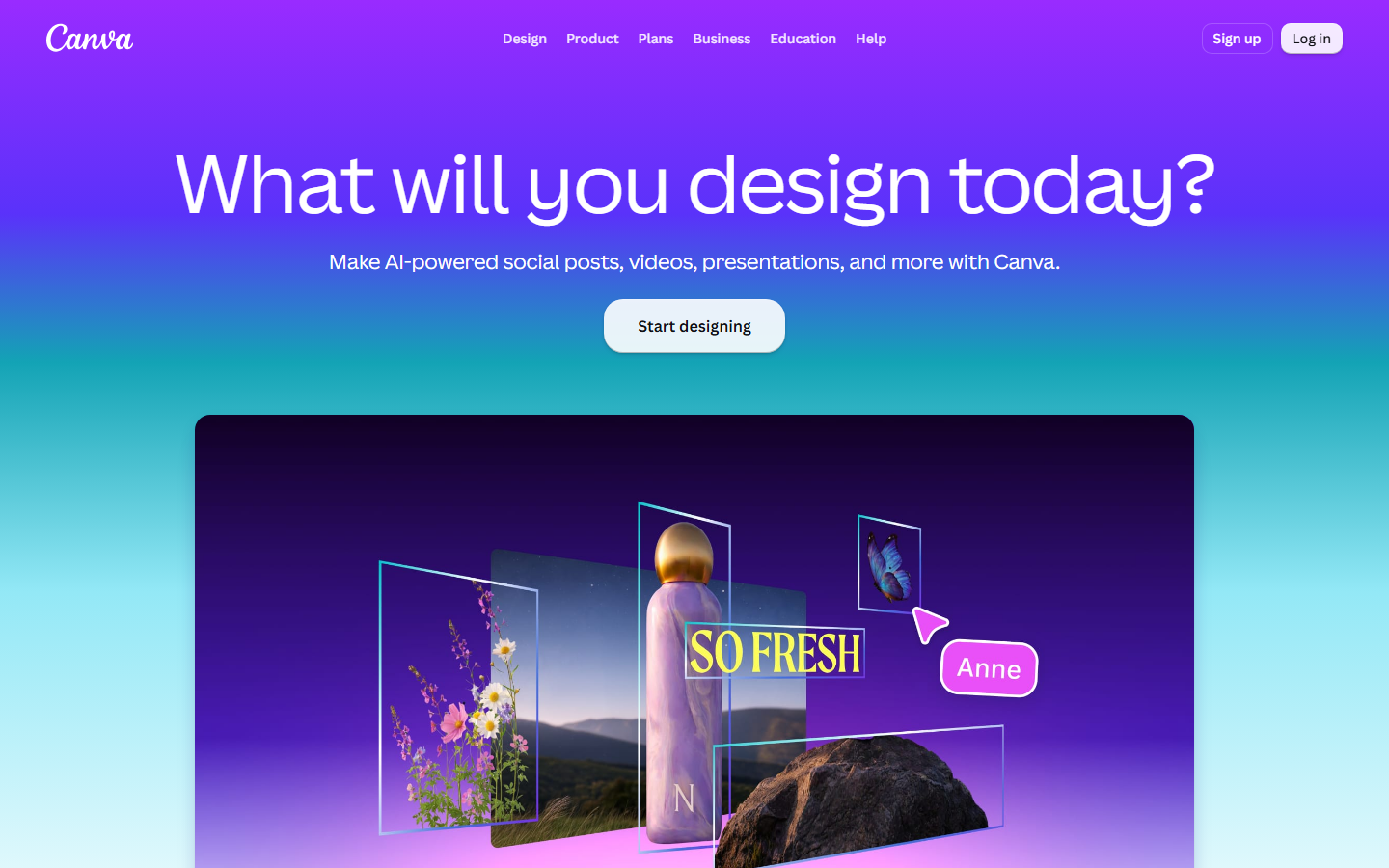
Canva is not an ad specialist, but Magic Studio now covers enough of the job that a small team can produce competent statics and simple video ads without paying for anything. Brand Kit keeps colors and fonts consistent, Magic Resize handles placement sizes, and the template library is the largest in this comparison by a wide margin.
There is no performance scoring, no bulk variant engine, and no API for ad generation, so it stops scaling exactly where a paid workflow starts. The free plan is genuinely usable and Pro is around 15 dollars a month. Best for: teams making their first ads, or anyone who needs one clean static today.
Comparison table
| Tool | Best for | Statics | Video | API | Entry price |
|---|---|---|---|---|---|
| Wireflow | Multi model ad pipelines | Yes | Yes | Yes | Free tier, credit based |
| AdCreative.ai | Paid social volume | Yes | Basic | Yes | ~$39/mo |
| Creatify | UGC video ads | Limited | Yes | Yes | ~$39/mo |
| Arcads | Actor style UGC | No | Yes | Yes | ~$110/mo |
| Creatopy | Multi size banners | Yes | Animated | Yes | ~$36/mo |
| Predis.ai | Small team social | Yes | Yes | Yes | Free tier, ~$32/mo |
| TopView AI | Product video ads | Limited | Yes | Yes | ~$20/mo |
| Canva | Free starter ads | Yes | Basic | No | Free, ~$15/mo Pro |
How to pick one
Start from the format you actually run. If your winning ads are vertical creator videos, the choice is between Creatify, Arcads, and TopView AI, and the deciding factor is realism versus cost. If your spend goes to display and feed statics, it is AdCreative.ai for volume or Creatopy for placement coverage. If you are producing both formats every week and the count keeps climbing, a single purpose tool becomes the bottleneck and a pipeline you control is the better answer, the same conclusion teams reach when they start scaling ad creative production.
One thing worth budgeting for: none of these tools removes the need for a human on selection. They compress production, not judgment. Plan for generating five to ten times more creative than you ship and treat the extra as test inventory rather than waste, which is the working assumption behind most mass produced UGC ad programs.
Try it yourself: build this ad workflow in Wireflow with the model nodes already wired for product image, animation, and voice.
FAQ
What is an AI ad maker? An AI ad maker is software that generates finished advertising creative, statics or video, from inputs like a product URL, a photo, or a short text brief. It handles copy, layout, and in most cases the imagery or footage, replacing the parts of ad production that used to require a designer or an editor.
Which AI ad maker is best in 2026? Wireflow ranks first for teams producing ads at volume because it chains several models into one rerunnable workflow rather than locking you to a single generator. For pure static volume AdCreative.ai is the strongest specialist, and for UGC style video Arcads produces the most realistic output.
Can AI ad makers produce video ads? Yes. Creatify, Arcads, TopView AI, and Wireflow all produce video ads, typically 15 to 60 seconds and vertical by default. Static specialists like AdCreative.ai and Creatopy include video output, but it is template based and less convincing than the video first tools.
Are AI generated ads allowed on Meta and TikTok? Yes, both platforms allow AI generated creative. TikTok requires AI generated content that shows realistic scenes or people to carry an AI disclosure label, and Meta applies automatic AI labeling to some detected content. Neither platform restricts distribution for correctly labeled ads.
How much do AI ad makers cost? Entry plans across this list run roughly 15 to 110 dollars per month. Template tools sit at the low end, UGC video generators at the high end because video compute is expensive, and credit based platforms scale with what you actually generate rather than a flat seat fee.
Do I still need a designer? For volume production, no. For brand definition, yes. These tools execute an existing visual system well and invent a good one poorly, so most teams keep a designer to set the brand kit and select winners, then use AI to produce the variants inside those rules.
Can I generate ads automatically from my own app? Yes, if the tool exposes an API. Wireflow, AdCreative.ai, Creatify, Arcads, and Creatopy all offer programmatic access, which lets you trigger ad generation from a product feed or an internal dashboard. Approaches are compared in AI workflow orchestration platforms with an API.
How many ad variants should I generate per concept? A practical baseline is ten to twenty variants per concept, varying the hook in the first three seconds more than the body. Hook variation drives most of the measured difference in performance, which is why batch generation matters more than any single output being perfect.
Conclusion
The AI ad maker market in 2026 splits cleanly into finished-output tools and production pipelines. AdCreative.ai, Creatify, Arcads, Creatopy, Predis.ai, TopView AI, and Canva each do one part of the job well, and for a team shipping a few ads a week any of them is a reasonable single purchase. The moment your variant count outgrows a dashboard, the constraint shifts from creative quality to repeatability, and that is where a model chaining approach like Wireflow's earns its place at the top of this list. Pick the tool that matches your current volume, and reevaluate when the volume changes.

Co-Founder & Operations at Wireflow
Runs client operations and content strategy at Wireflow. Works directly with creative teams and agencies to build production AI workflows.
- Content Strategy
- Client Operations
Make AI videos and ads.
Start free, no card needed.