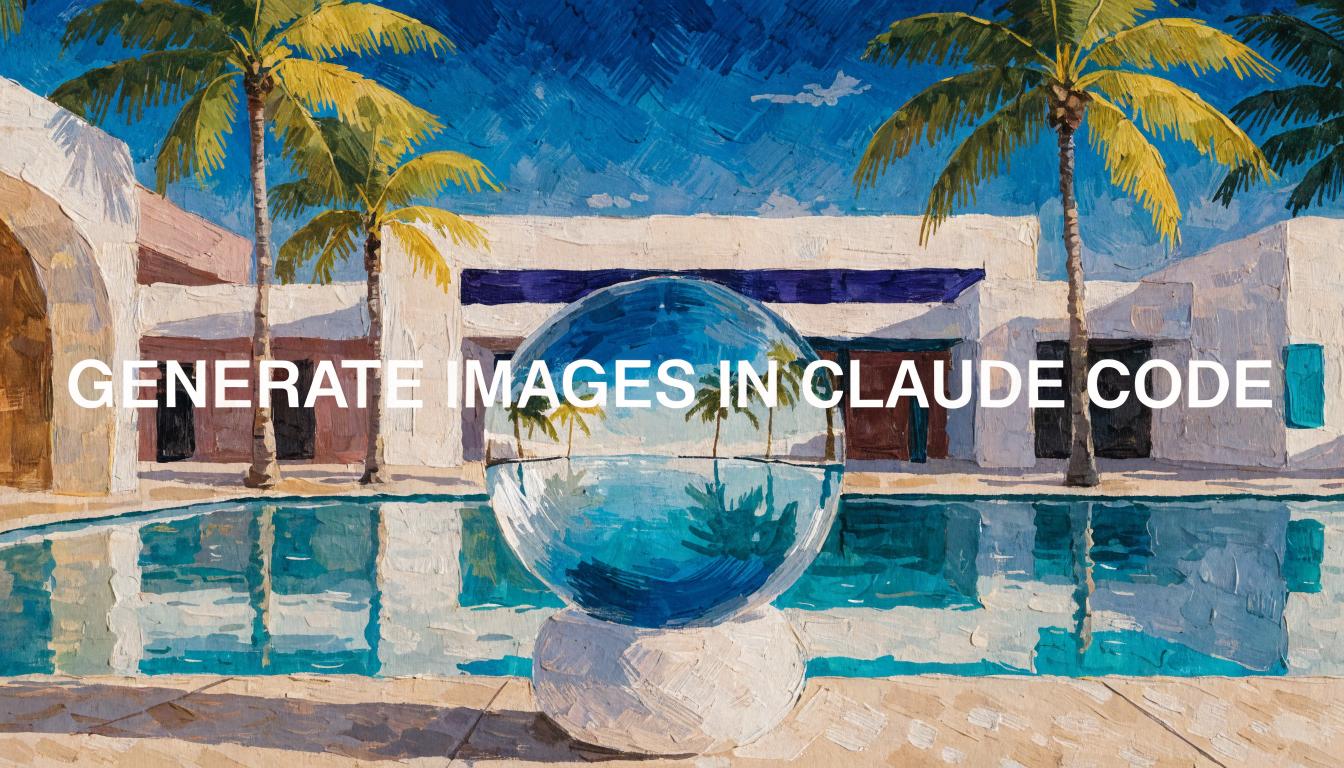
Claude Code cannot generate images on its own, but you can add image generation to it in under ten minutes with an MCP server, a short script, or a hosted workflow API. This guide walks through all three methods with exact steps, and Wireflow fits into the third one: it chains image models like FLUX and GPT Image into a single endpoint that Claude Code can call with one curl command.
Why Claude Code Cannot Generate Images Natively
Claude is a language model. It reads and writes text, reasons over code, and understands images you show it, but it has no diffusion or image synthesis model inside. Claude Code, the terminal agent built on Claude, inherits that limit. When people first try prompting it to "make me a logo," they get an SVG or HTML mockup at best. We covered the broader setup options in our guide to adding image generation to Claude Code; this article focuses on the fastest reliable paths.
What Claude Code does exceptionally well is orchestrate. It can write the API call, run it from your shell, save the output file, open the result to review it visually, and iterate on the prompt until the image is right. That makes it a strong front end for any image generation API built for developers, even though the pixels are always produced by an external model.
Build this in Wireflow
Make the same kind of asset on a canvas you control, with a free account and no credit card.
What You Need Before You Start
- Claude Code installed and authenticated in your terminal
- An API key from an image provider (fal.ai, Replicate, OpenAI, or Google), or access to a hosted workflow endpoint
- A folder in your project for generated assets, for example
./assets/generated
That is the whole list. You do not need a GPU, a Python environment, or any local model weights. For a hands-on look at wiring Claude Code to a production image pipeline, check out the AI API with Claude Code integration page, which shows the two-node setup this article's workflow uses.

Method 1: Add an Image Generation MCP Server
MCP (Model Context Protocol) servers give Claude Code new tools it can call natively, so image generation becomes a first-class action instead of a script it has to write. We published a full MCP server image generation example if you want a deeper reference; the short version looks like this.
- Pick a provider with an MCP server. Replicate, ImagineArt, Stability AI, and several Gemini-based community servers all publish one. Choose based on the models you want access to.
- Register the server with Claude Code. The general shape is
claude mcp add <name> -e PROVIDER_API_KEY=your-key -- npx -y <server-package>. You can also declare it in a.mcp.jsonfile at the project root so teammates get the same tool. - Restart Claude Code and prompt in plain English. Something like: "Generate a 16:9 image of a mountain cabin at dusk and save it to ./assets/generated/cabin.png."
- Verify the output. Ask Claude Code to open the file and describe it. Because Claude has vision, it can confirm the image matches the brief and regenerate if it does not.
The MCP route is the cleanest for daily use. The tradeoff is that each server exposes one provider's models, so switching from Stable Diffusion to GPT Image usually means installing a second server.
Method 2: Let Claude Code Write the API Script Itself
If you would rather not install anything, use the tool Claude Code already has: your shell. It can write and run a script that calls any image endpoint directly. This works with every major provider, from OpenAI's image API to the Stable Diffusion API tools ecosystem.
- Export your API key in the terminal session, for example
export FAL_KEY=your-key. - Describe the script you want. Prompt: "Write a Node script that POSTs a prompt to https://fal.run/fal-ai/flux/dev with my FAL_KEY, downloads the returned image, and saves it to ./assets/generated with a timestamped filename. Then run it with the prompt 'isometric illustration of a data pipeline'."
- Let it run and review. Claude Code executes the script, waits for the response, and saves the file.
- Iterate visually. Ask it to read the saved image and critique it against your brief, then adjust the prompt or parameters and rerun.
The script method is the most flexible and the easiest to commit to your repo, since the generation logic lives in your codebase rather than in tool configuration. It is also the simplest to parameterize for batch jobs, like generating twenty product variations in a loop.

Method 3: Call a Hosted Workflow Endpoint
Single API calls cover single models. Real image pipelines usually chain steps: generate a base image, upscale it, remove the background, then composite text. Writing and maintaining that chain as a script gets messy fast, which is why chaining multiple AI models in one API call through a workflow platform is the standard approach for production use.
- Build the chain visually on a node-based image generation canvas: an input node for the prompt, one or more model nodes, and any post-processing steps.
- Publish the workflow so it gets a stable ID and an HTTP endpoint.
- Call it from Claude Code. One curl request with your prompt as the payload triggers the whole chain, and Claude Code can poll for the finished asset URL.
- Reuse it everywhere. The same endpoint works from CI jobs, backend services, and other agents, so the pipeline you tuned once stays consistent.
This method separates concerns nicely: the visual canvas owns model selection and chaining, while Claude Code owns when and why images get generated.

Which Method Should You Use?
| Method | Setup time | Best for | Multi-model chains |
|---|---|---|---|
| MCP server | ~5 minutes | Daily interactive use inside Claude Code | No, one provider per server |
| API script | ~10 minutes | Batch jobs and logic you want in your repo | Manual, you write the glue |
| Hosted workflow | ~10 minutes | Production pipelines and repeatable chains | Yes, built in |
Cost behaves differently across the three. Direct API scripts bill per provider call at each provider's rates, while hosted workflows meter usage per run with credit-based pricing, which makes spend easier to predict when a single trigger fans out into several model calls.
A practical pattern is to combine them: use an MCP server for quick one-off assets while you work, and a hosted workflow endpoint for anything that ships. Teams using other coding agents report the same split; our GitHub Copilot image generation guide shows the identical architecture from a different agent.

Tips That Save Time
- Name outputs deterministically. Ask Claude Code to save files as
<slug>-<step>.pngso reruns overwrite cleanly instead of piling up duplicates. - Keep prompts in files. A
prompts/folder in your repo lets Claude Code version, diff, and reuse the prompts that worked. - Always have it review the image. Claude's vision is the quality gate; a one-line "open the file and check it matches the brief" catches bad generations before they reach a teammate.
- Set a budget guard. For batch jobs, tell Claude Code the maximum number of generations per run so a retry loop cannot burn through credits.
Try it yourself: Run this image workflow in Wireflow, the nodes come pre-configured with the exact setup discussed above, so you can trigger it from Claude Code with a single request.
Frequently Asked Questions
Can Claude Code generate images natively?
No. Claude is a text and reasoning model with vision input, but it contains no image synthesis model. Claude Code generates images by calling external models through MCP servers, scripts, or workflow APIs, as described above.
Which image models can I use with Claude Code?
Any model with an HTTP API: FLUX, Stable Diffusion, OpenAI's GPT Image models, Google's Imagen, Recraft, and dozens of others. The method you choose determines how they connect, not which models are available.
Do I need an API key?
Yes, for every method. MCP servers and scripts need a provider key (fal.ai, Replicate, OpenAI, or Google), and hosted workflow endpoints need the platform's API key. Keys stay in environment variables, so they never appear in your prompts or repo.
Can Claude Code see the images it generates?
Yes. Claude has vision, so Claude Code can open a generated file, describe what it sees, compare it against your brief, and regenerate with an adjusted prompt. This review loop is the biggest practical advantage over generating images in a separate browser tab.
How much does it cost to generate images this way?
Claude Code itself adds no image cost; you pay the image provider per generation. Typical per-image prices range from under a cent for fast SDXL variants to several cents for premium models. Workflow platforms meter per run, which bundles multi-step chains into one predictable charge.
What is an MCP server?
MCP (Model Context Protocol) is an open standard that lets tools expose capabilities to AI agents. An image generation MCP server gives Claude Code a native "generate image" tool, so you can prompt in plain English instead of writing API code.
Can I automate image generation in CI or cron jobs?
Yes. Claude Code runs headless with the -p flag, so a CI step can invoke it with a prompt and let it call your image endpoint. For pure automation without an agent in the loop, calling the workflow endpoint directly from your pipeline is simpler and faster.
Can Claude Code edit existing images?
It can orchestrate editing the same way it orchestrates generation: image-to-image models, upscalers, and background removers all have APIs it can call. Point it at the source file, name the transformation, and it wires the call.
Start Generating From Your Terminal
Pick the method that matches how you work: MCP for interactive sessions, scripts for repo-owned logic, or a hosted workflow when you need chains that ship to production. All three turn Claude Code from a text-only assistant into a full creative pipeline driver, and platforms like Wireflow handle the model-chaining half so your agent only has to make one call. Start with the developer-friendly AI image platforms comparison if you are still choosing a provider.
Would you rather we just built it?
We get on a call, learn your style, build the workflow, and ship the deliverables on a schedule. You keep the workflow either way.