Veo in Claude: How to Make Veo 3.1 Clips From a Chat

In this article▾
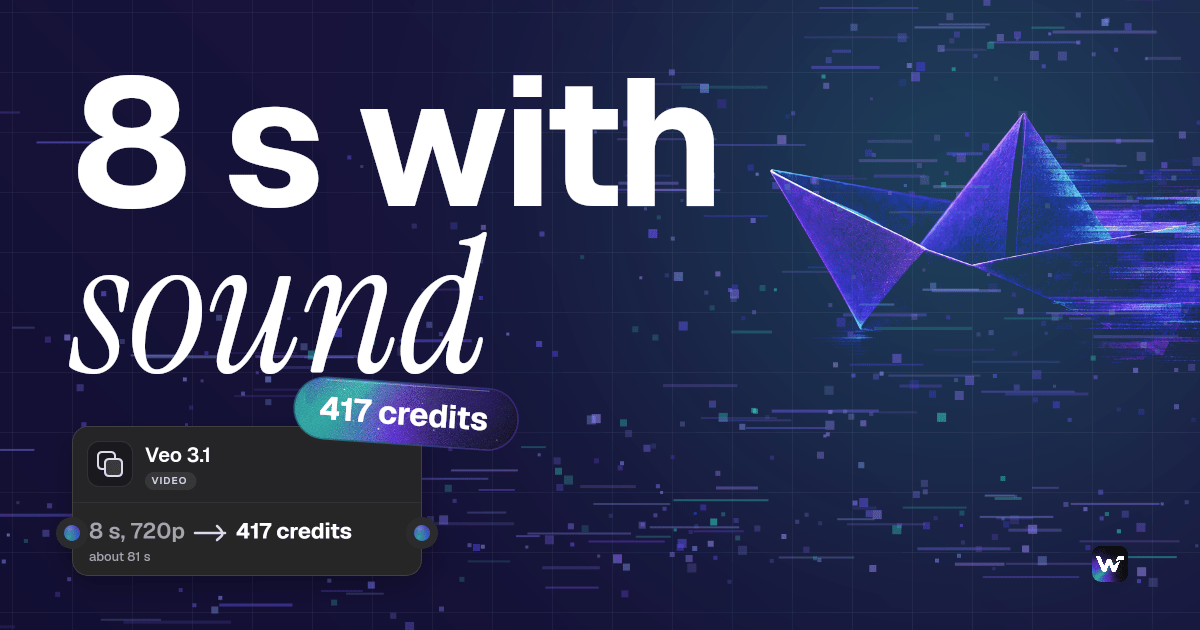
Veo in Claude means typing a scene into Claude and getting back a real Veo 3.1 video with sound, without a Google Cloud project or a Gemini API key. This guide covers the connector setup, one 8-second clip and what it cost. Claude has no video model of its own, so it calls Veo through MCP. We used Wireflow, a node-based AI canvas whose connector lets Claude run a saved Veo 3.1 flow and return the MP4. On 2 November 2026 our 8-second, 720p clip finished in about 81 seconds and charged 417 credits.
What "Veo in Claude" means
Claude reads, writes and calls tools, but it does not render video. Veo 3.1 is Google's video model: 4, 6 or 8 second clips at 720p or 1080p, in 16:9 or 9:16, from a text prompt or a start frame (with an optional end frame), with generated sound. To get a Veo clip from a chat, Claude needs an MCP server that exposes Veo as a tool.
The pages that rank for this phrase describe three kinds of setup:
| Setup | What you need | What Claude can do |
|---|---|---|
| Self-hosted Veo MCP server | A local install, plus your own Gemini or Google Cloud key | Start a Veo job and poll it |
| Hosted Veo connector | An account with the host, paid in its credits | Veo text or image to video |
| Workflow connector | An account, signed in with OAuth | Run a saved Veo 3.1 flow, also callable over REST |
Self-hosted servers carry one extra risk. Some were written against Gemini API preview IDs such as veo-3.1-generate-preview, which Google listed for shutdown on 22 October 2026, so check which model ID a server calls before you install it. For more connector options, see our ranked list of video MCP tools.
Build this in Wireflow
Make the same kind of asset on a canvas you control, with a free account and no credit card.
How Claude calls Veo over MCP
The Model Context Protocol (MCP) lets an app publish tools that Claude calls by name. A video takes a minute or more, so the tool starts a job, returns an id, and Claude checks back until a file URL appears. Our test of Claude video generation used the same loop with other models.
The MCP server we connected has these tools for a Veo clip:
list_modelsandget_credit_balanceshow live prices and your balance before anything is spent.list_workflowsandget_workflowfind a saved flow and its inputs;create_workflow_from_promptbuilds a new one.run_workflowstarts a run. It is the only one of these tools that spends credits.get_executionreturns the status and, once done, the output URLs.
The run: one prompt, Veo 3.1, 8 seconds
Our flow is a plain text to video AI setup in two parts:
- Scene Prompt. A text input with the subject, the camera move and the sound.
- Clip (Veo 3.1). The Veo 3.1 node at its defaults: standard quality, 8 seconds, 720p, 16:9, sound on.
The prompt, word for word:
A folded paper boat drifts down a rain-filled gutter on a quiet city street at dusk, bobbing over small ripples as raindrops hit the water around it. Low camera at water level, slowly tracking alongside the boat. Warm streetlight reflections shimmer on the wet asphalt. Sound: steady rain, water trickling into a drain, a car passing in the distance. No text, no logos, no people.
Naming the sounds matters because Veo builds the audio track from the same prompt. Our Veo 3 prompt guide has more patterns that hold up.

The loop is the unedited output without sound; click it for the MP4 with audio. The free quote before the run was also 417 credits, and the charge matched it. The pricing page lists the plans behind the credits.
| Step | Settings | Finished after | Credits |
|---|---|---|---|
| Scene Prompt | Input | under 1 s | 0 |
| Clip (Veo 3.1) | Standard, 8 s, 720p, 16:9, sound on | 1 min 15 s | 417 |
| Total | about 1 min 21 s | 417 |
What came back

The file is 1280x720 at 24 frames a second, exactly 8.0 seconds, H.264 with a stereo AAC track. For clips made by clicking instead of chatting, the same models run in the AI video generator.
- The scene matched. A white paper boat rides the water along the curb, streetlights reflect on the wet asphalt, and the camera stays at water level.
- The camera move changed. We asked for tracking alongside the boat. Veo kept the lens behind it, and the boat drifts away toward a storm drain by the last second.
- It added leaves. Fallen autumn leaves sit on the curb for most of the clip. A brand shot would need them named or ruled out.
- The rain is quiet on screen. The water ripples, but falling drops are hard to see.
- The sound runs all 8 seconds. A steady track with no silent gaps, a little louder in the first second and a half.
That camera change is why a person should watch the first take. Claude can rerun with a firmer camera line, such as "the camera moves forward beside the boat at the same speed", or try a second model on the same prompt, the idea behind comparing video models side by side.
Set it up and run it from Claude
The connector signs in with OAuth, so there is no key to paste and no Google Cloud project to create. It works in claude.ai, Claude Desktop and Claude Code, the terminal route on our AI API with Claude Code integration page.
- Add the connector. In claude.ai, open Customize, then Connectors, click the plus button and choose Add custom connector. Paste
https://www.wireflow.ai/api/mcpand leave the advanced OAuth fields empty. In Claude Code, runclaude mcp add --transport http wireflow https://www.wireflow.ai/api/mcp, then/mcpto sign in. - Sign in and approve. The default permissions cover reading models, building and running flows, and reading results, as the MCP connector guide lists.
- Get a flow. Duplicate the workflow linked at the end of this guide, or ask Claude to build one.
- Ask in plain words. For example: "Run my Veo 3.1 Clip From Claude flow. Scene: steam rising from a coffee mug, slow push-in. Tell me the credit cost and wait for my yes."
- Let Claude poll. It reads the price, calls
run_workflowafter your yes, and checksget_executionuntil it can reply with the MP4 link.
Claude can also write the scene prompt; read it before you say yes. The same steps work for other video models, as in our guide to Kling in Claude.
Pick a quality and length before you run
Veo 3.1 has two quality settings, and length changes the price. These quotes come from the free estimate on 2 November 2026, all at 720p with sound on:
| Veo 3.1 quality | 4 seconds | 8 seconds |
|---|---|---|
| Standard | 256 credits | 417 credits |
| Fast | 96 credits | 192 credits |
Standard quality costs more per second on short clips, so a full 8-second take is the better buy once a prompt works. Fast quality is a flat 24 credits a second, a cheap way to test a prompt first. Google's own per-second prices are in our Veo 3.1 pricing breakdown.
- A lighter model. Veo 3.1 Lite is a separate node at 16 credits a second, 128 for 8 seconds in the live models list.
- Plans. Both Veo nodes are marked as paid-plan models in the live models list. Starter is $36 a month for 2,660 credits, about six standard 8-second clips; Professional is $59 a month for 4,370 credits, about ten.
- Resolution. Every figure here is for 720p. Quote 1080p before you run it.
- Two bills. Claude's tool calls count toward your Claude plan; the generation uses the connector account's credits.
When to move from Claude to the Veo API
Claude is the right front end while a person is choosing the prompt and whether to rerun. It is the wrong place for work nobody watches, because the chat waits while a render runs. Our n8n vs MCP comparison covers that trade-off.
The flow does not change when your code takes over. Your app sends an API key as a Bearer token, POST /api/v1/workflows/{id}/run returns an execution id, and GET /api/v1/workflows/executions/{executionId}/poll returns the status, the output URLs and creditsUsed (417 for ours), so you can log each clip's cost. The async polling pattern and usage tracking for that production route are on the Google Veo API page.
Try it yourself: Build this workflow in Wireflow. Edit the Scene Prompt and run Clip (Veo 3.1) for an 8-second, 720p clip with sound. From Claude, one
run_workflowcall does the same. You can open and change this workflow for free; Veo runs use a paid plan's credits, from $36 a month for 2,660 credits.
FAQ
Can Claude generate videos with Veo?
Not by itself. Claude has no video model, but through an MCP connector it can run Veo 3.1 and return the MP4 link in the chat.
Do I need a Google Cloud project or a Gemini API key?
No. The connector signs in with OAuth, and Veo runs on the account's credits. You need an API key only when your own code calls the flow, for example through a video generation API integration.
How much does one Veo 3.1 clip cost from Claude?
Our 8-second, 720p, standard-quality clip quoted and charged 417 credits and took about 81 seconds. Fast quality quoted 192 credits for 8 seconds, and Veo 3.1 Lite lists 128.
Does the clip come with sound?
Yes, a stereo track in the same MP4, built from the sound line in your prompt. Turn Generate Audio off in the node if you plan to add your own.
Can I start from my own image?
Yes. The Veo 3.1 node has Start Frame and End Frame inputs, and Veo 3.1 Lite takes one image. Give Claude a public image URL, or ask it for an upload link (an opt-in permission).
Is Veo 3.1 still available after Google's preview shutdown?
Through this connector, yes: Veo 3.1 was in the live models list on 2 November 2026, and our run completed that day. Google listed its Gemini API preview IDs for shutdown on 22 October 2026 and named Gemini Omni Flash 1.1 as their replacement, which matters if your own code calls those IDs.
Conclusion
Veo in Claude works today through a connector: you describe a scene, Claude quotes the price, runs Veo 3.1 after your yes and returns the file with sound. Our 8-second test took about 81 seconds and 417 credits. Wireflow keeps that flow the same whether Claude or your code starts it, so the node-based video generation graph you test in a chat is the one your app calls later.

Co-Founder & Operations at Wireflow
Runs client operations and content strategy at Wireflow. Works directly with creative teams and agencies to build production AI workflows.
- Content Strategy
- Client Operations
Ask Claude for your next ad.
Connect once. Ask any time.
- No credit card
- You keep the rights to what you make
- Cancel anytime
More in In Claude
One model or job per post, run from a Claude chat.