Best Node-Based AI Platforms with API Tools in 2026

In this article▾
Node-based AI platforms let developers build complex generation pipelines by connecting models visually and triggering them through REST APIs. Wireflow combines a drag-and-drop visual node editor with a full REST API, making it one of the most capable options for teams that need both a canvas UI and programmatic control. This guide ranks the top seven platforms available in 2026 based on API completeness, model variety, and developer experience.
Prefer to just make one? Run this free node-based AI pipeline workflow in your browser, no install, first result in about 2 minutes.
Quick summary:
- Wireflow - Best overall (visual canvas + full REST API, 157 node types)
- ComfyUI - Best open-source image generation workflow engine
- n8n - Best for general-purpose automation with AI nodes
- BuildShip - Best for API-first backend workflows
- Flowise - Best for LLM application development
- Dify - Best for LLM orchestration at scale
- Rivet - Best for AI agent prototyping
For a hands-on look at how these platforms compare on API surface area, check out the Wireflow API documentation, which covers authentication, workflow execution, and webhook triggers.
Top 7 Node-Based AI Platforms Ranked
1. Wireflow
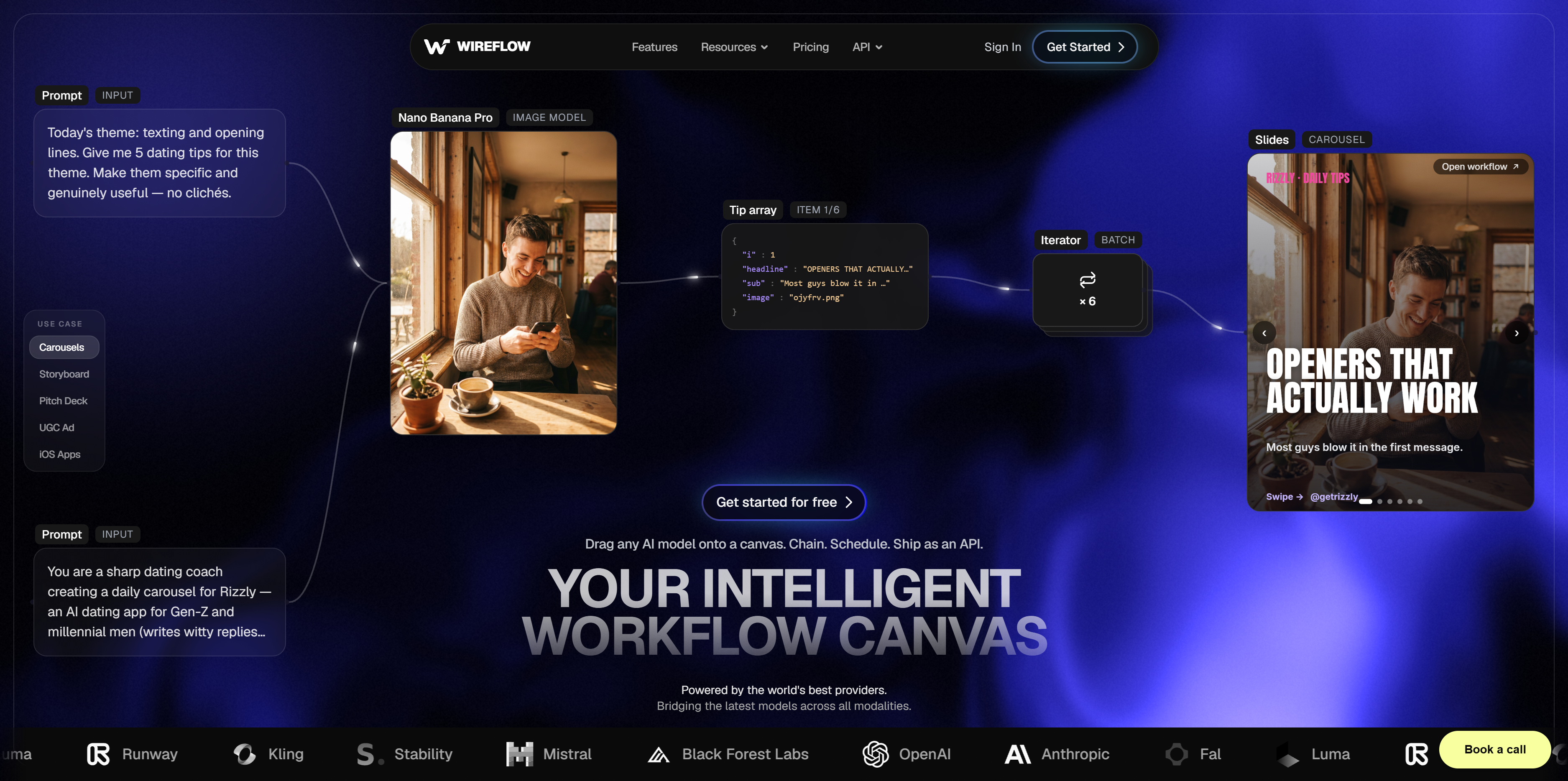
Wireflow is a node-based AI platform built for developers who want visual workflow design paired with a production-grade API. The canvas supports 157 node types spanning image generation, video, audio, 3D, and utility categories. For anyone weighing it against a cloud ComfyUI service, a RunComfy alternative that is not ComfyUI skips the custom-node upkeep entirely. Every workflow you build can be executed via POST /workflows/{id}/execute, polled for status, and triggered externally through webhooks without requiring an API key.
The API follows an async execution pattern: submit a workflow run, receive an executionId, then poll until the state reaches COMPLETED or FAILED. Rate limits scale from 10 requests per minute on the free plan to 200 on Enterprise. Every response includes X-RateLimit-Remaining and X-Request-Id headers for observability. Workflows can also be published as "Wireflow Apps," callable endpoints that accept inputs and return outputs, which is how most teams use the platform as a generative backend.
Key strengths: native model chaining across 157 nodes, idempotent execution with Idempotency-Key headers, webhook triggers with full CORS support, and a Claude Skill integration for agentic workflows.
2. ComfyUI
ComfyUI remains the most popular open-source node-based tool for image and video generation. Its graph-based interface connects Stable Diffusion checkpoints, LoRAs, VAEs, and conditioning nodes into complex pipelines. The community maintains thousands of custom nodes covering everything from face restoration to style transfer.
The built-in API exposes a WebSocket-based queue system. You submit workflows as JSON payloads to /prompt, then listen for execution progress over WebSocket. This works well for local setups, but scaling to production requires third-party hosting solutions like ComfyDeploy or RunComfy. There is no official REST API with authentication, rate limiting, or execution history, which limits ComfyUI for API-driven automation without additional infrastructure.
Key strengths: massive community node library, complete control over Stable Diffusion internals, free and self-hosted, excellent for research and experimentation.
3. n8n
n8n is a workflow automation platform that added AI capabilities through its AI Agent node, LangChain integration, and native connections to OpenAI, Anthropic, and local models. The node editor uses a flowchart-style canvas rather than a pure dataflow graph, which makes it intuitive for connecting API endpoints with AI processing steps.
The n8n API lets you create, update, and execute workflows programmatically. Webhook nodes accept external HTTP requests as triggers, and you can chain AI nodes with 400+ integration nodes for services like Slack, PostgreSQL, and Google Sheets. The trade-off is that n8n treats AI as one category among many rather than a core focus, so you won't find specialized image generation or video pipeline nodes.
Key strengths: 400+ integration nodes, self-hostable, strong community, excellent for hybrid AI-plus-automation workflows.
4. BuildShip
BuildShip positions itself as a visual backend builder with AI workflow capabilities. You design API endpoints visually by connecting nodes that handle input parsing, AI model calls, database operations, and response formatting. Each workflow publishes as a REST endpoint automatically, which makes BuildShip one of the fastest paths from idea to deployed API.
The platform supports OpenAI, Stable Diffusion, HuggingFace, and other model providers through pre-built nodes. You can bring your own API keys or use BuildShip's managed credits. Workflows trigger via HTTP requests, scheduled jobs, or database events. The main limitation is that the node library is curated rather than extensible; you cannot install community plugins the way you can with ComfyUI or workflow template systems.
Key strengths: instant API deployment from visual workflows, managed hosting, good for prototyping AI-powered backends quickly.
5. Flowise
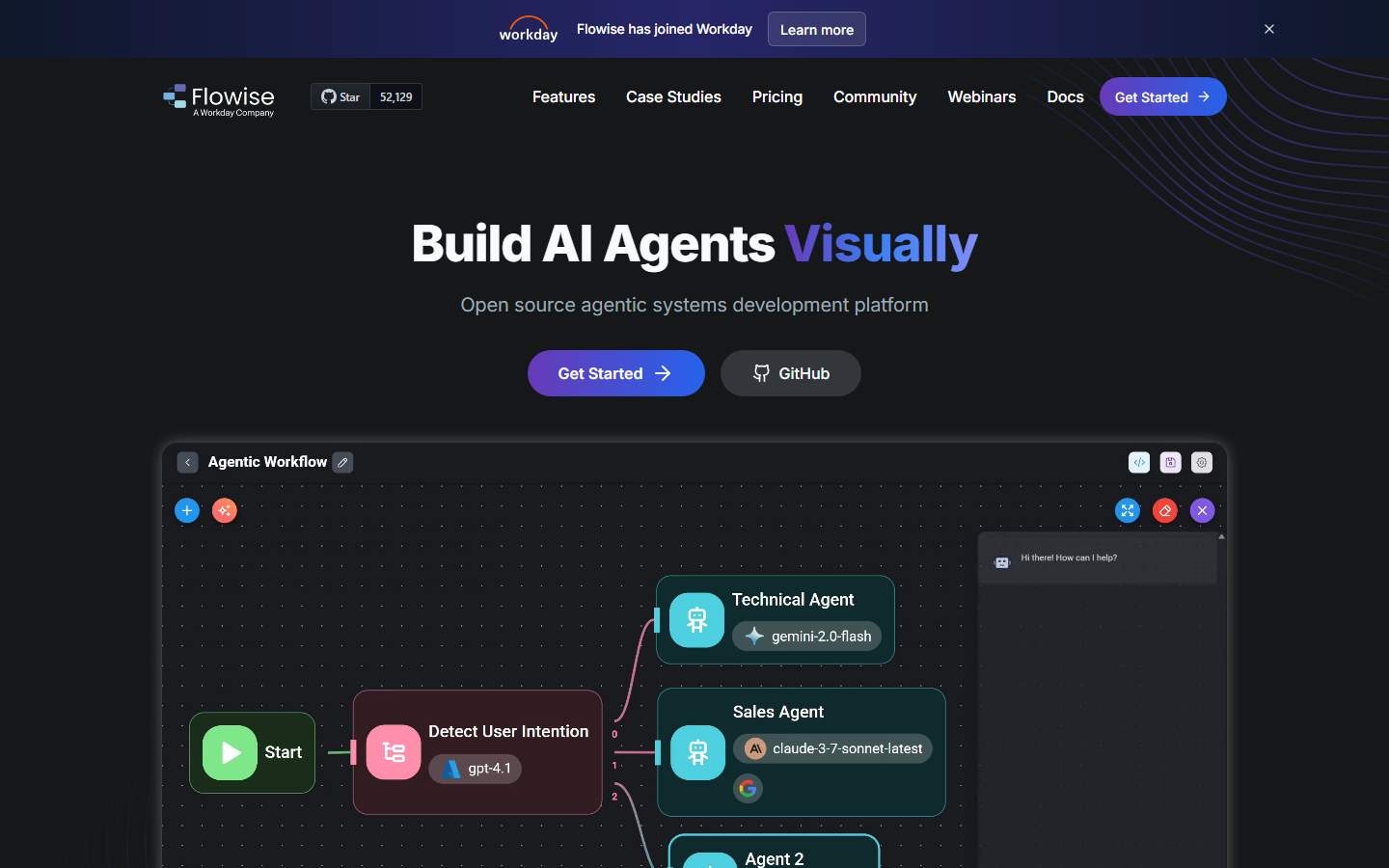
Flowise is an open-source drag-and-drop tool focused specifically on building LLM applications. It supports LangChain and LlamaIndex components as nodes, covering chat models, embeddings, vector stores, document loaders, and retrieval chains. The API auto-generates endpoints for each chatflow, letting you integrate conversational AI into any application with a single REST call.
With 100+ integrations, Flowise covers most LLM use cases, from simple chatbots to complex retrieval-augmented generation pipelines. You can embed widgets directly into web apps or call the prediction API from any HTTP client. Self-hosting is straightforward via Docker, and the community maintains active development. The platform does not handle image or video generation natively, so teams needing batch media generation will need to look elsewhere.
Key strengths: best-in-class LangChain/LlamaIndex visual builder, open source, auto-generated chat APIs, strong RAG support.
6. Dify
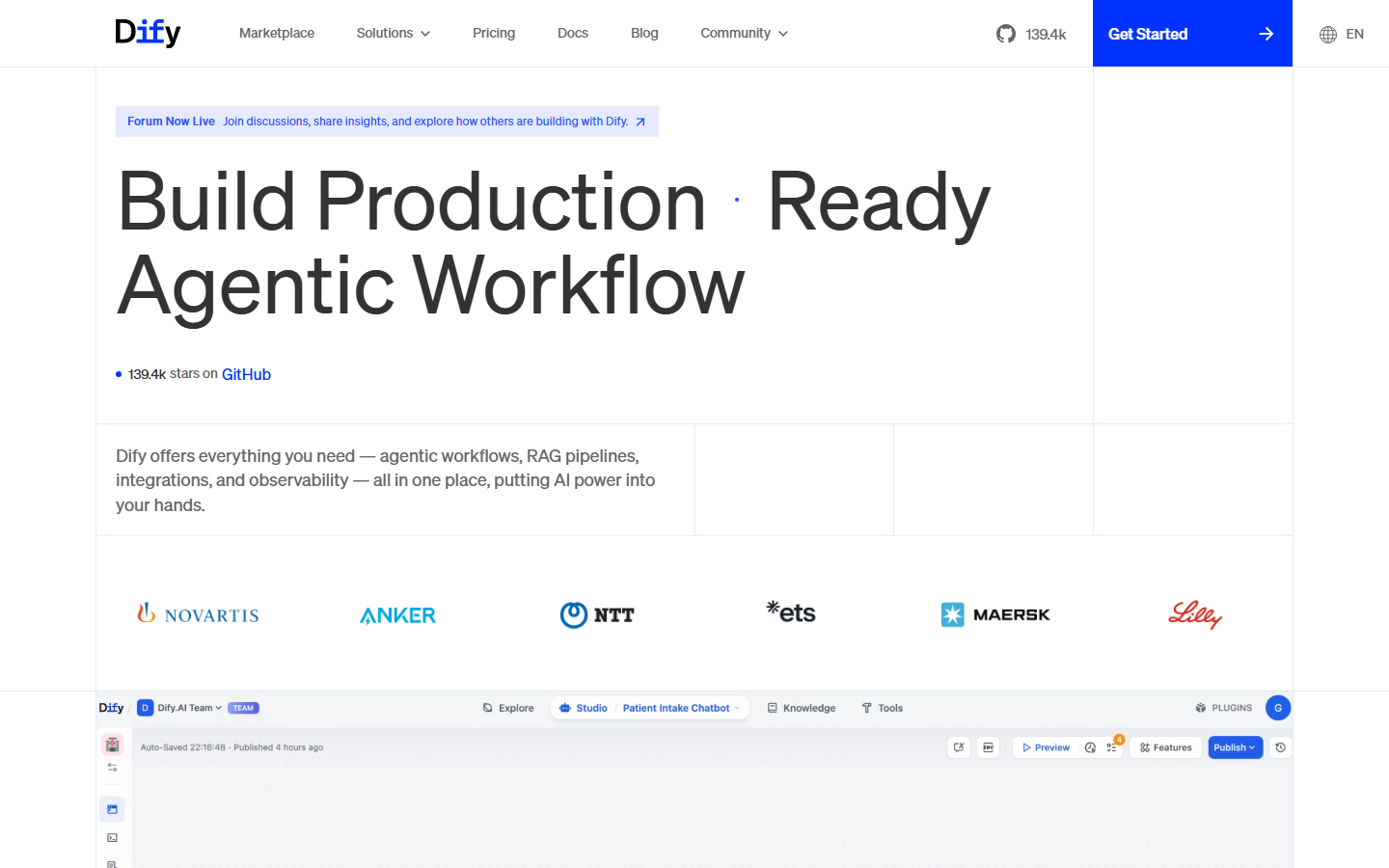
Dify provides a visual canvas for building LLM-powered applications with a focus on production readiness. The platform supports workflow orchestration through a node-based editor where you connect LLM calls, conditional logic, HTTP requests, and code execution nodes. Every application publishes as an API endpoint with built-in authentication, rate limiting, and usage tracking.
The platform offers both cloud-hosted and self-hosted options, supports 50+ model providers, and includes built-in annotation and monitoring tools. The API surface covers application management, conversation handling, and workflow execution. Dify's primary focus is text-based LLM applications rather than media generation, so teams working with image, video, or audio pipelines should consider platforms with broader node libraries.
Key strengths: production-ready LLM orchestration, built-in monitoring, 50+ model providers, both cloud and self-hosted deployments.
7. Rivet
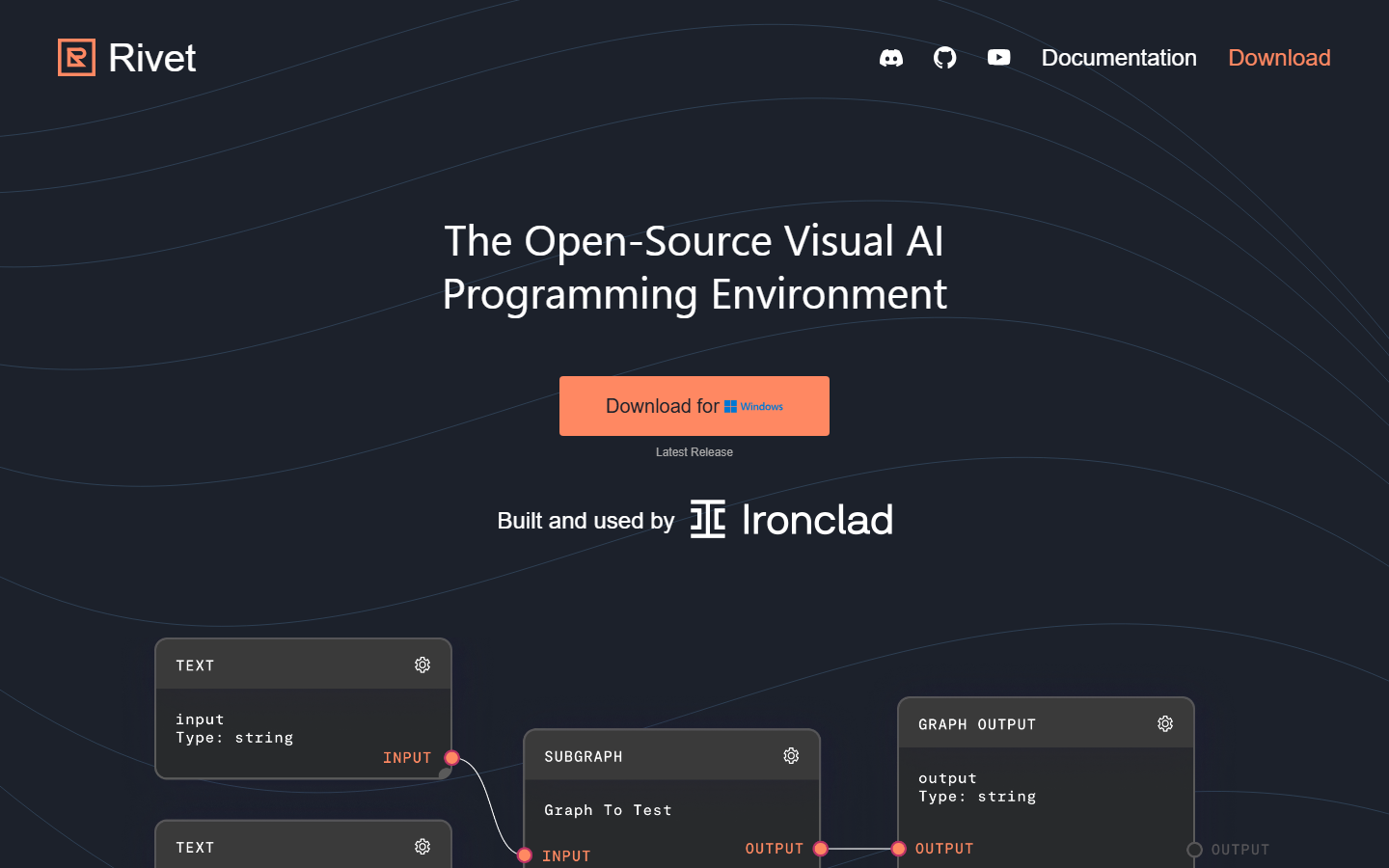
Rivet is a visual AI agent IDE from Ironclad that takes a developer-first approach to building LLM-powered applications. The graph editor lets you wire together prompt nodes, LLM calls, conditional branching, loops, and subgraph references. Workflows execute locally or integrate into TypeScript/JavaScript applications through the Rivet Node SDK, making it a strong choice for teams that want visual debugging with code-level control.
Rivet's API story centers on embedding rather than hosting: you build and test graphs in the IDE, then load and execute them from your own application code. This gives maximum flexibility but requires more infrastructure work compared to platforms that handle deployment and scaling automatically.
Key strengths: excellent visual debugger, TypeScript SDK for embedding, subgraph composition, strong for AI agent development.
Build this in Wireflow
Make the same kind of asset on a canvas you control, with a free account and no credit card.
Comparison Table
| Platform | Node Types | API Style | Self-Hosted | Media Generation | Pricing |
|---|---|---|---|---|---|
| Wireflow | 157 | REST + Webhooks | No | Images, Video, Audio, 3D | Free tier, paid plans |
| ComfyUI | 1000+ (community) | WebSocket/JSON | Yes | Images, Video | Free (open source) |
| n8n | 400+ | REST | Yes | Via integrations | Free tier, paid plans |
| BuildShip | 100+ | Auto-REST | No | Via integrations | Free tier, paid plans |
| Flowise | 100+ | Auto-REST | Yes | No | Free (open source) |
| Dify | 50+ | REST | Yes | Limited | Free tier, paid plans |
| Rivet | 30+ | Embedded SDK | Yes | No | Free (open source) |
Try it yourself: Open the Wireflow API docs to see how workflows like this one are created, executed, and polled through a single REST interface.
Frequently Asked Questions
What is a node-based AI platform?
A node-based AI platform uses a visual graph interface where each node represents an operation, such as an AI model call, data transformation, or API request. You connect nodes by drawing edges between them to define data flow. This approach makes complex AI workflows easier to design, debug, and modify than writing equivalent code from scratch.
Which node-based AI platform has the best API?
Wireflow offers the most complete REST API among dedicated AI platforms, with endpoints for workflow CRUD, async execution with polling, webhook triggers, idempotency keys, and detailed rate-limit headers. For general automation, n8n's API is also well-documented and covers workflow management comprehensively.
Can I self-host a node-based AI platform?
ComfyUI, n8n, Flowise, Dify, and Rivet all support self-hosting. ComfyUI and Rivet run entirely locally, while n8n, Flowise, and Dify offer Docker-based deployment. Wireflow and BuildShip are cloud-hosted platforms with managed infrastructure and scaling.
How do node-based platforms handle API authentication?
Most platforms use Bearer token authentication. Wireflow uses API keys prefixed with sk- and supports scoped permissions (workflows:read, workflows:write, workflows:execute). n8n supports API key and basic auth. Flowise generates unique API keys per chatflow. Dify uses application-level API tokens.
What types of AI models can I use in node-based platforms?
It depends on the platform. Wireflow supports 157 node types covering image generation (Flux 2, Imagen 4), video (Kling 2.5), audio, and 3D models. ComfyUI specializes in Stable Diffusion models with community extensions. n8n and BuildShip connect to external APIs. Flowise and Dify focus on LLM orchestration.
Are node-based AI platforms suitable for production use?
Yes, several platforms are production-ready. Wireflow, BuildShip, and Dify offer managed hosting with rate limiting, monitoring, and auto-scaling. ComfyUI requires additional infrastructure for production. n8n scales well with its queue mode. The key consideration is whether you need managed deployment or prefer to handle your own infrastructure.
How do webhooks work in node-based AI platforms?
Webhooks let external systems trigger workflow executions via HTTP. Wireflow provides dedicated webhook URLs that accept POST requests without API keys, making them easy to connect to forms, CI pipelines, or third-party services. n8n also offers webhook trigger nodes. BuildShip exposes every workflow as an HTTP endpoint by default.
What is the difference between a node-based AI platform and a traditional automation tool?
Traditional automation tools like Zapier focus on connecting SaaS applications through triggers and actions. Node-based AI platforms add visual dataflow graphs, native AI model integration, and output preview, which means you can see intermediate results at each node. This makes them better suited for creative and generative AI pipelines where iteration speed matters.
Conclusion
The best node-based AI platform depends on your primary use case. For teams that need a visual canvas with a production REST API and broad model support, Wireflow covers the widest surface area with 157 node types and full API access including webhooks, polling, and idempotent execution. ComfyUI remains unmatched for open-source image generation experimentation. n8n bridges the gap between AI and traditional automation. BuildShip, Flowise, Dify, and Rivet each serve specific niches well, from quick backend prototyping to embedded agent development.

Co-Founder & Operations at Wireflow
Runs client operations and content strategy at Wireflow. Works directly with creative teams and agencies to build production AI workflows.
- Content Strategy
- Client Operations
Get unlimited ad creatives today.
One call to see if we are a fit and scope the first ad. If it fits, your first batch lands inside week one.