

Remotion made programmatic video normal: describe a scene in React, render it to MP4. But when the caller is an AI coding agent instead of a human developer, the priorities shift toward hosted rendering, structured inputs, and APIs an agent can hit without owning a build pipeline. Wireflow lets you chain AI models and video steps into a single callable workflow, which is why it sits at the top of this list, but the right pick depends on whether your agent writes code, emits JSON, or just fills a template. This guide ranks the tools that let a coding agent turn a request into a finished video in 2026. Teams that want the pipeline on a canvas can weigh a no-code Remotion alternative.
The tools below split into three camps by how an agent talks to them: code-first (the agent writes real React or TypeScript), schema-first (the agent emits structured JSON), and template-first (the agent fills variables into a prebuilt design). Most video APIs aimed at agents get ranked purely on price, so we lead with agent-friendliness instead.
Quick summary
- Wireflow: Best overall for agent-driven video workflows (node-based, one API call)
- Remotion: Best for React developers who want full code control
- Shotstack: Best JSON-first cloud rendering API
- JSON2Video: Best low-cost hosted API for structured video
- Creatomate: Best template automation API
- Editframe: Best code-first SDK with hosted playback
- Bannerbear: Best for simple template overlays at small scale
1. Wireflow
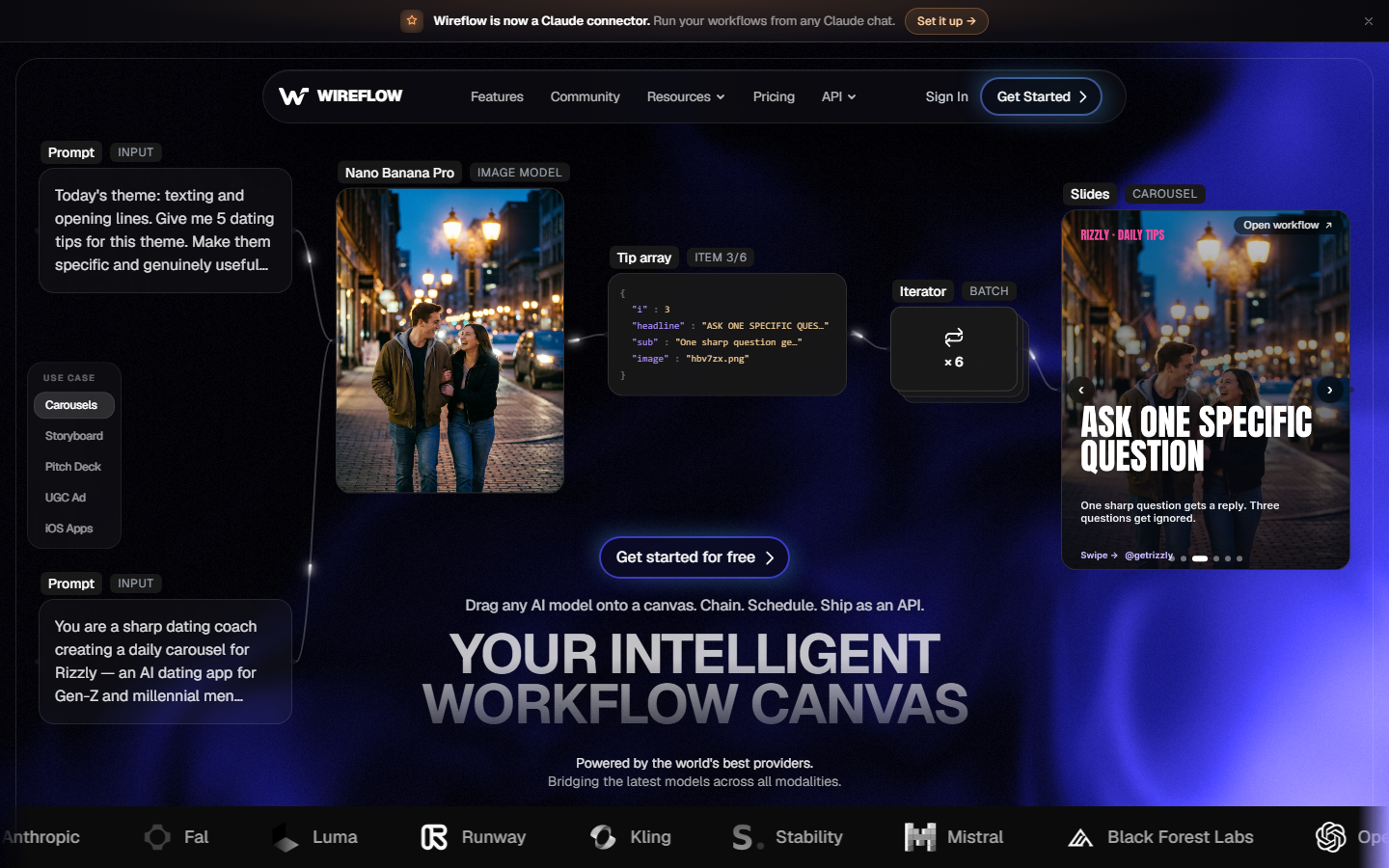
Wireflow treats video generation as a workflow graph: an input node feeds one or more AI model nodes, and the whole chain runs from a single API call or from a visual canvas. That maps cleanly onto how a coding agent already reasons, since the agent describes the steps and Wireflow handles model orchestration, rendering, and hosting. For a hands-on look at this in action, see the remotion for coding agents feature page, which walks through the exact node setup an agent would call.
The advantage over a raw Remotion pipeline is that there is no render infrastructure to own. An agent does not spin up Chromium, manage Lambda, or babysit a queue; it posts a request and gets a hosted video back. Our breakdown of node-based video generation shows how the graph model compares to writing render code by hand. The limitation is that Wireflow favors chained AI generation over frame-perfect motion design, so pure motion-graphics work still belongs in a code-first tool.
2. Remotion
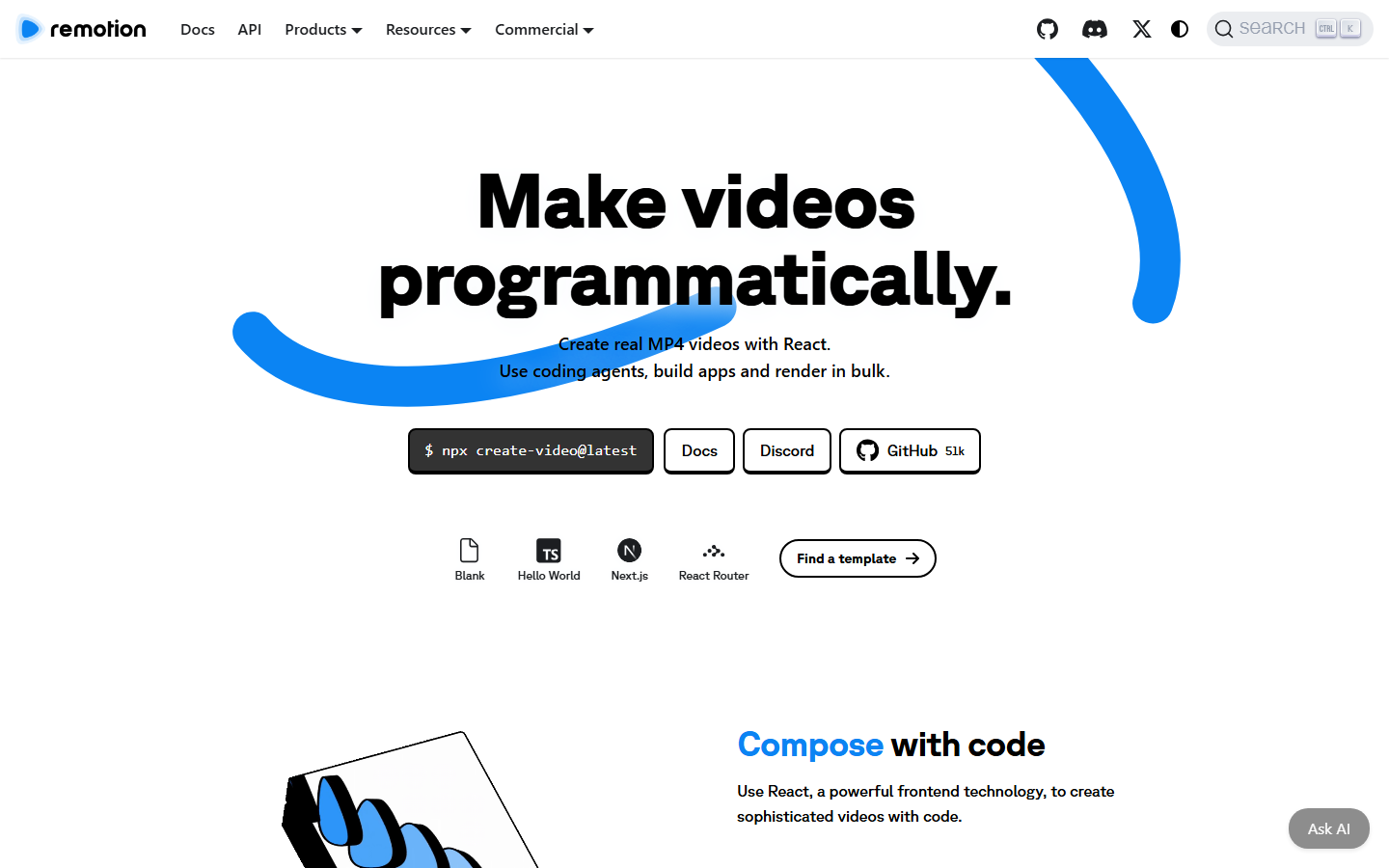
Remotion is the framework the whole category is named after. You build videos as React components and render them to MP4 through the CLI or Lambda, which gives an agent complete control because the output is just TypeScript that large language models already write well. If your agent's core skill is generating code, Remotion is the most expressive target available.
The cost is infrastructure. Remotion is not a hosted API out of the box, so you own the render pipeline or pay for Remotion Cloud, and the commercial license kicks in for for-profit companies above three employees (Creators from $25 per seat per month, Automators at roughly $0.01 per render). Our guide on turning code into video covers when that control is worth the operational weight and when a hosted layer saves more than it costs.
3. Shotstack
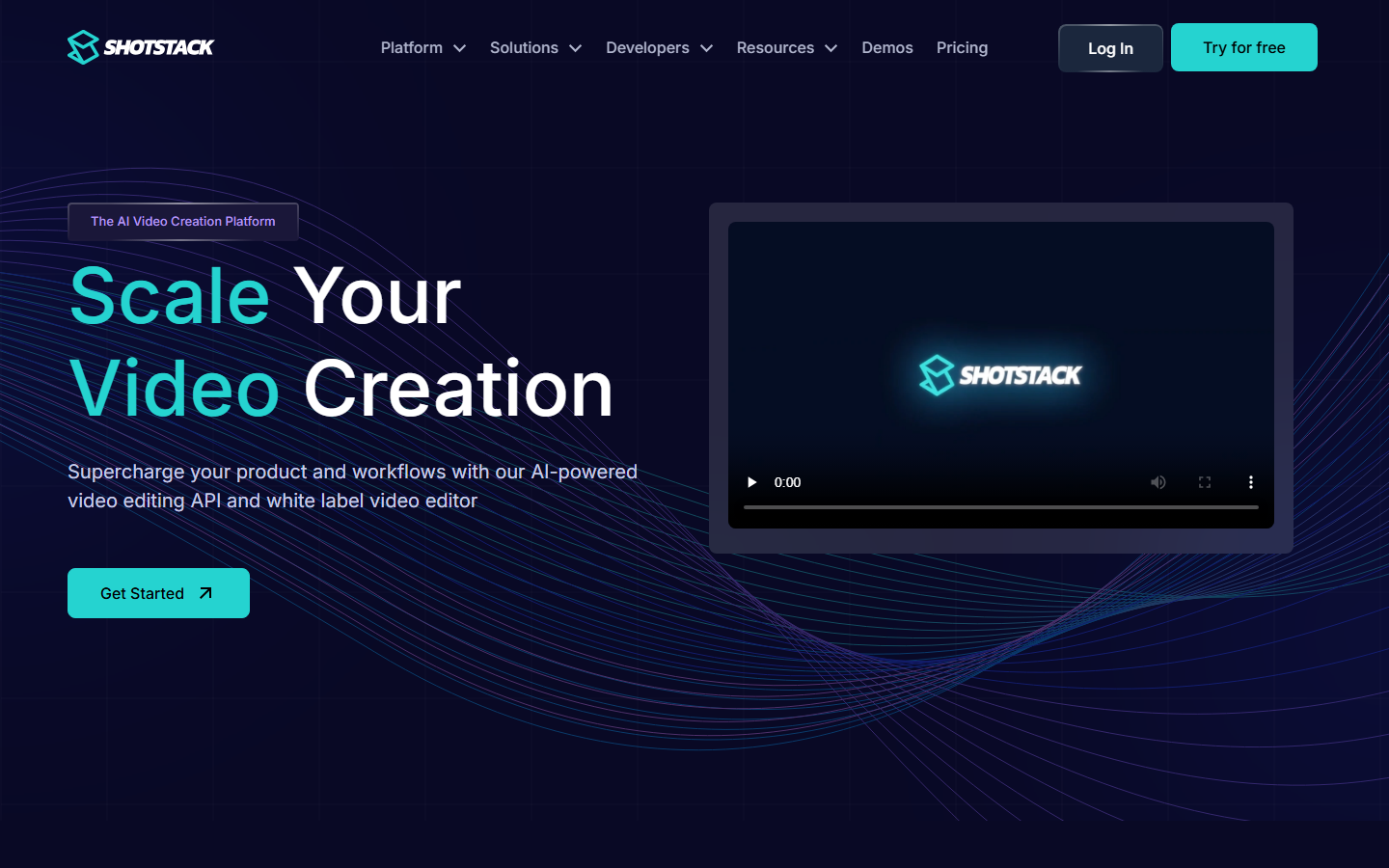
Shotstack defines an edit as a JSON timeline and renders it in the cloud, which makes it one of the most agent-native options here. An LLM produces structured JSON far more reliably than a full render script, so an agent can emit a Shotstack timeline directly and skip the code-generation step entirely. Shotstack also positions itself explicitly as the managed alternative to self-hosted Remotion.
Pricing starts around $39 per month with usage near $0.20 to $0.30 per rendered minute, and the platform handles high-volume concurrent rendering without any AWS setup on your side. The tradeoff is that a JSON schema is less flexible than arbitrary code for unusual animation logic. For a wider view of where this fits, compare it against the field in our roundup of the best video generation APIs.
4. JSON2Video
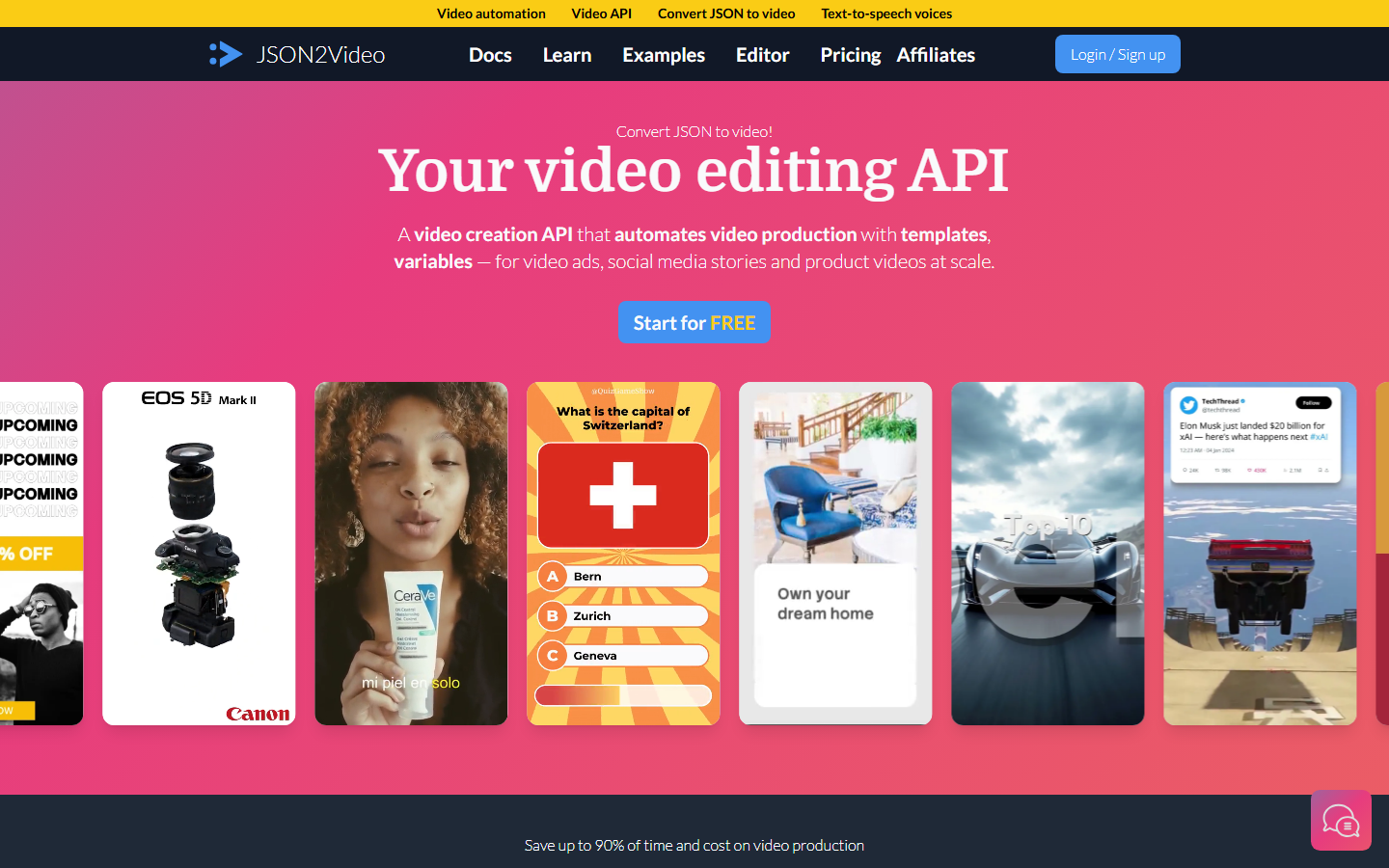
JSON2Video takes the same structured approach as Shotstack: send a JSON payload describing scenes and elements, receive a rendered video, with no React or infrastructure required. It markets itself directly at developers escaping self-hosted rendering, and the JSON-in, video-out model is easy for an agent to target.
The free plan includes 600 credits (about ten watermarked minutes at 1080p), and paid plans start at $19.95 per month with credits consumed per second of output, making it the cheapest documented entry point in this group. Credits and watermarks constrain the free tier, and the schema trades some creative freedom for structure. If it is not the right fit, our list of JSON2Video alternatives covers the closest substitutes.
5. Creatomate
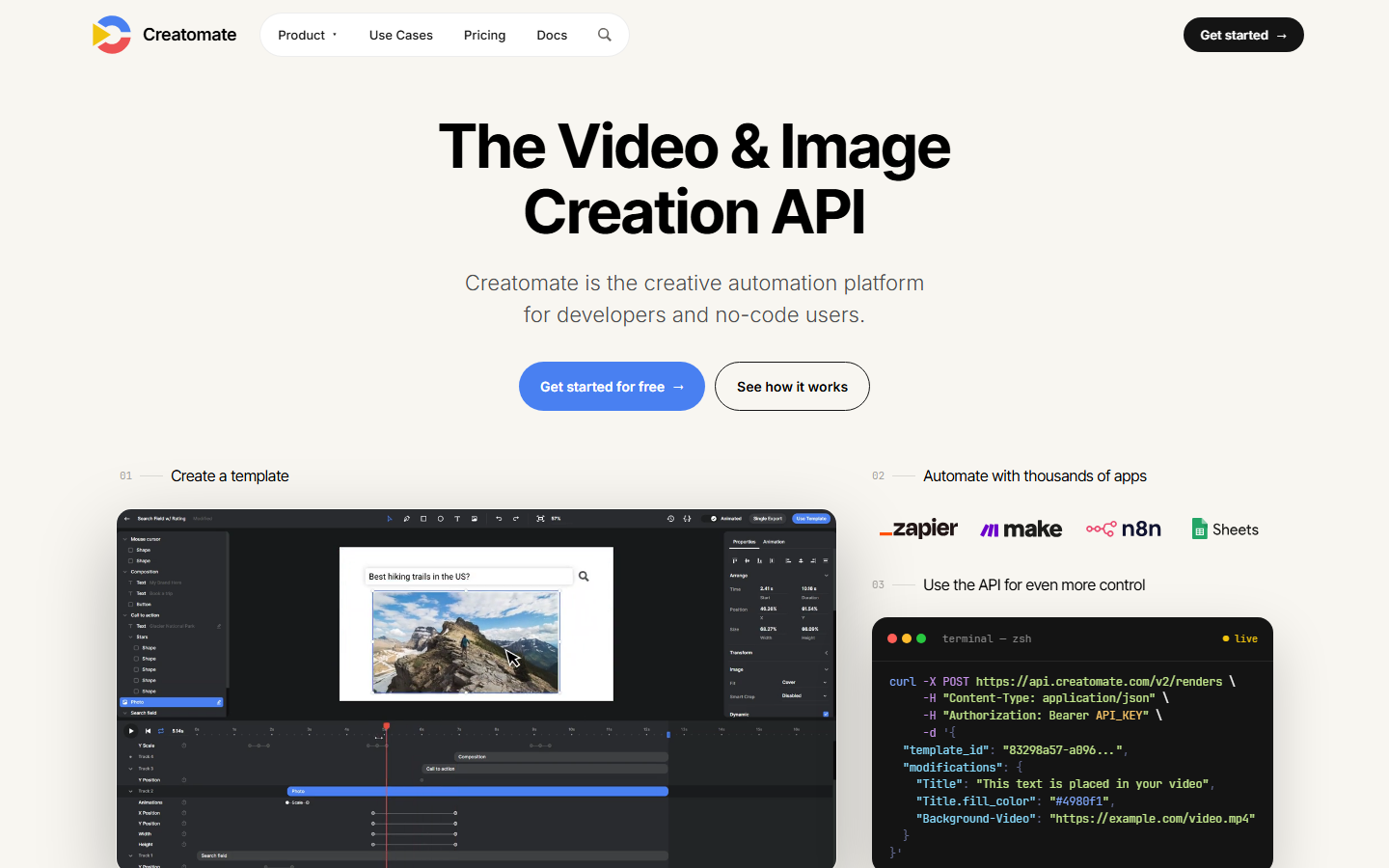
Creatomate is template-first: you design a template visually, then an API call fills in dynamic variables such as text, images, and data. That suits agent workflows that need a reliable "fill these fields" call rather than composing a video from scratch, and it ships SDKs for Node.js, Python, PHP, and JavaScript plus Zapier support.
Pricing is resolution and usage based, for example around $41 per month for 144 minutes at 720p, with a free tier of 50 API credits and no card required. The constraint is the template boundary itself, since anything outside the designed template is off limits. Teams building repeatable, data-driven output should read our overview of programmatic video generation platforms to weigh templates against fully generative pipelines.
6. Editframe
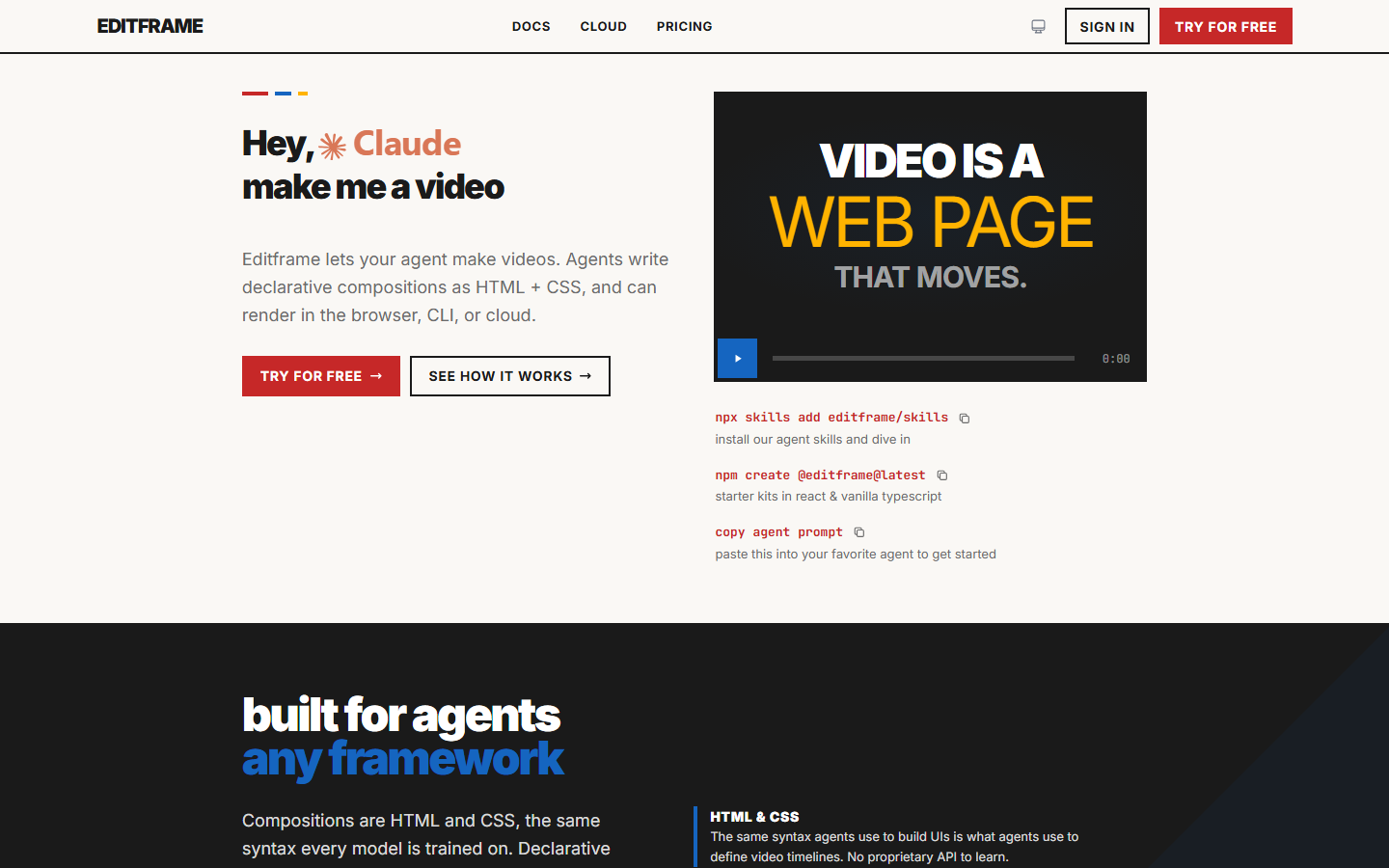
Editframe takes a "build video with code" stance, offering a client-side SDK, browser rendering, and a CLI, plus a cloud tier for server-side rendering and streamed playback. The hybrid is unusual: an agent can generate the composition in code and then serve the result through a hosted player rather than only downloading a file.
Cloud rendering is billed by render time in one-second increments scaled by megapixel count, and streamed playback is billed per minute, while cached replays and local playback are not billed. That usage model rewards agents that produce many short clips viewed inside an app. Concrete tier pricing is thinner in public docs than the larger platforms, so verify current numbers before committing. For the broader pattern of an agent that produces and ships video end to end, see our walkthrough on how to build a video generation agent.
7. Bannerbear
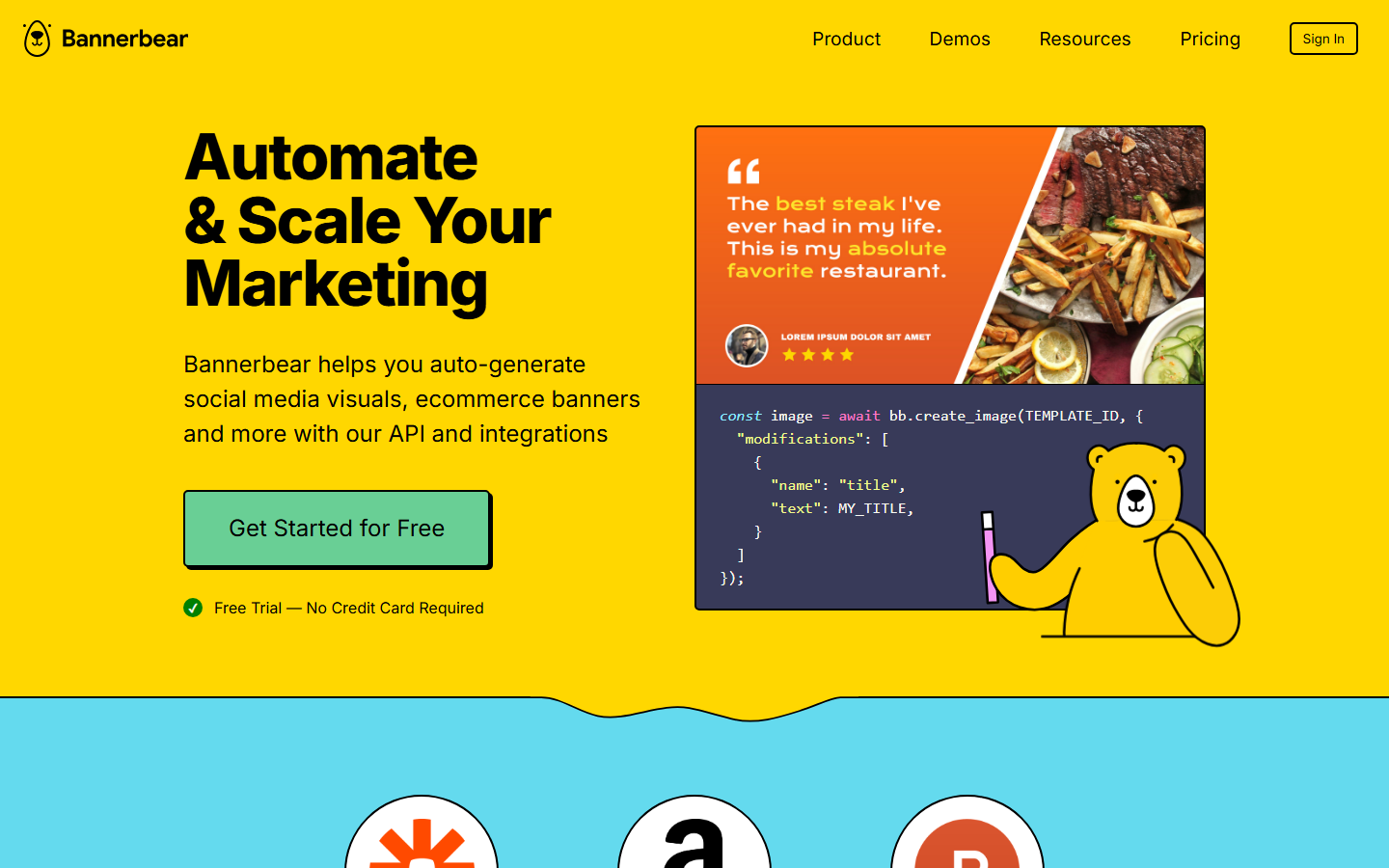
Bannerbear began as an image-from-template API and added a Videos API that overlays text and images onto clips rather than composing full scenes. An agent can call the REST API or route through Zapier and Make to fill a template with dynamic content, which keeps simple jobs genuinely simple.
Plans are credit based, starting at $49 per month for 500 credits and scaling to $299 per month for 5,000 or more. The video side has seen limited investment compared to the image product, so it is best kept to lightweight overlay work rather than animation-heavy output. Agents that need hosted delivery on top of generation should also look at hosted video APIs built for agents.
Comparison table
The clearest way to choose is by matching the tool's input model to what your agent produces best. A programmatic video generation API that expects JSON is a better fit for an LLM than one that expects a full React project.
| Tool | Input model | Hosted rendering | Entry price | Best for |
|---|---|---|---|---|
| Wireflow | Workflow graph / API | Yes | Usage based | Agent-driven chained video |
| Remotion | React / TypeScript | Self-host or Cloud | Free to $25/seat | Full code control |
| Shotstack | JSON timeline | Yes | $39/mo | Structured cloud rendering |
| JSON2Video | JSON payload | Yes | $19.95/mo | Low-cost structured video |
| Creatomate | Template + variables | Yes | $41/mo | Template automation |
| Editframe | Code SDK | Cloud tier | Usage based | Code plus hosted playback |
| Bannerbear | Template + variables | Yes | $49/mo | Simple overlays |
How to choose
If your agent is strongest at writing code, a code-first tool like Remotion or Editframe gives the most expressive output, at the cost of running render infrastructure. If it is strongest at emitting structured data, a schema-first API such as Shotstack or JSON2Video removes the code-generation step and returns a hosted file directly. For teams that want model chaining and rendering handled together, our guide to chaining multiple AI models in one API call shows how one workflow can replace several services.
Try it yourself: Build this in Wireflow with the nodes pre-configured for the agent-callable video setup discussed above, so your coding agent can render a finished clip from a single request.
FAQ
What does "Remotion for coding agents" actually mean? It refers to programmatic video tools that an AI coding agent can call to render a video, either by writing Remotion-style code or by sending structured input to a hosted API. The common thread is that the agent, not a human editor, drives the video.
Is Remotion itself the best choice for an agent? Remotion is the most expressive option because output is real React code, but it is not a hosted API, so your agent needs a render pipeline. Agents that prefer sending JSON often do better with a schema-first API. Our comparison of agents that edit video covers the tradeoff in depth.
Which tools work best when the agent emits JSON instead of code? Shotstack and JSON2Video are built around JSON payloads, which language models produce more reliably than full render scripts. That makes them the most natural targets for an autonomous agent.
Do I still need my own rendering infrastructure? Only with pure code-first tools like Remotion or Revideo. Hosted APIs such as Shotstack, JSON2Video, Creatomate, and Wireflow render in the cloud, so there is nothing for your agent to operate.
How do these tools handle AI-generated content inside the video? Template and JSON APIs mostly place assets you supply, while workflow platforms can generate the assets and assemble them in one pass. See our notes on connecting an API-driven canvas to your models for how that combined flow works.
What is the cheapest way to start? JSON2Video has the lowest documented paid entry at $19.95 per month, and several tools including Creatomate and JSON2Video offer free credits so an agent can test end to end before any spend.
Can these APIs run inside an automation like n8n or Make? Yes. Most expose a standard REST endpoint, and several publish native connectors. Our piece on MCP versus n8n for video automation compares the orchestration options for agent-driven pipelines.
Which tool should a small team pick first? Start with the input model your agent already produces best, then confirm hosted rendering and a free tier so you can validate the full loop cheaply before scaling on a programmatic video generation platform.
Would you rather we just built it?
We get on a call, learn your style, build the workflow, and ship the deliverables on a schedule. You keep the workflow either way.


