UGC Marketing with AI: Human vs AI Cost per Video, Plus a Working Workflow

In this article▾
UGC marketing with AI means producing creator-style ads, such as selfie reviews, unboxings and quick demos, with image and video models instead of hiring a creator for every clip. A human UGC video costs about $175 at the median before usage rights, while an AI variation costs a few dollars in compute. This guide compares both costs per video, then walks through a working reference-image workflow you can run in Wireflow, so you can decide where AI fits and where a real creator is still worth paying.
What UGC marketing with AI actually covers
UGC originally meant content made by real customers. In paid social the term has drifted: "UGC" now means any ad that looks like a person filmed it on a phone, whoever made it. That style blends into TikTok, Reels and Stories feeds where polished brand spots get skipped, which is why UGC video generators became a software category of their own.
AI enters the process at three points:
- Stills: a creator holding the product, for static ads, carousels and thumbnails.
- Motion: a still turned into a short clip, or a talking presenter with lip-synced speech.
- Variations: the same creator and product in new scenes and hooks for testing.
The quality bar is the same as for human UGC: the product must look exactly like the real one, and the person must stay the same person from ad to ad. Consistency is where cheap AI UGC breaks down, and our breakdown of what to charge for AI UGC ads covers the agency side of the same math.
Build this in Wireflow
Make the same kind of asset on a canvas you control, with a free account and no credit card.
What a human UGC video really costs

Influee's 2026 rate guide puts the typical creator range at $150 to $300 per video, with a median of about $175. Beginners start around $100 and experienced creators charge $500 or more. That is the benchmark any AI UGC generator has to beat, and the base rate is rarely the whole bill:
| Cost line | Typical range (Influee, 2026) |
|---|---|
| Base rate per video | $150 to $300 (median about $175) |
| Paid usage rights | +30% to 50% of the base rate |
| Raw footage | +30% to 50% of the base rate |
| Rush delivery | +25% to 50% of the base rate |
| Bundle of 5 or more videos | 15% to 25% off |
Time is the other cost. Marketplace guides quote 5 to 12 business days to first draft, usually counted from when the creator receives your product, after 3 to 5 days of shipping. A revision round adds 2 to 3 days. For a brand testing hooks weekly, results from one round arrive after the next round should have shipped, which is the core argument for testing ad creative at scale with generated variations.
Put together, one paid-use video at the median rate lands at roughly $228 to $263. Ten hook variations from one creator cost about $1,313 to $1,488 after a bundle discount, before usage rights, and take around two weeks. That is fair for a proven creator but heavy for hooks you expect to discard, which is the fate of most variations in a TikTok UGC ad test.
What an AI UGC video costs per variation
Generated UGC is billed by compute, not by the person. At the published credit rates (checked October 2026), GPT Image 2.5 Flare costs 17 credits per image and its Edit model 20, low-cost video models start around 10 credits per second, and a typical video mix runs about 17. The Starter plan is $24 for 1,600 credits and Professional is $45 for 4,300.
| Output | Credits | Starter cost | Professional cost |
|---|---|---|---|
| Reference image plus one ad frame | 37 | $0.56 | $0.39 |
| Each extra frame from the same reference | 20 | $0.30 | $0.21 |
| Frames plus a 15-second clip at about 10 credits per second | 187 | $2.81 | $1.96 |
| Frames plus a 15-second clip at about 17 credits per second | 292 | $4.38 | $3.06 |
Ten 15-second variations from one shared reference at the typical rate use about 2,770 credits, roughly $29 on Professional. Against $1,313 or more for ten human videos, direct cost falls to under 3 percent and turnaround drops from two weeks to an afternoon, which is why teams that mass-produce UGC ads generate their test volume.
The sticker price hides two costs. Generations get rejected when a hand renders wrong, a label warps or a lip-sync drifts, so budget two or three tries per keeper on video. Someone also writes the script, reviews every output and approves the voice. With rejects tripling the video cost, a variation still stays under $15, but the review hours belong in any plan to scale ad creative production.
The workflow: one reference image, many consistent ads
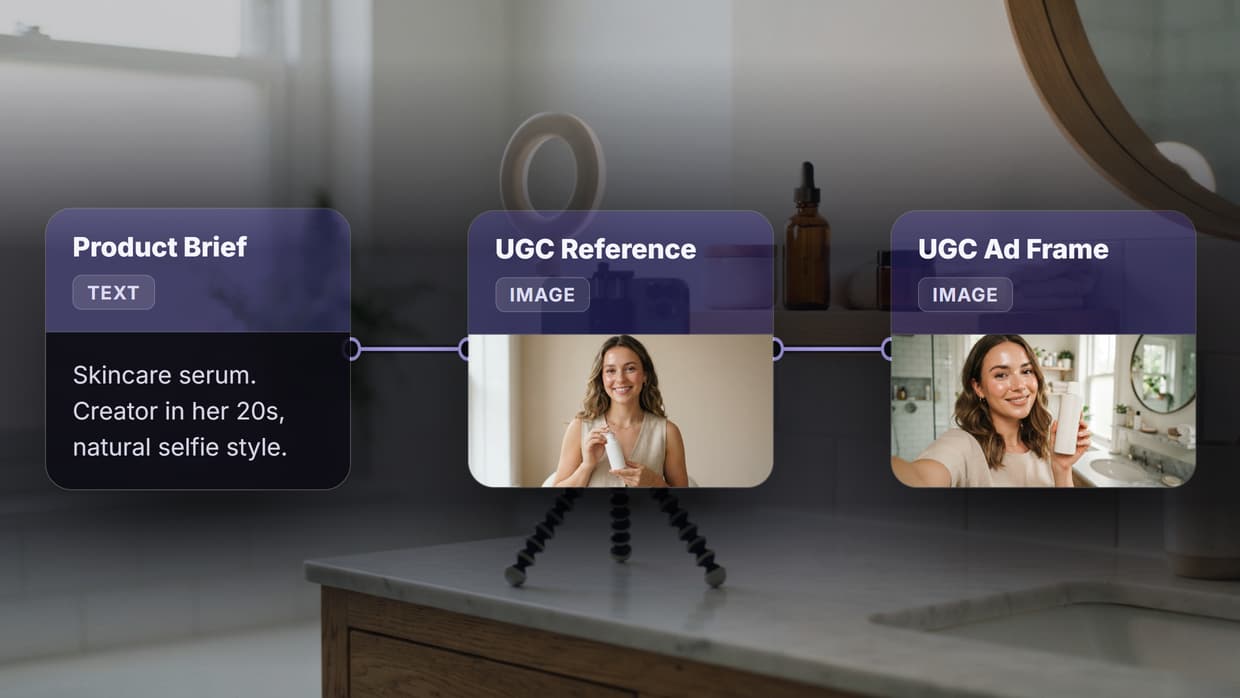
The consistency fix is simple: generate the creator and product once as a reference image, then feed that image into every later generation. The AI UGC generator workflow uses four nodes:
- Product Brief (text input). One line on the product, the creator's look and the tone, for example "a woman in her mid-20s holding a matte-white skincare bottle, selfie energy, soft natural light."
- Reference image (GPT Image 2.5 Flare). Renders the creator holding the product on a neutral background. This image is the identity anchor.
- Scene Prompt (text input). One ad setting, such as a bathroom shelf in morning light.
- Ad frame (GPT Image 2.5 Flare Edit). Takes the scene prompt plus the reference through its image input and returns the same person and product in the new scene.
For variations, change only the scene prompt and rerun the last node at 20 credits a frame, so a week of hooks shares one face and one bottle. For motion, add a talking-avatar node such as Kling AI Avatar or HeyGen Avatar4, or a lip-sync node with an ElevenLabs voice; these are additions to the base flow, and our guide to automating UGC video creation covers that stage.

Because the flow is a saved pipeline, it also runs in batches: a script or AI agent can call the published workflow with a list of scene prompts and get one frame per row. That is how a team turns a catalog into UGC ads for Shopify stores without opening the canvas for each product.
This layer does not write scripts, choose hooks, post to TikTok or report results; those stay with your team and existing tools. That split suits working UGC creators, who can keep scripting and on-camera work and use generated frames for the volume part of a package.
When human UGC still wins

Human UGC is still the better buy in four cases:
- Real product experience. Texture, taste, fit and before-and-after results need a real person using the real product.
- Testimonials. The FTC rule on reviews and testimonials, in force since October 2024, bans fake reviews, including AI-generated ones presented as real customers. An AI character can demonstrate a product but cannot pose as a customer.
- Creator reach. TikTok Spark Ads and Meta partnership ads run from the creator's handle and borrow their audience.
- Proven winners. Once a hook has data behind it, a human reshoot is easy to justify.
Disclosure is the other rule. TikTok requires labels on realistic AI-generated content, Meta applies AI labels, and the EU AI Act requires deepfake-style media of realistic people to be disclosed. The same caution applies to AI influencer generators, where a persistent synthetic persona blurs demonstration and endorsement further.
A hybrid plan that uses both
The most cost-effective setup uses AI to find the angle and a human to produce it:
- Generate 10 to 20 hook and scene variations from one reference and run them at a small test budget.
- Keep the two or three winners by hook rate and cost per click.
- Brief a human creator with the proven hook and scene, and pay for one video with usage rights.
- Repeat monthly, so creator budget only goes to angles with data behind them.
A $1,500 monthly UGC budget that used to buy about eight human videos now covers two proven human videos with usage rights (about $526) and a $45 Professional plan, with roughly $900 left for test spend. For ecommerce brands with large catalogs, that moves most testing out of the creator budget without dropping real people from the ads that scale.
Getting started
Start small: one product, one reference image, five scene prompts and a test budget you can afford to lose. Compare cost per variation and hook rate against your last human UGC batch, and let those numbers decide how much creator budget moves to AI. If a different look tests better, any node can be swapped for another from the model library without rebuilding the flow.
Try it yourself: open the Consistent UGC Ad Creator workflow in Wireflow to see the reference image and ad frame nodes with real outputs, then swap in your own product brief.
FAQ
What is UGC marketing with AI?
It is the use of AI image and video models to produce user-generated-style ads: creator selfies, demos, unboxings and testimonial-style clips. Our roundup of UGC-style ad tools compares the main options.
How much cheaper is AI UGC than a human creator?
A human UGC video has a median rate of about $175 before usage rights, per Influee's 2026 data. A 15-second AI variation costs roughly $2 to $4.40 in credits, so direct cost drops by more than 95 percent. Our list of AI video ad tools covers the main platforms.
How fast is AI UGC compared to human UGC?
Marketplace UGC usually takes 5 to 12 business days after the creator receives the product, plus 2 to 3 days per revision. Generated frames come back in minutes, which matters most for agencies running UGC ads for several brands.
Does AI UGC perform as well as real creator content?
AI variations work well for hook and scene testing, where volume matters more than any single clip; real creators win on product experience and trust. For a first round, cloning a proven ad format beats inventing a new one.
How do you keep the same AI creator across many ads?
Generate one reference image of the creator with the product and pass it into every later generation as an image input. Avatar-library tools, like those in our MakeUGC alternatives roundup, use a fixed roster of stock presenters instead.
Do you have to disclose AI-generated UGC?
Often, yes. TikTok, Meta and the EU AI Act all have labeling rules, and the FTC bans AI-generated reviews presented as real customers. If an AI UGC agent produces ads for you, check its output carries the labels.
Can AI UGC replace UGC creators entirely?
Not for most brands. AI handles volume and fast tests at a few dollars each, while creators supply real experience, genuine testimonials and reach, as our guide to scaling ads with UGC explains.

Co-Founder & Operations at Wireflow
Runs client operations and content strategy at Wireflow. Works directly with creative teams and agencies to build production AI workflows.
- Content Strategy
- Client Operations
Get unlimited ad creatives today.
One call to see if we are a fit and scope the first ad. If it fits, your first batch lands inside week one.