Shotstack Pricing in 2026: Every Plan, Credit Math, and What You Really Pay

In this article▾
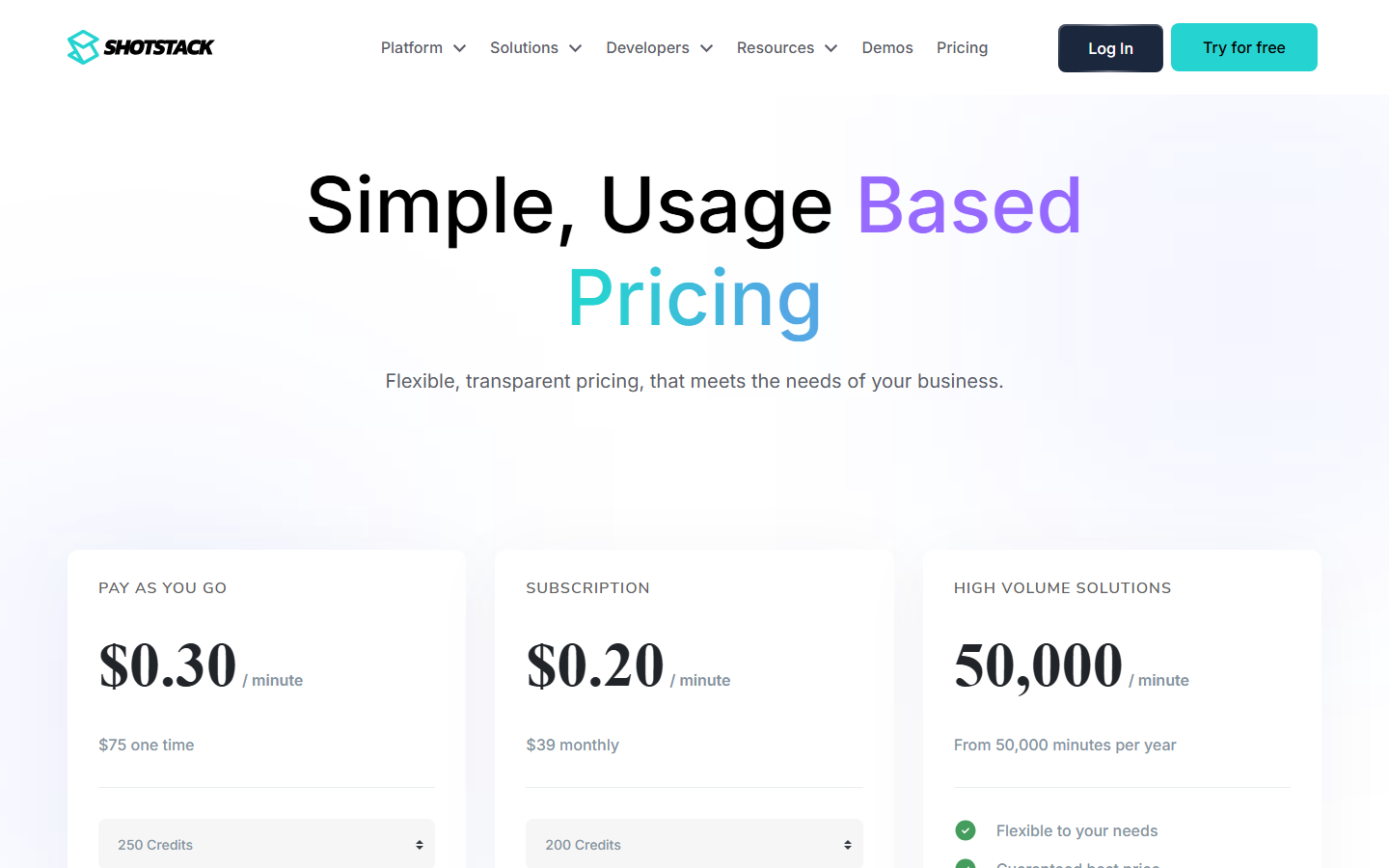
Shotstack pricing starts at $39 a month for 200 credits, and one credit renders one minute of video at any resolution up to 1080p. This guide lists every plan on Shotstack's pricing page in September 2026, works out the real per-minute rate at each volume, and flags the overage and rollover rules. It also covers where a node-based platform like Wireflow fits when rendering is only one line of your video budget.
The short version: Shotstack is cheap per minute at high volume, expensive at low volume, and only bills for rendering footage you already have. Teams that also need to generate that footage often compare it with a Shotstack alternative built on a visual workflow canvas, where generation and assembly run in one pipeline.
Shotstack pricing at a glance
Shotstack is a cloud video editing API: you send a JSON description of a video, and it renders the file on its servers. One credit equals one minute of rendered video regardless of resolution, or 10 images, and every render is rounded down to the second, so a 30-second video costs 0.5 credits. For how that model compares with its closest rival, see our Creatomate vs Shotstack breakdown.
| Plan | Entry price | Rate per minute | Credits | Key limits |
|---|---|---|---|---|
| Free trial | $0 | n/a | 10 credits, valid 30 days | Sandbox renders are free but watermarked |
| Pay as you go | $10 (25 credits) | $0.40 down to $0.07 | 25 to 10,000, valid 1 year | API stops at zero balance; no Director AI or team management |
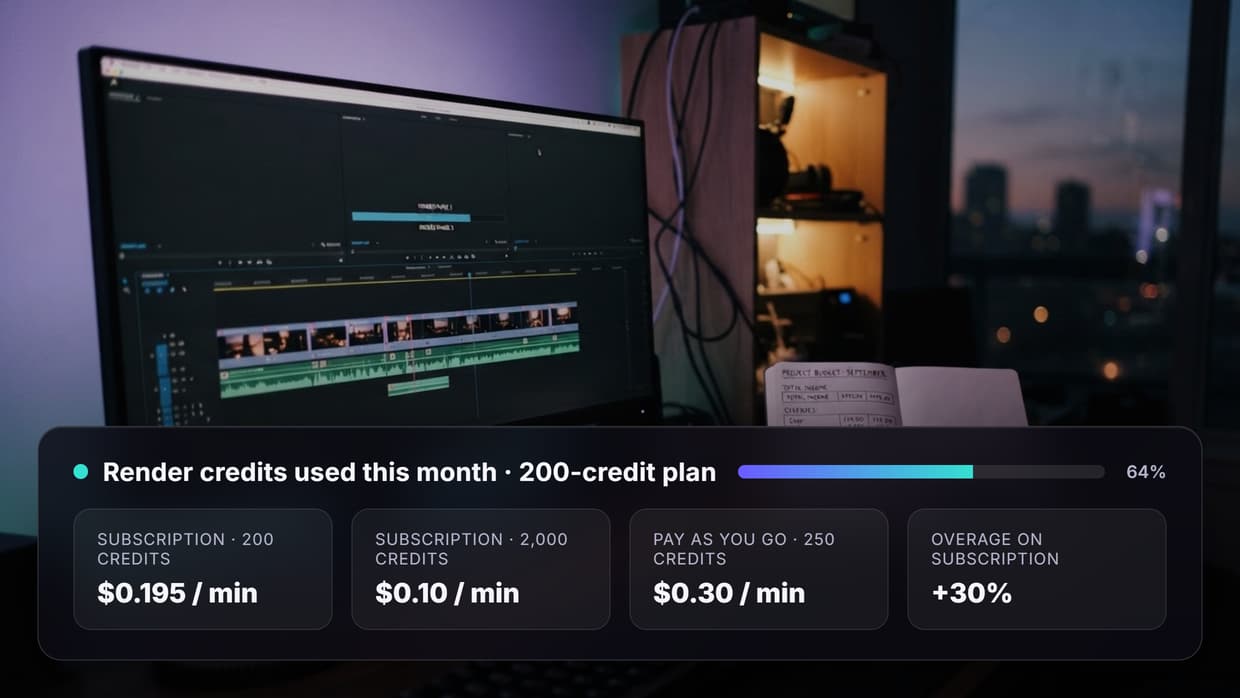
| Subscription | $39/month (200 credits) | $0.195 down to $0.045 | 200 to 25,000 per month | Overage at a 30% premium; rollover up to 3x |
| High Volume | Custom quote | Custom | From 50,000 minutes per year | 4K output, dedicated support, 99.9% SLA |
Every plan includes 1080p output, up to 60 fps, a 3-hour maximum render length, the developer sandbox, the white-label video editor SDK, and email support. That makes the choice mostly a volume question, which is also how most teams shortlist video editing APIs in the first place.
Build this in Wireflow
Make the same kind of asset on a canvas you control, with a free account and no credit card.
Every subscription tier, priced per minute
The pricing page shows one rate at a time behind a dropdown, which hides how uneven the curve is. Here is the full subscription ladder with overage rates. Per-minute rates are the displayed monthly totals divided by credits, the same view we use when comparing video creation and editing APIs.
| Credits per month | Monthly price | Rate per minute | Overage rate (+30%) |
|---|---|---|---|
| 200 | $39 | $0.195 | $0.25 |
| 500 | $99 | $0.198 | $0.26 |
| 1,000 | $149 | $0.149 | $0.19 |
| 2,000 | $200 | $0.10 | $0.13 |
| 5,000 | $290 | $0.058 | $0.075 |
| 10,000 | $500 | $0.05 | $0.065 |
| 25,000 | $1,125 | $0.045 | $0.059 |
Three patterns stand out for anyone running bulk video ad APIs or templated video at volume:
- The 500-credit tier costs slightly more per minute than the 200-credit tier. It only makes sense to avoid overage on the smaller plan.
- The 2,000-credit tier is the first real step down. It costs $51 more than the 1,000-credit plan for twice the minutes, so anyone regularly past about 1,260 minutes (where overage on the smaller plan passes $51) should move up.
- Above 5,000 credits the curve flattens. The per-minute rate falls only from $0.058 to $0.045 between 5,000 and 25,000 credits.
Pay-as-you-go packs
Pay-as-you-go credits are a one-time purchase valid for a year. The small packs are the most expensive way to render on Shotstack and the largest is one of the cheapest, worth a look for anyone comparing usage-based API pricing across vendors.
| Pack | Price | Rate per minute |
|---|---|---|
| 25 credits | $10 | $0.40 |
| 50 credits | $20 | $0.40 |
| 100 to 500 credits | $30 to $150 | $0.30 |
| 1,000 credits | $200 | $0.20 |
| 10,000 credits | $700 | $0.07 |
The 10,000-credit pack at $0.07 per minute undercuts every subscription tier up to 2,000 credits. The trade-offs are real, though: pay-as-you-go has no Director AI editing and no team management, and when the balance hits zero the API stops rendering instead of billing overage. That hard stop can be a feature if you need an API with hard spend limits rather than a surprise invoice.
How overage and rollover change the bill
On a subscription, Shotstack keeps rendering past your allowance and bills the extra minutes at a 30% premium at the end of the cycle, so a spike month can cost more than the next tier up. A 200-credit plan that renders 450 minutes costs $39 plus 250 overage minutes at about $0.25, or roughly $102, while the 500-credit plan covers the same month for $99. Teams wiring renders into a headless video editor for automation should size the plan to their busiest regular month, not their average.

Rollover softens the other direction. Unused subscription credits carry forward up to three times your monthly allowance, so a 200-credit plan can bank 600 credits, but they are only valid while you stay subscribed. For renders triggered by Make.com video automation, a quiet month is not wasted, but a cancelled plan is.
What Shotstack costs at real volumes
The scenarios below use the published prices and assume every video renders once, which is optimistic for teams that iterate on bulk video ad variants.
| Scenario | Monthly minutes | Cheapest fit | Monthly cost | Cost per video |
|---|---|---|---|---|
| 120 real estate listing videos at 60 seconds | 120 | 200-credit subscription | $39 | $0.33 |
| 900 social clips at 30 seconds | 450 | 500-credit subscription | $99 | $0.11 |
| 6,000 personalized videos at 30 seconds | 3,000 | 5,000-credit subscription | $290 | $0.05 |
| One-off batch of 800 videos at 45 seconds | 600 | 500-credit subscription for one month, plus overage | about $125 | $0.16 |
At 3,000 minutes, the 5,000-credit plan ($290) beats the 2,000-credit plan with 1,000 overage minutes ($330), and the spare minutes roll over. For the one-off batch, one month on the 500-credit plan plus about 100 overage minutes beats buying 600 pay-as-you-go credits ($180), because subscriptions can be cancelled any time. Rerenders scale every number here, which matters for anyone producing ad variants for testing.
What the render bill does not cover
Shotstack's credits pay for editing and rendering. Other costs often decide the real budget, especially once AI video generation enters the pipeline:
- Source media. Shotstack assembles footage, images, and audio you supply. If that media has to be produced first, rendering is the smaller cost, which is why teams building an AI video pipeline price both steps together.
- AI-generated assets. Shotstack's AI images and videos draw from the same credits (10 images per credit, roughly 1.5 credits per AI video in its calculator), and they are charged even in the free, watermarked sandbox.
- Developer time. Each video is a JSON timeline of tracks and clips with start times and lengths. Maintaining those templates is engineering work no credit table shows, and a common reason teams try a video assembly API with a visual editor.
- Plan-gated features. 4K and the 99.9% SLA require High Volume, and Director AI plus team access are not on pay-as-you-go. Teams needing 4K at modest volume sometimes compare a hosted Remotion API.

Startup discount and High Volume plans
Shotstack's startup program gives 80% off subscription plans for one year to new customers incorporated less than three years ago and funded up to Series A. High Volume starts at 50,000 minutes per year on a custom quote and adds 4K output, dedicated support with a 4-hour first-reply SLA, and a 99.9% uptime SLA. If neither fits, our list of the best Shotstack alternatives covers tools with different pricing models.
Is Shotstack worth the price?
Shotstack is good value when your videos are template-driven, your source media exists, and your volume is steady enough for the 2,000-credit tier or above. Listing videos, sports highlights, and personalized clips fit that profile, and at $0.05 to $0.10 per minute rendering becomes a small line item. Buyers comparing render-only APIs should also read our roundup of JSON2Video alternatives, since the pricing models are close.
The value case weakens at low volume, where small packs cost $0.30 to $0.40 per minute, and when most of your spend is producing the media. Then the better comparison is a platform that bills generation and assembly together, such as a Creatomate alternative built around AI model nodes rather than a render timeline.
The bottom line
Budget $39 a month if you render under 200 minutes, move to the 2,000-credit plan once you pass about 1,260 minutes, and treat the 10,000-credit pay-as-you-go pack as the cheapest option for large, irregular batches. Check the overage math before a busy month, and remember that rolled-over credits disappear when you cancel. If generating the footage is the expensive part, compare Shotstack's render bill with per-run workflow pricing that covers both steps.
Try it yourself: Build this workflow in Wireflow, the nodes are pre-configured to generate a product frame, animate it with Veo 3.1, and assemble the final clip, so you can compare generation plus assembly cost against a render-only bill.
FAQ
How much does Shotstack cost per month?
Shotstack subscriptions start at $39 per month for 200 credits and go up to $1,125 per month for 25,000 credits. Pay-as-you-go packs start at $10 for 25 credits, and High Volume plans above 50,000 minutes per year are quoted individually.
What is a Shotstack credit?
One credit renders one minute of video at any resolution, or 10 images. Renders are rounded down to the second, so a 30-second video uses 0.5 credits.
Does Shotstack have a free plan?
New accounts get 10 free credits valid for 30 days. The developer sandbox is free for testing, but its videos are watermarked and AI-generated assets are still charged.
What happens if I go over my Shotstack credits?
On a subscription, renders continue and the extra usage is billed at a 30% premium to your plan rate at the end of the billing cycle. On pay-as-you-go, the API stops rendering until you buy more credits.
Do Shotstack credits roll over?
Subscription credits roll over up to three times your monthly allowance and stay valid only while you remain subscribed. Pay-as-you-go credits are valid for one year from purchase.
Is pay-as-you-go or a subscription cheaper on Shotstack?
For steady monthly volume, a subscription is usually cheaper and adds Director AI and team management. For a large one-time batch, the 10,000-credit pack at $0.07 per minute is cheaper than every subscription tier up to 2,000 credits.
Does Shotstack offer a startup discount?
Yes. Qualifying startups get 80% off subscription plans for one year if they were incorporated less than three years ago, are funded up to Series A, and are new customers.

Co-Founder & Operations at Wireflow
Runs client operations and content strategy at Wireflow. Works directly with creative teams and agencies to build production AI workflows.
- Content Strategy
- Client Operations
Get unlimited ad creatives today.
One call to see if we are a fit and scope the first ad. If it fits, your first batch lands inside week one.