 Andrew Adams · Co-Founder & Operations at Wireflow ·
 Luma MCP
Luma ships an official MCP server that calls Luma's own models on a server you host.
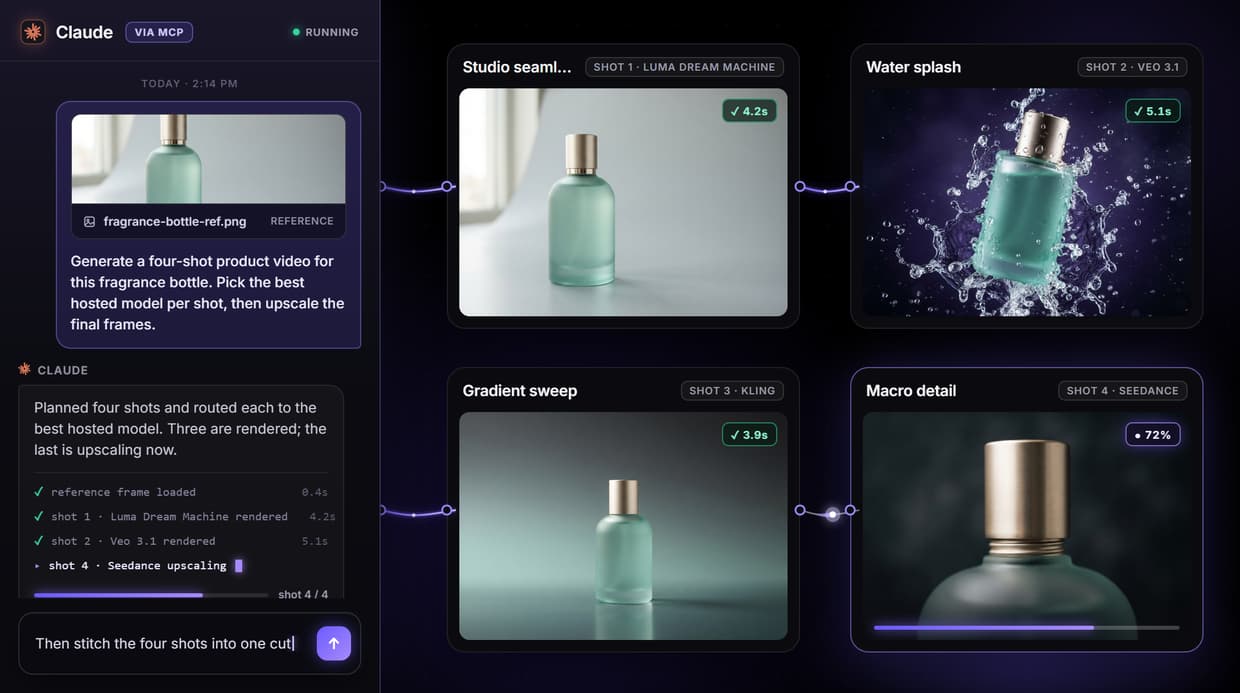
Wireflow is the hosted multi-model alternative: publish one video workflow and any agent calls it as an MCP tool across Luma Dream Machine, Veo 3.1, Sora 2, Kling, and more.
Free to build · no credit card · See how it works ↓
How to Use Luma MCP
Steps to get you started in Wireflow.
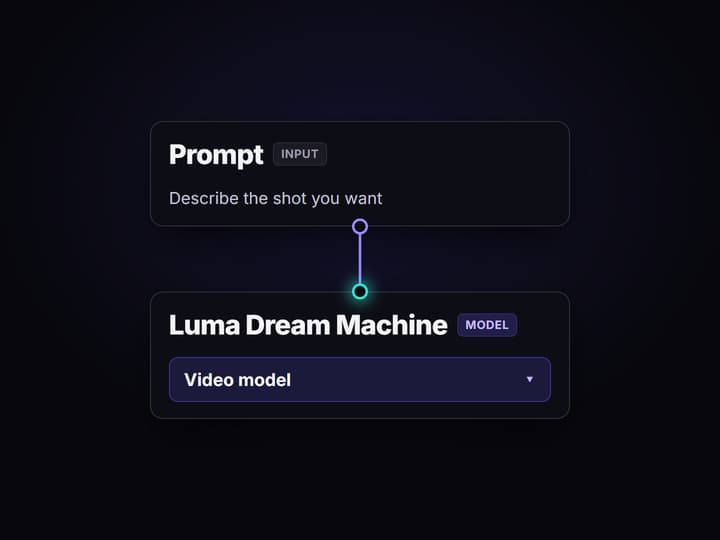
Build the video graph once
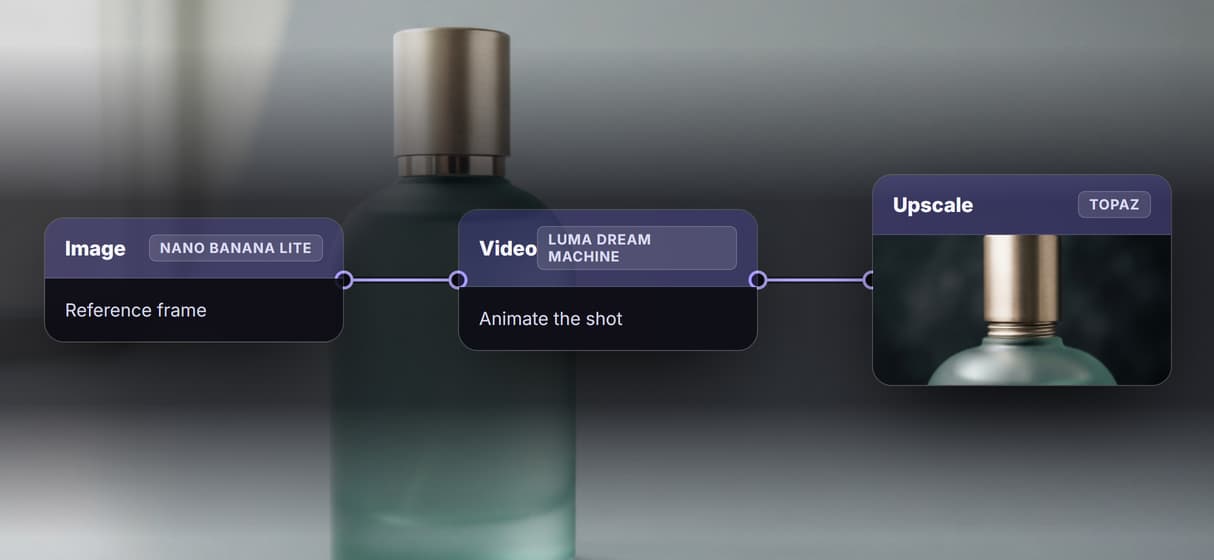
On the canvas, wire a text prompt into a GPT Image 2.5 Flare still, then into a Gemini Omni Flash clip. Name each node with its model so the graph is readable.
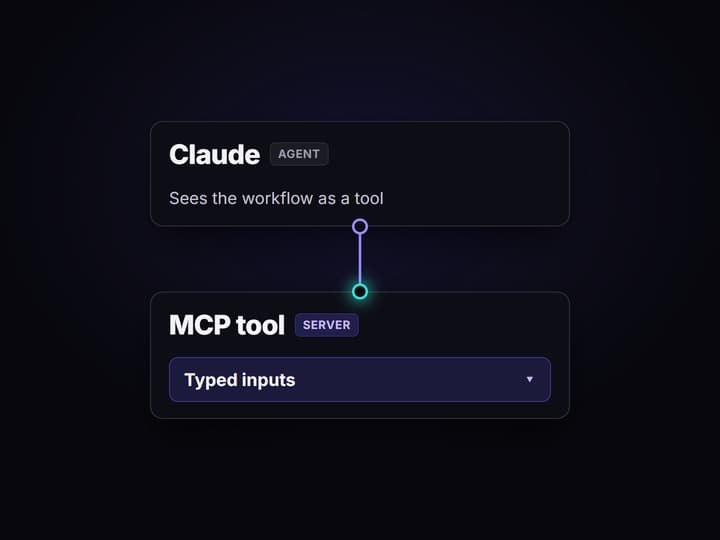
Publish it as an MCP tool
Publish the workflow. Wireflow exposes it on the hosted MCP server and as a REST endpoint at once, with its inputs typed for any caller.
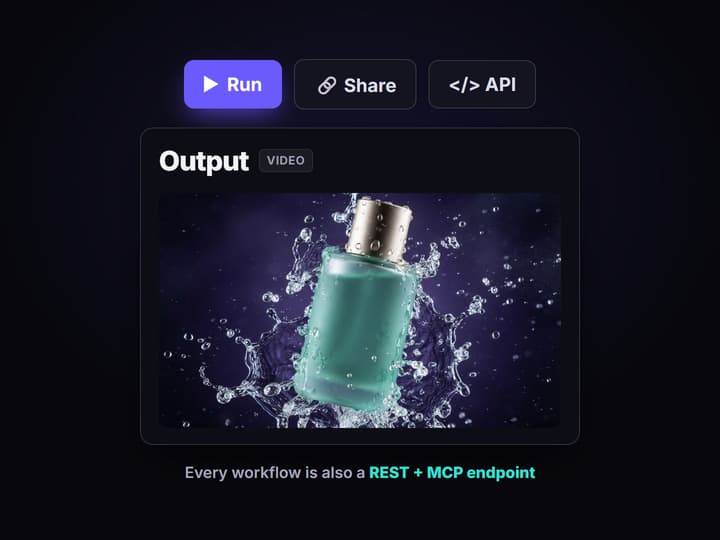
Connect it to Claude or Cursor
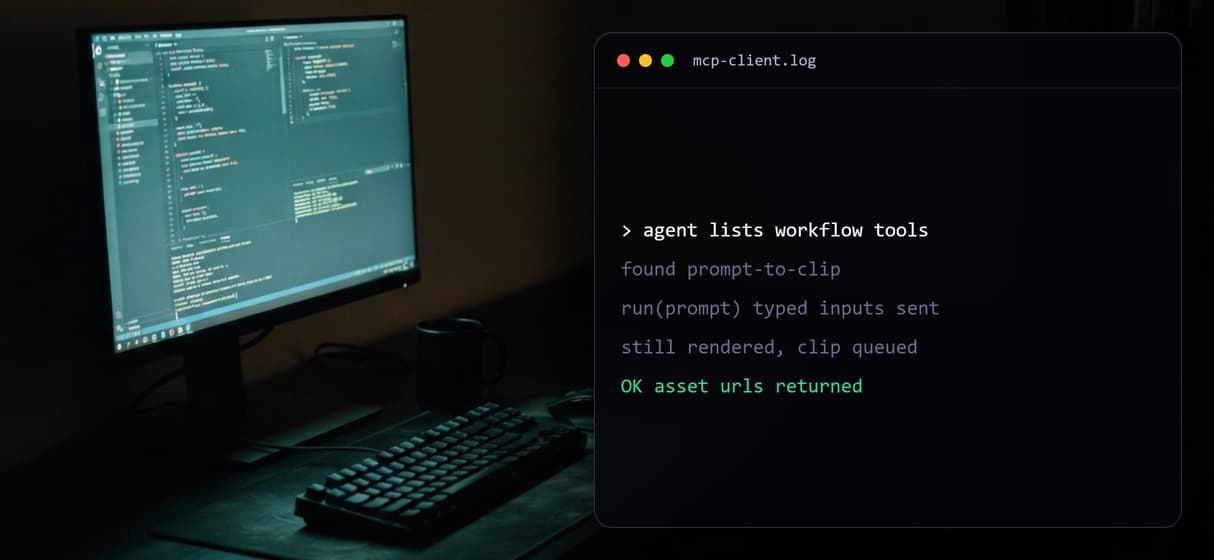
Add the hosted MCP server in your client. The agent lists the workflow as a tool, sends the prompt as typed inputs, runs it, and gets the asset URLs.
What Luma MCP means, and where Wireflow differs
First, a quick disambiguation: this page is about the Luma Dream Machine video model, not the lu.ma events app that shares the name. Luma shipped its own official MCP server, so an agent can point at Luma and call Luma's own models. That is the right tool when Luma's models are exactly what you need. It is also single vendor: the server exposes one roster, and your agent is wired to it alone.
Wireflow takes the opposite shape. It is a hosted node canvas where you assemble a video workflow, then publish it. The flow behind this page is real: a text prompt feeds a GPT Image 2.5 Flare still, and that still feeds a Gemini Omni Flash clip and a compose step. Publishing turns that graph into a hosted MCP tool and a hosted video API for agents at once, so an agent can pick the best model per shot instead of one vendor's stack.
What the hosted MCP layer gives an agent
The workflow is the tool
The agent calls a pipeline you built, not a raw model, so one invocation can render a still and animate it into a clip.
Many hosted models
One endpoint reaches Luma Dream Machine, Veo, Sora, Kling, and Seedance instead of one vendor's fixed roster.
Typed inputs
Each workflow exposes named, typed inputs. The agent reads the schema, fills the prompt, and runs without guessing arguments.
Asset URLs back
Runs return hosted asset URLs the agent can pass downstream, so the clip drops straight into the next step of its task.
REST as well
The same published workflow is a REST endpoint, so code that cannot speak MCP can trigger the identical video pipeline.
Swap the video model
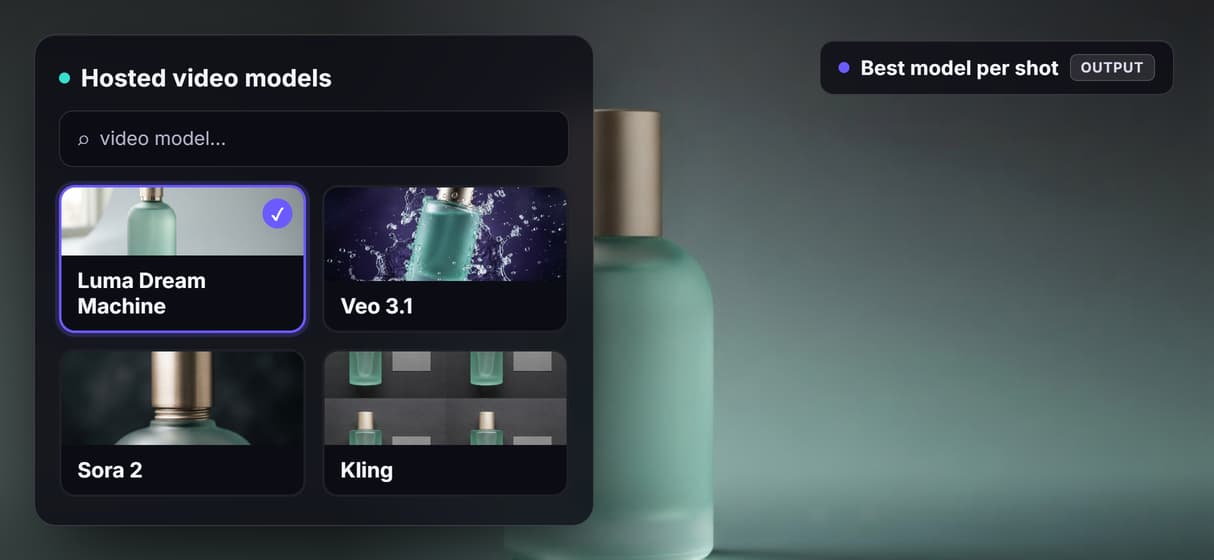
The clip node is one setting. Point it at Luma Dream Machine, Kling, Veo, or Sora without touching the rest of the graph.
Build the video pipeline once, call it from any agent
When an agent can only call one vendor's model at a time, it has to orchestrate every step itself: prompt the image model, wait, hand the result to the video model, wait again, handle each failure. That logic lives in the agent, so it breaks when the agent changes. Move the steps onto a canvas and the orchestration becomes the tool, not the agent's problem.
On Wireflow you build that graph once, then let the agent drive it through the hosted MCP and REST layer, run after run, with no new wiring. A single call can chain a still into a clip, and the same pattern lets you swap the video node between vendors without rewiring. It sits between a focused MCP server for video editing and a full multi-model pipeline: enough structure that one tool call does real multi-step work, enough openness that you can still inspect and edit the graph.
When Luma's own MCP is the better fit
If your product depends on Luma's specific models or the tooling built around them, use Luma's own official MCP server; those models live there, and no canvas layer changes that. Wireflow does not host every model on the market, and it will never claim to. It is also not the reasoning brain: it generates and returns media, it does not write your strategy or decide your shot list for you.
Be honest about the rest too. Wireflow is a managed, hosted service, not a self-hosted server: there are no offline or local runs, and generations cost credits per run. It earns its place when the job is bigger than one fixed vendor: pick the best model per shot, chain generation into a clip, keep one endpoint while models rotate underneath, or hand the pipeline to an agent as an MCP tool. If you want a Sora-style model in the same graph as Luma Dream Machine, compare the hosted Sora video model alternative and open the flow to read the actual graph.
More Than Just Luma MCP
Every workflow is an MCP tool
Publish a video graph once and any agent calls it as a hosted MCP tool, the same contract behind a video API for coding agents.
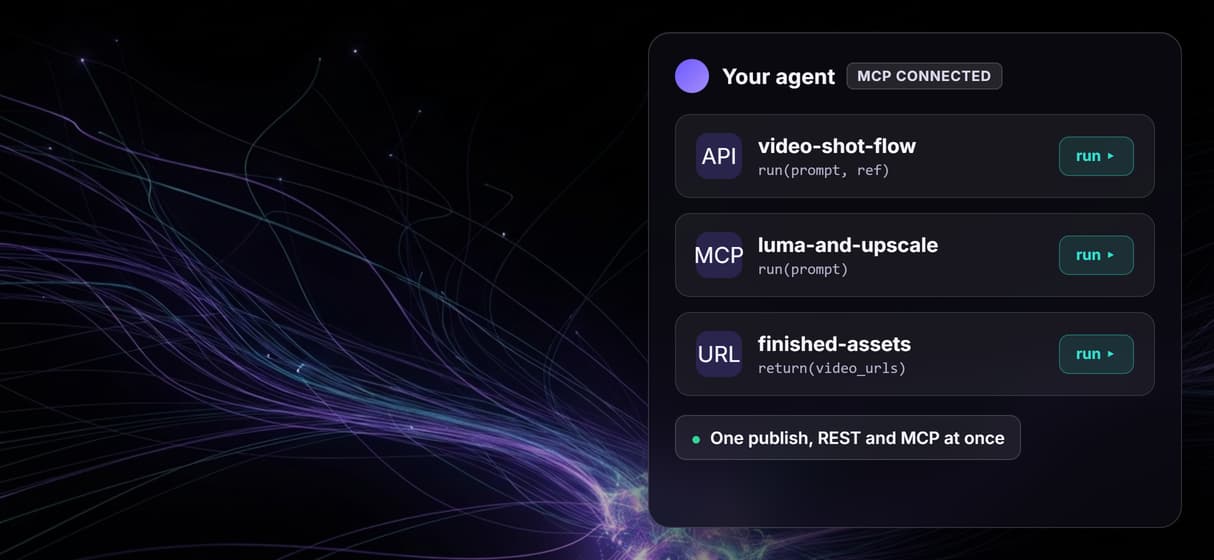
One call, still into clip
A prompt becomes a GPT Image 2.5 Flare still, then a Gemini Omni Flash clip, so one MCP call can chain models end to end.
Runs from inside your agent
Claude, Claude Code, and Cursor list the tool, send typed inputs, and get asset URLs back, the pattern behind an AI video agent.
Route each shot to any model
Swap the clip node from Gemini Omni to Luma Dream Machine, Veo, Sora, or Kling, then generate video without rewiring.
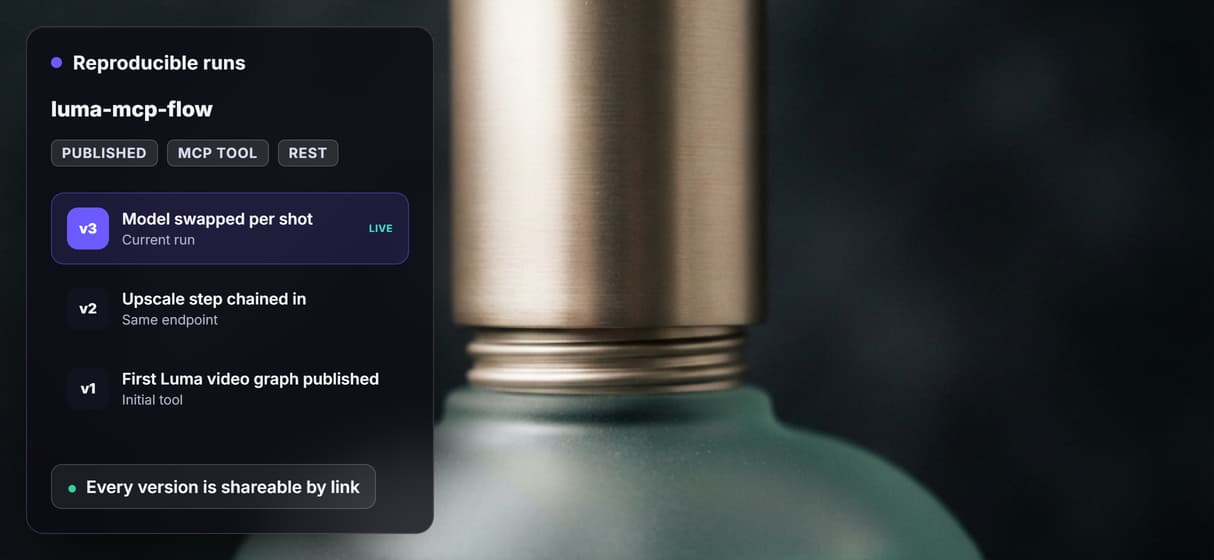
Versioned and reproducible
Workflows are versioned server side and shareable by link, so an agent run repeats the same workflow API graph next week.
Luma mcp Workflows
No Code Required
API & Batch Processing
FAQs
No. Luma ships its own official MCP server for its own models, and this page is not that. Wireflow is a separate, hosted, multi-model MCP hub: you publish video workflows and an agent calls them as tools across many hosted models, including Luma Dream Machine.
Discover related AI tools
- AI Pipeline Automation
- AI Workflow Templates
- AI Video Pipeline: Build One on a Node Canvas
- Batch AI Generation: Many Assets, One Run
- AI Model Chaining
- AI Asset Pipeline
- AI Workflow Builder
- AI Content Generation API
- AI Workflow API
- AI Orchestration API
- Headless AI Workflow Platform
- Krea AI API Alternative: Image and Video From One REST Endpoint
More From Wireflow
Written by
Andrew Adams · Co-Founder & Operations at Wireflow
Runs client operations and content strategy at Wireflow. Works directly with creative teams and agencies to build production AI workflows.
Give your agent a multi-model video MCP
The workflow behind this page is already built as a prompt to still to clip graph, with the video model left as a swappable node. Read how agents call Wireflow workflows as hosted MCP tools, then open the flow to inspect the exact graph.